

Quick Summary: Taking 8 mg of tizanidine at once is generally considered safe for many patients under medical supervision, though it exceeds the typical recommended starting dose. Single doses above 8 mg have limited safety data and carry increased risk of side effects like dizziness, drowsiness, and low blood pressure. The standard dosing protocol starts at 2 mg and increases gradually, with most patients achieving therapeutic benefit between 2-36 mg daily split across multiple doses spaced 6-8 hours apart.
Tizanidine is a commonly prescribed muscle relaxant that helps manage spasticity from conditions like multiple sclerosis, spinal cord injuries, and acquired brain injuries. But when it comes to dosing, particularly whether taking 8 mg at once is safe, the answer depends on several important factors.
Understanding the proper dosing of tizanidine isn’t just about following label instructions. It involves knowing how the medication works in your body, what side effects to watch for, and how your individual circumstances affect safety.
What Is Tizanidine and How Does It Work?
Tizanidine is a short-acting muscle relaxant classified as a centrally acting alpha-2 receptor agonist. According to the National Institutes of Health, it works primarily by binding to alpha-2 receptors in the central nervous system, inhibiting the release of excitatory neurotransmitters that cause muscle spasms.
The medication effectively blocks nerve impulses that send pain sensations to the brain. This alpha-2 receptor-mediated inhibition reduces spasm frequency and clonus while providing additional anti-nociceptive effects.
After oral administration, tizanidine reaches peak plasma concentrations in about 1 hour when taken on an empty stomach, with a half-life of approximately 2 hours.
Standard Tizanidine Dosing Guidelines
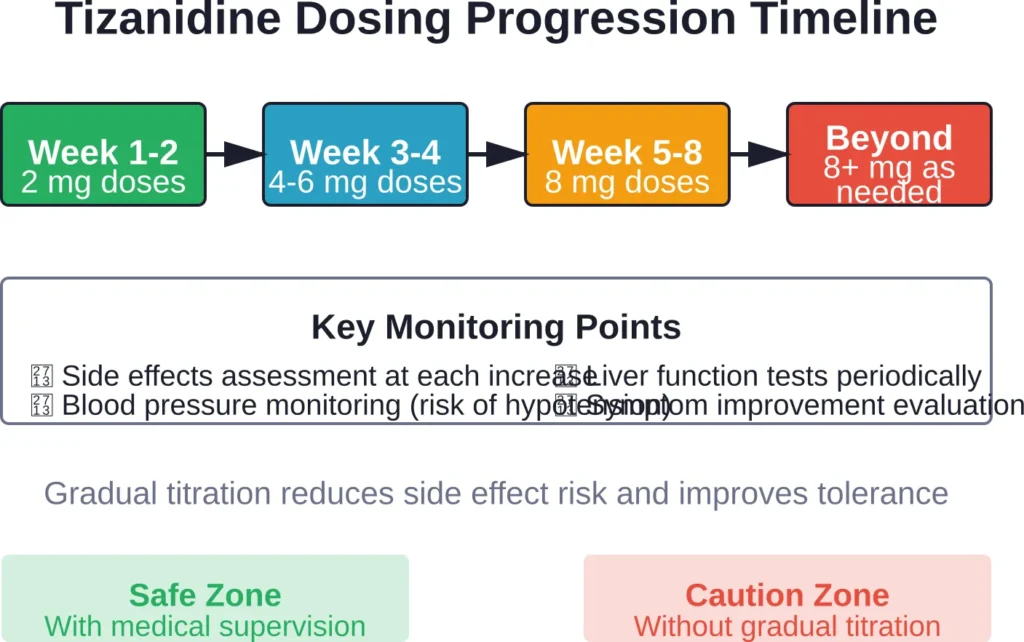
The recommended starting dose is 2 mg, according to prescribing information from the National Library of Medicine. This conservative approach allows healthcare providers to assess how patients respond to the medication while minimizing side effects.
Here’s how standard dosing typically progresses:
| Dosing Stage | Amount | Timing | Maximum |
|---|---|---|---|
| Starting dose | 2 mg | Every 6-8 hours | 3 doses/24 hours |
| Dose intervals | Repeat as needed | 6-8 hour spacing | – |
| Peak effect window | – | 1-2 hours post-dose | – |
| Effect duration | – | 3-6 hours | – |
| Dose increases | 2-4 mg increments | Every 1-4 days | 36 mg daily total |
Dosage can be gradually increased in 2-4 mg increments to achieve the optimal effect with tolerable side effects. The medication’s effect peaks at approximately 1-2 hours post-dose and dissipates between 3-6 hours after taking it.
Treatment can be repeated at 6-8 hour intervals as needed, but patients should never exceed three doses in 24 hours.
Is 8 mg of Tizanidine Safe?
The short answer? It depends on your specific situation and medical history.
Taking 8 mg of tizanidine falls within the range that many patients eventually reach during treatment. Single doses above 8 mg have limited safety data according to source material. The sources specifically note that single doses above 8 mg, such as 16 mg, are not routinely recommended due to limited safety data.
Research from academic studies shows that effective doses in clinical practice range from 6-36 mg/day, with a mean effective dose of 23 mg/day for conditions like neuropathic pain. This suggests that 8 mg can be appropriate for some patients, but it’s typically reached through gradual titration rather than as an initial dose.
Factors That Affect Safety at 8 mg
Several individual factors determine whether 8 mg is appropriate:
- Dosing history: Patients who have gradually titrated up from 2 mg typically tolerate higher doses better than those attempting to start at 8 mg
- Kidney function: Tizanidine clearance is reduced by 50% in elderly patients with renal insufficiency (creatinine clearance less than 25 mL/min)
- Liver health: Clinical studies have shown that about 5% of people who take tizanidine have elevations of liver enzymes up to more than three times the upper limit of normal
- Gender and contraceptives: Women on oral contraceptives have 50% lower clearance compared to women not taking them, meaning their tizanidine exposure is significantly higher
- Food intake: When two 4 mg tablets are administered with food the mean maximal plasma concentration is increased by approximately 30% and the median time to peak plasma concentration is increased by 25 minutes, to 1 hour and 25 minutes
When 8 mg Might Be Prescribed
Healthcare providers may prescribe 8 mg doses in specific situations:
For patients who’ve been taking tizanidine for weeks or months and have demonstrated tolerance to lower doses, stepping up to 8 mg may provide better symptom control. Some patients with severe spasticity from multiple sclerosis or spinal cord injuries require higher doses to achieve meaningful relief.
Real talk: jumping straight to 8 mg without medical supervision is risky. The medication’s side effect profile becomes more pronounced at higher doses, and individual responses vary significantly.
Side Effects to Watch For at 8 mg
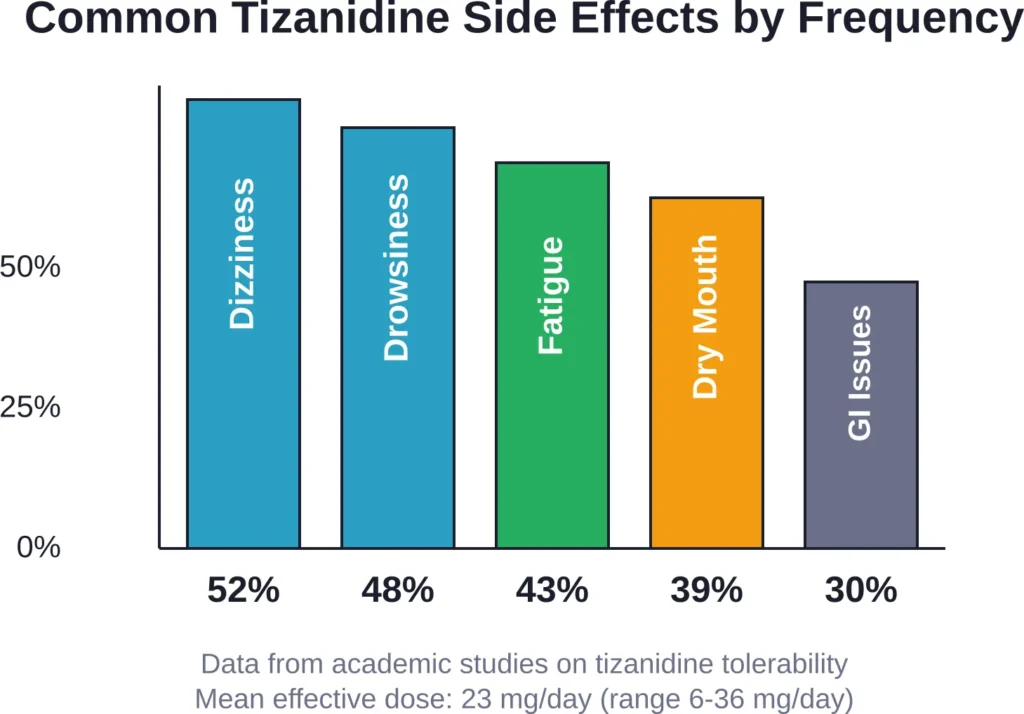
Higher doses of tizanidine correlate with increased side effect frequency and severity. Research data from neuropathic pain studies provides clear statistics on what to expect:
| Side Effect | Incidence Rate | Severity |
|---|---|---|
| Dizziness/Lightheadedness | 52% | Mild to moderate |
| Drowsiness | 48% | Moderate |
| Fatigue/Weakness | 43% | Moderate |
| Dry mouth | 39% | Mild |
| Gastrointestinal upset | 30% | Mild to moderate |
| Sleep difficulty | 22% | Mild |
These percentages come from studies where the mean effective dose was 23 mg/day, suggesting that even at therapeutic doses, side effects are common.
Serious Side Effects Requiring Immediate Attention
While most side effects are manageable, some require immediate medical attention:
Hallucinations have been documented as a side effect in clinical studies. Clinical studies have shown that about 5% of people who take tizanidine have elevations of liver enzymes up to more than three times the upper limit of normal.
Cases of significant liver injury have been documented, along with cardiovascular complications including low blood pressure and slow heart rate. One documented case involved a patient developing liver, renal, and cardiovascular failure after unintentional tizanidine overdose.
Withdrawal symptoms can also occur. A case study documented a patient presenting to the emergency department with vomiting, continuous hiccups, and fever approximately 10 hours after missing a dose.
Drug Interactions That Make 8 mg Riskier
Certain medications significantly alter tizanidine levels in the body, making higher doses potentially dangerous.
Ciprofloxacin, a common antibiotic, dramatically increases tizanidine blood levels. Retrospective analysis of coadministration shows this combination can lead to severe adverse effects. The interaction is so significant that taking tizanidine with ciprofloxacin is generally contraindicated.
Other notable interactions include:
- Fluvoxamine and other CYP1A2 inhibitors significantly increase tizanidine concentrations
- Alcohol enhances sedative effects and increases drowsiness
- Other central nervous system depressants (benzodiazepines, opioids) compound sedation
- Blood pressure medications may cause additive hypotensive effects
When taking 8 mg doses, these interactions become more clinically significant than at lower doses.
Special Populations and 8 mg Dosing
Elderly Patients
Older adults face additional challenges with tizanidine. Age-related decline in kidney function means the medication clears more slowly from the body. In elderly patients with renal insufficiency, clearance drops by 50%.
Starting doses should be lower, and increases more gradual. An 8 mg dose in an elderly patient with compromised kidney function could produce blood levels equivalent to 12-16 mg in a younger person with normal renal function.
Patients with Liver Disease
Because tizanidine undergoes extensive first-pass hepatic metabolism, liver disease significantly impacts safety. The medication is generally not recommended for patients with hepatic impairment.
Regular liver function monitoring is essential for all patients on tizanidine, but particularly those on higher doses like 8 mg.
Women Taking Oral Contraceptives
Women on oral contraceptives have 50% lower clearance compared to women not taking them, meaning their tizanidine exposure is significantly higher.
This means an 8 mg dose in a woman on oral contraceptives produces blood levels similar to 12 mg in women not taking contraceptives. Dose adjustments and closer monitoring become critical in this population.
Comparing 8 mg to Other Muscle Relaxants
How does an 8 mg dose of tizanidine compare to other muscle relaxants?
| Medication | Typical Dose Range | Duration of Action | Primary Use |
|---|---|---|---|
| Tizanidine 8 mg | 2-36 mg/day | 3-6 hours | Spasticity |
| Cyclobenzaprine | 15-30 mg/day | 12-24 hours | Muscle spasms |
| Baclofen | 15-80 mg/day | 4-8 hours | Spasticity |
| Methocarbamol | 4000-4500 mg/day | 4-6 hours | Acute musculoskeletal |
Tizanidine’s short duration of action means patients can time doses around activities where spasticity relief is most important. But it also means more frequent dosing compared to longer-acting alternatives like cyclobenzaprine.
For patients with low back pain specifically, skeletal muscle relaxants are typically initiated after failure of first-line analgesics. Evidence shows temporary additional benefit, though these medications carry risks of adverse effects that require careful consideration.
What Clinical Studies Show About Higher Doses
Academic research on tizanidine effectiveness provides valuable context for understanding 8 mg dosing.
Research from academic studies shows that effective doses in clinical practice range from 6-36 mg/day, with a mean effective dose of 23 mg/day for conditions like neuropathic pain.
In that research, 68% of patients reported their pain relief was improved or much improved with tizanidine therapy. Two patients became completely pain-free. The mean average weekly pain score decreased by 1.7 points from baseline.
This research demonstrates that many patients require doses well above the 2 mg starting point to achieve therapeutic benefit. An 8 mg dose falls comfortably within the range where clinical studies show efficacy.
That said, these studies also documented the side effect profile mentioned earlier, with more than half of patients experiencing dizziness and drowsiness.
Practical Tips for Taking 8 mg Safely
If a healthcare provider has prescribed 8 mg of tizanidine, these strategies can help maximize safety:
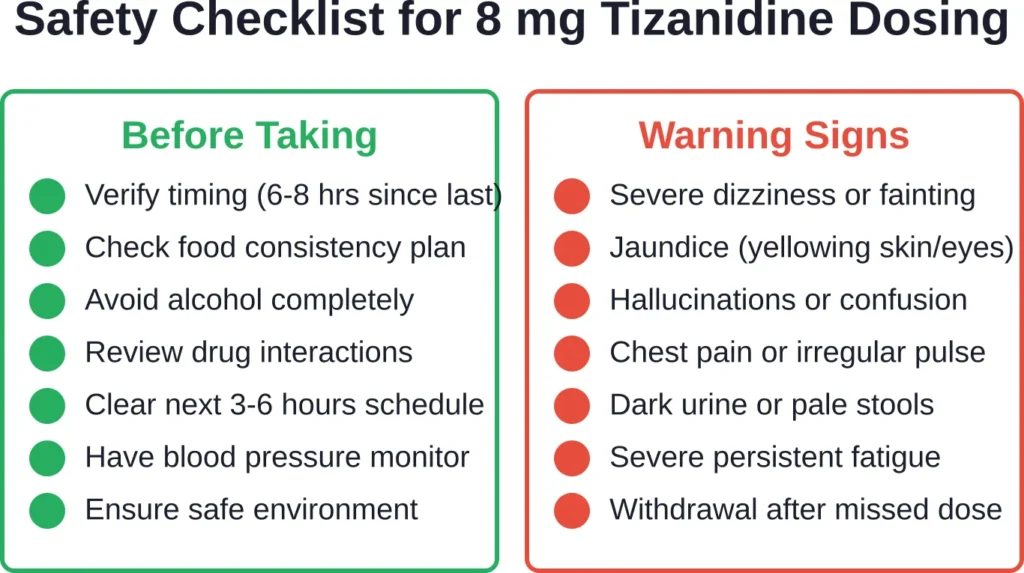
Timing matters. Because peak effect occurs 1-2 hours after dosing and dissipates within 3-6 hours, plan dose timing around when symptom relief is most needed.
Food consistency counts. When two 4 mg tablets are administered with food the mean maximal plasma concentration is increased by approximately 30% and the median time to peak plasma concentration is increased by 25 minutes, to 1 hour and 25 minutes. Pick one approach—always with food or always without—and stick with it. Switching back and forth creates unpredictable blood levels.
Monitor blood pressure. Tizanidine can lower blood pressure significantly. Check blood pressure regularly, especially when first starting 8 mg doses or after dose increases. Stand up slowly from sitting or lying positions to avoid dizziness.
Avoid alcohol completely. Alcohol significantly enhances tizanidine’s sedative effects and increases fall risk.
Never double up. If a dose is missed, take it when remembered only if it’s not close to the next scheduled dose. Never take two 8 mg doses close together to make up for a missed dose.
Plan activities. Don’t drive, operate machinery, or perform tasks requiring alertness during the 3-6 hour window when the medication is most active in the system.
When to Contact Your Doctor
Certain situations require immediate medical consultation:
- Severe dizziness or fainting episodes
- Yellowing of skin or eyes (jaundice)
- Dark urine or pale stools
- Unusual fatigue that doesn’t improve
- Hallucinations or confusion
- Chest pain or irregular heartbeat
- Severe nausea or vomiting
- Symptoms that appear after missing doses (potential withdrawal)
Additionally, if 8 mg isn’t providing adequate symptom relief, don’t increase the dose on your own. Contact your healthcare provider to discuss whether further titration is appropriate.
Frequently Asked Questions
Taking 8 mg of tizanidine all at once can be appropriate for some patients under medical supervision, but it should only be done if a doctor has specifically prescribed that dose. Single doses above 8 mg have limited safety data. The standard approach involves starting at 2 mg and gradually increasing to minimize side effects. If considering 8 mg, patients should have already demonstrated tolerance to lower doses through gradual titration.
Tizanidine reaches peak plasma concentration and maximum effect approximately 1-2 hours after taking the dose. Effects typically start within 30-60 minutes, with the strongest effect occurring around the 1-2 hour mark. The therapeutic effect lasts 3-6 hours post-dose, after which symptoms may return. Taking tizanidine with food delays peak effect by an additional 25 minutes.
The maximum is three doses in 24 hours, with doses spaced 6-8 hours apart. While individual doses can reach 8 mg or higher, the total daily dose generally shouldn’t exceed 36 mg without specific medical justification. Most patients achieve therapeutic benefit at total daily doses between 6-36 mg. Never exceed the dosing schedule a healthcare provider has prescribed, as higher doses significantly increase side effect risk.
Safety depends entirely on which other medications are being taken. Tizanidine has serious interactions with ciprofloxacin and fluvoxamine, which can dramatically increase blood levels and cause dangerous side effects. Other central nervous system depressants like benzodiazepines, opioids, and alcohol significantly enhance sedation. Blood pressure medications may cause additive drops in blood pressure. Always review the complete medication list with a healthcare provider before starting or increasing tizanidine.
No, one should not drive or operate machinery for at least 3-6 hours after taking 8 mg of tizanidine. The medication causes drowsiness in 48% of patients and dizziness in 52%. These effects peak 1-2 hours after dosing and persist throughout the 3-6 hour therapeutic window. Plan dose timing so that the peak effect period coincides with times when one can safely rest and doesn’t need to perform tasks requiring alertness or coordination.
Contact poison control or seek emergency medical attention immediately. Tizanidine overdose can cause severe drops in blood pressure, extreme drowsiness, respiratory depression, and in serious cases, liver, renal, and cardiovascular complications. Documented overdose cases have resulted in significant organ damage. Don’t wait to see if symptoms develop—overdose requires prompt medical evaluation even if feeling fine initially.
Taking tizanidine with food increases absorption and affects peak concentration timing compared to taking it on an empty stomach. Switching between taking it with food and without food creates unpredictable blood levels, making it difficult to assess effectiveness and increasing the risk of side effects. Consistency ensures stable, predictable drug levels that a healthcare provider can properly adjust and monitor.
Making an Informed Decision About 8 mg Dosing
So, is it okay to take 8 mg of tizanidine? The answer comes down to medical context and supervision.
For patients who’ve gradually titrated up from lower doses and demonstrated good tolerance, 8 mg can be an appropriate and effective dose. Research shows mean effective doses of 23 mg/day, indicating that many patients require doses in this range to achieve meaningful symptom relief.
However, jumping straight to 8 mg without medical guidance creates unnecessary risk. The medication’s side effect profile becomes more pronounced at higher doses, with more than half of patients experiencing dizziness and drowsiness even at therapeutic doses.
Individual factors matter enormously. Kidney function, liver health, age, gender, contraceptive use, and concurrent medications all affect how the body processes tizanidine. An 8 mg dose in one person might produce blood levels equivalent to 4 mg or 12 mg in another person depending on these variables.
The safest approach involves open communication with healthcare providers. If the current dose isn’t providing adequate relief, discuss whether increasing to 8 mg makes sense for the specific situation. If experiencing concerning side effects at 8 mg, healthcare providers can help find the right balance between symptom control and tolerability.
Never adjust tizanidine dose without medical guidance. The difference between therapeutic relief and dangerous side effects can be surprisingly narrow, especially at higher doses.
Ready to discuss tizanidine dosing with a healthcare provider? Bring specific information about symptoms, current medications, and any side effects experienced. The more detailed information provided, the better a doctor can optimize the treatment plan for safe, effective spasticity management.