

Quick Summary: Yes, it is possible to be in love with two people at the same time. Research on attachment and neurobiology shows that humans can form multiple emotional bonds simultaneously. While Western culture traditionally emphasizes monogamous love, studies indicate that approximately 21.9% of people have experienced consensual non-monogamous relationships, and emotional capacity for multiple attachments is supported by psychological and neurobiological evidence.
The question of whether someone can genuinely love two people at once has puzzled philosophers, poets, and everyday people for centuries. It’s a situation that feels both intensely personal and universally confusing when it happens.
And here’s the thing—emotions don’t follow neat, logical rules. They don’t wait for permission or check whether someone is already “taken” in your heart. Love can emerge unexpectedly, even when it complicates everything.
But what does science actually say? Can the human brain and heart sustain genuine love for multiple people simultaneously, or is one of those feelings something else masquerading as love?
What Science Reveals About Loving Multiple People
The contemporary Western model of romantic love centers on the idea of a dyadic bond—two people, exclusive and complete. This cultural narrative suggests that “true love” means finding “the one” and directing all romantic energy toward that single person.
Yet research challenges this monolithic view.
According to data from national surveys in the United States, approximately 21.9% of people report having been in a consensually non-monogamous relationship at some point in their lives. Currently, about 4-5% of North Americans actively engage in consensually non-monogamous relationships.
These aren’t just casual arrangements. Studies on polyamory—a distinct type of consensual non-monogamy where people engage in romantic love and sexual relationships with multiple partners—show that participants report high satisfaction and need fulfillment in these relationships.
The existence of functioning polyamorous relationships doesn’t just suggest that loving multiple people is theoretically possible. It demonstrates that people actually do it, sustain it, and find fulfillment through it.
The Neurobiology of Love and Attachment
To understand whether loving two people is possible, researchers have examined how love functions in the brain.
According to research published in the journal Biology, being in love activates specific neurobiological processes tied to attachment and pair bonding. These processes involve neurotransmitters and hormones like oxytocin, dopamine, and vasopressin, which create the feelings of bonding, reward, and attachment we associate with romantic love.
Interestingly, approximately 9% of mammals are socially monogamous, but pair bonds can exist between animals that aren’t sexually exclusive. This biological observation is crucial—it suggests that the capacity for attachment and bonding doesn’t inherently require exclusivity at the neurological level.
Research on the neurobiology of pair bonding shows that these attachment systems evolved to create strong social relationships. But nothing in the underlying biology explicitly limits these systems to firing for only one person at a time.
The brain’s attachment circuitry can theoretically activate for multiple individuals, creating genuine feelings of love, connection, and bonding with more than one person.
Attachment Theory and Multiple Bonds
Attachment theory provides another lens for understanding how people can love multiple individuals simultaneously.
Originally developed to explain infant-caregiver bonds, attachment theory has been extensively applied to romantic relationships. Research in this area examines how people form emotional bonds, seek security, and navigate intimacy.
Studies on attachment styles in romantic relationships show that people vary in how they approach closeness, dependency, and security with partners. But attachment theory doesn’t suggest humans have a hard limit on the number of attachment bonds they can form.
Children regularly form secure attachments to multiple caregivers—both parents, grandparents, and other consistent figures in their lives. The attachment system doesn’t shut down after bonding with one person.
The same principle can apply to adult romantic attachments. While each relationship has unique dynamics, the capacity for attachment isn’t necessarily limited to a single romantic partner.
The Cultural Context: Monogamy as Social Construct
The discomfort many people feel when contemplating loving two people simultaneously stems less from biological impossibility and more from cultural conditioning.
Monogamous marriage carries what researchers describe as an apparent “halo” of moral superiority. This social structure remains deeply embedded in Western culture, supported by legal frameworks around immigration, property, inheritance, family, and tax laws.
But monogamy isn’t a universal human trait—it’s a cultural pattern that varies across societies and historical periods.
Research examining consensual non-monogamy notes that these relationships can vary on many factors: the kinds of relationships engaged in (romantic or only sexual, long-term or short-term), the degree of transparency involved, and the specific terms of consensually agreed behavioral conduct between partners.
The key word here is “consensual.” The question isn’t whether loving two people violates some biological law. It’s whether all parties involved have agreed to a relationship structure that accommodates multiple attachments.
Desire and Familiarity with Non-Monogamy
A national sample of single adults in the United States revealed interesting patterns about openness to non-monogamous relationships.
The research examined the prevalence of desire for, familiarity with, and engagement in polyamory. Results showed that approximately 1 in 6 people (16.8%) desire to engage in polyamory. This doesn’t mean everyone wants polyamory. But it does indicate that the capacity to conceptualize loving more than one person isn’t rare or aberrant—it’s within the realm of normal human emotional experience.
Can You Really Love Two People? The Practical Reality
So, the science suggests that loving two people is neurobiologically possible, psychologically feasible, and culturally practiced by a meaningful minority.
But can you really love two people in the fullest sense of that word?
The answer depends on what “love” means to you.
Different Types of Love
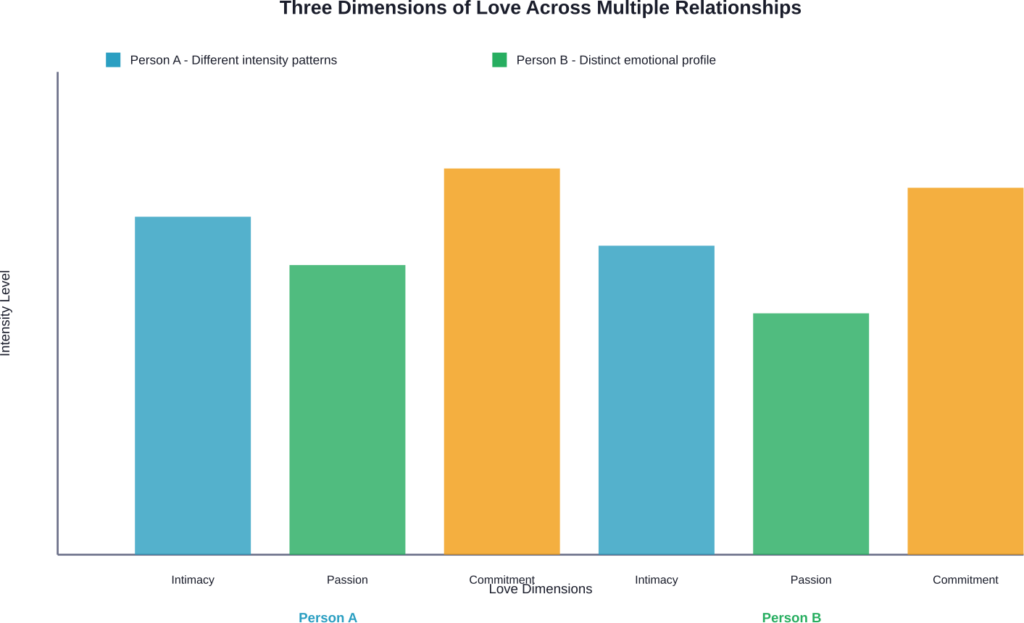
Not all love feels identical. The ancient Greeks identified multiple types of love—eros (romantic, passionate), philia (deep friendship), storge (familial), and agape (unconditional, selfless).
When people love two individuals simultaneously, those loves often differ in quality, intensity, or expression. One relationship might be characterized by intense passion and novelty. Another might offer deep comfort, shared history, and stability.
These differences don’t make one love more “real” than the other. They simply reflect the unique nature of each connection.
Community discussions on platforms like Reddit reveal that many people who’ve experienced loving two people describe exactly this phenomenon—the loves feel distinct, not interchangeable. Each person fulfills different emotional needs and brings out different aspects of the self.
Emotional Capacity Isn’t Zero-Sum
One common misconception is that love operates like a finite resource—loving one person must diminish the love available for another.
Research on autonomy in multi-partnered relationships challenges this assumption. Studies show that polyamorous individuals often report high levels of need fulfillment, suggesting that emotional bonds don’t necessarily deplete each other.
Think about how parents love multiple children. Few would argue that a parent’s love for their second child diminishes the love for the first. Emotional capacity expands rather than divides.
Romantic love can function similarly, though it requires conscious effort, strong communication, and agreed-upon boundaries that feel ethical to everyone involved.
The Challenges of Loving Two People
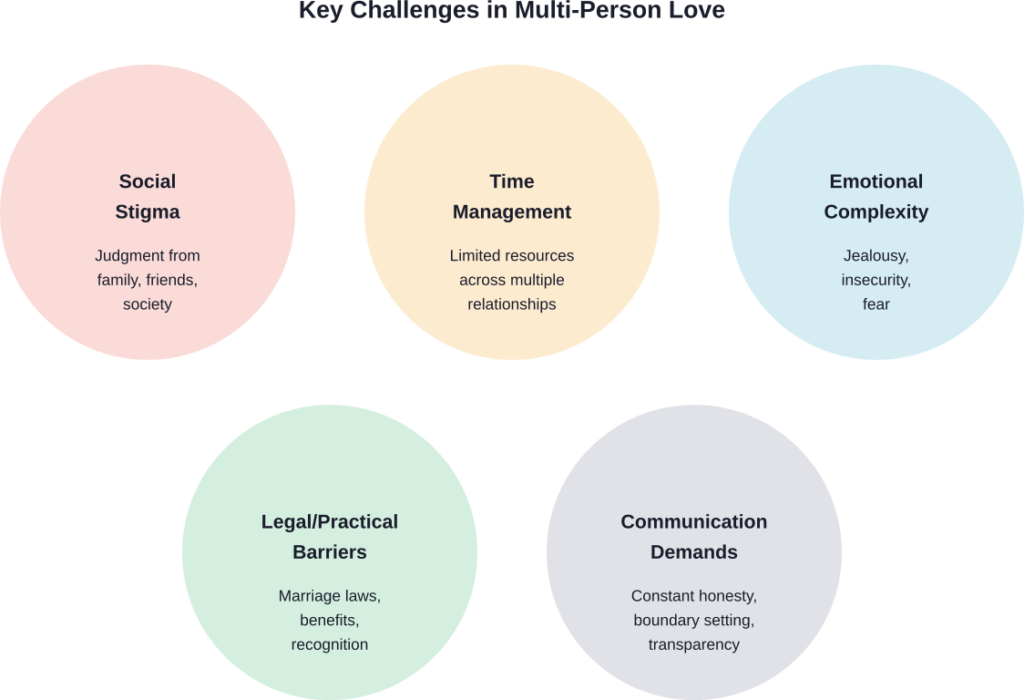
Acknowledging that loving two people is possible doesn’t mean it’s easy. In fact, it’s often deeply complicated.
Social Stigma and Judgment
Research on stigma in consensually non-monogamous relationships highlights the social challenges people face when their relationship structures deviate from monogamous norms.
Despite growing awareness and acceptance, CNM relationships still face discrimination, misunderstanding, and moral judgment. People in these relationships may face stigma in professional settings, family relationships, and social circles.
This external pressure adds significant stress, even when the relationships themselves are healthy and consensual.
Time and Energy Constraints
Relationships require time, attention, emotional energy, and care. Loving two people means dividing these finite resources across multiple relationships.
This isn’t about love itself being limited—it’s about the practical realities of maintaining healthy connections. Deep relationships need quality time, honest communication, and consistent presence.
Managing multiple romantic relationships demands exceptional time management, clear communication, and often, significant flexibility from everyone involved.
Jealousy and Insecurity
Even in consensually non-monogamous relationships where all parties agree to the arrangement, jealousy can emerge.
Research on emotion regulation in romantic relationships shows that feelings of jealousy relate to attachment security, self-esteem, and fear of abandonment. These emotions don’t simply disappear because someone intellectually agrees to non-monogamy.
Successfully navigating these feelings requires emotional maturity, self-awareness, and ongoing communication with partners about needs, fears, and boundaries.
When One Person Isn’t Enough: Understanding Why This Happens
Why does someone fall in love with a second person while already in a committed relationship?
The reasons vary, but some patterns emerge from both research and personal accounts.
Unmet Needs in the Primary Relationship
Sometimes loving two people signals that one relationship isn’t meeting all emotional, intellectual, or physical needs.
No single person can be everything to another. Expecting one partner to fulfill every need—companion, lover, best friend, intellectual equal, co-parent, adventure partner—places impossible pressure on a relationship.
When significant needs go unmet, people may find themselves drawn to others who fulfill those specific gaps.
Different People, Different Connections
In other cases, both relationships might be fulfilling, but in distinctly different ways.
One partner might share deep intellectual compatibility and life values. Another might create intense passion and emotional intensity. Rather than one being “better,” each offers something unique and valuable.
This isn’t necessarily about deficiency—it’s about the reality that different people bring out different aspects of ourselves and meet different needs.
The Capacity for Multiple Bonds
For some people, the ability to love multiple individuals simultaneously simply reflects their emotional wiring and relationship orientation.
Just as some people are naturally more extroverted or introverted, relationship orientations exist on a spectrum. Some people genuinely feel most fulfilled in monogamous structures. Others feel constrained by those structures and thrive with multiple simultaneous connections.
Neither orientation is inherently superior—they’re simply different ways of experiencing and expressing love.
Making Ethical Decisions When You Love Two People
Recognizing that loving two people is possible doesn’t resolve the practical question: what should someone actually do in this situation?
Honesty as the Foundation
The single most important factor in ethical multi-person love is honesty with all parties involved.
Deception transforms a potentially ethical situation into betrayal. When someone secretly maintains romantic connections with multiple people without their knowledge or consent, that’s infidelity—regardless of the genuine feelings involved.
Research consistently shows that communication forms the foundation of successful consensually non-monogamous relationships. Honesty allows all parties to make informed decisions about their participation and set appropriate boundaries.
Consent from Everyone Involved
All parties must actively consent to the relationship structure, not just reluctantly tolerate it.
Coerced consent—where someone agrees to non-monogamy under pressure, ultimatum, or fear of losing the relationship—doesn’t create ethical non-monogamy. It creates an imbalanced power dynamic where one person’s desires override another’s comfort and wellbeing.
Genuine consent means everyone involved actively chooses this relationship structure because it aligns with their values and desires, not because they’re trying to keep someone who would otherwise leave.
Considering the Impact on Others
Relationships don’t exist in isolation. Partners have families, children, shared finances, and interconnected lives.
Making decisions about relationship structures requires considering the broader impact. How will this affect children? What are the practical implications for shared households? How do legal and financial entanglements complicate matters?
These practical considerations don’t automatically preclude non-monogamous arrangements, but they demand careful thought and planning.
| Relationship Structure | Key Characteristics | Communication Needs | Best Suited For |
|---|---|---|---|
| Monogamy | Exclusive romantic and sexual bond between two people | Moderate to high | Those who prefer deep focus on one partnership |
| Polyamory | Multiple simultaneous romantic relationships with consent | Very high—constant transparency required | Those comfortable with multiple emotional bonds |
| Open Relationship | Committed primary relationship with agreed-upon outside sexual encounters | High—clear boundaries essential | Those separating romantic love from sexual exclusivity |
| Relationship Anarchy | Rejection of relationship hierarchies; each connection defined individually | Extremely high—continuous negotiation | Those who resist traditional relationship structures |
Navigating the Decision: Choosing or Embracing Both
For someone experiencing love for two people, the path forward typically involves one of several choices.
Choosing One Person
Many people ultimately decide to commit fully to one relationship and end the other connection.
This decision might stem from practical considerations, personal values around monogamy, or the recognition that maintaining both relationships causes more harm than benefit.
Choosing one person doesn’t necessarily mean the feelings for the other person were less “real.” It reflects a decision that one relationship better aligns with life goals, values, or circumstances.
User experiences shared in online communities reveal that this choice often involves grief—mourning the loss of a genuine connection, even when the decision feels ultimately right.
Pursuing Consensual Non-Monogamy
Others choose to openly pursue relationships with both people, provided all parties consent to this arrangement.
This path requires exceptional communication skills, emotional maturity, and often significant life restructuring. It’s not the “easy” option—in many ways, it’s considerably more complex than monogamy.
Success in consensual non-monogamy demands continuous negotiation around time, boundaries, emotional needs, and practical logistics. Partners must navigate jealousy, develop compersion (joy in a partner’s other relationships), and maintain transparency.
Research on autonomy in multi-partnered relationships indicates that these arrangements can thrive when all parties experience genuine autonomy and have their needs respected.
Stepping Back to Gain Clarity
Sometimes the wisest choice involves creating space from both relationships to gain perspective.
When emotions run high and confusion overwhelms, distance can provide clarity. This might mean taking a break, seeking individual therapy, or spending time alone to understand personal needs and values.
This option works best when honest communication accompanies the decision—explaining the need for space rather than simply disappearing or being dishonest about motivations.
The Role of Self-Reflection and Therapy
Navigating love for multiple people benefits enormously from professional guidance and deep self-reflection.
Understanding Your Attachment Style
Attachment theory research shows that people develop different attachment styles based on early life experiences and relationships.
Someone with an anxious attachment style might interpret feelings for a second person differently than someone with a secure attachment style. Understanding these patterns helps clarify whether feelings represent genuine multiple attachments or an anxious response to intimacy with a primary partner.
Therapy can help identify these patterns and work through underlying fears or unresolved issues that might be influencing relationship choices.
Examining Relationship Patterns
Sometimes loving two people reveals patterns worth examining.
Does this situation repeat across multiple relationships? Is there a pattern of becoming emotionally involved with someone new whenever a relationship reaches certain stages of intimacy or commitment?
These patterns might indicate attachment issues, fear of genuine intimacy, or other psychological factors worth addressing with professional support.
Values Clarification
Understanding personal values around relationships, fidelity, honesty, and commitment helps guide decisions.
What does love mean to you? What role does exclusivity play in your ideal relationships? What are your core values around honesty and commitment?
These questions don’t have universal answers, but getting clear on personal values provides a foundation for making choices aligned with authentic self-expression rather than cultural expectations or partner pressure.
Common Myths About Loving Two People
Several persistent myths surround the possibility of loving multiple people. Let’s address them directly.
Myth: If You Love Someone Else, You Don’t Really Love Your Partner
This assumes love is binary—either present or absent, with no possibility of coexistence.
But emotional experience doesn’t work this way. Humans routinely hold seemingly contradictory feelings simultaneously. Someone can feel both excited and anxious, grateful and resentful, content and restless.
Loving two people doesn’t automatically negate either love. It indicates emotional complexity, not emotional fraud.
Myth: Loving Two People Means Being Greedy or Selfish
This moral judgment assumes that having feelings for multiple people stems from selfishness or an inability to commit.
In reality, someone might experience genuine love for two people despite not wanting or seeking this situation. Feelings aren’t always chosen—they arise, sometimes inconveniently.
Acting on those feelings might be selfish if done deceptively or without regard for others’ wellbeing. But having the feelings themselves doesn’t constitute a moral failing.
Myth: This Only Happens When Something Is Wrong with the Primary Relationship
While relationship dissatisfaction can certainly make someone vulnerable to outside connections, that’s not the only scenario.
Research and personal accounts show that people in happy, fulfilling relationships can still develop feelings for others. Human attraction and emotional bonding don’t stop just because someone is already in a satisfying relationship.
This reality makes the situation even more confusing—if nothing is “wrong,” why are these feelings emerging?
Myth: You Have to Choose—There’s No Middle Ground
The either/or framework—choose one person or lose both—reflects cultural assumptions more than practical reality.
Actual options include consensual non-monogamy, maintaining different types of relationships with each person (perhaps one romantic and one platonic), or even choosing to remain single while processing these feelings.
The “right” choice depends entirely on the specific people, circumstances, and values involved.
What Research Says About Relationship Satisfaction
Does loving two people necessarily mean lower relationship satisfaction? What does research reveal about wellbeing in various relationship structures?
Satisfaction in Consensual Non-Monogamy
Studies examining polyamorous relationships have found that participants report high satisfaction and need fulfillment—often comparable to or even exceeding satisfaction reported in monogamous relationships.
The key factor isn’t the number of partners. It’s whether the relationship structure aligns with all participants’ authentic preferences and whether communication, trust, and mutual respect characterize the relationships.
People who genuinely prefer non-monogamy and practice it consensually often report feeling more authentic and fulfilled than they did in previous monogamous relationships that felt constraining.
The Importance of Autonomy
Research on autonomy in multi-partnered relationships highlights this factor as crucial for satisfaction.
When individuals feel they have genuine choice in their relationship structures and that their needs and boundaries receive respect, satisfaction remains high. When people feel coerced, obligated, or unable to express their true preferences, satisfaction plummets—regardless of whether the relationship is monogamous or non-monogamous.
Autonomy means having real choice, not just theoretical permission. It means being able to express discomfort, renegotiate boundaries, and even choose to leave without excessive penalty.
Monogamy and Satisfaction
Conversely, many people in monogamous relationships report deep satisfaction, security, and fulfillment.
For individuals whose authentic preference is monogamy, that structure provides focus, security, and depth that multiple relationships might dilute. The concentrated emotional energy on one partnership can create profound intimacy and understanding.
Neither relationship structure guarantees satisfaction. What matters is alignment between the structure and participants’ genuine preferences, values, and needs.
Practical Considerations: Legal and Social Realities
Beyond emotional considerations, practical realities significantly impact decisions around loving multiple people.
Legal Recognition and Rights
Legal systems in most Western countries recognize only monogamous marriage.
This creates practical challenges for polyamorous relationships around property rights, inheritance, medical decision-making authority, parental rights, immigration, and tax benefits.
Someone in a polyamorous relationship might face difficult choices about which partner receives legal recognition and the accompanying rights—essentially forcing a hierarchy that might not reflect the emotional reality.
Social and Professional Consequences
Despite growing awareness, consensual non-monogamy still faces significant stigma.
People in CNM relationships may face discrimination in employment, housing, custody battles, and social relationships. Coming out as polyamorous can result in lost friendships, family estrangement, and professional consequences.
These real-world impacts must factor into decision-making, particularly when children are involved or careers could be jeopardized.
Practical Logistics
Managing multiple relationships involves complex logistics: scheduling time, managing holidays, coordinating living situations, and navigating social events.
These practical matters might seem trivial compared to emotional considerations, but they create daily stress that accumulates over time. Successfully managing multiple relationships requires not just emotional capacity but also practical skills in organization, communication, and boundary-setting.
Moving Forward: Creating Your Own Relationship Ethics
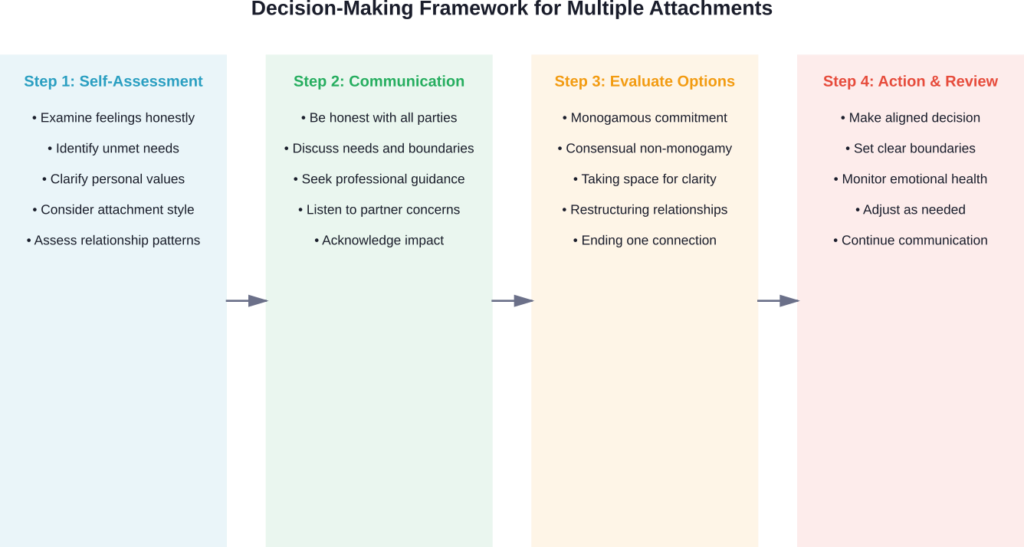
Ultimately, decisions about loving multiple people require developing personal relationship ethics based on honesty, consent, and care for all involved.
Defining Your Values
Rather than simply accepting cultural defaults around monogamy or reacting against them, developing conscious relationship ethics means articulating what matters most.
What role does sexual exclusivity play in your concept of commitment? How do you define fidelity—is it about sexual exclusivity, emotional exclusivity, honesty, or something else? What makes you feel secure and valued in relationships?
Getting clear on these questions helps make decisions aligned with authentic values rather than cultural expectations or partner pressure.
Prioritizing Honesty and Consent
Whatever relationship structure someone chooses, honesty and consent must remain foundational.
Deception transforms love into betrayal. Maintaining multiple relationships without the knowledge or consent of partners involved isn’t ethical non-monogamy—it’s infidelity.
Honest communication allows all parties to make informed choices about their participation, set appropriate boundaries, and maintain their dignity and autonomy.
Accepting That There Are No Perfect Solutions
Sometimes there isn’t a clean answer that makes everyone happy and resolves all complications.
Loving two people might require choosing between imperfect options, accepting loss alongside gain, or living with ambiguity and uncertainty.
Real life rarely offers fairy-tale resolutions. Sometimes the best choice is the one that minimizes harm, aligns most closely with core values, or offers the most possibility for authentic living—even if it’s not ideal.
Frequently Asked Questions
Yes, developing attraction or even feelings for someone outside a primary relationship is relatively common and doesn’t automatically indicate relationship problems. Humans don’t stop noticing or connecting with others just because they’re partnered. The key ethical question isn’t whether these feelings arise but how someone chooses to handle them—through honest communication with partners, maintaining appropriate boundaries, or exploring consensual relationship structures.
Research shows that polyamorous relationships can absolutely succeed long-term when all parties genuinely prefer this structure and maintain strong communication. Studies indicate that satisfaction in consensually non-monogamous relationships often matches or exceeds satisfaction in monogamous relationships. Success depends on alignment between relationship structure and participants’ authentic preferences, not simply on the number of partners involved. Long-term polyamorous relationships require exceptional communication skills, emotional maturity, and ongoing negotiation around boundaries and needs.
Distinguishing love from infatuation requires time and honest self-examination. Infatuation typically involves intense preoccupation, idealization, and fantasy, often based on limited real knowledge of the person. Love develops over time through shared experiences, involves acceptance of flaws, and includes care for the other person’s wellbeing beyond personal gratification. If feelings for a second person persist beyond several months, involve genuine concern for their happiness, and exist alongside continued care for a primary partner, they may represent genuine love rather than temporary infatuation. Consider working with a therapist to gain clarity.
This depends entirely on the specific people and relationship involved. Some partners respond to honesty with appreciation for the transparency, even if the information is difficult. Others may experience it as devastating betrayal. Consider the context: Has there been physical involvement? What is the partner’s stance on monogamy? What agreements exist in the relationship? While honesty is generally ethically superior to deception, timing and approach matter significantly. Consider seeking couples therapy to facilitate this conversation in a safe, supported environment where both parties can process emotions and explore options together.
Not necessarily. Experiencing feelings for two people at once describes a temporary emotional state, while polyamory describes an ongoing relationship orientation or practice. Someone might experience loving two people without identifying as polyamorous or wanting ongoing non-monogamous relationships. Conversely, someone might identify as polyamorous based on their general relationship preferences, not just one specific situation. Polyamory involves actively maintaining consensual multiple romantic relationships with ongoing communication and boundary negotiation, not simply having feelings for more than one person.
Not at all. Love isn’t determined by which option someone ultimately chooses. Choosing one relationship over another often reflects practical considerations, value alignment, life circumstances, or commitment to existing relationships—not the objective “realness” of competing feelings. Someone might genuinely love two people but choose one because that relationship has greater history, better practical compatibility, shared children, or closer alignment with long-term goals. The decision reflects priorities and circumstances, not whether the feelings themselves were authentic.
The fundamental difference is consent and honesty. Ethical non-monogamy involves all parties knowingly agreeing to a relationship structure that includes multiple partners, with clear communication about boundaries, expectations, and the status of outside relationships. Cheating involves deception—maintaining relationships or encounters that violate agreed-upon relationship boundaries without a partner’s knowledge or consent. Someone can have multiple romantic or sexual partners ethically if everyone involved has agreed to this arrangement with full information. The same situation becomes cheating if pursued through deception or violation of agreed boundaries.
Conclusion: Love’s Capacity Beyond Cultural Boundaries
So, is it possible to be in love with two people at the same time?
The answer, supported by neurobiology, attachment research, and lived experience of many people, is yes. The human capacity for emotional bonding isn’t inherently limited to one person at a time.
But possibility doesn’t equal inevitability, and capability doesn’t determine ethics.
What transforms the possibility of loving multiple people into ethical reality is honesty, consent, and genuine care for everyone’s wellbeing. Deception turns love into betrayal, regardless of the authenticity of feelings involved.
For someone experiencing love for two people, the path forward requires brutal honesty—with oneself and others. It demands examining motivations, understanding needs, clarifying values, and communicating transparently.
There’s no universal right answer. Some people will choose monogamous commitment, recognizing that their values or their partner’s needs require focusing emotional energy on one relationship. Others will pursue consensual non-monogamy, building relationship structures that honor multiple connections.
Both choices can be ethical. Both can lead to fulfillment. What matters is that decisions emerge from honesty, respect autonomy, and prioritize care for all people affected.
The cultural narrative that positions monogamy as the only legitimate expression of love is exactly that—a cultural narrative, not a biological law. But challenging cultural norms doesn’t make alternative paths easier. It often makes them considerably harder.
Anyone navigating these complex emotional waters deserves compassion—for themselves and others involved. Love, in whatever form it takes, is rarely simple. When it involves multiple people, complexity multiplies exponentially.
The question isn’t whether loving two people is possible. It’s whether you can do so with integrity, honesty, and genuine care for everyone involved—including yourself.
That’s the real challenge, and the real opportunity.
Ready to explore your relationship values and needs more deeply? Consider speaking with a licensed therapist who specializes in relationship issues. Whether you ultimately choose monogamy or consensual non-monogamy, professional guidance can help you navigate these complex emotions with clarity, honesty, and care for everyone involved.