

Quick Summary: Yes, it is possible to become ambidextrous through deliberate training and practice. Research shows that 89% of participants in studies demonstrated significant improvements in non-dominant hand precision, speed, and accuracy after just 10 days of focused training. While genetics play a role (about 25%), environmental factors account for 75% of handedness determination, meaning consistent practice can develop near-equal dexterity in both hands.
Most people navigate life with a clear preference for one hand. Right-handers dominate the world—roughly 90% of the population—while lefties make up the minority. But what about those rare individuals who seem equally skilled with both hands?
The question isn’t just whether ambidexterity exists (it does), but whether the rest of us can train ourselves to achieve it. And here’s the thing: the science suggests we absolutely can.
What Does Ambidextrous Actually Mean?
True ambidexterity means having equal skill and comfort using both hands for any task. It’s different from being mixed-handed, where someone might write with their left hand but throw with their right.
Natural ambidexterity is remarkably rare—only about 1% of people are born this way. But that doesn’t mean the ability is locked away from everyone else.
The brain’s capacity for change, called neuroplasticity, allows us to rewire neural pathways through practice and repetition. This same mechanism that helps stroke patients relearn motor skills can help anyone develop proficiency with their non-dominant hand.
The Science Behind Training Your Non-Dominant Hand
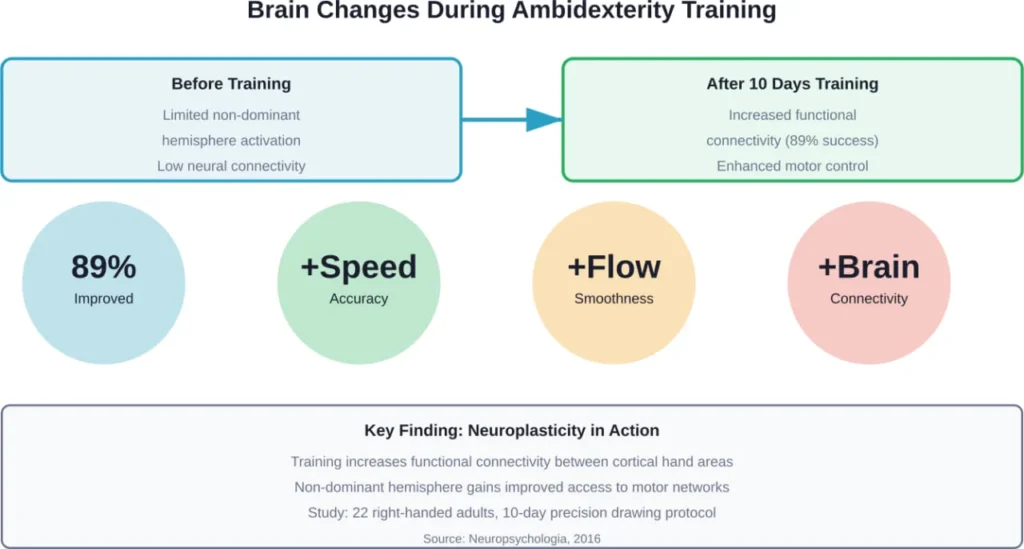
Research from medical studies provides compelling evidence that ambidexterity training actually works. According to findings published in Neuropsychologia, 22 healthy right-handed adults underwent resting state functional connectivity MRI scans before and after 10 days of training on a left-hand precision drawing task.
The results? 89% of participants significantly improved left-hand speed, accuracy, and smoothness. But wait—it gets better.
Brain imaging revealed increased functional connectivity between cortical hand areas and the praxis network. Translation: the brain physically rewired itself to support the newly trained skills. The non-dominant hemisphere gained improved access to motor control networks typically dominated by the opposite side.
This wasn’t an isolated finding. Research on chopstick operation training with the left non-dominant hand showed similar patterns. Complex fine motor skills—exactly the type required for chopstick manipulation—can be acquired through focused practice.
Nature vs. Nurture: What Determines Handedness?
Before diving into training methods, it’s worth understanding what creates handedness in the first place.
According to research, handedness is determined by approximately 25% genetic factors and 75% non-genetic factors like environmental influences. It clearly runs in families, but genetics aren’t destiny.
That 75% environmental component? That’s your opening.
Research on converted left-handers—people who switched writing hands—reveals long-term neurological adaptations. Brain imaging showed these individuals developed unique functional neuroanatomy for handwriting, demonstrating the brain’s remarkable ability to reorganize around new motor demands.
How Long Does It Take to Become Ambidextrous?
Real talk: there’s no magic number.
The 10-day study showed measurable improvements, but that involved controlled, intensive daily practice on specific tasks. Achieving true functional ambidexterity—where the non-dominant hand performs as naturally and skillfully as the dominant one—typically requires months or even years of consistent training.
The timeline depends on several factors:
- Current skill gap between hands
- Complexity of tasks being trained
- Daily practice duration and intensity
- Age (younger brains show faster neuroplastic changes)
- Consistency of training schedule
Research and practitioner reports indicate varied experiences. Some report noticeable improvements in basic tasks within weeks, while complex skills like handwriting or musical instrument playing take considerably longer.
Effective Training Methods to Develop Ambidexterity
Based on research findings and practical applications, certain training approaches prove more effective than others.
Start With Fine Motor Control
Research indicates that shaping exercises—not just general activity training—increase dexterity of the trained non-dominant hand. Random use doesn’t cut it. Deliberate, focused practice on precise movements yields results.
Begin with tracing the alphabet using the non-dominant hand. Start with lowercase letters, then progress to uppercase. This introduces the hand to controlled, familiar movements. Aim for straight lines and clean curves, practicing at least 10 minutes daily.
The hand may strain initially—that’s normal. Take breaks and resume when comfortable.
Progress to Daily Activities
Once basic control develops, integrate the non-dominant hand into routine tasks:
- Brushing teeth
- Using utensils during meals
- Opening doors and containers
- Computer mouse operation
- Throwing and catching
The chopstick training research demonstrates that complex, handedness-specific motor skills can be acquired through task-specific practice. Activities requiring precise coordination between multiple fingers prove particularly effective.
Apply Mode-Specific Training
Studies on cortical reorganization reveal that the mode of hand training determines the type of brain changes that occur. Shaping exercises that emphasize precision and control produce different neural adaptations than general activity training.
For maximum benefit, combine both approaches but prioritize quality over quantity. Fifteen minutes of focused precision work outperforms an hour of mindless non-dominant hand use.
Who Benefits Most from Ambidexterity Training?
While anyone can pursue ambidexterity, certain groups stand to gain the most.
Rehabilitation and Recovery
Research indicates that approximately 70-80% of stroke patients experience upper extremity paralysis, compromising motor skills necessary for daily living. Only 20% achieve complete recovery.
For these individuals, training the non-dominant hand isn’t optional—it’s essential. Physical therapy protocols based on neuroplasticity research help patients develop functional skills with their previously weaker hand.
Athletes and Performers
Athletes benefit enormously from bilateral skill development. Basketball players who can dribble and shoot with both hands become unpredictable. Baseball players who can bat from either side create strategic advantages.
Musicians, particularly pianists and guitarists, already train for bilateral coordination, though they still typically favor one hand for the most technically demanding parts.
Injury Prevention and Preparedness
Developing non-dominant hand skills provides insurance against dominant hand injury. If complications arise with the previously dominant hand—whether from accident, repetitive strain, or age-related conditions—existing non-dominant hand training makes adaptation significantly easier.
The Neuroscience of Learning with Both Hands
Research reveals fascinating details about how the brain adapts during ambidexterity training.
Studies on intermanual transfer learning show that pre-training learning involves declarative (explicit) motor learning, primarily mediated by the cortical motor network. After training becomes established, it shifts to procedural knowledge, activating both subcortical and cortical motor network regions.
This transition—from conscious, effortful movement to automatic, fluid execution—mirrors how we originally learned to use our dominant hand. The brain doesn’t discriminate which hand deserves motor mastery; it simply requires sufficient repetition and focused practice.
Transcranial magnetic stimulation studies demonstrate that shaping exercises increase dexterity of the trained non-dominant hand in parallel with shifts in active cortical areas. Physical changes occur in the brain’s structure and function, not just subjective feelings of improvement.
Potential Downsides and Considerations
Research on behavioral ambidexterity and brain health reveals some nuanced findings worth noting.
While forced handedness switching in childhood has historically raised concerns, modern voluntary training in adults appears to carry minimal risk when approached sensibly. The key difference: choice and gradual progression versus forced, stressful switching during critical developmental periods.
Some considerations include:
- Initial frustration and slower task completion
- Temporary hand fatigue or mild strain
- Need for sustained motivation over months
- Possible plateaus in skill development
Studies on converted left-handers who were forced to switch in childhood showed long-term neurological adaptations without necessarily indicating harm, though the psychological stress of forced switching was a separate concern. Voluntary adult training doesn’t carry these same psychological burdens.
Practical Training Schedule
Based on research protocols and practical application, here’s a structured approach:
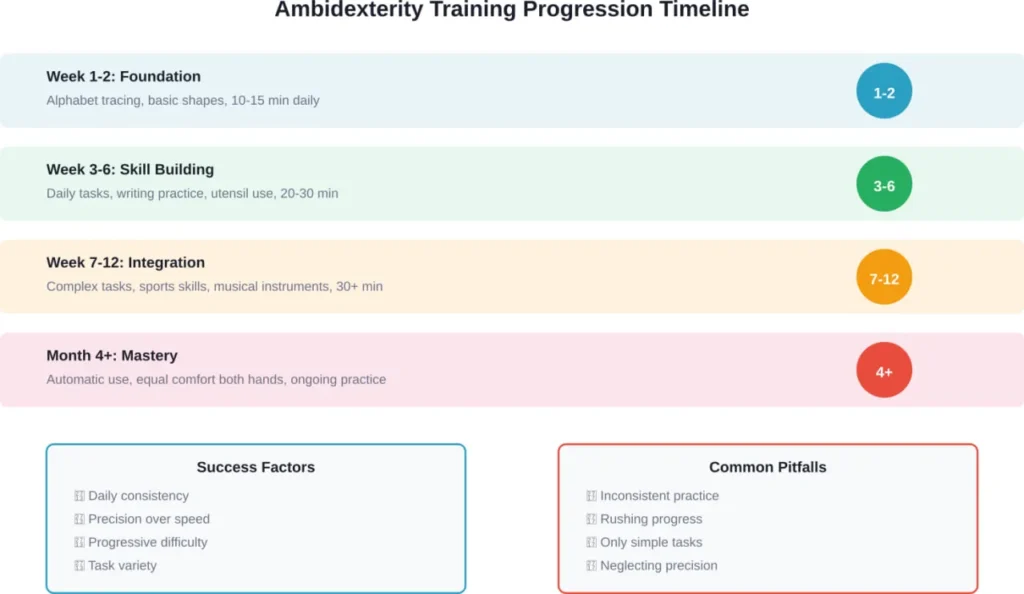
| Training Phase | Duration | Daily Practice | Focus Activities |
|---|---|---|---|
| Foundation | Weeks 1-2 | 10-15 minutes | Alphabet tracing, basic shapes, straight lines |
| Development | Weeks 3-6 | 20-30 minutes | Writing words, brushing teeth, using utensils |
| Integration | Weeks 7-12 | 30-45 minutes | Complex tasks, sports practice, detailed drawing |
| Mastery | Months 4+ | Ongoing use | Equal task distribution, skill refinement |
The research showing 89% improvement after 10 days involved focused precision drawing practice. Applying this intensity to varied daily tasks should yield noticeable results within weeks, with continued improvement over months.
Does Age Matter?
Neuroplasticity decreases with age, but it never disappears entirely.
Research on handedness across different age groups shows that chronological age has significant influence on hand and foot laterality, particularly for abstract and symbolic activities like writing and painting. This suggests that lateralization isn’t fixed throughout life—it can change, though perhaps more slowly in older adults.
Younger individuals typically show faster skill acquisition due to higher neuroplastic capacity. But older adults shouldn’t be discouraged. The same fundamental mechanisms that allowed them to learn their dominant hand skills decades ago remain functional, just requiring more patience and consistency.
Frequently Asked Questions
Most people can develop significant non-dominant hand skills through training, with research showing 89% of participants improving precision, speed, and accuracy. True equal-handed ability requires extensive practice over months or years, but functional ambidexterity for many tasks is achievable by most individuals willing to commit to consistent training.
Initial improvements appear within 10 days of focused practice according to research studies. Basic functional skills typically develop within 6-12 weeks of consistent daily practice. Achieving near-equal proficiency with both hands for complex tasks usually requires several months to years depending on the skill complexity and training intensity.
Studies show that non-dominant hand training increases functional connectivity between cortical hand areas and motor networks. This demonstrates neuroplastic brain changes, though whether this translates to broader cognitive benefits remains an area of ongoing research. The training certainly creates measurable brain reorganization.
Research indicates that shaping exercises—focused, precision-based practice—produce better results than general activity training alone. Starting with specific skills like writing or drawing, then expanding to varied daily tasks, appears more effective than randomly using the non-dominant hand for everything at once.
Absolutely. Since 70-80% of stroke patients experience upper extremity paralysis with only 20% achieving complete recovery, non-dominant hand training becomes crucial. The same neuroplasticity principles that allow healthy individuals to develop ambidexterity help rehabilitation patients regain functional independence. Physical therapy protocols specifically leverage these mechanisms.
Ambidextrous individuals can perform tasks equally well with either hand. Mixed-handed (or cross-dominant) people prefer different hands for different tasks—like writing left-handed but throwing right-handed. True ambidexterity is much rarer naturally, though it can be developed through training.
No evidence suggests that training the non-dominant hand diminishes dominant hand abilities. In fact, research on intermanual transfer learning shows that motor learning can transfer between hands. Training one hand may actually benefit the other through neural mechanisms, though the trained hand shows the primary improvements.
Moving Forward With Ambidexterity Training
The evidence is clear: becoming ambidextrous isn’t just possible—it’s a well-documented outcome of deliberate practice supported by neuroplastic brain changes.
The 89% success rate in research studies should encourage anyone considering this path. These weren’t genetically gifted individuals or lifelong athletes. They were ordinary right-handed adults who committed to 10 days of focused practice and achieved measurable improvements.
Success requires realistic expectations. True equal-handed mastery takes time—months or years for complex skills. But functional proficiency for daily tasks? That’s achievable within weeks for most people.
The approach matters tremendously. Random non-dominant hand use produces minimal results. Focused, precision-based practice following structured progression—starting with simple motor control and advancing to complex tasks—yields the neuroplastic changes that translate to real skill.
Whether pursuing ambidexterity for practical reasons (injury recovery, athletic performance), intellectual curiosity, or personal challenge, the path forward involves the same principles: consistency, precision, progression, and patience.
Start today with 10 minutes of alphabet tracing using your non-dominant hand. By this time next month, you’ll have measurable improvements. By next year, you might surprise yourself with what that “other” hand can accomplish.
The brain’s remarkable plasticity makes it possible. Your commitment makes it real.