
Quick Summary: Bringing back dinosaurs is scientifically impossible because DNA completely degrades within approximately 6.8 million years, while dinosaurs went extinct 66 million years ago. According to Nature research, DNA has a 521-year half-life, making recovery from dinosaur fossils unfeasible. While de-extinction works for recently extinct species through cloning or genetic engineering, dinosaurs remain too ancient for any current or foreseeable technology to resurrect.
Ever since Jurassic Park hit theaters in 1993, the question has captivated imaginations worldwide: could we actually bring dinosaurs back from extinction? The idea of seeing a living, breathing Tyrannosaurus rex or Triceratops feels tantalizingly close in our age of genetic engineering and CRISPR technology.
But here’s the thing—the science tells a different story than Hollywood does.
Dinosaurs dominated Earth for over 140 million years before an asteroid impact ended their reign approximately 66 million years ago. That enormous time gap creates insurmountable challenges for resurrection efforts. Let’s break down exactly why bringing back dinosaurs isn’t possible, what science has tried, and which extinct creatures we might actually see return.
The DNA Problem: Why Time Destroys Everything
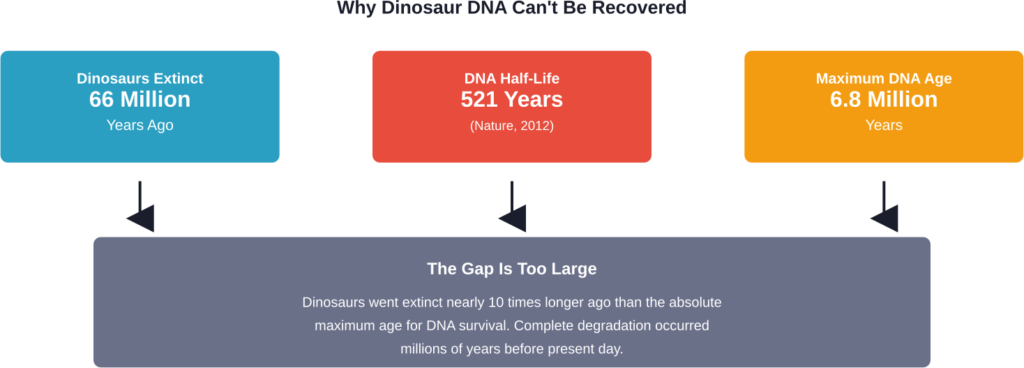
The fundamental barrier to dinosaur resurrection is DNA degradation. According to research published in Nature in 2012, DNA has a half-life of 521 years. This means that every 521 years, half of the bonds between nucleotides in the DNA backbone break down.
Do the math. After 6.8 million years—even under absolutely perfect preservation conditions—every single bond would be destroyed. The DNA would be completely unreadable.
Dinosaurs went extinct 66 million years ago. That’s roughly ten times longer than DNA can possibly survive, even in the most optimal scenarios imaginable.
Research from the Max Planck Institute for Evolutionary Anthropology confirms that DNA sequence information can only be retrieved from remains less than approximately 100,000 years old in most circumstances. Even then, only multicopy DNA like mitochondrial DNA stands a chance of recovery.
The Natural History Museum puts it plainly: we simply cannot recover genetic material from dinosaurs. The molecules have long since broken down into unrecognizable fragments.
What About Dinosaur DNA in Amber?
Jurassic Park popularized the idea of extracting dinosaur DNA from mosquitoes preserved in amber. The concept seems logical—ancient insects trapped in tree resin, perfectly preserved for millions of years.
Real talk: it doesn’t work that way.
While amber does preserve organisms remarkably well, it doesn’t prevent DNA degradation. The same chemical processes that break down genetic material happen inside amber just as they do in other environments. The 521-year half-life applies regardless of the preservation medium.
Scientists have never found intact dinosaur DNA in amber, blood, or any other source. Every claim has either been debunked or traced back to modern contamination.
Could We Build Dinosaur DNA From Scratch?
If we can’t find dinosaur DNA, could scientists synthesize it in a laboratory? This approach faces an even bigger problem: we don’t have the blueprint.
Creating a complete genome requires knowing the exact sequence of billions of base pairs. For dinosaurs, we have no reference sequence. We’d essentially be guessing at what their DNA looked like, which wouldn’t produce an actual dinosaur—just our best fictional approximation.
That said, scientists have explored related approaches.
The Reverse-Engineering Approach
Birds are direct descendants of dinosaurs. This isn’t speculative anymore—it’s widely accepted scientific fact. When Jurassic Park was released, this connection wasn’t as firmly established as it is today.
Some researchers have theorized about reverse-engineering birds to express more dinosaur-like traits. The idea involves identifying genes in modern birds that suppress ancestral features, then deactivating those genes to allow dinosaur characteristics to emerge.
For example, birds have genes that once coded for teeth, tails, and arm claws in their dinosaur ancestors. These genes still exist but are turned off during development.
Theoretically, manipulating these genetic switches could produce a bird with more dinosaur-like features. But here’s where expectations need adjustment: this wouldn’t create an actual dinosaur. It would create a genetically modified bird with some superficial resemblance to its ancient relatives.
The resulting organism would be something entirely new—not a true dinosaur, but rather a chimera of modern and ancient traits.
What About Cloning Methods?
Cloning requires intact DNA from the organism being cloned. The process typically involves extracting a complete nucleus from a preserved cell and implanting it into an egg from a closely related species.
This technique has worked for recently extinct animals. Scientists have successfully cloned species that died out within the last few decades or centuries, where frozen tissue samples preserved viable genetic material.
But cloning dinosaurs? Not happening.
Without intact DNA, there’s nothing to clone. The entire process requires a complete, readable genome as the starting template.
The Christmas Island Rat Study
Research on de-extinction limits provides sobering context. A study on the Christmas Island rat examined how much of an extinct species’ genome could be recovered using a close living relative as a reference.
Even using the extremely high-quality Norway brown rat genome as a reference, researchers found that nearly 5% of the genome sequence remained unrecoverable. The study identified 1,661 genes recovered at lower than 90% completeness, with 26 genes completely absent.
That’s for a species that went extinct recently, with a very close living relative available for comparison.
For dinosaurs—extinct for 66 million years with only distant bird relatives—the genetic gap would be astronomically larger. Reconstructing their genome would be impossible even with the most advanced computational tools.
De-Extinction: What Actually Works
While dinosaurs remain off the table, de-extinction science is making real progress with more recently extinct species.
According to research published in Genes, three principal methods are under discussion for “true” de-extinction: back-breeding, cloning, and genetic engineering.
Back-breeding involves selectively breeding living animals to express traits of their extinct relatives. Cloning requires preserved DNA from the extinct species. Genetic engineering uses CRISPR and related tools to edit the genome of a living relative to match the extinct species more closely.
These approaches only work when:
- The extinction happened recently enough that DNA survived
- Close living relatives exist for comparison and surrogacy
- Sufficient genetic material can be recovered from preserved specimens
- The ecological knowledge exists to sustain the resurrected population
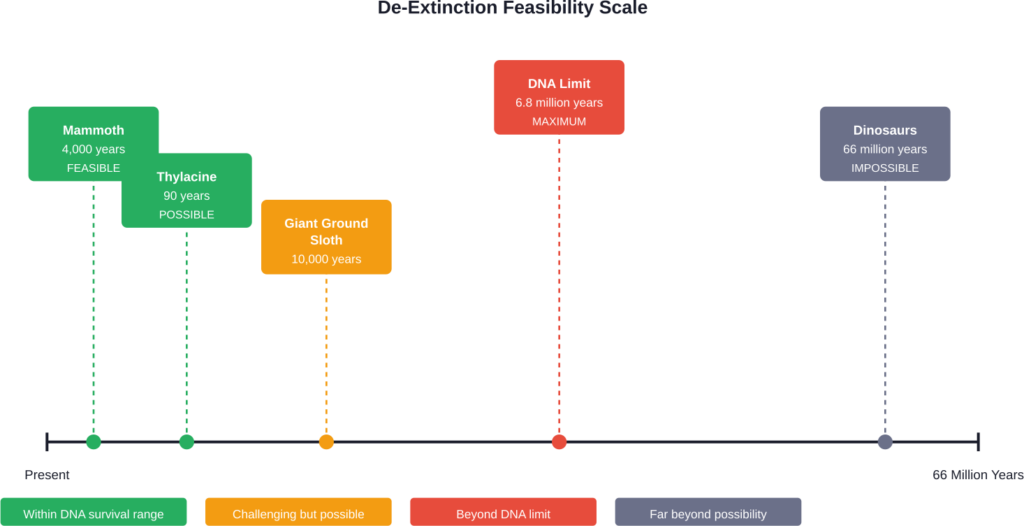
The woolly mammoth represents the most prominent de-extinction effort currently underway. The mammoth went extinct only about 4,000 years ago—well within the DNA survival window. Frozen specimens in Siberian permafrost have yielded recoverable genetic material.
Asian elephants are extremely close relatives, providing both a genomic reference and potential surrogate mothers. Companies like Colossal Biosciences are actively working to create mammoth-elephant hybrids by editing elephant genomes to include mammoth traits.
| Extinct Species | Years Since Extinction | DNA Available? | De-Extinction Feasibility |
|---|---|---|---|
| Dinosaurs | 66 million | No | Impossible |
| Woolly Mammoth | 4,000 | Yes | In Progress |
| Passenger Pigeon | 108 | Yes | Theoretically Possible |
| Thylacine | 90 | Partial | Being Researched |
| Quagga | 140 | Partial | Back-breeding Attempted |
The Ethical Questions We’re Not Asking
Even if bringing back dinosaurs were scientifically possible, should we do it?
The ecological systems that supported dinosaurs vanished millions of years ago. Earth’s atmosphere, climate, vegetation, and entire biosphere have transformed completely. A resurrected dinosaur would find itself in an alien world, with no natural habitat, no appropriate food sources, and no ecological niche.
Where would a Brachiosaurus find the massive quantities of Cretaceous-era plants it evolved to eat? How would carnivorous dinosaurs fit into modern ecosystems without devastating existing wildlife?
These questions become even more complex when considering animal welfare. Creating an organism only to confine it to captivity, with no others of its kind and no appropriate environment, raises serious ethical concerns.
De-extinction research for recently extinct species faces similar dilemmas. The Christmas Island rat study highlighted how incomplete genetic recovery creates organisms that aren’t quite the original species—they’re approximations with unknown characteristics.
What Scientists Are Actually Working On
While dinosaur resurrection remains in the realm of science fiction, de-extinction science is actively pursuing several realistic targets.
The passenger pigeon went extinct in 1914, leaving behind abundant museum specimens with recoverable DNA. Researchers are using genomic analysis and CRISPR editing to modify band-tailed pigeons—the closest living relative—to recreate passenger pigeon traits.
The thylacine, or Tasmanian tiger, died out in 1936. Preserved specimens and even some tissue samples exist. Australian researchers are investigating whether sufficient genetic material can be recovered for de-extinction attempts.
Interestingly, molecular paleontology is also exploring “de-extinct” antimicrobials. According to research in ACS Omega, scientists are studying ancient genes to develop bioactive peptides and antibiotics. Research has shown that a gene cluster on chromosome 3 identified as a major genetic risk factor for respiratory failure after SARS-CoV-2 infection was conferred by a genomic segment inherited from Neanderthals.
This shows how ancient DNA research offers value beyond literal resurrection—understanding evolutionary history improves modern medicine and biotechnology.
The Future of Ancient DNA Research
Just because we can’t bring back dinosaurs doesn’t mean paleogenomics is a dead end.
Researchers continue extracting valuable information from ancient remains within the viable timeframe. Studies on Steller’s sea cow, arctic foxes during the Late Pleistocene, and other relatively recent extinctions provide insights into evolutionary biology, climate adaptation, and genetic diversity.
The Steller’s sea cow went extinct in 1768—in the recent past relative to paleontological timescales. Scientists have successfully recovered genomic data from 12 individuals, revealing information about skin phenotype and cold adaptation. This kind of research helps us understand how species evolve in response to environmental pressures.
Ancient DNA studies also inform conservation biology. Understanding what genetic factors led to species’ vulnerability helps protect currently endangered animals.
Why Birds Are as Close as We’ll Get
When Jurassic Park was released, the idea that birds descended from dinosaurs wasn’t universally accepted. Now it’s established fact.
Birds aren’t just related to dinosaurs—they are dinosaurs. Specifically, they’re avian dinosaurs, descendants of theropod dinosaurs that survived the mass extinction event 66 million years ago.
Look at a cassowary, emu, or ostrich. These large flightless birds retain many dinosaurian features: powerful legs, sharp claws, aggressive territorial behavior. Their skeletal structure shows clear connections to their theropod ancestors.
In a very real sense, dinosaurs never went extinct. They evolved, adapted, and continued thriving in the form of over 10,000 bird species alive today.
If scientists ever do create dinosaur-like organisms through reverse engineering bird genomes, they’ll be working with creatures that are already dinosaurs—just trying to reactivate suppressed ancestral traits.
Frequently Asked Questions
No. Dinosaur resurrection is impossible with current technology or any foreseeable future technology. DNA completely degrades after 6.8 million years maximum, while dinosaurs went extinct 66 million years ago. No viable genetic material exists to work with, regardless of technological advancement.
No authenticated dinosaur DNA has ever been discovered. All claims have been debunked or traced to modern contamination. The 521-year half-life of DNA means complete degradation occurred millions of years before present day, making preservation impossible under any conditions.
Not with actual dinosaurs. The premise of extracting dinosaur DNA from amber-preserved mosquitoes is scientifically impossible because DNA degrades regardless of preservation medium. However, scientists could theoretically use genetic engineering to create bird-dinosaur hybrids by reactivating ancestral genes in modern birds, though these wouldn’t be true dinosaurs.
Only recently extinct species with recoverable DNA and close living relatives. The woolly mammoth, passenger pigeon, and thylacine are primary candidates. These species died out within the last few thousand years, leaving preserved specimens with viable genetic material. De-extinction requires DNA survival, which limits possibilities to extinctions within roughly 100,000 years.
Creating DNA from scratch requires knowing the exact sequence of billions of base pairs. Without a reference genome, scientists would be guessing at what dinosaur DNA looked like. The result wouldn’t be an actual dinosaur but rather a fictional approximation with unknown characteristics and viability.
No serious scientific efforts are underway to resurrect dinosaurs because the scientific community recognizes it as impossible. Some researchers explore reverse-engineering bird genomes to express ancestral traits, but this represents evolutionary biology research rather than true de-extinction. Actual de-extinction efforts focus on recently extinct species like the woolly mammoth.
According to Nature research, DNA has a 521-year half-life. Even under perfect conditions, all DNA bonds break down after approximately 6.8 million years. Fossils older than this timeframe contain no recoverable genetic material, only mineralized remains of bones and tissues.
The Bottom Line on Dinosaur Resurrection
Bringing back dinosaurs isn’t just difficult or unlikely—it’s fundamentally impossible given the laws of chemistry and biology.
DNA degradation isn’t a technological problem we can engineer around. It’s a basic molecular reality. Every bond in dinosaur DNA broke down millions of years ago, leaving nothing to recover, sequence, or clone.
But that doesn’t make paleontology or de-extinction science less fascinating.
Real progress is happening with recently extinct species. The woolly mammoth could walk the Earth again within decades. The passenger pigeon might follow. These achievements represent incredible scientific advancement and raise important questions about conservation, ecology, and our responsibility to species we’ve driven to extinction.
As for dinosaurs? We have something even better—their descendants. Every robin, eagle, penguin, and parrot represents a living connection to the age of dinosaurs. They’re evolutionary success stories that adapted and thrived for 66 million years.
Sometimes reality offers something more remarkable than science fiction.
Want to learn more about extinction, evolution, and cutting-edge paleontology? Explore the resources at natural history museums, follow current research in journals like Nature, and stay updated on legitimate de-extinction projects. The real science might not involve resurrecting T. rex, but it’s every bit as exciting.