

Quick Summary: Burning 1,000 calories in a single day is possible but requires significant time and intense effort—typically 90-120 minutes of vigorous activity like running, cycling, or swimming. However, body weight, fitness level, and exercise intensity dramatically affect calorie burn rates, making this goal unrealistic for most people as a daily target. According to the CDC, adults need at least 150 minutes of moderate-intensity activity weekly for health benefits, which translates to far less than 1,000 calories burned per workout session.
The idea of torching 1,000 calories in a single day sounds impressive. Maybe even a bit heroic.
But here’s the thing—burning that many calories through exercise alone requires serious commitment, time, and intensity that most people can’t sustain regularly. And honestly? It’s not necessary for health or weight loss.
Understanding what it actually takes to hit that 1,000-calorie mark helps set realistic expectations. This guide breaks down the science, the workouts, and whether this ambitious goal makes sense for most people.
What Does “Burning 1,000 Calories” Actually Mean?
First, there’s a critical distinction to make. Everyone burns calories simply by existing.
The body requires energy for essential biological functions like breathing, circulating blood, building new tissues, and maintaining body temperature. For most adults, this baseline metabolic rate accounts for at least 1,000-2,000 calories daily without any intentional exercise.
When people talk about burning 1,000 calories through exercise, they mean additional calories burned beyond this baseline through intentional physical activity. That’s a completely different challenge.
How the Body Burns Calories
Total daily energy expenditure consists of three components:
- Basal metabolic rate (60-75% of total): Energy needed for essential body functions at rest
- Thermic effect of food (10%): Calories burned digesting and processing nutrients
- Activity thermogenesis (15-30%): Energy expended through exercise and daily movement
Burning an extra 1,000 calories means dramatically increasing that third component—activity thermogenesis—through sustained, intense physical effort.
The Reality: Who Can Actually Burn 1,000 Calories in a Workout?
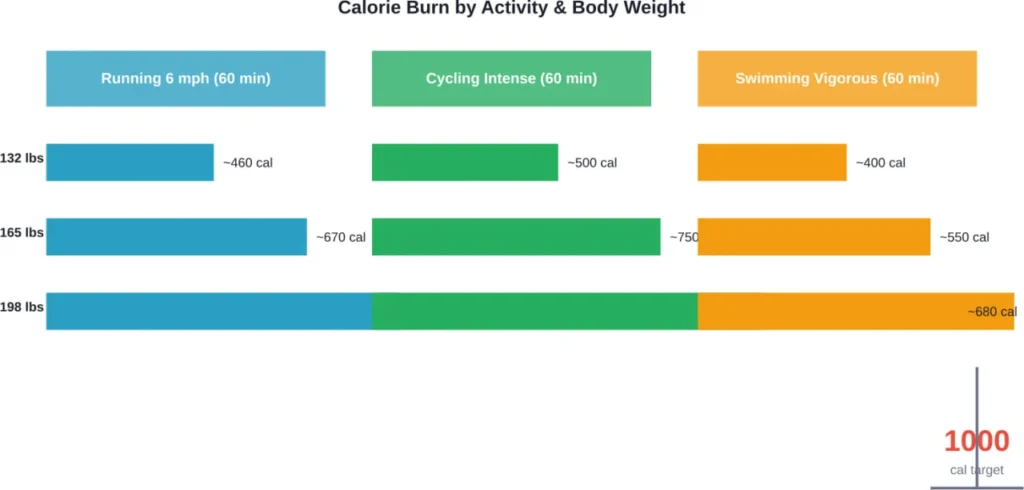
Body weight makes a massive difference in calorie burn rates. A 150-pound person running at 6 mph for 60 minutes burns approximately 750 calories. That same person would need roughly 90 minutes to hit 1,000 calories.
But a 220-pound person running at the same pace for the same duration might burn closer to 1,100 calories in that hour.
| Body Weight | Running (6 mph) | Cycling (Intense) | Swimming (Vigorous) |
|---|---|---|---|
| 132 lbs (60 kg) | ~130 minutes | ~120 minutes | ~150 minutes |
| 165 lbs (75 kg) | ~90 minutes | ~80 minutes | ~110 minutes |
| 198 lbs (90 kg) | ~70 minutes | ~65 minutes | ~90 minutes |
According to CDC guidelines, adults need at least 150 minutes of moderate-intensity aerobic activity weekly—that’s just 30 minutes a day, five days a week. This recommendation prioritizes consistent, sustainable movement over extreme single-session burns.
Fitness Level Matters Enormously
Attempting to burn 1,000 calories in a single workout isn’t appropriate for most people.
Athletes and highly trained individuals can sustain vigorous exercise for extended periods. Someone training for marathons or competing in multiple sports may regularly achieve this level of calorie expenditure.
But for someone balancing a desk job, family responsibilities, and moderate fitness? That type of sustained intensity isn’t realistic—and forcing it risks exhaustion, injury, and burnout.
Best Workouts for High Calorie Burns
So what actually gets someone to that 1,000-calorie milestone?
Running
Running remains one of the most efficient calorie-burning activities. At a moderate pace of 6 mph (10-minute miles), a 165-pound person burns approximately 670 calories per hour.
To reach 1,000 calories, that same person would need to run for about 90 minutes continuously. Increase the pace to 10 mph, and the time requirement drops to roughly 60 minutes—but maintaining that speed for an hour demands exceptional cardiovascular fitness.
Cycling
Intense cycling can burn 600-900+ calories per hour depending on speed, resistance, and body weight. Around 70-75 minutes of hard cycling effort can push a 165-pound person past the 1,000-calorie mark.
The advantage? Cycling causes less impact stress on joints compared to running, making longer sessions more sustainable.
Swimming
Vigorous swimming engages the entire body and burns substantial calories. Expect approximately 600-700 calories per hour for continuous, strong swimming.
Reaching 1,000 calories typically requires 90-110 minutes of sustained effort in the pool.
High-Intensity Interval Training (HIIT)
HIIT alternates between maximum effort bursts and brief recovery periods. This approach can increase calorie burn by up to 30% compared to steady-state exercise.
But here’s the catch—true HIIT is exhausting. Maintaining that intensity for the 75-90 minutes needed to hit 1,000 calories is extremely difficult and potentially counterproductive.
| Activity Type | Calories/Hour (165 lbs) | Time to 1,000 Calories |
|---|---|---|
| Running (6 mph) | ~670 | 90 minutes |
| Running (10 mph) | ~1,000+ | 60 minutes |
| Cycling (intense) | ~750 | 80 minutes |
| Swimming (vigorous) | ~600 | 100 minutes |
| HIIT circuits | ~800 | 75 minutes |
| Rowing (vigorous) | ~680 | 90 minutes |
The Post-Exercise Burn: Does It Add Up?
Exercise doesn’t just burn calories during the activity itself.
Excess post-exercise oxygen consumption (EPOC) refers to the elevated metabolic rate that persists after a workout ends. Research shows that a 45-minute vigorous exercise session can increase energy expenditure for up to 14 hours afterward, with excess post-exercise oxygen consumption (EPOC) contributing additional calorie burn beyond the workout itself.
But this bonus isn’t massive. Even with EPOC factored in, hitting 1,000 calories total still requires substantial exercise duration and intensity during the primary workout itself.
Is Burning 1,000 Calories Daily Realistic—or Even Necessary?
For most people, the answer is no on both counts.
Research on high-caloric expenditure exercise has examined programs targeting at least 1,000 kcal/week for improving health outcomes. For weight management, research has indicated targets of at least 2,000 kcal/week.
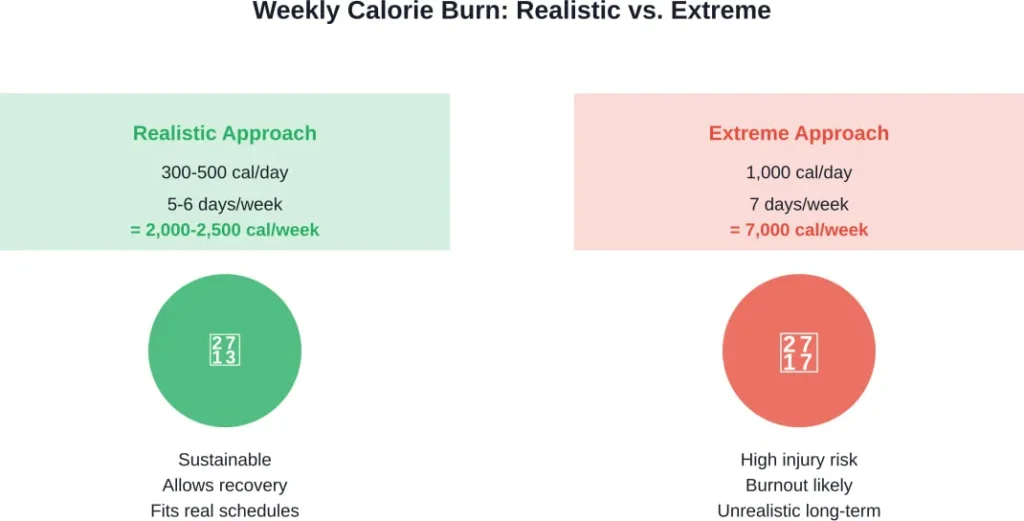
Notice those are weekly targets, not daily ones. Spreading 2,000 calories across an entire week means roughly 285 calories per day—far more manageable than 1,000.
The Sustainability Problem
Attempting to burn 1,000 calories daily through exercise creates several problems:
- Time commitment: Most people can’t dedicate 90-120 minutes to intense exercise every single day
- Recovery needs: Muscles, joints, and the cardiovascular system require rest days to repair and strengthen
- Injury risk: Overtraining increases the likelihood of stress fractures, tendinitis, and burnout
- Appetite increase: Extreme exercise often triggers compensatory eating that negates the calorie deficit
According to CDC physical activity guidelines, adults need 150-300 minutes of moderate-intensity aerobic activity weekly, plus muscle-strengthening activities on two or more days. This balanced approach supports long-term health without the risks of daily extreme calorie burns.
When Burning 1,000 Calories Makes Sense
There are specific scenarios where this level of calorie expenditure happens naturally:
Athletic Training
Competitive athletes training for endurance events regularly burn 1,000+ calories during long training sessions. A marathon runner logging 15+ miles or a cyclist completing a 50-mile ride will easily exceed this threshold.
But this happens within a structured training program that includes rest days, periodization, and nutritional support.
Active Occupations
Construction workers, landscapers, and others with physically demanding jobs may burn 1,000+ calories through their work activities combined with intentional exercise.
Special Events
Occasionally pushing for a 1,000-calorie burn—during a hiking trip, charity run, or weekend sports tournament—is different from making it a daily expectation.
Smarter Alternatives to Extreme Calorie Burns
Research on energy expenditure increasingly shows that consistent moderate activity provides substantial health benefits without requiring heroic effort.
Recent studies examining physical activity levels found that regular movement throughout the day—combined with structured exercise sessions—creates sustainable results.
The 300-500 Calorie Sweet Spot
Aiming for 300-500 calories burned per workout session is far more realistic for most people. This requires 30-60 minutes of moderate to vigorous activity—achievable even with busy schedules.
Multiply that by 5-6 days per week, and the total reaches 2,000-2,500 calories weekly—right in line with research-backed recommendations for weight management.
Movement Throughout the Day
Non-exercise activity thermogenesis (NEAT) accounts for calories burned through daily activities like walking, standing, fidgeting, and household tasks.
Increasing NEAT by taking stairs, parking farther away, or incorporating walking meetings adds meaningful calorie expenditure without formal workouts.
Safety Considerations and Red Flags
Attempting to burn 1,000 calories daily comes with legitimate health risks.
When to absolutely avoid this goal:
- New to exercise or returning after extended inactivity
- History of eating disorders or disordered eating patterns
- Existing injuries or chronic joint pain
- Medical conditions affecting heart health or metabolic function
- Already experiencing signs of overtraining (persistent fatigue, declining performance, mood changes)
Always consult healthcare professionals before dramatically increasing exercise volume, particularly when planning sustained high-intensity training.
Frequently Asked Questions
Yes, but it requires substantial time commitment. Activities like brisk hiking for 2-3 hours, yard work combined with walking, or playing active sports can accumulate 1,000 calories. The key is sustained moderate to vigorous movement over extended periods.
For general health, aim for 200-400 calories burned through intentional exercise, 5-6 days per week. This aligns with CDC recommendations of 150-300 minutes of moderate-intensity activity weekly. For weight loss, targeting 2,000-2,500 calories burned per week through exercise is more sustainable than daily extreme goals.
Not necessarily. Weight loss depends on total calorie balance—intake versus expenditure. Intense exercise often increases appetite significantly. If calorie intake increases proportionally, no deficit exists. Additionally, research shows that baseline caloric consumption matters; people consuming over 2,000 calories daily who create extreme deficits may experience greater weight regain.
Creating a 500-calorie daily deficit (through exercise and diet combined) theoretically produces about 1 pound of weight loss per week. However, individual results vary based on metabolism, body composition, sleep quality, stress levels, and dietary composition. Visible changes typically appear within 4-6 weeks of consistent effort.
Both serve different purposes. Cardio burns more calories during the activity itself. Strength training builds muscle mass, which increases resting metabolic rate over time. According to CDC guidelines, adults need both aerobic activity and muscle-strengthening exercises on two or more days weekly for comprehensive health benefits.
Yes, but it requires significant distance. A 165-pound person walking at 3.5 mph burns approximately 300 calories per hour. Reaching 1,000 calories means walking for about 3.5 hours—roughly 12+ miles. While possible, this duration isn’t practical for most people’s daily schedules.
Adequate nutrition becomes critical with high-calorie burns. Focus on replenishing glycogen with carbohydrates, supporting muscle repair with protein (20-30g post-workout), and maintaining hydration with electrolytes. Don’t try to create extreme deficits—eating too little after intense exercise can decrease metabolic rate and impair recovery.
The Bottom Line: Skip the Extremes
Can someone burn 1,000 calories in a day through exercise? Absolutely.
Should most people make that a daily goal? Probably not.
The relentless pursuit of massive calorie burns often leads to injury, burnout, and ultimately abandoning exercise altogether. Research and health guidelines consistently point toward moderate, sustainable activity as the key to long-term health.
Instead of fixating on hitting 1,000 calories, focus on consistency. Aim for 30-60 minutes of activity most days. Mix cardiovascular exercise with strength training. Find activities that feel enjoyable rather than punishing.
That approach won’t generate impressive calorie-tracking screenshots, but it builds lasting fitness, supports metabolic health, and actually fits into real life.
Real talk: The best workout is the one that happens regularly, not the one that sounds heroic on paper.
Ready to build a sustainable fitness routine that works with a schedule? Start with the CDC’s physical activity recommendations and adjust based on how the body responds. Consistency beats intensity every single time.