
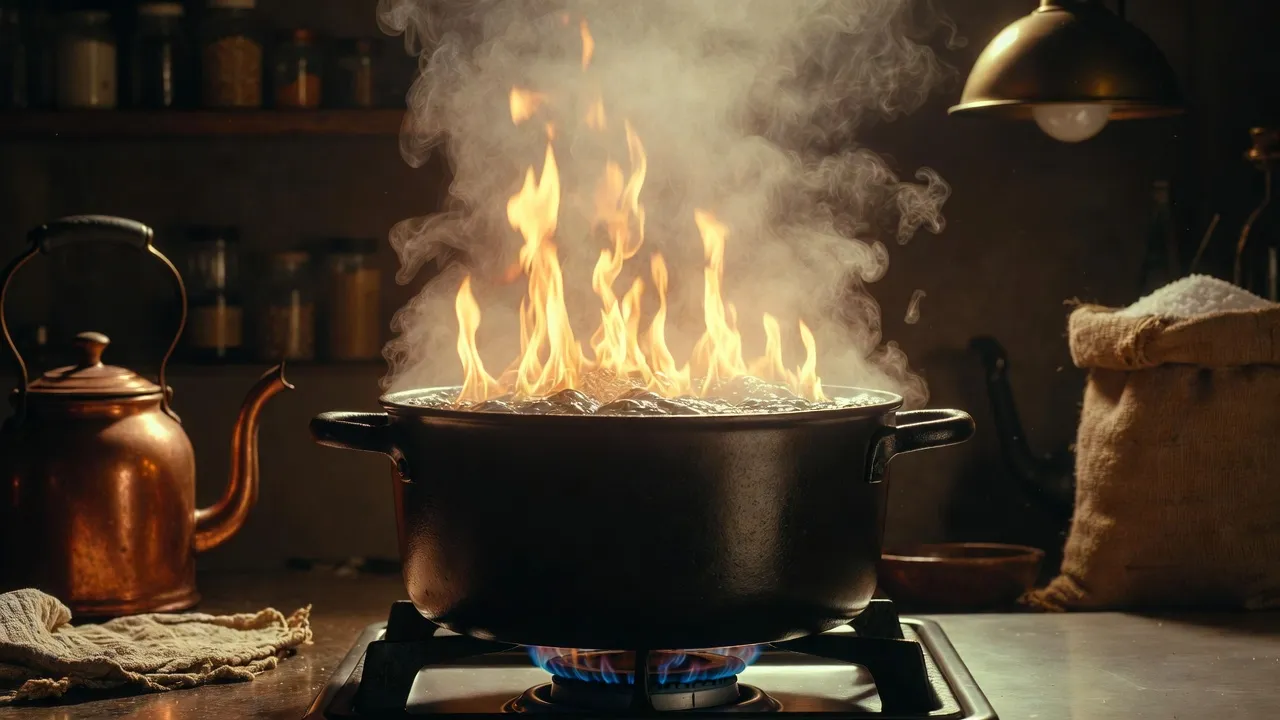
Quick Summary: Water cannot burn under normal conditions because it’s already the product of combustion between hydrogen and oxygen. When hydrogen burns, it combines with oxygen to form water (H₂O), meaning water represents the end result of burning, not fuel that can burn itself.
The question sounds paradoxical at first. Water contains hydrogen, which is highly flammable. So why doesn’t your glass of water spontaneously combust?
The answer lies in understanding what burning actually means in chemistry terms.
Why Water Doesn’t Burn
Burning is a chemical process called combustion. It happens when a fuel reacts with oxygen, releasing energy as heat and light. Here’s the thing though—water is already burned.
When hydrogen gas burns, it combines with oxygen to create water (H₂O). This reaction releases significant energy, which is why hydrogen is so flammable. But once that reaction completes, you’re left with water molecules.
Water doesn’t contain carbon, but neither do many flammable substances. Flammability depends on whether a material can sustain enough heat energy to keep reacting with oxygen.
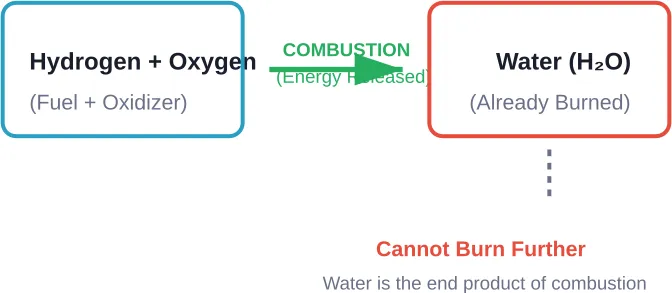
Water represents the stable end product. Trying to burn it would be like trying to burn ash—there’s no more energy to extract through oxidation.
The Chemistry Demonstration Trick
Videos circulating online often show “burning water,” but this is a chemistry illusion.
ChemEd X explains the trick involves hexane (C₆H₁₄), which is flammable, less dense than water, and immiscible with water. The hexane floats on top and burns, creating the visual effect that water itself is on fire.
Real talk: the water underneath remains completely unaffected by the flames above it.
FAQ
Yes, water contains hydrogen, which is flammable as a gas. However, once hydrogen bonds with oxygen to form H₂O, the resulting molecule is chemically stable and won’t burn.
Water cools burning materials below their ignition temperature and blocks oxygen access to the fuel source, stopping the combustion process.
Under normal conditions, no. Water is already oxidized hydrogen. Some extreme laboratory conditions might break water molecules apart, but that’s decomposition, not combustion.
Water and oil don’t mix. The water rapidly vaporizes under the oil, expanding violently and spreading burning grease. Never use water on grease fires.
Yes, hydrogen gas is highly flammable and explosive when mixed with oxygen. But hydrogen bonded in water molecules is chemically stable and safe.
Yes, through electrolysis—passing electricity through water splits it into hydrogen and oxygen gases. These separated gases are flammable, but water itself is not.
Understanding why water doesn’t burn clarifies fundamental combustion chemistry. Water isn’t fuel—it’s what you get after fuel burns completely with oxygen.