

Quick Summary: Human cloning is scientifically possible and has been achieved at the embryonic stage in laboratory settings. While researchers successfully created cloned human embryos in 2001 and 2013 using somatic cell nuclear transfer (SCNT), bringing a cloned embryo to full-term birth remains unachieved and faces enormous technical, ethical, and legal barriers in most countries worldwide.
The question isn’t whether we can clone humans anymore. It’s whether we should.
Since Dolly the sheep made headlines in 1997 as the first successfully cloned mammal, the scientific community has been wrestling with a profound reality: the technology to clone humans exists. Advanced Cell Technology announced in 2001 that they’d created cloned human embryos. Scientists in 2013 achieved a 23% success rate creating human SCNT blastocysts when male fibroblast cell nuclei were introduced into 29 enucleated oocytes obtained from three young donors.
But here’s the thing—creating a cloned embryo in a petri dish is vastly different from bringing a cloned human baby to term. And that gap between technical possibility and practical reality reveals everything about where human cloning actually stands today.
What Human Cloning Actually Means
Human cloning refers to creating a genetically identical copy of a human. The term covers both artificial reproduction of human cells and tissue, though it doesn’t apply to natural conception of identical twins.
Two distinct types of cloning dominate scientific discourse:
Reproductive cloning aims to create a cloned human being. This process would theoretically use somatic cell nuclear transfer to create an embryo that develops into a full person.
Therapeutic cloning focuses on creating cloned embryos to harvest stem cells for medical research and regenerative medicine. These embryos aren’t intended to develop beyond early stages.
The distinction matters enormously. While therapeutic cloning offers potential medical breakthrages, reproductive cloning raises fundamental questions about human dignity, identity, and personhood.
How Somatic Cell Nuclear Transfer Works
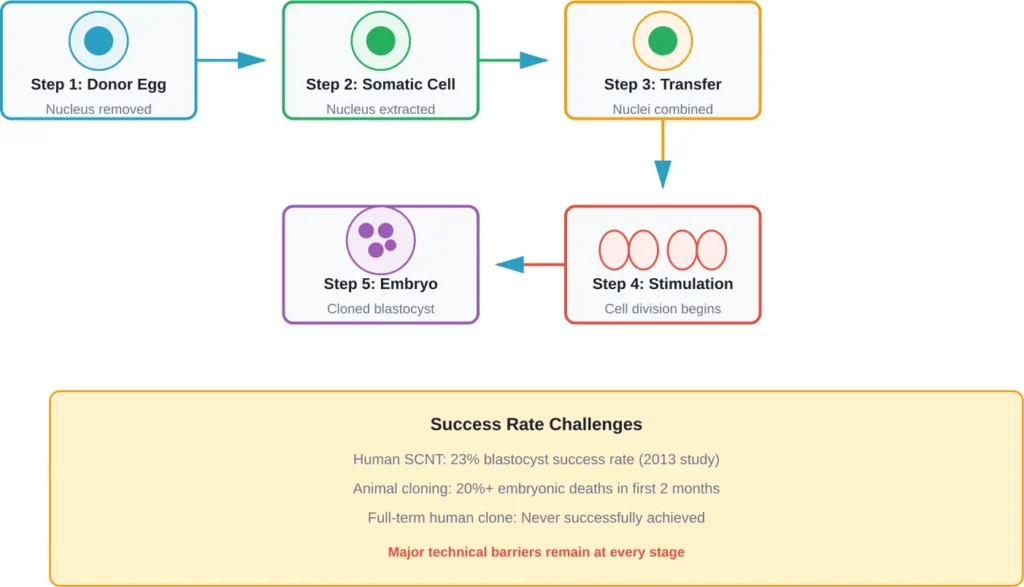
SCNT is the primary technique behind cloning attempts. Here’s how it works:
Scientists remove the nucleus from a donor egg cell. They then insert the nucleus from a somatic cell (any body cell except sperm or egg) from the individual being cloned. The reconstructed egg, now containing the complete genetic material from the donor, is stimulated to divide and develop into an embryo.
Sounds straightforward. It isn’t.
The Current State of Human Cloning Technology
Scientists have successfully created cloned human embryos. That’s not speculation—it’s documented fact.
Advanced Cell Technology announced in November 2001 that they’d created cloned human embryos from adult cells, though the announcement received mixed reactions from the scientific community regarding the significance of the findings.
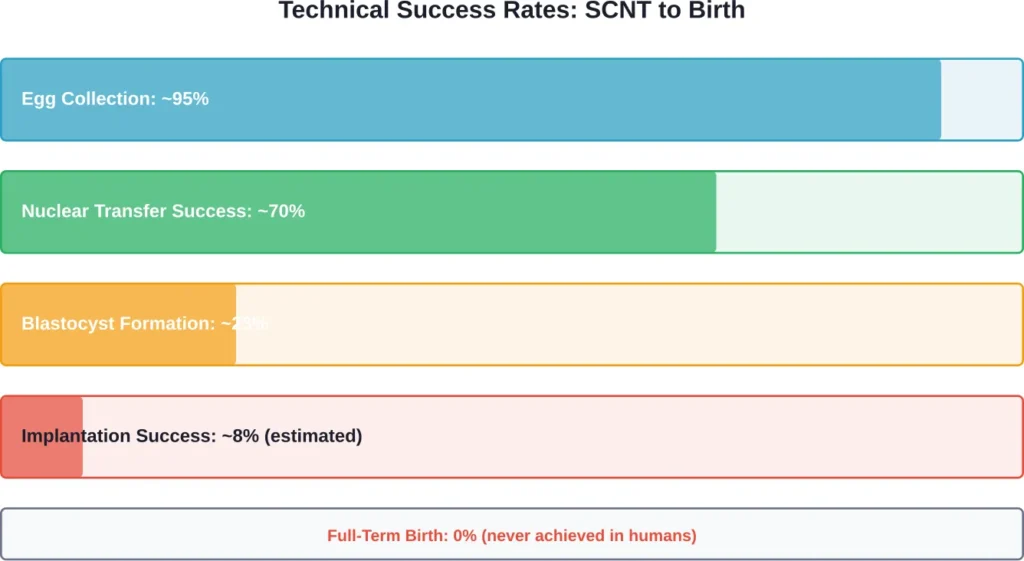
More substantially, researchers reported in 2013 the production of several SCNT blastocysts when male fibroblast cell nuclei were introduced into 29 enucleated oocytes obtained from three young donors. The success rate? Twenty-three percent.
When compared to previous reports, a likely reason for success in this instance traces back to the source of oocytes—young, healthy donors provided higher-quality eggs. This detail matters enormously because egg quality directly impacts cloning success rates.
Why Full-Term Human Cloning Hasn’t Happened
Creating an embryo is one thing. Bringing it to birth is entirely different.
The technical obstacles are substantial. Death during early embryonic development may go totally undetected, but research shows that no less than 20% of all ascertained human conceptions end in spontaneous abortion during the first 2 mo of pregnancy. Such deaths are often due to deleterious genetic constitutions.
Cloned embryos face even higher failure rates. The SCNT process itself introduces abnormalities. Epigenetic reprogramming—the process by which the adult cell nucleus must “reset” to an embryonic state—frequently goes wrong.
And that’s just the beginning. Even successfully cloned animals often suffer health problems. Dolly the sheep developed arthritis and lung disease, dying at age six—roughly half the normal lifespan for her breed.
The Primate Problem
Achieving successful somatic cell nuclear transfer in humans and subhuman primates relative to other mammals has been questioned for a variety of technical and logistical issues.
Primates present unique challenges. Their reproductive biology differs significantly from animals like sheep and cattle where cloning has achieved more success. Egg collection is more difficult. The cellular machinery that coordinates cell division appears more sensitive to manipulation.
These aren’t minor technical hurdles. They represent fundamental biological barriers that make human cloning exponentially more difficult than cloning other mammals.
Therapeutic Cloning vs Reproductive Cloning
The distinction between therapeutic and reproductive cloning shapes the entire debate.
Therapeutic cloning offers significant potential in regenerative medicine. The process creates embryonic stem cells genetically matched to a patient, theoretically allowing treatment of diseases without immune rejection.
Research has shown promising results. In studies on Parkinson’s disease, dopaminergic neurons derived from cloned embryonic stem cells were directly injected into the cortical striatum of mice with Parkinson-like lesions. Long-term behavioral rescue was observed, and 80% of the ntESC derived neurons were alive 8 week post-transplantation, contrary to only 40% for stem cell-derived neurons.
That’s a significant difference. It suggests therapeutic cloning could revolutionize treatment for degenerative diseases.
But here’s where it gets ethically complex.
| Aspect | Therapeutic Cloning | Reproductive Cloning |
|---|---|---|
| Primary Goal | Create stem cells for medical treatment | Create a cloned human being |
| Embryo Development | Stopped at blastocyst stage (5-7 days) | Allowed to develop to full term (9 months) |
| Scientific Status | Achieved in laboratory settings | Never successfully completed |
| Legal Status | Permitted in some countries with regulation | Banned in most countries worldwide |
| Ethical Concerns | Embryo destruction, commodification | Human dignity, identity, safety risks |
| Medical Applications | Regenerative medicine, disease treatment | None scientifically validated |
The Stem Cell Promise
Therapeutic cloning promises treatments for conditions that currently have no cure. Parkinson’s disease, Alzheimer’s, spinal cord injuries, diabetes—the potential applications span medicine.
The key advantage? Genetic matching eliminates immune rejection. When stem cells derive from a patient’s own genetic material, the body doesn’t recognize them as foreign. This solves one of transplant medicine’s biggest challenges.
Research and training in interdisciplinary fields continues advancing therapeutic cloning techniques. Scientists are perfecting methods to improve success rates and reduce the number of eggs required.
But therapeutic cloning still requires creating and destroying human embryos. That fact alone makes it ethically contentious.
The Ethics of Human Cloning
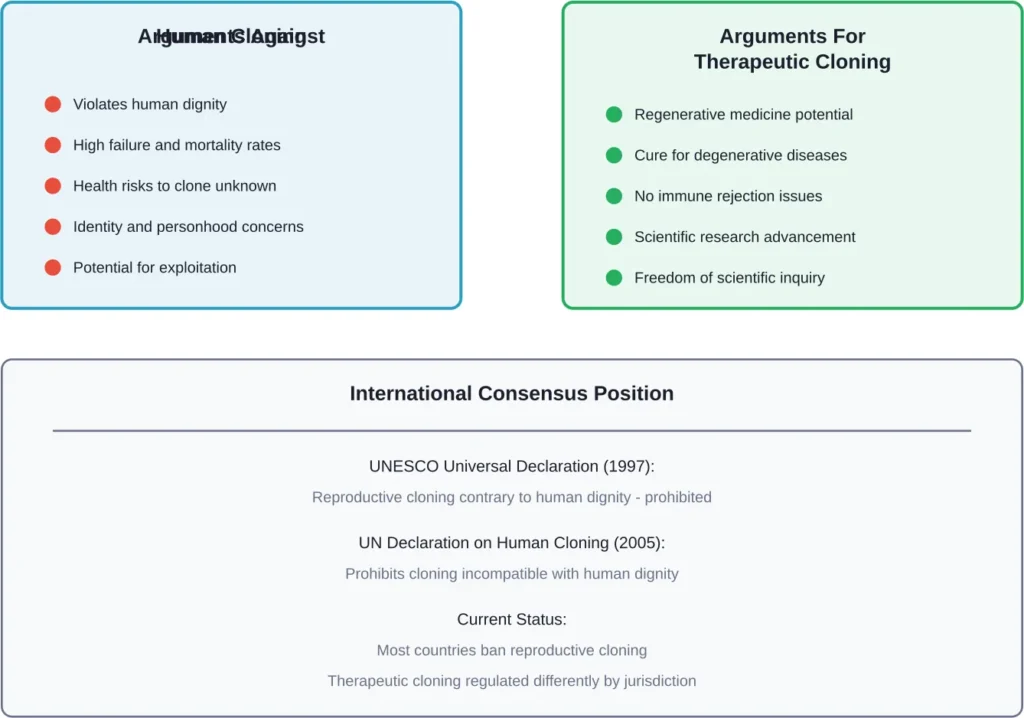
Practices contrary to human dignity, such as reproductive cloning of human beings, shall not be permitted according to UNESCO’s Universal Declaration on the Human Genome and Human Rights adopted in 1997.
The ethical objections to human cloning run deep.
Personal identity concerns top the list. Whether “the clone” is understood to be an exact replica would influence the ascription of personal identity and personhood. Research participants maintain that a clone “would not have the same identity as the original, due to environmental and parental upbringing influences.”
This gets to something fundamental: a clone isn’t a photocopy of a person. They’re a genetic twin, separated by time. They’d have their own experiences, memories, and personality.
Human Dignity Arguments
The possibility of using human cloning to reproduce has been met with unease, shock, and prohibition in many countries, as well as the International Committee for Monitoring Assisted Reproductive Technology and the World Health Organization.
Why such strong reactions?
Critics argue cloning reduces humans to their genetic characteristics, violating the principle that each individual possesses inherent dignity and uniqueness. The Universal Declaration on the Human Genome specifically states that dignity “makes it imperative not to reduce individuals to their genetic characteristics and to respect their uniqueness and diversity.”
There’s also concern about commodification. If humans can be cloned, does that reduce people to manufactured products? The declaration explicitly states: “The human genome in its natural state shall not give rise to financial gains.”
Yet some public health estimates suggest that 10,000 organs are now traded every year, with figures soaring off the back of a huge rise in black market kidney transplants. Wealthy patients are paying up to £128,500 for a kidney to gangs, often in China, India, and Pakistan, who harvest organs from desperate donors.
The fear? Cloning could create a market for cloned humans as organ sources.
Safety and Medical Ethics
The recent desperation to clone human embryos may be seriously undermining accepted ethical principles of medical research, with potentially profound wider consequences.
Standard medical research ethics require rigorous safety testing before human trials. Cloning hasn’t met those standards. The high failure rates, developmental abnormalities, and health problems observed in cloned animals suggest attempting full-term human cloning would pose enormous risks.
Research, treatment, or diagnosis affecting an individual’s genome shall be undertaken only after rigorous and prior assessment of the potential risks and benefits according to international guidelines. In all cases, prior, free, and informed consent of the person concerned must be obtained.
But how do you get informed consent from someone who doesn’t exist yet? A cloned embryo can’t consent to being brought into existence with potentially serious health problems.
Legal Status Around the World
Since Dolly the sheep was cloned in 1996, the question of whether human reproductive cloning should be banned or pursued has been the subject of international debate. Feelings run strong on both sides.
In 2005, the United Nations adopted its Declaration on Human Cloning to deal with the issue. The declaration prohibits “all forms of human cloning inasmuch as they are incompatible with human dignity and the protection of human life.”
That wording is deliberately ambiguous. It received only ambivalent support from UN member states.
Country-by-Country Variations
Legal approaches vary dramatically worldwide:
Complete bans: Many countries prohibit all forms of human cloning, both reproductive and therapeutic. These nations view any cloning of human embryos as ethically unacceptable.
Reproductive bans only: Some countries ban reproductive cloning while permitting therapeutic cloning under strict regulations. The United Kingdom falls into this category, allowing therapeutic cloning for research purposes with appropriate oversight.
No specific legislation: A surprising number of countries lack explicit laws on human cloning. This doesn’t mean it’s permitted—it often means the issue hasn’t been legislatively addressed.
The lack of clarity in international law is unhelpful for states yet to formulate national regulations or policies on human cloning. Despite this, member states of UNESCO resisted the idea of a legally binding convention for several years.
Enforcement Challenges
Even where laws exist, enforcement proves difficult. Cloning research can be conducted in private laboratories. International researchers can work in countries with permissive regulations.
The global nature of science complicates governance. A researcher facing restrictions in one country can potentially relocate to another with more lenient rules. This creates a potential “race to the bottom” where countries compete to attract research investment by relaxing regulations.
The Technical Barriers That Remain
Let’s talk about why we don’t have cloned humans yet, despite having the basic technology.
The technical challenges go far beyond just inserting a nucleus into an egg. Every step of the process involves sophisticated biological mechanisms that can—and frequently do—fail.
Epigenetic Reprogramming
When you take a nucleus from an adult cell and put it into an egg, that nucleus needs to completely reprogram itself. Adult cells have specific epigenetic markers—chemical modifications that determine which genes are active and which are silent.
An adult skin cell has skin-cell epigenetic patterns. To become an embryo, those patterns must reset to an embryonic state. This reprogramming often fails or happens incompletely.
The result? Cloned embryos with abnormal gene expression patterns that prevent normal development.
Mitochondrial Complications
Here’s something most people miss: cloning creates organisms with DNA from two sources. The nucleus comes from the donor, but mitochondria—the cell’s energy factories—come from the egg.
Mitochondria have their own DNA. In a cloned organism, nuclear DNA and mitochondrial DNA come from different individuals. This mismatch can cause subtle or severe problems with cellular energy production.
The human genome, which by its nature evolves, is subject to mutations and contains potentialities that are expressed differently according to each individual’s natural and social environment, including state of health, living conditions, nutrition, and education.
Cloning doesn’t account for these environmental factors. Even a perfect genetic copy would develop differently based on conditions in the womb, nutrition, and countless other variables.
The Oocyte Quality Problem
Success rates depend heavily on egg quality. The 2013 study that achieved 23% blastocyst success used eggs from young, healthy donors. Older eggs, or eggs from donors with health issues, show much lower success rates.
But obtaining high-quality human eggs is difficult, expensive, and ethically fraught. Egg donation involves hormone treatments and surgical procedures that carry risks. Some research has explored paying women £1000 to donate eggs for research—a practice that raises concerns about exploitation.
Cloning vs Natural Twins: Understanding the Difference
A common misconception needs addressing: clones aren’t identical to their genetic donors in the way people imagine.
Identical twins share virtually all their DNA and develop simultaneously in the same womb. They’re exposed to similar environmental conditions during critical developmental periods.
A clone and their donor share nuclear DNA but differ in mitochondrial DNA. More importantly, they develop in completely different environments, potentially decades apart.
The Environmental Factor
Genes don’t determine everything. The human genome contains potentialities that are expressed differently according to natural and social environment. Two organisms with identical DNA can develop differently based on:
- Maternal health during pregnancy
- Nutrition and environmental exposures
- Epigenetic modifications during development
- Random developmental variations
- Life experiences after birth
Cloned animals frequently look different from their genetic donors. Coat patterns vary. Personality differs. Health outcomes diverge.
The same would be true for cloned humans. A clone wouldn’t be a duplicate person—they’d be a genetic twin with their own identity, experiences, and characteristics.
The Therapeutic Cloning Breakthrough
While reproductive cloning faces enormous barriers, therapeutic cloning has made genuine progress.
The technology creates patient-specific stem cells that could revolutionize regenerative medicine. Instead of relying on donors, patients could receive treatments derived from their own genetic material.
Current Research Applications
Scientists are exploring therapeutic cloning for conditions including:
Parkinson’s disease: Dopaminergic neurons derived from cloned stem cells could replace damaged brain cells. Animal studies show 80% of these neurons surviving eight weeks post-transplantation—double the survival rate of stem cells from other sources.
Spinal cord injuries: Stem cells could potentially regenerate damaged nerve tissue, restoring function after previously untreatable injuries.
Diabetes: Insulin-producing cells derived from cloned stem cells could cure type 1 diabetes by replacing destroyed pancreatic cells.
Heart disease: Cardiac muscle cells created from therapeutic cloning could repair heart damage after heart attacks.
The potential is enormous. Degenerative diseases that currently have no cure could become treatable or even curable.
The Stem Cell Alternative
Recent advances in stem cell technology have reduced the urgency of therapeutic cloning somewhat. Scientists can now reprogram adult cells directly into induced pluripotent stem cells (iPSCs) without creating embryos.
This technique offers similar benefits—patient-specific stem cells without immune rejection—while avoiding the ethical controversy of creating and destroying embryos.
But iPSCs aren’t perfect. They may retain epigenetic memory from their original cell type. Some studies suggest they don’t match embryonic stem cells in every respect.
Therapeutic cloning research continues because it remains scientifically valuable for understanding development and potentially for specific medical applications where iPSCs fall short.
Cost and Practical Considerations
Beyond the technical and ethical issues, practical considerations make human cloning unlikely in the near term.
The cost would be astronomical. Consider what’s involved:
- Recruiting egg donors and compensating them
- Sophisticated laboratory equipment and facilities
- Highly skilled technical personnel
- Hundreds of failed attempts before potential success
- Prenatal care and monitoring for high-risk pregnancy
- Long-term health monitoring of any resulting child
Animal cloning costs provide a baseline. Cloning a pet costs $50,000 to $100,000 through commercial services. Human cloning would cost exponentially more due to complexity, regulations, and ethical oversight requirements.
Some estimates suggest human cloning could cost millions of dollars per attempt, with no guarantee of success.
What the Future Might Hold
So where does cloning technology go from here?
Therapeutic cloning will likely continue advancing. The medical potential is too significant to abandon, and regulatory frameworks in some countries permit research with appropriate oversight.
Reproductive cloning remains unlikely for the foreseeable future. The technical barriers are substantial, the ethical opposition is fierce, and the legal prohibitions are nearly universal.
But technology evolves. Techniques that seem impossible today become routine tomorrow. The question isn’t whether humans could eventually be cloned—the technology already exists in primitive form. The question is whether society will permit it.
The Role of International Governance
Establishing a robust global governance framework in this area may be possible via an alternative deliberative format, based on knowledge sharing and feasibility testing rather than interest-based bargaining common to intergovernmental organizations.
In 2008 UNESCO set up a Working Group to investigate the possibility of a legally binding convention to ban human reproductive cloning. Member states resisted for years. The situation changed in 2015, but practical progress remains limited.
Effective governance requires international cooperation. Science is global. Researchers collaborate across borders. Technology developed in one country spreads worldwide.
Without coordinated international standards, the risk of a regulatory race to the bottom remains real.
Frequently Asked Questions
No complete human clone has ever been brought to term and born. Scientists have successfully created cloned human embryos in laboratory settings—Advanced Cell Technology announced creating cloned human embryos in 2001, and researchers achieved a 23% success rate creating blastocysts in 2013. However, no research team has attempted or succeeded in bringing a cloned human embryo to full-term birth. The technical barriers, ethical prohibitions, and legal restrictions make full human cloning highly unlikely in the near future.
Therapeutic cloning creates embryos to harvest stem cells for medical research and treatment, with embryos destroyed at the blastocyst stage (5-7 days). Reproductive cloning aims to create a full human being by allowing the embryo to develop to term. Therapeutic cloning is legal with regulation in some countries and shows promise for treating degenerative diseases. Reproductive cloning is banned in most countries worldwide and raises severe ethical concerns about human dignity, safety, and personhood.
Laws vary significantly by country. Most nations prohibit reproductive cloning entirely based on UNESCO’s Universal Declaration and the UN Declaration on Human Cloning. Some countries like the United Kingdom permit therapeutic cloning under strict regulatory oversight while banning reproductive cloning. Other nations lack specific legislation on cloning. No major country currently permits reproductive human cloning, and international pressure maintains this near-universal prohibition.
Humans and primates present unique technical challenges compared to other mammals. The success rate for creating even cloned embryos remains low (23% in the best human study). Primate reproductive biology differs from animals like sheep—egg collection is harder, and cellular division mechanisms are more sensitive to manipulation. Additionally, the ethical oversight and legal restrictions on human research prevent the hundreds of failed attempts that animal cloning typically requires before success. The high failure rates and health problems in cloned animals make attempting full human cloning ethically unacceptable.
No. A clone would be a genetic twin, not an identical copy of the person. While they’d share nuclear DNA, they’d have different mitochondrial DNA from the egg donor. More importantly, environmental factors profoundly influence development—nutrition, conditions in the womb, life experiences, and countless other variables shape who we become. Research participants note that a clone “would not have the same identity as the original, due to environmental and parental upbringing influences.” Even cloned animals show different personalities, appearance details, and health outcomes from their genetic donors.
This common hope misunderstands what cloning can do. Cloning could theoretically create a genetic twin of a deceased person, but it wouldn’t restore the person themselves. Memories, personality, experiences—everything that made someone who they were—can’t be cloned. The result would be a different person who happens to share DNA with the deceased. Additionally, DNA from deceased individuals degrades rapidly, making cloning technically difficult or impossible unless cells were preserved specifically for that purpose under appropriate conditions shortly after death.
The risks are substantial and multifaceted. Technical risks include high embryonic mortality rates (20%+ of natural conceptions abort in the first two months, with cloned embryos showing even higher failure rates), developmental abnormalities, epigenetic reprogramming errors, and unknown long-term health effects. Dolly the sheep developed premature aging and health problems. Ethical risks include violation of human dignity, psychological harm to clones regarding identity and personhood, potential exploitation for organ harvesting, and commodification of human life. These combined risks make attempting full human cloning ethically unjustifiable under current medical research standards.
Conclusion: Scientific Possibility Meets Ethical Reality
Human cloning is scientifically possible at the embryonic level. That’s no longer debatable. Researchers have created cloned human embryos in controlled laboratory settings with documented success rates.
But scientific possibility doesn’t equal practical feasibility, medical safety, or ethical acceptability.
The technical barriers to bringing a cloned embryo to full term remain enormous. The ethical objections are profound and widely shared across cultures and nations. The legal prohibitions are nearly universal.
Therapeutic cloning offers genuine medical promise for treating degenerative diseases without the controversial step of attempting to create cloned humans. This application will likely continue advancing within appropriate regulatory frameworks.
Reproductive human cloning? That remains in the realm of science fiction—not because it’s technically impossible, but because society has collectively decided the risks outweigh any potential benefits.
The question we’re left with isn’t “Can we clone humans?” It’s “Should we?” And the overwhelming international consensus remains: no.
Want to understand more about the cutting edge of genetic technology and bioethics? Stay informed about developments in regenerative medicine, stem cell research, and the evolving frameworks that govern how science pushes forward while respecting human dignity.