

Quick Summary: At 11 weeks pregnant, most women cannot feel their baby move yet. While the baby is actively kicking, stretching, and moving at this stage, these movements are too small to detect. First-time moms typically feel movement between 16-20 weeks, while women who’ve been pregnant before may notice it slightly earlier around 13-16 weeks.
Pregnancy brings countless moments of anticipation, and feeling those first flutters ranks high on every expectant mom’s list. At 11 weeks, the excitement builds as your baby grows rapidly inside you.
But here’s the thing—what’s actually happening at this stage might surprise you.
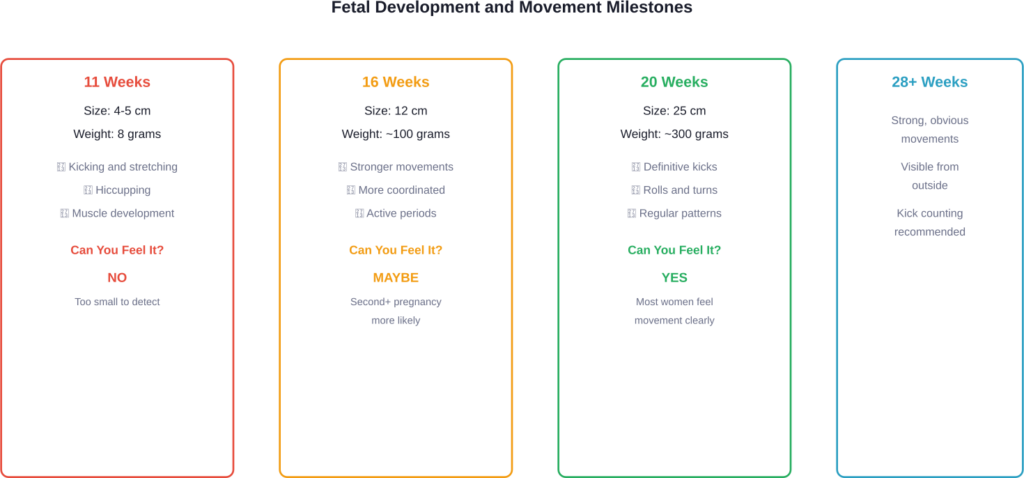
Your baby is indeed moving at 11 weeks. Kicking, stretching, even hiccupping as the diaphragm strengthens. The problem? These movements are incredibly subtle, and your baby is still tiny—about the size of a fig, roughly 4-5 centimeters from head to bottom.
Real talk: the vast majority of pregnant women won’t feel anything this early. And that’s completely normal.
What’s Actually Happening at 11 Weeks
Your baby is far more active than you might imagine. At this stage, muscle development allows for genuine movement—arms and legs bend, fingers open and close, and the body practices stretching motions that will become more coordinated over time.
The baby’s face is forming rapidly, with the mouth nearly complete. Eyes remain widely separated and fused shut, while ears sit lower than they will at birth. Inside that tiny mouth, baby teeth are settling into their sockets, and the palate bones are fusing together.
Despite all this activity, detection remains nearly impossible. The baby weighs approximately 8 grams—less than half an ounce. The movements, while real, generate minimal force against the uterine wall.
Sound familiar if you’ve felt something? Many women report sensations at 11 weeks, but these typically result from digestive activity rather than fetal movement. Gas, intestinal contractions, and abdominal muscle twitches can mimic what movement might feel like.
When Most Women Actually Feel Movement
Timing varies significantly based on several factors, but patterns emerge across pregnancies.
First-time mothers typically don’t feel movement until 16-20 weeks at the earliest. Some won’t notice anything definitive until 20 weeks or slightly beyond. The reason? They haven’t experienced fetal movement before and may not recognize the sensation immediately.
Women pregnant with their second or subsequent child often feel movement earlier—sometimes around 13-16 weeks. Experience matters. These moms know exactly what they’re feeling for and can distinguish fetal movement from other abdominal sensations.
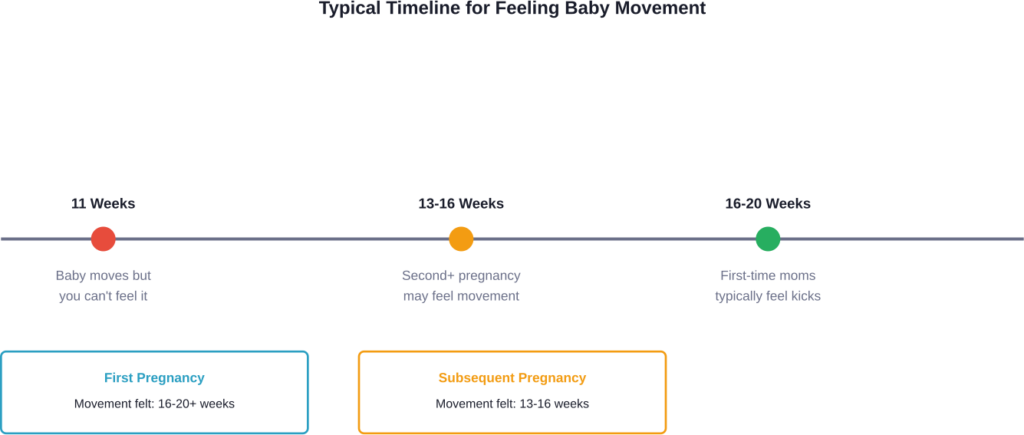
According to Children’s Hospital of Philadelphia, by 20 weeks gestation, most women are able to feel their baby’s movements. This marks a general threshold where movement becomes consistently noticeable.
The medical term for first feeling movement is “quickening.” Historically, this milestone held significance as one of the first confirmations of pregnancy before modern ultrasound technology.
What Baby Movement Actually Feels Like
Descriptions vary widely, partly because the sensation evolves as pregnancy progresses.
Early movements often feel like:
- Flutters or butterflies in the lower abdomen
- Bubbles popping or fizzing sensations
- Gentle tapping from the inside
- A rolling or swishing feeling
- Light muscle twitches that seem to come from deep within
These sensations differ markedly from gas or digestive activity, though distinguishing between them takes time and experience. Gas typically feels more diffuse and moves through the intestinal tract. Fetal movement stays localized to specific areas of the uterus.
As weeks pass and the baby grows stronger, movements become unmistakable—definitive kicks, punches, and rolls that leave no doubt about their source.
Factors That Influence When You Feel Movement
Several variables affect timing beyond pregnancy number.
Placental position matters significantly. An anterior placenta (positioned at the front of the uterus) acts as a cushion between the baby and abdominal wall. This placement can delay feeling movement by several weeks. Women with a posterior placenta (toward the back) often feel kicks earlier and more intensely.
Body composition plays a role. Women with less abdominal fat tissue may detect subtle movements sooner than those with more adipose tissue, which provides additional cushioning.
Activity level affects awareness. Movement often becomes noticeable during quiet moments—lying down at night, resting on the couch, or sitting still. The baby may move throughout the day, but busy schedules mask the sensation until external activity decreases.
Uterine position varies between individuals. Some women have a tilted uterus, which can change how movement is perceived through the abdominal wall.
| Factor | How It Affects Feeling Movement | Typical Impact |
|---|---|---|
| Anterior Placenta | Cushions movement sensations | May delay feeling kicks by 2-4 weeks |
| Second+ Pregnancy | Experienced recognition of sensations | Feel movement 2-4 weeks earlier |
| Body Composition | Adipose tissue provides cushioning | Variable; less tissue = earlier detection |
| Activity Level | External movement masks internal sensations | Most noticeable during rest periods |
The Community Experience at 11 Weeks
Community discussions reveal interesting patterns in what pregnant women report feeling early in pregnancy.
Some women adamantly believe they’ve felt movement at 11 weeks, describing “little flickers” in the uterus that feel distinctly different from any previous sensation. These reports shouldn’t be dismissed entirely—individual variation exists in pregnancy as in all biological processes.
That said, medical consensus holds that most 11-week sensations result from other causes. The baby simply hasn’t developed sufficient strength to create perceptible movement against the uterine wall in most cases.
What complicates matters? Pregnancy heightens body awareness. The uterus expands, hormones surge, and blood flow increases dramatically to the pelvic region. All these changes create sensations that pregnancy amplifies in consciousness.
Why Monitoring Movement Matters Later
While movement at 11 weeks isn’t expected or necessary for confirming fetal well-being, movement patterns become important later in pregnancy.
Fetal movement counting, often called kick counting, provides a simple way to monitor baby health in the second and third trimesters. According to ACOG guidelines, special testing for monitoring fetal well-being is usually started between 32 weeks and 34 weeks of pregnancy in high-risk situations.
Generally speaking, once regular movement is established, consistent patterns indicate healthy fetal activity. Changes in these patterns—particularly decreased movement—warrant medical evaluation.
Most fetuses develop circadian activity rhythms, with active and quiet periods throughout the day. Learning these patterns helps identify when something might be wrong.
When to Contact Your Healthcare Provider
At 11 weeks, absence of felt movement requires no concern whatsoever. The baby’s well-being is monitored through other means—ultrasound visualization and fetal heart rate monitoring.
Later in pregnancy, movement patterns become a valuable monitoring tool. But wait—specific guidelines apply only after regular movement is established.
If regular movement has been felt and then decreases significantly or stops, contact a healthcare provider promptly. Tests like the nonstress test can assess fetal well-being through heart rate monitoring. According to ACOG, this test uses a belt with a sensor that measures the fetal heart rate and is placed around the abdomen, usually taking at least 20 minutes.
The biophysical profile and other specialized tests may be ordered when there’s concern about fetal health, particularly in high-risk pregnancies.
What Happens Next in Your Pregnancy
Over the coming weeks, dramatic changes unfold. The baby doubles in size multiple times. Muscle strength increases exponentially. Coordination improves as the nervous system matures.
By week 12, most critical organ development completes. From this point forward, the primary task shifts to growth—getting bigger, stronger, and preparing for life outside the womb.
The placenta, which develops rapidly through week 11, will be fully formed around week 12. This remarkable organ handles nutrient transfer, waste removal, and hormone production throughout the remainder of pregnancy.
Between weeks 11-14, many healthcare providers offer the dual test or first-trimester screening. This combines nuchal translucency measurement via ultrasound with maternal blood work to assess certain risk factors.
The second trimester brings noticeable changes. Energy often returns as early pregnancy symptoms fade. The belly grows visibly. And yes—movement becomes unmistakable.
Frequently Asked Questions
While extremely rare, individual variation means a small number of women might detect very subtle sensations at 11 weeks, particularly in subsequent pregnancies. However, the vast majority of 11-week sensations result from digestive activity, gas, or heightened body awareness rather than actual fetal movement. The baby simply lacks the size and strength to create perceptible movement in most cases.
Gas typically feels more diffuse, moves through the intestinal tract, and may be accompanied by audible gurgling or the need to pass gas. Baby movement feels more localized, comes from a specific spot in the lower abdomen, and doesn’t migrate. Early fetal movement is often described as flutters, bubbles, or gentle tapping that stays in one area. The distinction becomes clearer with experience.
Absolutely not. Not feeling movement at 11 weeks is completely normal and expected. Healthcare providers don’t rely on maternal perception of movement this early to assess fetal well-being. Ultrasound and fetal heart rate monitoring provide accurate assessment at this stage. Most first-time mothers won’t feel anything until 18-20 weeks.
An anterior placenta typically delays the perception of movement because it cushions sensations, but it doesn’t prevent feeling movement entirely. Women with anterior placentas usually feel kicks 2-4 weeks later than those with posterior placentas. Once the baby grows larger and stronger, movement becomes obvious regardless of placental position.
If genuine movement was felt unusually early in a first pregnancy, factors like a particularly posterior placental position, less abdominal tissue, or exceptional fetal activity might explain it. However, many women who believe they felt early movement later realize those sensations were digestive in nature once they experience unmistakable kicks in later weeks.
Formal kick counting typically begins in the third trimester, around 28 weeks. By this stage, movement patterns have been established and the baby is large enough that decreased activity could indicate a potential problem. Healthcare providers offer specific guidance on when to start and how to perform kick counts based on individual pregnancy circumstances.
No. The wide range of normal timing for first feeling movement—anywhere from 16 to 22 weeks for first-time mothers—means later perception doesn’t indicate problems. Factors like placental position, body composition, and activity level affect timing significantly. As long as healthcare providers confirm normal fetal development through examinations and tests, timing of first felt movement doesn’t determine pregnancy health.
The Bottom Line on 11-Week Movement
Here’s what matters: at 11 weeks, the baby moves actively inside the uterus, practicing movements that will become refined over the coming months. Kicking, stretching, and hiccupping all occur at this stage as muscle development progresses.
Can mothers feel this activity? In the overwhelming majority of cases, no. The baby remains too small and movements too subtle to create perceptible sensations through the uterine wall and abdominal tissue.
This timeline is normal, healthy, and expected. First-time mothers typically feel movement between 16-20 weeks. Women who’ve been pregnant before often notice it slightly earlier, around 13-16 weeks.
The waiting period, while challenging for eager parents, doesn’t last forever. Those first unmistakable flutters will arrive soon enough, followed by kicks strong enough to take your breath away.
Focus on other aspects of prenatal care during these early weeks—proper nutrition, prenatal vitamins, regular check-ups, and preparing for the journey ahead. Movement will come in its own time, marking another milestone in this remarkable process.
Trust your healthcare provider for assessment of fetal well-being at this stage. They have the tools and expertise to ensure everything progresses normally, regardless of what sensations you’re experiencing—or not experiencing—at 11 weeks.