

Quick Summary: Yes, flight is possible through understanding and applying the four fundamental forces: lift, weight, thrust, and drag. While humans cannot fly unaided due to our body structure and weight, aircraft achieve flight by generating lift through wings and overcoming gravity with thrust. The principles of aerodynamics, discovered through centuries of observation and experimentation, make modern aviation possible.
The question “is it possible to fly” has captivated humans for thousands of years. From watching birds soar effortlessly to building machines that carry millions of passengers daily, flight represents one of humanity’s greatest achievements. But what makes flight actually work?
According to NASA, aerodynamics is the way objects move through air. The rules of aerodynamics explain how an airplane is able to fly. Anything that moves through air reacts to aerodynamics, from rockets blasting off launch pads to paper airplanes gliding across rooms.
Here’s the thing though—flight isn’t magic. It’s pure physics.
The Four Forces That Make Flight Possible
NASA’s Glenn Research Center explains that a force may be thought of as a push or pull in a specific direction. A force is a vector quantity, meaning it has both magnitude and direction. When describing how flight works, both the magnitude and direction matter equally.
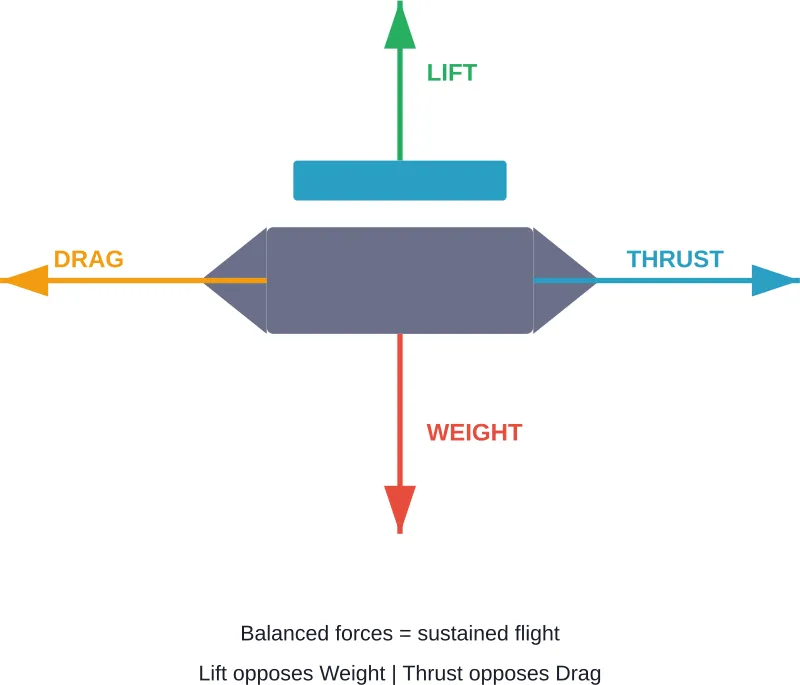
Four fundamental forces act on every airplane in flight. Understanding these forces answers the core question of whether flight is possible and how it actually happens.
Weight: The Force Pulling Downward
NASA defines weight as a force that is always directed toward the center of the earth. The magnitude of the weight depends on the mass of all the airplane parts, plus the amount of fuel and passengers aboard.
Weight never stops acting on an aircraft. Gravity pulls everything down constantly.
Lift: Overcoming Gravity
Lift is the upward force that makes flight possible. According to the Smithsonian’s How Things Fly resource, as an airplane moves through the air, its wings cause changes in the speed and pressure of the air moving past them. These changes result in the upward force called lift.
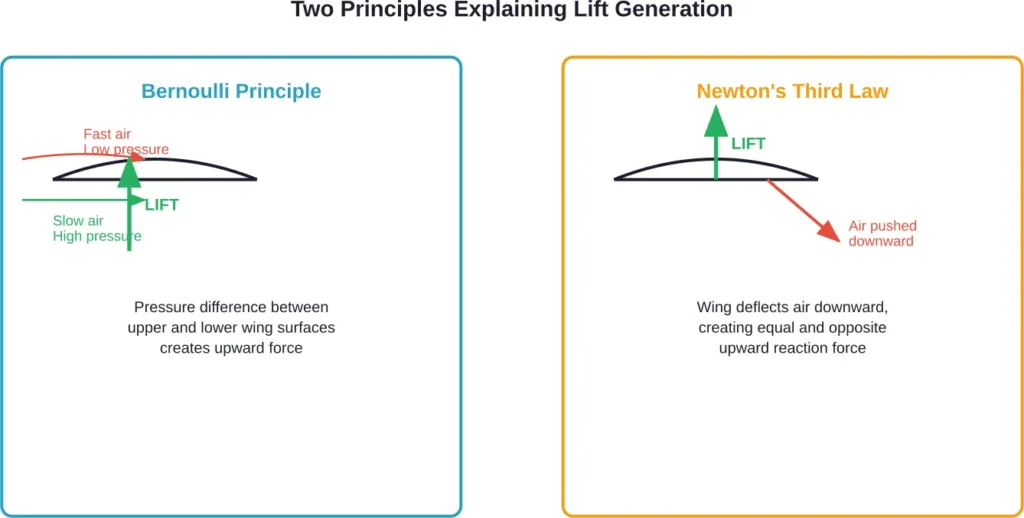
Wings aren’t just flat surfaces. Their shape—called an airfoil—creates different air pressures above and below the wing. Faster-moving air over the curved top surface creates lower pressure, while slower air beneath creates higher pressure. This pressure difference generates lift.
But wait. The Bernoulli principle alone doesn’t tell the whole story.
Research from Georgia State University’s HyperPhysics explains that both Bernoulli’s equation and Newton’s laws contribute to lift. Wings also deflect air downward, and by Newton’s third law, this downward deflection creates an equal and opposite upward force.
Thrust: Moving Forward
Thrust is the forward force produced by engines or propellers. Without thrust, an airplane cannot move through the air fast enough to generate lift. The faster air flows over the wings, the more lift gets created.
Jet engines, propellers, and even human-powered pedaling systems can generate thrust. The University of Southern California’s Viterbi School recently founded a Human-Powered Flight Research Team where pilots pedal to drive propellers that power aircraft.
Drag: The Resistance Fighter
Drag opposes thrust. It’s the air resistance that slows aircraft down. Every surface exposed to airflow creates some drag. Engineers design aircraft to minimize drag through streamlined shapes and smooth surfaces.
For sustained flight, thrust must equal or exceed drag. When thrust drops below drag, the aircraft slows down.
Why Can’t Humans Fly Without Machines?
Science World addresses this directly: humans are not physically designed to fly. We cannot create enough lift to overcome the force of gravity.
Several biological limitations prevent unaided human flight:
Body structure matters. Birds have hollow bones that dramatically reduce their weight while maintaining structural strength. Human bones are dense and heavy—necessary for supporting our upright posture and large brains, but terrible for flight.
Muscle power falls short. Even the strongest humans cannot generate enough force through arm movements to create sufficient lift. Birds have powerful flight muscles compared to their body mass. Humans would need impossibly large chest muscles to power wings capable of lifting our weight.
Surface area limitations. Wings must be large enough relative to body weight. Birds maintain favorable wing-area-to-weight ratios. Human arms, even with attached wings, don’t provide enough surface area to generate the necessary lift.
The How Things Fly resource states it plainly: “In order for a human to fly without actually being in an airplane, hot air balloon, rocket, jetpack, or any other flying vehicle that person must be able to provide an upward thrust sufficient to counter his weight. Unfortunately, we have no way to provide this force without some outside assistance.”
How Airplanes Overcome These Limitations
Airplanes succeed where human bodies fail by applying aerodynamic principles discovered through centuries of observation and experimentation.
| Human Limitation | Aircraft Solution | Result |
|---|---|---|
| Insufficient muscle power | Jet engines or propellers | Powerful thrust generation |
| Heavy bone structure | Lightweight aluminum alloys | Reduced overall weight |
| Small surface area | Large wings with airfoil design | Adequate lift production |
| Dense body mass | Hollow fuselage construction | Improved weight-to-lift ratio |
The FAA’s aerodynamics documentation explains that understanding how air flows around wings unlocks the secret to controlled flight. Airfoil shape, wing angle, and airspeed all contribute to lift generation.
The Physics Behind Aerodynamics
Aerodynamics comes from two Greek words: aerios (concerning the air) and dynamis (which means force). NASA’s Glenn Research Center defines aerodynamics as the study of forces and the resulting motion of objects through the air.
Real talk: air isn’t empty space. It’s a physical substance with weight and molecules constantly moving. Air pressure is created by molecules in motion. Moving air generates force—the same force that lifts kites and birds into the sky.
Air Pressure and Speed Relationships
The Bernoulli principle states that an increase in the speed of a fluid occurs simultaneously with a decrease in the pressure of that fluid. Air behaves as a fluid, flowing around objects and changing speed based on surface contours.
When air flows over a curved wing surface, it must travel farther than air flowing beneath. To cover more distance in the same time, the upper airflow accelerates. This faster-moving air exerts less pressure than the slower air below.
The pressure difference creates lift.
Newton’s Laws in Action
Wings also redirect airflow. As wings move through air at an angle of attack, they push air downward. Newton’s third law—every action has an equal and opposite reaction—means the downward air deflection produces an upward force on the wing.
MIT’s research on airfoils confirms that both Bernoulli’s equation and Newton’s laws are physically correct and both contribute to explaining how aircraft generate the needed lift to fly.
Could Humans Ever Evolve to Fly?
Community discussions on evolution forums raise an interesting question: if life began in the sea and evolved to live on land, could humans eventually evolve the ability to fly?
The short answer? Extremely unlikely.
Evolution doesn’t work toward predetermined goals. Natural selection favors traits that improve survival and reproduction in current environments. Modern humans face no survival pressure that would favor flight-enabling mutations.
Additionally, the biological changes required would be so extreme—hollow bones, massive chest muscles, dramatically reduced weight, wing structures—that the resulting creature wouldn’t resemble humans anymore.
Birds evolved flight over millions of years from small dinosaur ancestors. Each tiny modification provided some advantage. Humans lack both the starting adaptations and the environmental pressures that would drive such dramatic changes.
Human-Powered Flight: The Exception
While humans can’t fly unaided, human-powered aircraft have achieved remarkable success. Human-powered aircraft projects like Daedalus involved pilots pedaling bicycle-like mechanisms to power propellers.
These aircraft work because they apply mechanical advantage. The pilot’s leg muscles—much stronger than arm muscles—drive an efficient propeller. The aircraft frame uses ultra-lightweight materials. The wings provide enormous surface area relative to total weight.
The Daedalus aircraft flew from Crete to Santorini in 1988, proving sustained human-powered flight is achievable with proper engineering.
Still, this isn’t humans flying. It’s humans providing power to carefully designed machines that fly.
Understanding Flight Dynamics
NASA’s dynamics of flight research explains that controlling an aircraft requires managing all four forces simultaneously across three axes of rotation: pitch, roll, and yaw.
Pilots adjust control surfaces—ailerons, elevators, and rudders—to change how air flows around the aircraft. These adjustments alter the balance of forces, enabling turns, climbs, and descents.
Modern aerospace engineers understand how to balance forces effectively, though some aspects of turbulent airflow remain incompletely understood. According to discussions among aerospace professionals, engineers know how to make aircraft fly reliably even while researchers continue exploring complex fluid dynamics.
Frequently Asked Questions
No. Humans cannot generate sufficient upward thrust to counter our weight. Our body structure, muscle power, and bone density make unaided flight impossible. We lack the biological adaptations that enable birds to fly.
Airplanes fly by balancing four forces: lift generated by wings opposes weight, while thrust from engines overcomes drag. Wing shape creates pressure differences that generate lift, and powerful engines provide the thrust needed to maintain airspeed.
Birds have hollow bones, air sacs that reduce body weight, and powerful flight muscles. Humans have dense bones, insufficient muscle power, and inadequate wing surface area relative to our weight.
Yes, but only with specially designed aircraft. Human-powered planes like the Gossamer and Daedalus used ultra-lightweight materials, enormous wings, and efficient propeller systems powered by the pilot’s leg muscles. These prove human-powered flight works with proper engineering.
The Bernoulli principle states that faster-moving air creates lower pressure. Wings shaped as airfoils make air flow faster over the top surface than the bottom, creating a pressure difference that generates lift. Both Bernoulli’s principle and Newton’s laws explain how wings generate lift.
Extremely unlikely. Evolution doesn’t work toward goals—it responds to survival pressures. Modern humans face no environmental pressure favoring flight. The required changes would be so extreme that the resulting creature would no longer be recognizably human.
According to NASA, the four forces are weight (gravity pulling downward), lift (upward force from wings), thrust (forward force from engines), and drag (air resistance). Sustained flight requires lift to equal weight and thrust to equal or exceed drag.
Conclusion: Flight Is Possible Through Understanding Physics
So, is it possible to fly? Absolutely—but only by respecting and applying the fundamental principles of aerodynamics.
Humans cannot fly unaided because our biology doesn’t support the necessary lift generation. But through understanding weight, lift, thrust, and drag, engineers have created aircraft that safely transport millions of people daily.
The science of flight demonstrates how observation, experimentation, and applied physics can overcome seemingly insurmountable natural limitations. From the Wright brothers’ first powered flight to modern supersonic jets, human innovation transforms scientific principles into practical reality.
Want to learn more about the physics that makes flight possible? Explore NASA’s aerodynamics resources and the FAA’s flight training materials to deepen your understanding of how aircraft conquer gravity every day.