

Quick Summary: Getting visible abs in 2 months is possible for some people, but depends entirely on your starting body fat percentage. If you’re already below 15% body fat, a focused diet and training plan can reveal abs within 8 weeks. However, most people starting above 15% body fat will need longer than 2 months to reduce fat enough for ab visibility.
Let’s cut through the noise right away.
Everyone wants defined abs. But the question of whether you can achieve them in just two months doesn’t have a simple yes-or-no answer. The timeline depends almost entirely on where you’re starting from.
Here’s the reality: visible abs are revealed through fat loss, not built through endless crunches. And according to research on short-term weight loss interventions, most people can expect to lose around 2-3 kg over an 8-week period with proper diet and exercise protocols.
The question isn’t whether abs exercises work—it’s whether you can reduce body fat enough in two months to make them visible.
Your Starting Body Fat Percentage Changes Everything
Body fat percentage determines ab visibility more than any other single factor.
According to fitness sources, achieving six-pack abs in a short timeframe is only realistic for certain people. If someone has more than 15% body fat, getting visible abs in 60 days is not realistic for most people. Between 10-11% body fat? It’s possible, but requires tremendous dedication.
For men, abs typically become visible around 10-12% body fat. Women generally need higher percentages for ab definition due to physiological differences in fat distribution.
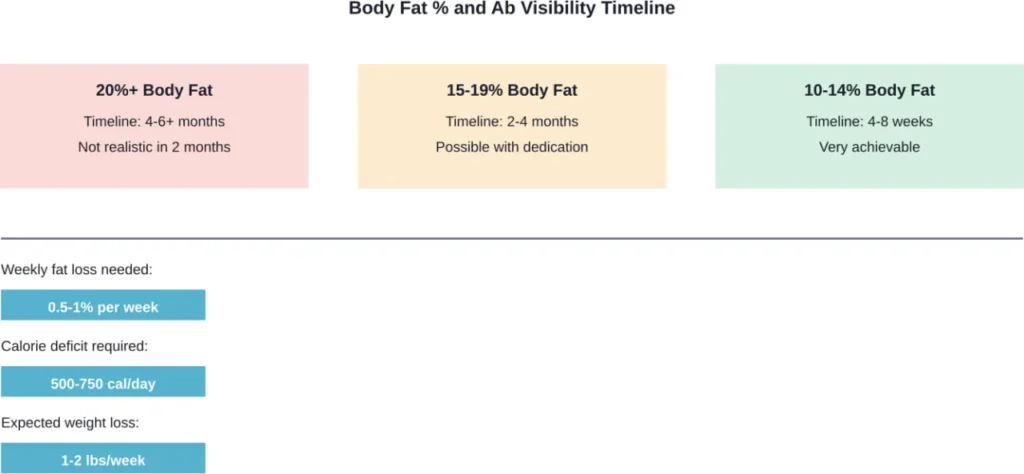
The CDC emphasizes that healthy weight loss occurs at a gradual pace of 1 to 2 pounds per week. Even modest weight loss of 5-10% of body weight can improve health markers significantly.
So, do the math. If someone weighing 200 pounds needs to lose 20 pounds to reach visible ab territory, that’s 10-20 weeks at a healthy rate—not 8 weeks.
What Actually Makes Abs Visible
Abs don’t need to be “built” as much as they need to be revealed.
Everyone has abdominal muscles. The rectus abdominis—the “six-pack” muscle—is already there. The problem isn’t muscle size; it’s the layer of fat covering it.
That said, training abs does matter. Research on trunk muscle composition shows that combining weight loss with exercise produces better results than diet alone. But the exercise component matters more for overall fat reduction than for spot-targeting the midsection.
According to the CDC’s guidelines on physical activity, adults need at least 150 minutes of moderate-intensity aerobic activity per week for overall health. For weight management, more activity is typically needed.
The Role of Diet in Ab Development
Diet controls fat loss. Period.
No amount of ab exercises will overcome a poor diet. Research shows that protein intake becomes especially important during weight loss—it has a high thermic effect (meaning the body uses additional energy digesting it) compared to other macronutrients.
According to CDC meta-analysis of short-term interventions, participants in programs lasting less than 13 weeks achieved a mean weight loss of 2.70 kg. Those who increased protein intake while maintaining a calorie deficit saw the best body composition results.
| Dietary Factor | Why It Matters | Recommended Approach |
|---|---|---|
| Calorie Deficit | Creates fat loss | 500-750 calories below maintenance |
| Protein Intake | Preserves muscle, increases satiety | 0.8-1g per pound of body weight |
| Carbohydrate Timing | Fuels workouts, manages energy | Focus around training sessions |
| Hydration | Reduces bloating, aids digestion | Half your body weight in ounces daily |
| Sodium Control | Minimizes water retention | Monitor processed food intake |
The CDC notes that healthy eating patterns should include a variety of whole foods. Restrictive crash diets might produce faster initial results, but they’re not sustainable and often lead to muscle loss alongside fat loss.
The 8-Week Workout Strategy
Here’s where training comes in.
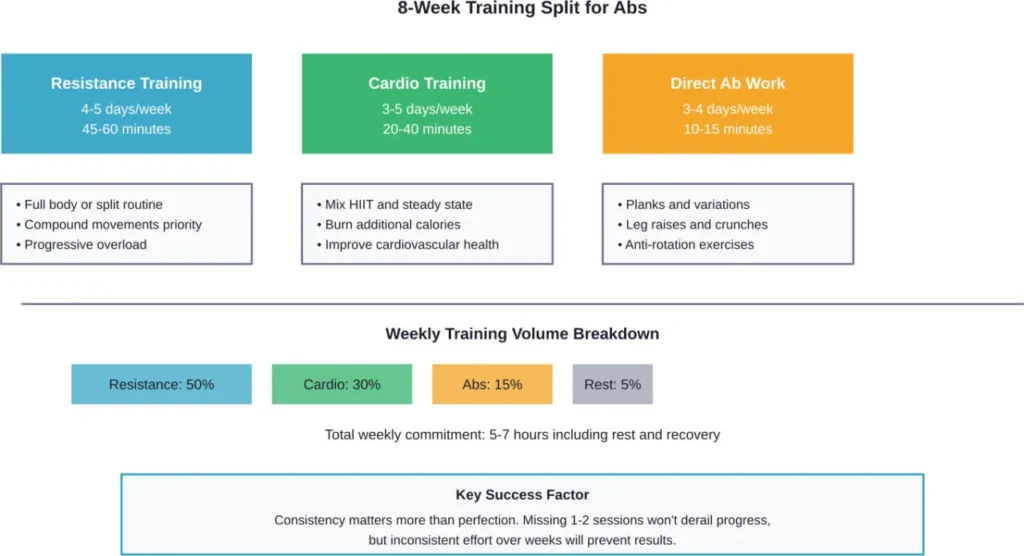
An 8-week plan needs to balance three components: resistance training, cardiovascular work, and direct ab training. Community discussions show that people often make the mistake of only doing ab exercises—spending 10-20 minutes daily on crunches and planks while ignoring the bigger picture.
That’s backwards.
Resistance training builds and maintains muscle mass during a calorie deficit. More muscle means higher metabolic rate, which supports fat loss. Research indicates that combining resistance training with calorie restriction can help maintain muscle mass while reducing fat over 8-week periods.
Core Exercises That Actually Work
Not all ab exercises deliver equal results.
Planks, dead bugs, pallof presses, and hanging leg raises train the core functionally. They build strength and stability, not just isolated muscle contraction. Research on trunk muscle composition demonstrates that exercises targeting multiple muscle groups simultaneously produce better functional outcomes.
But here’s what community experiences reveal: doing 100 crunches daily won’t create visible abs if body fat is too high. Direct ab work matters, but it’s maybe 20% of the equation.
Realistic Expectations for Different Starting Points
Let’s get specific about timelines.
Someone at 12% body fat trying to reach 10% has a reasonable 8-week goal. That’s roughly 2% body fat reduction, which aligns with safe, sustainable fat loss rates of 0.5-1% per week.
Someone at 20% body fat? That’s a different story entirely. Reaching visible ab territory means dropping to around 12-14%, which represents 6-8% body fat reduction. At healthy rates, that’s 12-16 weeks minimum—not 8.
| Starting Body Fat % | Target Body Fat % | Realistic Timeline | 2-Month Outcome |
|---|---|---|---|
| 10-12% | 8-10% | 6-8 weeks | Visible abs achievable |
| 15-17% | 12-14% | 10-12 weeks | Partial definition possible |
| 20-22% | 15-17% | 12-16 weeks | Improved tone, no definition |
| 25%+ | 20-22% | 16-24+ weeks | Fat loss progress, abs not visible |
According to CDC data on weight loss interventions, the average weight loss in structured 8-week programs ranges from 2.5-3.5 kg. For a 180-pound person at 18% body fat, that’s meaningful progress—but probably not enough to reveal abs.
Common Mistakes That Sabotage Progress
Most people fail not because the goal is impossible, but because they make predictable mistakes.
First mistake: underestimating calorie intake. Tracking food accurately matters, as nutritional assessment research indicates tracking errors are common.
Second mistake: doing only ab exercises. Spot reduction doesn’t work. Fat loss occurs systemically, not locally. Hundreds of crunches won’t burn meaningful fat from the midsection.
Third mistake: neglecting sleep and stress management. Research on weight maintenance strategies emphasizes that lifestyle factors beyond diet and exercise significantly impact results. Poor sleep elevates cortisol, which promotes abdominal fat storage.
Fourth mistake: expecting linear progress. Weight fluctuates daily due to water retention, digestion, and hormonal factors. The scale might not move for a week, then drop 2 pounds overnight. That’s normal.
What You Can Realistically Achieve in 8 Weeks
So what’s actually possible?
If someone starts lean—around 12-14% body fat—dedicated effort can absolutely reveal abs in two months. The combination of a 500-750 calorie daily deficit, consistent training, and high protein intake creates the right conditions.
If someone starts above 15% body fat, two months will produce visible progress but probably not a defined six-pack. The abs will develop and strengthen through training, and fat will reduce, but full visibility takes longer.
That’s not failure. According to the CDC, losing 5-10% of body weight can improve health markers such as blood pressure, cholesterol, and blood sugar levels.
Real talk: getting abs isn’t just about aesthetics. The process builds discipline, improves overall fitness, and creates sustainable health habits.
Frequently Asked Questions
Yes, but it’s harder. Abs visibility depends primarily on reducing body fat through diet. Bodyweight exercises at home—planks, mountain climbers, burpees—can provide adequate training stimulus. However, gym access allows for progressive resistance training, which preserves muscle mass better during fat loss and supports a higher metabolic rate.
Three to four days weekly is sufficient for most people. The abs are muscles like any other—they need recovery time. Training them every single day doesn’t accelerate results and may lead to overtraining. Focus on quality movements with proper form rather than excessive volume.
No. Crunches strengthen abdominal muscles but don’t burn enough calories to create meaningful fat loss. Visible abs require reduced body fat percentage, which comes primarily from diet and total-body training. Direct ab work is supplementary, not primary.
Men typically need 10-12% body fat for visible abs, while women need higher percentages due to physiological differences. At 15%+ for men or 22%+ for women, abs remain hidden under subcutaneous fat regardless of how developed the muscles are underneath.
No. Spot reduction has been thoroughly debunked by research. Fat loss occurs systemically based on genetics, hormones, and overall calorie balance. Some people lose abdominal fat first; others lose it last. Targeted exercises strengthen specific muscles but don’t preferentially burn fat from that area.
Both. Resistance training preserves muscle mass during calorie restriction and builds the abdominal muscles themselves. Cardiovascular training burns additional calories and improves overall fitness. The most effective approach combines both modalities rather than choosing one exclusively.
Diet is approximately 70-80% of the equation. Exercise supports fat loss and builds muscle, but consuming more calories than needed will prevent abs from showing no matter how much training happens. Creating a calorie deficit through nutrition is the foundation; exercise enhances and accelerates results.
The Bottom Line
Can someone get abs in 2 months? Sometimes.
It depends entirely on starting body fat percentage, training consistency, diet adherence, and genetics. For people already relatively lean, eight weeks is enough time to reveal well-defined abs through focused effort.
For most people starting above 15% body fat, two months produces meaningful progress—visible fat loss, improved core strength, better overall fitness—but not necessarily a fully visible six-pack.
And that’s okay. Based on CDC guidelines, sustainable weight loss happens at 1-2 pounds weekly. Building abs is a marathon, not a sprint. The habits developed during an 8-week focused effort create the foundation for long-term results.
The real question isn’t whether abs are possible in exactly 60 days. It’s whether someone is ready to commit to the process regardless of the timeline. Start now, stay consistent, and the results will come—whether that’s 8 weeks, 12 weeks, or 16 weeks from today.