

Quick Summary: Yes, you can get STDs without having penetrative sex. Many sexually transmitted infections spread through oral sex, kissing, skin-to-skin contact, sharing needles, and even non-sexual routes like mother-to-child transmission. Some STIs like herpes, HPV, syphilis, and hepatitis can transmit through contact that doesn’t involve traditional intercourse.
Finding an unexpected STD diagnosis when you haven’t had sex can be confusing and scary. But here’s the thing—the name “sexually transmitted” doesn’t tell the whole story.
According to the CDC, sexually transmitted infections are caused by bacteria, viruses, or parasites that spread through sexual contact. But “sexual contact” goes way beyond penetrative intercourse. And some infections that often spread through sex can also transmit through completely non-sexual routes.
The reality is more nuanced than most people realize. Let’s break down exactly how STD transmission works.
How STDs Spread Without Penetrative Sex
STIs don’t require penis-in-vagina or penis-in-anus contact to move from one person to another. The pathogens that cause these infections live in bodily fluids, on skin surfaces, or in blood—and they’re opportunistic.
Look, penetrative sex is just one pathway. These infections can spread through any activity that brings infected fluids, skin, or blood into contact with mucous membranes or broken skin.
Oral Sex and STD Transmission
Oral sex is sex. Period. And it carries real STD risks that many people underestimate.
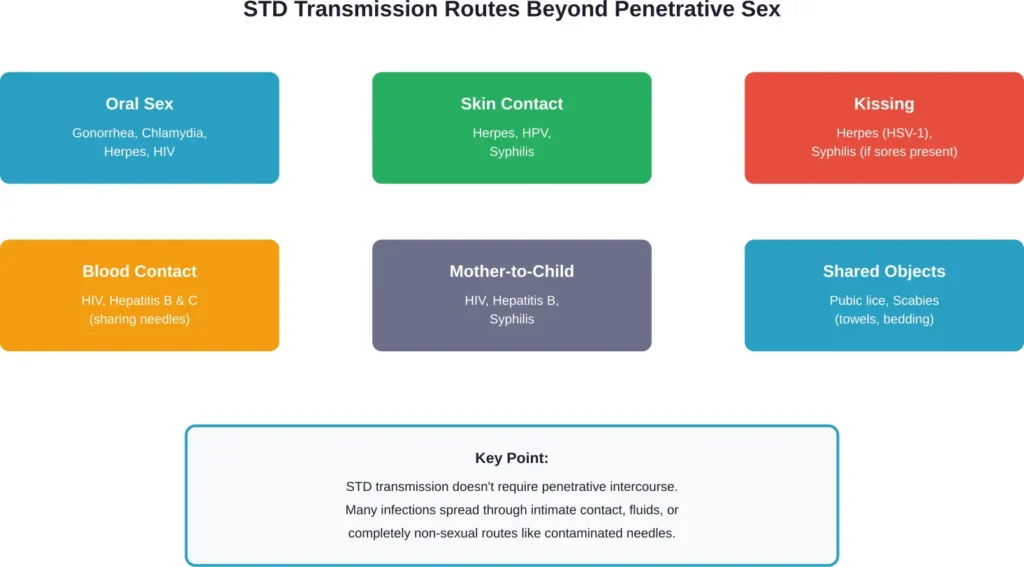
According to the CDC, HIV can spread through oral sex when body fluids from an infected person come into contact with mucous membranes. Gonorrhea and chlamydia commonly infect the throat through oral contact with infected genitals. Research published in medical literature confirms that nonsexual transmission discussions often overlook oral routes because people don’t categorize oral sex as “real” sex.
But throat infections are real. Gonorrhea can establish infections in the throat, often without symptoms. These infections can then spread to partners through kissing or additional oral contact.
Skin-to-Skin Contact Transmission
Some STDs don’t need fluids at all. They spread through direct skin contact.
Herpes simplex virus (both HSV-1 and HSV-2) transmits through contact with infected skin or sores. You can contract herpes from kissing someone with an active cold sore or touching an infected area and then touching your own mucous membranes. This is called autoinoculation—transferring the virus from one body part to another.
Human papillomavirus (HPV) also spreads through skin-to-skin genital contact. That means you can contract HPV from genital touching, even when no penetration occurs. According to medical research, HPV is so common that most sexually active people will get at least one type during their lifetime.
Syphilis, particularly in its primary and secondary stages when sores or rashes are present, can spread through direct contact with infectious lesions. These sores can appear on the genitals, mouth, or other areas.
Non-Sexual Routes of STD Transmission
Now this is where it gets really important. Some infections commonly categorized as STDs can absolutely spread without any sexual activity whatsoever.
Blood-to-Blood Contact
HIV, hepatitis B, and hepatitis C all spread efficiently through blood contact. According to CDC data, sharing needles or syringes for drug injection is a major transmission route. Syringe services programs (SSPs) are associated with an estimated 50% reduction in HIV and HCV incidence precisely because they address this transmission pathway.
Research on injection drug users in Kabul found HIV prevalence of 3.0%, HCV antibody prevalence of 36.6%, and hepatitis B surface antigen prevalence of 6.5%—demonstrating how blood-borne transmission drives infection rates in populations that share injection equipment.
Healthcare workers face occupational exposure risks from needle sticks. Tattoos or piercings performed with contaminated equipment can also theoretically transmit blood-borne infections, though this is rare with proper sterilization.
Mother-to-Child Transmission
Babies can acquire STDs from their mothers during pregnancy, labor, delivery, or breastfeeding. The WHO reports that in the absence of intervention, the rate of transmission of HIV from a mother living with HIV to her child during pregnancy, labour, delivery or breastfeeding ranges from 15% to 45%.
According to WHO data, globally, an estimated 1.3 million women and girls living with HIV become pregnant each year. This is why prenatal testing and treatment are so critical. With proper interventions, mother-to-child transmission rates drop dramatically. The WHO’s triple elimination initiative encourages countries to simultaneously commit to eliminating vertical transmission of HIV, syphilis, and hepatitis B.
Contaminated Objects and Surfaces
This route is less common but still possible for certain infections. Parasitic infections like pubic lice (crabs) and scabies mites can live on bedding, towels, or clothing for up to 24–48 hours. Sharing these items can potentially transmit the parasites.
Molluscum contagiosum, a viral skin infection, can spread through contaminated surfaces. However, most STD pathogens don’t survive long outside the human body, making fomite transmission relatively rare for infections like chlamydia, gonorrhea, or HIV.
Specific STDs and Their Non-Sexual Transmission
Let’s look at individual infections and how they can spread without intercourse.
| STD/STI | Can Spread Without Sex? | Non-Sexual Routes | Risk Level |
|---|---|---|---|
| Herpes (HSV-1/HSV-2) | Yes | Kissing, skin contact, autoinoculation | High |
| HPV | Yes | Skin-to-skin genital contact, potentially non-genital contact | Moderate-High |
| Syphilis | Yes | Direct contact with sores, mother-to-child | Moderate |
| HIV | Yes | Sharing needles, mother-to-child, blood transfusion | Moderate |
| Hepatitis B | Yes | Sharing needles, mother-to-child, contaminated equipment | Moderate-High |
| Hepatitis C | Yes | Sharing needles, contaminated equipment | High (for needle sharing) |
| Gonorrhea | Limited | Mother-to-child during birth, oral sex | Low (non-sexual) |
| Chlamydia | Limited | Mother-to-child during birth, oral sex | Low (non-sexual) |
| Pubic Lice | Yes | Shared bedding, towels, clothing | Low-Moderate |
| Scabies | Yes | Prolonged skin contact, shared bedding | Moderate |
Herpes Transmission Details
Herpes deserves special attention because it’s so common and spreads so easily. HSV-1 traditionally causes oral herpes (cold sores), while HSV-2 typically causes genital herpes. But both types can infect either location.
You can contract herpes from someone who doesn’t even know they have it. According to medical data, roughly 70% of herpes simplex virus infections may be asymptomatic or have minimal symptoms, meaning people don’t show obvious symptoms. The virus sheds from skin even without visible sores.
Kissing someone with HSV-1 during viral shedding can transmit the infection. Touching a cold sore and then touching your genitals can cause autoinoculation. Oral sex can transmit HSV-1 to genital areas or HSV-2 to the mouth.
HPV and Non-Penetrative Contact
HPV is incredibly common. About 70% to 90% of people with human papillomavirus (HPV) infection never develop symptoms. The virus spreads through skin-to-skin contact in the genital area.
That means manual genital contact—touching someone’s genitals with your hands and then touching your own—could theoretically transmit HPV, though this is less efficient than direct genital-to-genital contact. The virus requires access to skin cells, which it infects and uses to replicate.
When to Get Tested Even Without Intercourse
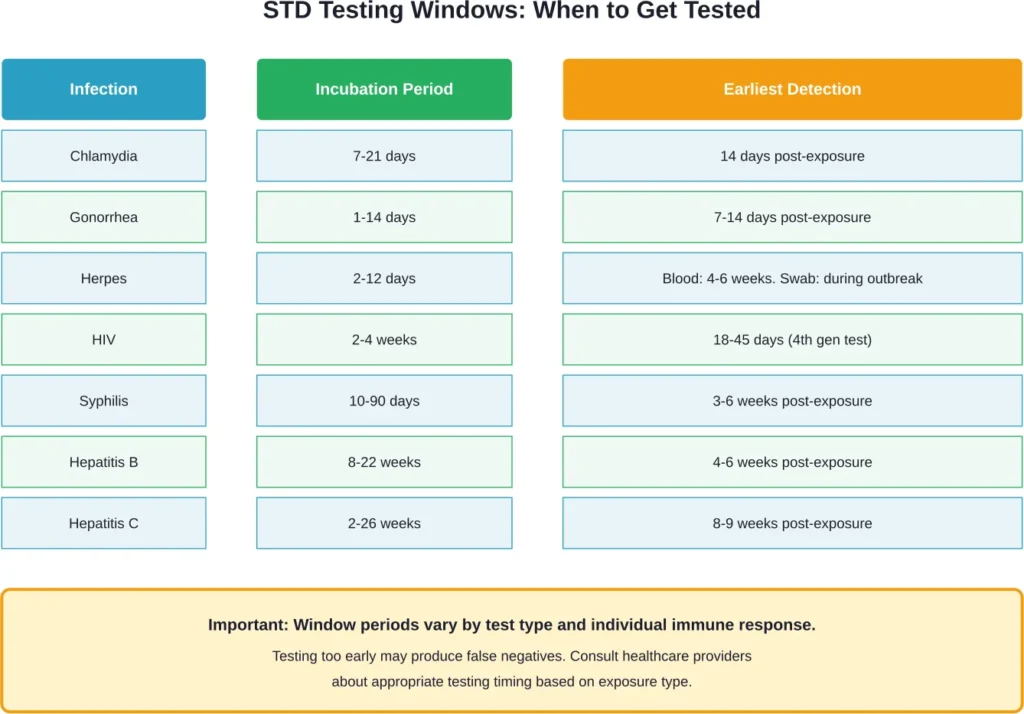
So when should someone get tested if they haven’t had penetrative sex?
The short answer? Anytime there’s been potential exposure through the routes we’ve discussed.
Testing Scenarios
Consider STD testing if there’s been:
- Oral sex with a new or casual partner
- Genital touching or manual stimulation with a partner whose STD status is unknown
- Kissing someone with visible cold sores or mouth lesions
- Sharing needles or injection equipment
- Occupational exposure to blood or bodily fluids
- Pregnancy (routine prenatal testing)
- Any symptoms like unusual discharge, sores, lesions, or pain
Many STDs remain asymptomatic. According to CDC data, half of all chlamydia cases in males and 70% of cases in females show no symptoms. At least half of gonorrhea cases in females and 40% of cases in males are asymptomatic.
This is why testing based on exposure, not symptoms, makes sense.
Prevention Strategies Beyond Condoms
Condoms are excellent for preventing transmission during penetrative sex. But preventing STDs without sex requires different strategies.
Practical Prevention Steps
Avoid direct contact with visible sores, lesions, or rashes. If a partner has a cold sore, skip kissing until it heals completely. Herpes sheds most actively during outbreaks.
Never share needles, syringes, or injection equipment. This applies to drug use but also diabetic supplies or hormone injections. Syringe services programs (SSPs) are associated with an estimated 50% reduction in HIV and HCV incidence.
Get vaccinated. HPV vaccines protect against the types most likely to cause cancer and genital warts. Hepatitis B vaccines provide effective protection against that virus. Hepatitis A vaccines are recommended for people at risk.
Practice good hand hygiene. Washing hands after touching potentially infected areas and before touching your own mucous membranes reduces autoinoculation risk.
Don’t share personal items that might contact bodily fluids or infected skin—razors, towels, toothbrushes, sex toys.
Understanding STD Symptoms
Real talk: most people with STDs don’t have obvious symptoms. But when symptoms do appear, they vary widely by infection.
Herpes causes painful blisters or sores that eventually crust over. Gonorrhea and chlamydia might cause discharge, burning during urination, or pelvic pain—but often cause nothing noticeable. Syphilis begins with a painless sore called a chancre, then may progress to rashes and other symptoms.
HIV’s acute infection stage can feel like flu—fever, fatigue, swollen lymph nodes—but many people experience no symptoms for years. Hepatitis might cause jaundice (yellowing of skin and eyes), fatigue, and abdominal pain.
The asymptomatic nature of most STDs is exactly why testing based on exposure, not symptoms, is so important.
Frequently Asked Questions
Generally speaking, chlamydia and gonorrhea spread primarily through sexual contact including oral, anal, and vaginal sex. Non-sexual transmission is rare in adults. However, mothers can transmit these infections to babies during childbirth. Gonorrhea can infect the throat through oral sex and potentially spread through kissing, though this is uncommon.
Yes, kissing can transmit certain STDs. Herpes simplex virus (especially HSV-1) commonly spreads through kissing. Syphilis can spread through kissing if there are oral sores present. Gonorrhea throat infections could theoretically spread through deep kissing, though this is less common than other transmission routes.
This varies significantly by infection. Herpes can remain dormant for months or years before the first outbreak. HIV can exist asymptomatically for a decade or more without treatment. Chlamydia and gonorrhea typically cause symptoms within days to weeks if symptoms appear at all—but many infections remain asymptomatic indefinitely. Syphilis has distinct stages with varying symptom patterns over months to years.
Yes. HPV spreads through skin-to-skin contact in the genital area. Genital touching, manual stimulation, and other non-penetrative contact can transmit the virus. According to medical research, HPV is so common that most sexually active people contract at least one type during their lifetime, and transmission doesn’t require intercourse.
Yes, HIV can transmit from a single needle-sharing incident. According to the CDC, sharing needles or injection equipment is an efficient transmission route for HIV. The virus spreads through direct blood-to-blood contact when contaminated needles are reused. This is why needle exchange programs are so effective at reducing transmission.
It depends on exposure history. Testing makes sense after oral sex with partners of unknown STD status, genital contact that didn’t involve penetration, potential blood exposure through shared needles, or any situation with symptoms. Many STDs transmit without intercourse, so testing decisions should be based on specific exposure risks rather than penetration alone.
No. This is a persistent myth, but syphilis bacteria don’t survive long on hard surfaces. The bacteria that cause syphilis (Treponema pallidum) require direct contact with infectious sores or lesions to transmit. Toilet seats don’t provide the conditions necessary for transmission. Syphilis spreads through direct contact with syphilis sores during sex or skin contact, or from mother to child.
Moving Forward: Testing and Peace of Mind
If there’s been potential STD exposure through any route—sexual or non-sexual—testing provides clarity. Modern STD tests are accurate, confidential, and increasingly accessible.
Many infections are easily treatable with antibiotics. Viral infections like herpes and HIV are manageable with antiviral medications. The key is knowing your status so treatment can begin if needed.
Don’t let stigma prevent testing. STDs are common infections with medical solutions. According to the CDC, millions of new infections occur every year in the United States. Getting tested is a routine part of healthcare.
Look for testing options through primary care providers, sexual health clinics, or public health departments. Many locations offer confidential or anonymous testing. Some infections require blood tests, others use urine samples or swabs.
The bottom line? STD transmission doesn’t require penetrative intercourse. Understanding the various transmission routes—from oral sex to skin contact to needle sharing—allows for better prevention strategies and informed testing decisions. When in doubt, get tested. It’s the only way to know for sure.