

Quick Summary: Yes, it’s possible to get pregnant after ovulation, but the window is narrow—typically 12 to 24 hours after the egg releases. However, the fertile window actually spans six days: the five days before ovulation plus the day of ovulation itself. Sperm can survive up to five days in the female reproductive tract, making timing before ovulation equally important for conception.
When you’re trying to conceive, understanding ovulation timing can feel like solving a puzzle. The question of whether pregnancy is possible after ovulation comes up constantly in fertility discussions, and the answer isn’t as straightforward as you might think.
Here’s the thing though—while pregnancy after ovulation is technically possible, the odds drop dramatically compared to having intercourse before ovulation. Let’s break down what actually happens and when your chances are highest.
Understanding the Fertile Window
According to research from the National Institute of Environmental Health Sciences, the fertile window spans approximately six days during each menstrual cycle. This window includes the five days leading up to ovulation and the day of ovulation itself.
But here’s where it gets interesting. According to the American College of Obstetricians and Gynecologists, sperm can survive in the female reproductive tract for up to five days, while an egg remains viable for only 12 to 24 hours after ovulation. This biological reality shapes when conception is actually possible.
That means having intercourse up to five days before ovulation or one day after can still result in pregnancy. The timing matters because sperm need to be present when the egg releases—or arrive shortly after.

What Happens During Ovulation
Ovulation occurs when one of your ovaries releases a mature egg. This egg then travels down the fallopian tube, where fertilization can occur if sperm are present.
The process is triggered by a surge in luteinizing hormone (LH), which happens approximately 36 hours before the egg releases. This LH surge is what ovulation predictor kits detect, giving you advance notice of your most fertile time.
Once the egg releases, it begins to deteriorate relatively quickly. Most research suggests the egg remains viable for fertilization for 12 to 24 hours maximum. After this window closes, conception becomes impossible until the next cycle.
Pregnancy Likelihood by Day: What the Data Shows
Research published in the British Medical Journal examined 221 healthy women planning pregnancy and tracked 696 menstrual cycles. The study provided specific day-by-day conception probabilities relative to ovulation.
| Timing Relative to Ovulation | Probability of Pregnancy | |
|---|---|---|
| 5 days before ovulation | 5% | |
| 4 days before ovulation | 18% | |
| 3 days before ovulation | 24% | |
| 2 days before ovulation | 26% | |
| 1 day before ovulation | 21% | |
| Day of ovulation | 10% | |
| 1 day after ovulation | [data not provided in source] |
Notice the pattern? Conception probability peaks one to two days before ovulation, not on ovulation day itself. By the day after ovulation, chances drop significantly.
The research concluded that nearly all pregnancies can be attributed to intercourse during a six-day window ending on the day of ovulation. According to the National Institute of Environmental Health Sciences, timing of intercourse after ovulation has minimal impact on conception success.
Can You Get Pregnant Two Days After Ovulation?
Real talk: the likelihood of conception two days after ovulation is extremely low, approaching nearly zero.
Why? Because the egg’s lifespan is limited to 12-24 hours post-release. By 48 hours after ovulation, the egg has already deteriorated and can no longer be fertilized.
Some fertility discussions mention late fertilization, but the scientific evidence doesn’t support conception occurring two full days after ovulation. If pregnancy occurs after what someone believes was ovulation, it’s more likely that ovulation timing was miscalculated.
Why Timing Calculations Can Be Off
Tracking ovulation isn’t an exact science for everyone. Several factors can throw off calculations:
- Irregular menstrual cycles make prediction difficult
- Ovulation predictor kits detect the LH surge, not ovulation itself (which occurs 12-36 hours later)
- Basal body temperature rises after ovulation has already occurred
- Cervical mucus changes can be subjective and vary between individuals
- Stress, illness, and other factors can delay ovulation within a given cycle
According to research published by the National Institute of Environmental Health Sciences, only about 30% of women have their fertile window entirely within days 10-17 of their cycle—the timeframe many clinical guidelines reference. Most women reach their fertile window earlier or later than this standard range.
How to Track Your Ovulation Accurately
If you’re trying to conceive, accurate ovulation tracking matters. Here are the most reliable methods:
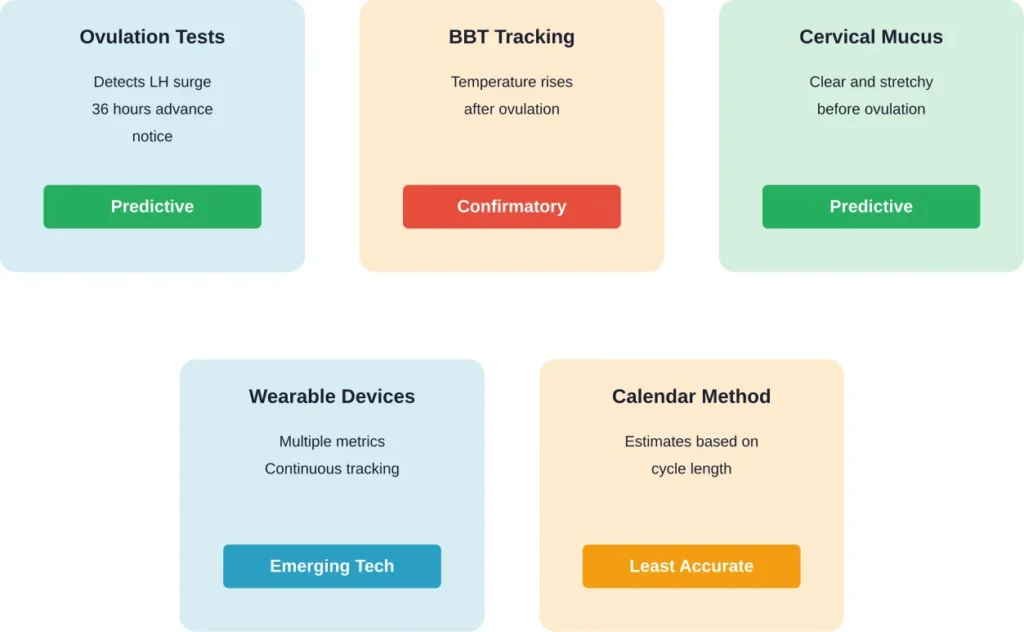
Ovulation Predictor Kits
These urine-based tests detect the LH surge that precedes ovulation. According to research, timed intercourse using ovulation predictor kits may improve conception rates, though the American Society for Reproductive Medicine sources provided do not contain this specific claim about live birth and pregnancy rates in women under 40.
The tests work best when used daily during your predicted fertile window, typically starting around day 10-12 of your cycle depending on cycle length.
Basal Body Temperature Charting
Your basal body temperature (BBT) rises slightly—about 0.5 to 1 degree Fahrenheit—after ovulation due to increased progesterone. By tracking daily temperature first thing in the morning, you can confirm that ovulation occurred.
The limitation? BBT tells you ovulation happened after the fact, not before. It’s useful for understanding your pattern over several months but doesn’t predict ovulation in the current cycle.
Cervical Mucus Monitoring
As ovulation approaches, cervical mucus becomes clearer, stretchier, and more abundant—often compared to raw egg whites. Some research suggests that cervical mucus changes can help predict conception probability and the fertile window.
To maximize conception likelihood, intercourse should occur on days with optimal mucus quality, regardless of exact timing relative to ovulation.
Fertility Monitors and Wearable Devices
According to ASRM, wearable health devices show promise for monitoring health parameters. As of 2024, nearly one-third of Americans report wearing a fitness tracker or smartwatch to monitor their health.
These devices typically track physiological parameters like skin temperature, heart rate variability, and resting pulse rate to identify fertile days. While promising, they’re still relatively new for fertility tracking compared to established methods.
When to Have Sex for Best Conception Odds
So what’s the optimal strategy? Based on the research, regular intercourse throughout your fertile window maximizes conception chances.
The American College of Obstetricians and Gynecologists recommends having sex every one to two days during the fertile window. Because the fertile window spans six days and sperm can survive up to five days, this approach ensures sperm are present whenever ovulation occurs.
You don’t need to wait until ovulation day. In fact, having sex before ovulation appears more effective than timing intercourse for ovulation day itself, based on the conception probability data.
How Often Should You Have Sex?
Daily intercourse during the fertile window slightly increases conception chances compared to every-other-day sex, but the difference is modest. For most couples, every other day is sufficient and may be more sustainable.
Outside the fertile window, intercourse frequency doesn’t significantly impact conception likelihood for that cycle—though maintaining regular intimacy matters for relationship and overall reproductive health.
Common Misconceptions About Ovulation Timing
Several myths persist about conception timing. Let’s clear them up.
Myth: You Can Only Get Pregnant on Ovulation Day
Not true. The six-day fertile window means conception can result from intercourse up to five days before ovulation. Sperm survival time creates this extended window.
Myth: Ovulation Always Happens on Day 14
According to the Office on Women’s Health, menstrual cycles typically last 28 days, but normal cycles can range from 21 to 35 days. Ovulation timing varies accordingly. According to the American College of Obstetricians and Gynecologists, ovulation generally occurs around day 14 of a 28-day cycle, but individual variation is substantial.
The research from the National Institute of Environmental Health Sciences found that only 30% of women have their fertile window within the commonly cited days 10-17.
Myth: Implantation Happens Immediately
Even after successful fertilization, the embryo doesn’t immediately implant. Fertilization typically occurs in the fallopian tube, and the developing embryo takes several days to travel to the uterus. Implantation usually occurs 6-12 days after ovulation—well after the fertile window closes.
What If You’re Not Getting Pregnant?
If you’ve been trying to conceive for several months without success, don’t panic. Conception isn’t guaranteed each cycle, even with perfect timing.
For healthy couples having regular unprotected intercourse, conception rates vary by age and other factors. These statistics should be verified with a healthcare provider.
However, certain situations warrant medical consultation sooner:
- Women under 35 who haven’t conceived after 12 months of trying
- Women 35 and older who haven’t conceived after 6 months of trying
- Known fertility issues or irregular cycles
- History of pelvic inflammatory disease or endometriosis
- Previous pelvic surgery or certain medical conditions
According to ACOG guidance on prepregnancy counseling, both the American College of Obstetricians and Gynecologists and the American Society for Reproductive Medicine support access to prepregnancy counseling and fertility services as core components of reproductive health care.
Factors That Affect Conception Beyond Timing
While timing matters, other factors influence conception success:
Age
Female fertility declines with age, particularly after 35. Research in Fertility and Sterility indicates effects of maternal age on reproductive outcomes.
Overall Health
Body weight, chronic conditions, medications, and lifestyle factors all impact fertility. The CDC’s recommendations for contraceptive use note multiple health criteria that can affect pregnancy likelihood.
Male Factor Fertility
Conception requires healthy sperm. Male fertility factors contribute to approximately 40-50% of infertility cases. Sperm count, motility, and morphology all matter.
Underlying Conditions
Conditions like polycystic ovary syndrome (PCOS), endometriosis, thyroid disorders, and uterine abnormalities can affect ovulation regularity and conception chances.
Maximizing Your Chances
Beyond timing intercourse, several strategies may improve conception odds:
- Maintain a healthy body weight
- Take prenatal vitamins with folic acid before conception
- Avoid smoking, excessive alcohol, and recreational drugs
- Manage chronic health conditions
- Reduce stress where possible
- Get adequate sleep and exercise moderately
- Both partners should optimize their health
The American College of Obstetricians and Gynecologists emphasizes that prepregnancy counseling should address family planning, medical history review, medications, immunizations, and lifestyle factors.
Frequently Asked Questions
Yes, pregnancy is possible for about 12-24 hours after ovulation while the egg remains viable. However, conception probability is significantly lower than having intercourse before ovulation day.
According to medical research and guidance from ACOG, an egg typically survives 12 to 24 hours after ovulation. After this window, the egg deteriorates and can no longer be fertilized.
Signs include a slight increase in basal body temperature, changes in cervical mucus (becoming less abundant and thicker), mild pelvic discomfort, and a positive ovulation predictor test 24-36 hours prior. Some women experience mittelschmerz—pain associated with ovulation.
Research shows conception is more likely from intercourse before ovulation. The highest probability occurs one to two days before ovulation, with chances decreasing sharply after ovulation day. Having sex throughout your fertile window—the five days before ovulation plus ovulation day—maximizes your chances.
While rare, it’s possible to release two eggs during one ovulation event, which can result in fraternal twins if both are fertilized. However, having two separate ovulation events days apart within the same cycle is extremely uncommon in humans.
Not necessarily. Some women with irregular cycles still ovulate, just unpredictably. However, irregular cycles can indicate anovulation (lack of ovulation) in some cases. Conditions like PCOS commonly cause both irregular cycles and ovulation problems. If you have irregular periods, consulting a healthcare provider can help determine if you’re ovulating.
Ovulation predictor kits are generally accurate at detecting the LH surge that precedes ovulation. However, they indicate that ovulation is likely to occur within 12-36 hours, not that it’s happening at that moment. Some conditions can cause false positives, and timing the test incorrectly can lead to missed surges.
The Bottom Line on Post-Ovulation Pregnancy
So, is it possible to get pregnant after ovulation? Yes, but only for a brief window of 12-24 hours while the egg remains viable.
But here’s what really matters: focusing solely on post-ovulation timing misses the bigger picture. The data clearly shows that conception is most likely when intercourse occurs before ovulation, particularly one to two days prior.
The fertile window encompasses six days—five before ovulation plus ovulation day itself. Regular intercourse throughout this window provides the best conception odds because it accounts for sperm survival time and ensures sperm are present when the egg releases.
If you’re tracking ovulation, use it to identify your fertile window and time intercourse accordingly. Don’t wait until you confirm ovulation has occurred, because by then, your best chances have already passed.
Understanding your cycle, using reliable tracking methods, and maintaining overall reproductive health will serve you better than trying to pinpoint the exact moment of ovulation. And if conception doesn’t happen quickly, remember that’s normal—most couples take several months to conceive even with optimal timing.
Ready to start tracking your cycle? Consider trying multiple methods—ovulation predictor kits combined with cervical mucus monitoring tends to work well for many women. And if you’ve been trying for several months without success, don’t hesitate to consult a healthcare provider who specializes in fertility.