

Quick Summary: No, pregnancy cannot occur without ovulation, as it requires an egg to be released and fertilized by sperm. However, conception is possible from intercourse up to 5 days before ovulation or within 24 hours after, since sperm can survive in the female body for up to 5 days and the egg remains viable for 12-24 hours post-ovulation. The fertile window spans approximately 6 days each cycle, and timing intercourse within this period maximizes pregnancy chances.
The question of whether pregnancy can happen without ovulation confuses many people trying to conceive. The short answer is straightforward, but the details reveal why timing matters so much for fertility.
Understanding how ovulation, sperm survival, and the fertile window interact helps clarify what’s actually possible when it comes to conception.
The Biological Reality: Ovulation Is Essential
Here’s the fundamental truth: pregnancy cannot occur without ovulation at some point in the process. The biological mechanism is clear.
Ovulation is when an ovary releases a mature egg into the fallopian tube. Without this egg, there’s nothing for sperm to fertilize. No egg means no conception, regardless of how much intercourse occurs.
But here’s where it gets interesting. The timing doesn’t have to be exact. Pregnancy can result from intercourse that happens days before the actual moment of ovulation.
Why Timing Isn’t As Narrow As You Think
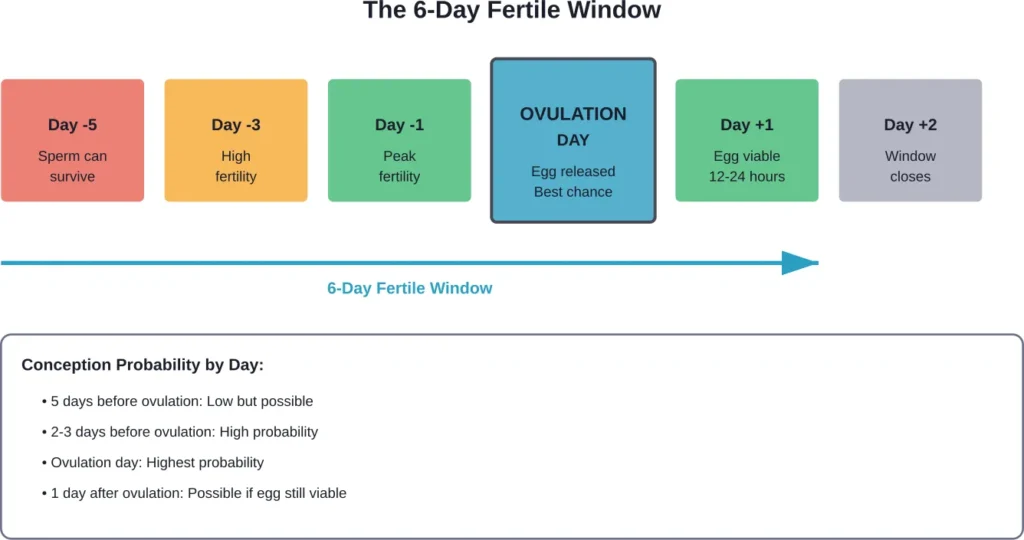
According to the American College of Obstetricians and Gynecologists, the fertile window is much wider than just ovulation day. It spans approximately 6 days each cycle.
This happens because sperm can survive in the female reproductive system for up to 5 days, while an egg remains viable for about 12 to 24 hours after ovulation.
So intercourse on Monday could lead to pregnancy from ovulation on Friday. The sperm wait for the egg to arrive.
What Actually Happens During Ovulation
Ovulation occurs roughly midway through a typical menstrual cycle. For someone with a 28-day cycle, that’s usually around day 14.
The process involves complex hormonal signaling. The pituitary gland releases luteinizing hormone, which triggers the ovary to release a mature egg from a follicle.
This egg then travels into the fallopian tube, where fertilization can occur if sperm are present. The egg remains viable for a limited time window.
Sperm Survival Creates the Extended Window
Sperm don’t just arrive and immediately die if no egg is present. They’re remarkably resilient.
In the female reproductive tract, sperm can survive for up to 5 days under optimal conditions. They wait in the fallopian tubes, essentially queuing up for the egg’s arrival.
This survival capacity is why intercourse several days before ovulation can still result in pregnancy. The sperm are there, ready and waiting.
Anovulation: When Ovulation Doesn’t Happen
Some individuals experience cycles without ovulation, a condition called anovulation. This makes conception impossible during those specific cycles.
According to research published in Hippokratia, anovulation is a common cause of infertility and affects various populations differently. Polycystic ovary syndrome accounts for the majority of anovulatory cases.
PCOS affects between 8 and 10 percent of women of childbearing age, causing hormonal imbalances that disrupt the normal ovulation process.
Common Causes of Anovulation
| Condition | How It Affects Ovulation | Prevalence |
|---|---|---|
| Polycystic Ovary Syndrome | Hormonal imbalance prevents egg maturation and release | 8-10% of reproductive-age women |
| Thyroid Disorders | Disrupts hormonal signaling needed for ovulation | Common in reproductive years |
| Excessive Exercise | Reduces body fat below threshold needed for hormonal balance | Common in athletes |
| Stress | Affects hypothalamic-pituitary axis controlling reproduction | Varies widely |
| Low Body Weight | Insufficient fat stores signal body that conditions aren’t optimal | Associated with eating disorders |
| Elevated Prolactin | Suppresses normal hormonal cycling needed for ovulation | Various causes including medications |
Research published in Paediatric and Perinatal Epidemiology indicates that sporadic anovulation in women with otherwise regular cycles is not necessarily a major barrier to conception. Many still achieve pregnancy.
Can You Get Pregnant With PCOS?
Yes, but it often requires medical intervention. PCOS is the most common cause of anovulation, but it’s treatable.
According to the American College of Obstetricians and Gynecologists, conventional treatment for anovulatory infertility starts with medications like clomiphene citrate or letrozole, which stimulate ovulation.
Research found that among women who ovulated on clomiphene citrate for at least six cycles but hadn’t conceived, 31 percent achieved ongoing pregnancy with continued treatment in cycles 7-12.
Understanding Your Fertile Window
The fertile window represents the days when pregnancy is biologically possible. It’s not just ovulation day.
Research indicates that among healthy women trying to conceive, pregnancies commonly result from intercourse during a six-day period ending on ovulation day.
But here’s the catch: the fertile window doesn’t always fall where clinical guidelines predict.
The Fertile Window Varies More Than Expected
Medical guidelines often suggest the fertile window falls between cycle days 10 and 17. Reality is messier.
The fertile window timing varies among individuals and may not always fall within predicted clinical guidelines. Most reach their fertile window earlier, and others much later.
Cycle length variability explains much of this unpredictability. Not everyone has a 28-day cycle, and even individuals with typically regular cycles experience variation.
Pregnancy Chances at Different Cycle Stages
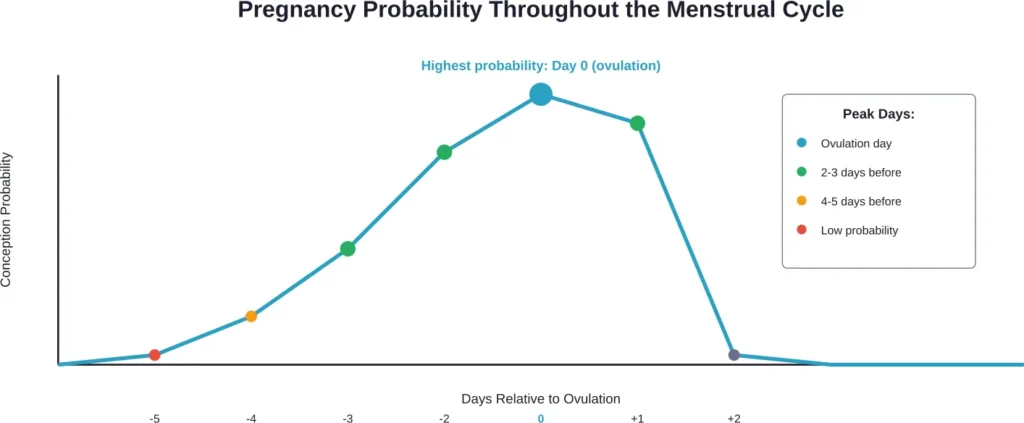
The probability of conception varies dramatically depending on when intercourse occurs relative to ovulation.
According to Baylor College of Medicine research, among 30-year-olds trying to become pregnant during one monthly cycle, approximately 20 percent will be successful. By comparison, a 40-year-old’s success rate in one cycle drops to about 5 percent.
During Your Period
Pregnancy from intercourse during menstruation is extremely unlikely but not technically impossible in certain scenarios.
For someone with a very short cycle and long period, ovulation could occur soon after menstruation ends. Since sperm survive up to 5 days, late-period intercourse could theoretically result in pregnancy if ovulation happens early.
But for most individuals with typical cycle lengths, pregnancy from period intercourse isn’t a realistic concern.
Right After Your Period
This timing moves closer to the potential fertile window, especially for those with shorter cycles.
Someone with a 24-day cycle might ovulate around day 10. Intercourse on day 6 or 7 (just after a period) could result in pregnancy since sperm can wait around for several days.
The probability increases as the days progress toward ovulation.
Before Ovulation
This is prime conception territory. The 2-3 days before ovulation offer some of the highest pregnancy probabilities.
Research indicates that intercourse timing during this window captures the peak fertility period while ensuring sperm are present when the egg releases.
On Ovulation Day
This represents the single day with the highest conception probability. The egg is present and viable, waiting for fertilization.
Ovulation day itself offers the peak chance for conception in any given cycle.
After Ovulation
The window closes rapidly after ovulation occurs. The egg remains viable for only 12-24 hours.
Intercourse on the day immediately after ovulation has a small but real chance of resulting in pregnancy if the egg is still viable. Beyond that, the probability drops essentially to zero for that cycle.
How Age Affects Conception Probability
Age significantly impacts fertility, independent of timing intercourse correctly.
According to the American College of Obstetricians and Gynecologists, for healthy couples in their 20s or early 30s, the chance of pregnancy is about 25 to 30 percent in any single menstrual cycle.
This percentage starts declining in the early 30s, drops more rapidly after age 37, and by age 40, the monthly probability has decreased substantially.
| Age Range | Probability Per Cycle | Cumulative Probability |
|---|---|---|
| 20-29 years | 25-30% per cycle | 75% within 6 months, 90% within 1 year |
| 30-34 years | Slightly lower than 20s | Decline begins but most conceive within 1 year |
| 35-37 years | Noticeable decline | Longer average time to conception |
| 38-40 years | Significant decline | Many require longer than 1 year |
| 40+ years | ~5% per cycle | Majority require fertility assistance |
The CDC reports that in the United States, 1 in 5 married women aged 15 to 49 with no prior births are unable to get pregnant after 1 year of trying.
Tracking Ovulation for Conception
Knowing when ovulation occurs helps time intercourse for maximum conception probability.
Several methods exist for tracking ovulation, each with different accuracy levels and complexity.
Ovulation Predictor Kits
These urine-based tests detect the luteinizing hormone surge that precedes ovulation by 24-36 hours.
According to Cochrane systematic review research, urinary ovulation tests probably increase pregnancy rates compared to intercourse without ovulation prediction, though the evidence quality is moderate.
Basal Body Temperature Tracking
Body temperature rises slightly after ovulation due to progesterone. Tracking this shift can confirm ovulation occurred.
The limitation is that temperature rises after ovulation has already happened, making this method better for confirming patterns than predicting the current cycle’s fertile window.
Cervical Mucus Monitoring
Cervical mucus changes consistency throughout the cycle, becoming clear, slippery, and stretchy around ovulation.
Fertility awareness methods that include cervical mucus monitoring have been associated with high conception rates when used consistently.
Fertility Awareness Apps and Devices
Modern technology offers various tools for tracking fertility signs and predicting the fertile window.
Effectiveness varies by method and individual consistency in tracking. Some devices combine multiple data points for more accurate predictions.
When to Seek Help
Not every couple conceives quickly, even with perfect timing. When should medical evaluation happen?
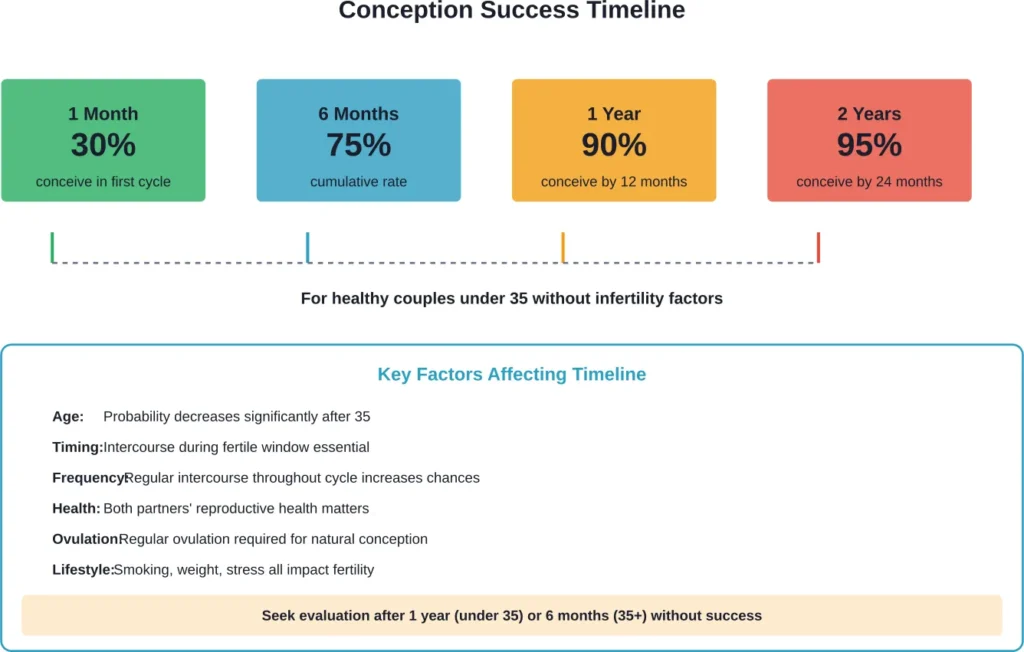
The American College of Obstetricians and Gynecologists recommends infertility evaluation if pregnancy hasn’t occurred after one year of regular, unprotected intercourse for women under 35.
For women 35 and older, the recommendation shortens to six months of trying before seeking evaluation.
What an Infertility Evaluation Includes
Evaluation involves both partners, as male and female factors contribute roughly equally to infertility cases.
Testing typically includes ovulation confirmation, semen analysis, tubal patency assessment, and uterine evaluation. The goal is identifying any correctable factors affecting conception.
According to research published in BMJ, conception is most likely in the first month of trying, with about a 30 percent rate. The chance then falls steadily to about 5 percent by the end of the first year.
Cumulative conception rates reach approximately 75 percent after six months, 90 percent after a year, and 95 percent at two years for couples without infertility factors.
Misconceptions About Conception Timing
Several myths persist about when pregnancy can occur. Clearing these up helps with realistic expectations.
Myth: You Can Only Get Pregnant on Ovulation Day
This oversimplifies the fertile window. The 5-day sperm survival period means intercourse days before ovulation commonly results in pregnancy.
In fact, some research suggests the days immediately before ovulation may have pregnancy rates equal to or higher than ovulation day itself, likely because sperm are already present when the egg releases.
Myth: You Can Get Pregnant Any Day of Your Cycle
While the fertile window doesn’t always fall where predicted, pregnancy cannot occur from intercourse more than a day or so after ovulation or more than 5 days before.
The biological realities of egg and sperm survival create a true fertile window, even if its timing varies between individuals and cycles.
Myth: Getting Pregnant is Easy If You’re Healthy
Even for perfectly healthy couples in their prime reproductive years, monthly conception probability peaks around 25-30 percent under ideal timing.
Many factors beyond timing and health affect conception, including aspects of sperm-egg interaction and implantation that remain somewhat mysterious even to researchers.
Improving Your Chances of Conception
While ovulation timing is crucial, other factors influence conception probability.
Maintain a Healthy Weight
Both excessive and insufficient body fat can disrupt hormonal balance and ovulation.
Achieving a healthy BMI before trying to conceive optimizes reproductive function for many individuals.
Manage Stress
Chronic stress affects the hypothalamic-pituitary axis, which controls reproductive hormones.
While easier said than done, stress management techniques may support more regular ovulation patterns.
Avoid Smoking and Excessive Alcohol
Both substances negatively impact fertility in various ways, from egg quality to implantation success.
Eliminating smoking and limiting alcohol consumption improves conception chances.
Address Underlying Health Conditions
Conditions like thyroid disorders, diabetes, or untreated PCOS affect fertility.
Working with healthcare providers to manage these conditions optimizes the chances of successful conception.
The Role of Male Fertility
Conception requires healthy sperm in addition to ovulation and optimal timing.
Male factor infertility accounts for roughly half of all infertility cases. Sperm count, motility, and morphology all matter.
Addressing male fertility through lifestyle changes, treating underlying conditions, or medical interventions can significantly improve conception chances even when ovulation timing is perfect.
Frequently Asked Questions
No. Ovulation must occur at some point for pregnancy to be possible. Without an egg being released, there’s nothing for sperm to fertilize. However, pregnancy can result from intercourse that occurs up to 5 days before ovulation, as sperm can survive in the female reproductive tract and wait for the egg to be released.
Pregnancy is possible from intercourse up to 5 days before ovulation. This is because sperm can survive in the female body for up to 5 days under optimal conditions. The highest pregnancy probability occurs from intercourse 2-3 days before ovulation through ovulation day itself.
Possibly, but the window is narrow. The egg remains viable for only 12-24 hours after ovulation. Intercourse on the day immediately after ovulation has a small chance of resulting in pregnancy if the egg is still viable, but the probability drops rapidly and is essentially zero beyond 24 hours post-ovulation.
Common signs of anovulation include irregular or absent periods, very light or very heavy menstrual bleeding, and lack of typical ovulation symptoms like cervical mucus changes or mittelschmerz. However, some people have no obvious symptoms. Confirming anovulation typically requires tracking methods like basal body temperature, ovulation predictor kits, or bloodwork measuring progesterone levels.
Yes. Chronic or severe stress can disrupt the hormonal signaling needed for ovulation. Stress affects the hypothalamic-pituitary-ovarian axis, potentially causing delayed or absent ovulation. This is why some individuals experience irregular cycles during particularly stressful periods.
Urinary ovulation predictor kits that detect luteinizing hormone are generally reliable at detecting the pre-ovulation hormone surge. Research indicates they probably increase pregnancy rates compared to intercourse without ovulation prediction. However, they work best for individuals with regular cycles and may give false results in certain conditions like PCOS.
Yes, but it may take longer and be more challenging. Irregular periods often indicate irregular or absent ovulation, which reduces the number of opportunities for conception. Many people with irregular cycles can still conceive naturally, particularly if ovulation occurs even sporadically. However, evaluation and treatment may be needed if irregular cycles result from conditions like PCOS or thyroid disorders.
Conclusion: Ovulation Is Essential, But Timing Has Flexibility
The bottom line is clear: pregnancy requires ovulation. Without an egg, conception cannot happen.
But the fertile window extends beyond just ovulation day itself. The combination of sperm survival and egg viability creates approximately a 6-day window each cycle when pregnancy is biologically possible.
Understanding this window, recognizing when ovulation occurs, and timing intercourse accordingly maximizes conception probability. For those struggling to conceive, medical evaluation can identify whether anovulation or other factors are preventing pregnancy and guide appropriate treatment.
If you’re trying to conceive and have questions about your ovulation patterns or fertility, consult with a healthcare provider who can offer personalized guidance based on your specific situation. Tracking your cycles and recognizing your body’s fertility signs provides valuable information for both natural conception attempts and medical evaluation if needed.