

Quick Summary: Herpes simplex virus (HSV) cannot be cured because the virus permanently integrates into nerve cells where it remains dormant and inaccessible to current medications. According to the CDC, genital herpes is a chronic, lifelong viral infection, though antiviral treatments can effectively manage symptoms and reduce outbreaks. Research is ongoing for vaccines and gene-editing therapies that may one day eradicate the virus.
The question haunts millions: is it possible to get rid of herpes once infected? The short answer is no—not with current medical technology. But that’s not the whole story.
According to the World Health Organization, an estimated 3.8 billion people under age 50 have HSV-1 infection globally, while approximately 520 million people aged 15-49 have HSV-2 infection. These staggering numbers reflect how common herpes infections are, yet misconceptions about the virus persist.
Here’s the thing though—while herpes can’t be cured, it can absolutely be managed. Research is advancing rapidly, and understanding what’s actually possible versus what’s fiction matters for anyone dealing with this diagnosis.
Understanding Why Herpes Can’t Currently Be Cured
The herpes simplex virus operates differently from many other infections. Once HSV enters the body, it doesn’t just circulate in the bloodstream where medications can easily reach it.
Instead, the virus travels to nerve cells near the spine and establishes what scientists call latency. During this dormant phase, the viral DNA integrates into the nerve cell’s genetic material and essentially goes to sleep. Current antiviral medications can’t reach these hidden viral reservoirs.
The CDC confirms that genital herpes is a chronic, lifelong viral infection. Two types of HSV can cause genital herpes: HSV-1 and HSV-2. Most cases of recurrent genital herpes are caused by HSV-2, and according to CDC data, 11.9% of persons aged 14-49 years are estimated to be infected in the United States.
How the Virus Hides From Treatment
When herpes reactivates, it travels back down the nerve to the skin’s surface, causing the characteristic blisters or sores. Antiviral drugs work during these active phases by blocking viral replication. They reduce symptom severity and duration.
But they can’t eliminate the dormant virus tucked away in nerve cells. This biological reality is why herpes persists for life, despite effective symptom management.
The virus can reactivate periodically throughout a person’s lifetime, triggered by stress, illness, hormonal changes, or immune system fluctuations. Some people experience frequent outbreaks, while others rarely have symptoms at all.
Current Treatment Options That Actually Work
No cure doesn’t mean no help. Modern antiviral medications have transformed herpes management, giving people effective tools to control their infection.
According to the WHO, medicines are used to treat first or recurrent symptomatic episodes. They can decrease how long symptoms last and how severe they are, even though they can’t cure the infection.
Antiviral Medications
Three main antiviral drugs dominate herpes treatment:
- Acyclovir (the original antiviral for herpes)
- Valacyclovir (better absorbed, requires less frequent dosing)
- Famciclovir (similar effectiveness to valacyclovir)
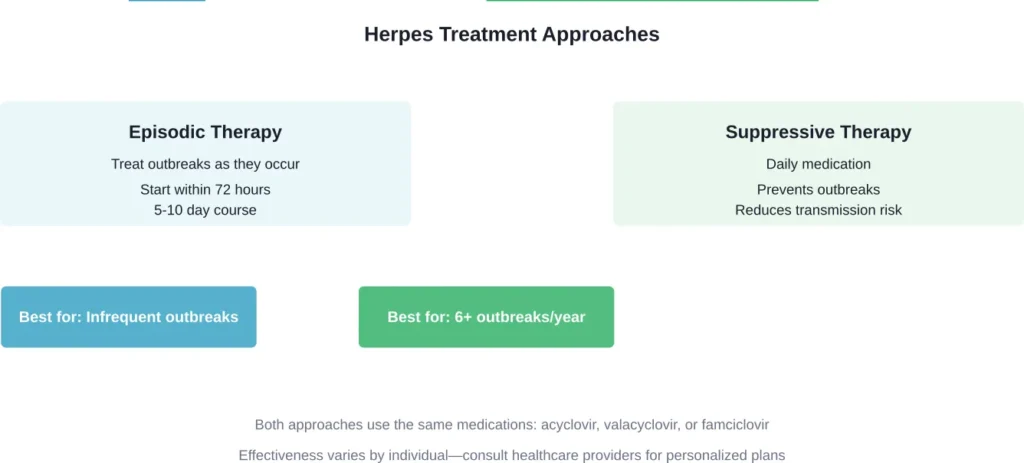
These medications work by inhibiting viral DNA replication. Clinical data shows that antiviral therapy initiated within 72 hours of symptom onset may shorten the duration of clinical manifestations and viral shedding.
Treatment approaches fall into two categories: episodic therapy for individual outbreaks and suppressive therapy for people with frequent recurrences. Suppressive therapy involves taking medication daily to prevent outbreaks and reduce viral shedding, which lowers transmission risk to partners.
Symptom Management Strategies
Beyond antiviral drugs, several approaches help manage discomfort during outbreaks:
- Wear cotton or other nonsynthetic underpants and avoid tight-fitting clothes—moist sores take longer to heal
- Soak in a warm bath to soothe irritated skin
- Take nonsteroidal anti-inflammatory drugs (NSAIDs) to relieve pain
- Apply topical 1% or 2% lidocaine to numb the area
- Wash hands after contact with sores to prevent spreading the virus to other body parts
These self-care measures won’t cure the infection, but they significantly improve quality of life during active outbreaks.
The Science Behind Why a Cure Is So Challenging
Creating a cure for herpes isn’t just difficult—it requires solving problems that have stumped virologists for decades. The virus’s biological behavior creates unique obstacles.
During latency, the virus produces minimal proteins and virtually no new viral particles. This dormant state means the immune system can’t recognize infected cells to eliminate them. Most vaccines and treatments work by training the immune system to recognize viral proteins, but herpes essentially goes invisible.
The Latency Problem
Nerve cells don’t regenerate like other cells in the body. They’re long-lived and essential, which means any treatment attempting to destroy infected nerve cells could cause permanent neurological damage.
The virus establishes latency in sensory ganglia—clusters of nerve cells near the spinal cord. For oral herpes, that’s typically the trigeminal ganglion. For genital herpes, it’s the sacral ganglia. These locations are anatomically protected and difficult to reach with medications.
Research published in medical journals examining novel approaches in fighting herpes simplex virus infections notes that while acyclovir and related nucleoside analogues provide successful modalities for treatment and suppression, HSV remains highly persistent.
Promising Research on the Horizon
Now, this is where it gets interesting. Scientists aren’t giving up on finding a cure—they’re just approaching the problem from entirely new angles.
According to a 2024 research review titled “Toward the Eradication of Herpes Simplex Virus,” researchers are pursuing multiple strategies. The World Health Organization estimates that 3.7 and 0.5 billion people worldwide are infected with HSV-1 and HSV-2, respectively. In the United States alone, annual expenditure on HSV treatment reaches $8 billion, not counting productivity losses.
Vaccine Development
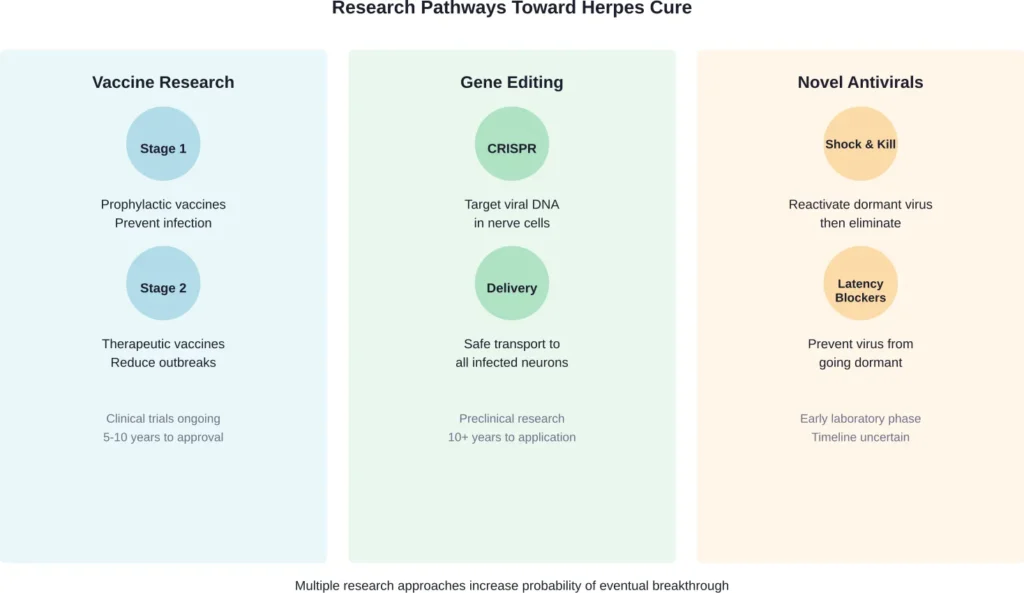
Multiple vaccine candidates are in various stages of development and clinical trials. These fall into two categories:
Prophylactic vaccines aim to prevent infection in people who’ve never had herpes. Therapeutic vaccines target people already infected, attempting to reduce outbreak frequency and severity or possibly clear the virus.
Several research teams have shown promising results in animal studies, though translating these findings to human efficacy has proven challenging. The complexity of the immune response needed to control herpes makes vaccine development particularly difficult.
Gene Editing Approaches
CRISPR and related gene-editing technologies represent a potential game-changer. These tools could theoretically target and destroy viral DNA hiding in nerve cells.
Researchers have demonstrated in laboratory settings that gene-editing enzymes can find and cut HSV DNA. The challenge lies in safely delivering these molecular scissors to every infected nerve cell in a living person without causing unintended genetic changes.
Real talk: this technology is still years away from human trials, but the concept has moved from science fiction to scientific possibility.
Novel Antiviral Strategies
Some researchers are exploring medications that work differently from current antivirals. Instead of blocking viral replication, these experimental drugs target the latency phase itself.
One approach involves reactivating dormant virus throughout the body simultaneously, then using powerful antivirals to eliminate the active virus before it can re-establish latency. This “shock and kill” strategy has shown promise in laboratory studies but hasn’t yet proven safe or effective in humans.
Living Well With Herpes
While researchers work toward a cure, millions of people manage herpes successfully. The diagnosis doesn’t have to define someone’s life or relationships.
According to Yale Medicine experts discussing how the stigma of herpes harms patients, as many as half to 60 percent of adults in United States have oral herpes, caused by HSV-1, and one of six individuals lives with genital herpes. The infection is far more common than many people realize.
Reducing Outbreak Frequency
Several lifestyle factors influence outbreak frequency:
- Stress management through meditation, exercise, or therapy
- Adequate sleep—typically 7-9 hours nightly
- Avoiding known triggers like excessive sun exposure or specific foods
- Maintaining overall immune health through balanced nutrition
- Limiting alcohol consumption
Some people find that tracking their outbreaks helps identify personal triggers. What causes reactivation varies significantly between individuals.
Preventing Transmission
People with herpes can have healthy sexual relationships. Key prevention strategies include:
Using barrier methods like condoms consistently reduces transmission risk, though they don’t provide complete protection since herpes can affect skin not covered by condoms. Avoiding sexual contact during outbreaks is critical, as viral shedding is highest when sores are present.
Suppressive antiviral therapy significantly reduces asymptomatic viral shedding—when the virus is present on skin without visible symptoms. Suppressive antiviral therapy has been shown to reduce transmission risk to partners.
Disclosure to sexual partners before intimacy is both ethically important and often legally required in some jurisdictions. Many people find that honest conversations about herpes strengthen relationships rather than ending them.
Debunking Common Myths
Misinformation about herpes is rampant. Let’s clear up some persistent myths.
Myth: Only promiscuous people get herpes. Reality: Herpes is incredibly common and can be transmitted through a single sexual encounter or even non-sexual contact for HSV-1. Moral judgments have no basis in medical fact.
Myth: You can always tell when someone has herpes. Reality: Most people with HSV don’t know they’re infected because they have no symptoms or symptoms so mild they don’t recognize them as herpes.
Myth: Natural remedies can cure herpes. Reality: While some complementary approaches may help manage symptoms, no natural remedy has been scientifically proven to eliminate the virus from the body. Research on complementary and alternative medicine for genital herpes shows patients use various treatments, but conventional antiviral drugs remain the only proven effective therapy.
Myth: Herpes only affects the genitals or mouth. Reality: HSV can infect other body parts, including fingers, eyes, and in rare cases, the brain. Proper hygiene prevents auto-inoculation to other sites.
When to See a Healthcare Provider
Anyone suspecting a first herpes infection should seek medical evaluation. Initial outbreaks tend to be the most severe, and early antiviral treatment provides maximum benefit.
According to CDC guidelines, HSV NAAT assays are the most sensitive tests for detecting HSV from genital ulcers or other mucocutaneous lesions. Although multiple FDA-cleared assays exist for HSV detection, these tests vary in sensitivity from 90.9% to 100%.
People with compromised immune systems should be particularly vigilant. About 30% of people hospitalized with herpes zoster have compromised or suppressed immune systems, making complications more likely.
Seek immediate medical attention if experiencing:
- Severe pain that doesn’t respond to over-the-counter medications
- Outbreaks lasting longer than two weeks
- Frequent outbreaks (more than six per year) despite suppressive therapy
- Signs of secondary bacterial infection like spreading redness or pus
- Symptoms near or affecting the eyes
The Bottom Line on Herpes and Hope
So, is it possible to get rid of herpes? With current medical technology, no. The virus establishes a permanent presence in nerve cells that existing treatments can’t eliminate.
But that’s not the end of the story. Effective management exists now, and genuine hope for a cure is building on solid scientific foundations. Vaccine trials continue advancing. Gene-editing technologies are maturing. Novel antiviral strategies are under investigation.
The timeline remains uncertain—maybe five years, maybe twenty. But researchers are making real progress toward solutions that were pure fantasy a generation ago.
In the meantime, antiviral medications, symptom management strategies, and informed prevention practices allow people with herpes to live full, healthy lives. The virus doesn’t have to control anyone’s relationships, career, or happiness.
Understanding the facts—what’s possible now and what’s coming—empowers better decisions and reduces the stigma that often causes more harm than the virus itself.
If concerned about herpes, talk with a healthcare provider. Testing, treatment options, and counseling are readily available. Knowledge replaces fear, and support is out there.
Frequently Asked Questions
No, herpes simplex virus cannot go away on its own. Once infected, the virus remains in the body permanently. However, symptoms can go away without treatment—initial outbreaks typically resolve within 2-4 weeks even without antiviral medication. The virus then enters a latent phase but remains in nerve cells. While symptoms may disappear for extended periods, the infection itself persists for life.
Suppressive antiviral therapy is highly effective for many people. Antiviral medication can significantly reduce outbreak frequency in people who previously experienced frequent recurrences. Additionally, suppressive therapy reduces asymptomatic viral shedding, lowering transmission risk to partners by approximately 50%. Effectiveness varies by individual—some people experience complete outbreak suppression while others see partial reduction.
Yes, stress is a well-documented trigger for herpes reactivation. When the body experiences physical or emotional stress, cortisol and other stress hormones can suppress immune function, allowing dormant virus to reactivate. Other common triggers include illness, fatigue, hormonal changes, sun exposure, and immune suppression from medications. However, triggers vary significantly between individuals, and some people experience outbreaks without identifiable causes.
No fundamental difference exists in cure potential between HSV-1 (typically oral) and HSV-2 (typically genital). Both virus types establish latency in nerve cells using the same mechanisms. Either type can infect either location—HSV-1 can cause genital herpes and HSV-2 can cause oral herpes. The biological challenges preventing a cure are identical regardless of infection site or virus type. Research targeting HSV generally addresses both types simultaneously.
Several herpes vaccine candidates are in clinical trials, but none are expected to reach the market in the immediate future. Based on current research timelines, experts estimate that a successful vaccine might become available within 5-10 years, though this is speculative. Vaccine development faces significant challenges because the immune response needed to prevent or clear HSV infection is complex and not fully understood. While progress is genuine, realistic expectations suggest vaccines are still years away from widespread availability.
Yes, people with herpes can absolutely have children safely. For pregnant individuals with genital herpes, the main concern is neonatal herpes—transmission to the baby during delivery. This risk is highest when the mother acquires herpes for the first time late in pregnancy. Suppressive antiviral therapy during the final weeks of pregnancy further reduces risk. Healthcare providers can develop safe delivery plans, and cesarean delivery may be recommended if active lesions are present at the time of labor.
No natural or alternative treatment has been scientifically proven to cure or eliminate herpes from the body. Some people report that certain supplements or remedies help manage symptoms, but evidence is limited and inconsistent. Research on complementary and alternative medicine for genital herpes shows that while patients use various treatments, conventional antiviral drugs remain the only proven effective therapy. Anyone interested in complementary approaches should discuss them with healthcare providers and continue evidence-based treatments rather than replacing them with unproven alternatives.