

Quick Summary: Hip dips are natural inward curves between the hips and thighs caused by bone structure, not body fat. While exercises can build surrounding muscle to reduce their appearance slightly, hip dips cannot be completely eliminated without surgical procedures like fat grafting or implants.
Scroll through social media for five minutes and you’ll probably encounter at least one post about hip dips. Some call them violin hips. Others refer to them as hip divots or hip valleys.
But here’s what matters: these small indentations between your hip bone and upper thigh have become a source of insecurity for many people. And that’s led to a flood of “miracle” exercises and treatments promising to eliminate them completely.
So can you actually get rid of hip dips? The short answer is more complicated than fitness influencers might want you to believe.
What Are Hip Dips Exactly?
Hip dips are inward curves that appear just below your hip bones and above your outer thighs. They create a slight indentation along the sides of your body where the skin dips inward rather than curving smoothly outward.
Some people have very prominent hip dips. Others barely notice them. And some people don’t have visible hip dips at all.
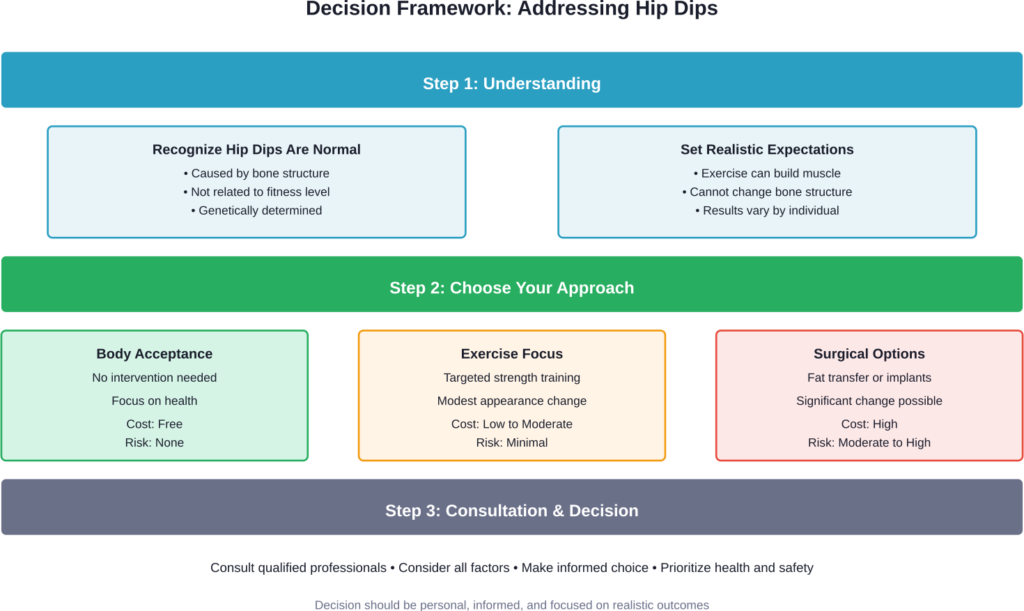
The key thing to understand? Hip dips are completely normal. They’re not a sign of being out of shape, carrying extra weight, or having weak muscles. They’re simply a natural aspect of human anatomy.
Why They’re Called Violin Hips
The term “violin hips” comes from the shape these indentations create. When hip dips are prominent, the body’s silhouette resembles the curved sides of a violin, with the dip creating that characteristic inward curve before the thigh curves back out.
It’s actually a pretty accurate description. But unlike the musical instrument, there’s nothing harmonious about the way social media has turned this natural feature into something people feel they need to fix.
What Actually Causes Hip Dips?
According to the National Institutes of Health, the hip joint forms where the femoral head articulates with the acetabulum of the pelvis. The shape and structure of these bones determine whether you’ll have visible hip dips.
Specifically, hip dips result from the relationship between your greater trochanter (the bony protrusion at the top of your femur) and your ilium (the uppermost part of your hip bone).
The Role of Bone Structure
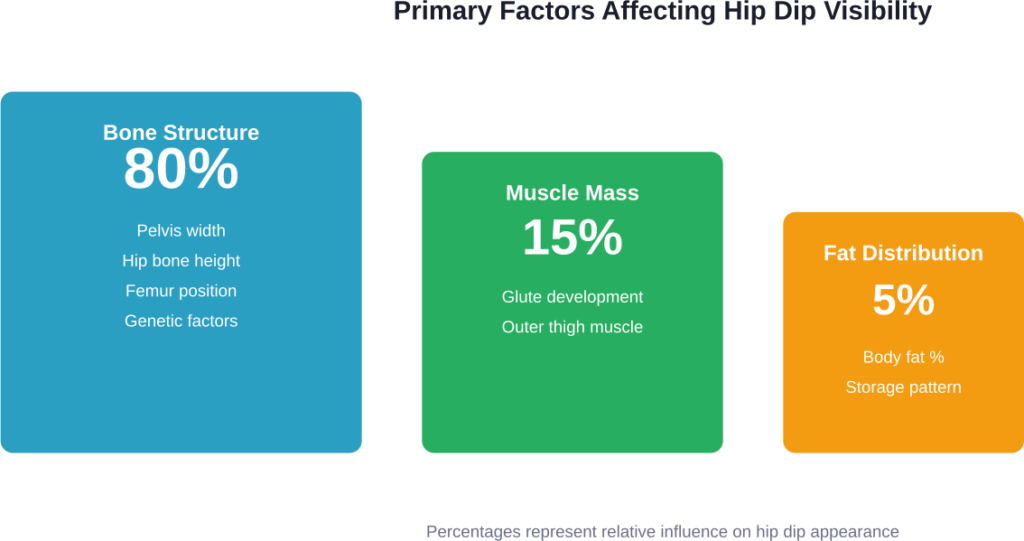
Your skeletal structure is the primary factor. People with high hip bones relative to their femur tend to have more noticeable hip dips. Those with wider-set hip bones might have more prominent indentations as well.
Research on hip morphology published by the National Center for Biotechnology Information shows that hip bone development is influenced by genetics, evolutionary factors, and skeletal maturation. The acetabulum completes its fusion between ages 20-25, meaning your basic hip structure is largely determined by your mid-twenties.
Here’s what that means in plain language: your bone structure sets the foundation for whether you’ll have hip dips. And you inherited that structure from your parents.
Other Contributing Factors
While bone structure is the main driver, a few other factors can affect how prominent your hip dips appear:
- Muscle distribution in your glutes and outer thighs
- Body fat percentage and how your body stores fat
- Width of your pelvis and shoulders
- Overall body proportions
But let’s be clear. These factors only influence the visibility of hip dips. They don’t cause them. Your skeleton does.
Are Hip Dips Related to Body Weight?
Nope. Hip dips have nothing to do with being overweight or underweight.
You can be at a perfectly healthy weight and have prominent hip dips. You can also be carrying extra weight and have no visible hip dips at all. Research on body composition and skeletal features shows that fat deposition patterns vary significantly between individuals regardless of overall body weight.
The confusion comes from the fact that body fat distribution can make hip dips slightly more or less visible. But it doesn’t cause them and it won’t eliminate them.
Hip Dips vs. Love Handles
These are not the same thing. Love handles are accumulations of excess fat around the waistline and lower back. They’re located higher on the torso than hip dips.
Hip dips are indentations below the hip bone. Love handles are protrusions above the hip bone. Losing weight might reduce love handles, but it won’t eliminate hip dips because they’re caused by bone structure, not fat.
Can Exercises Actually Get Rid of Hip Dips?
Here’s the thing fitness influencers often won’t tell you: you cannot eliminate hip dips through exercise alone.
That doesn’t mean exercise is pointless. Building muscle in your glutes and outer thighs can make hip dips less noticeable by filling in the area around them. But you’re not changing your bone structure.
Exercises That Might Help
According to discussions among personal trainers on Reddit, focusing on movements that target the gluteus medius and minimus, along with the tensor fasciae latae is important. These muscles sit in the hip area where dips appear.
Exercises worth trying include:
- Side-lying leg lifts and hip abductions
- Single-leg glute bridges
- Curtsy lunges and lateral lunges
- Side planks with leg raises
- Clamshells and fire hydrants
- Squats with emphasis on glute activation
Real talk: these exercises can build muscle mass around your hips. For some people, that added muscle slightly reduces the appearance of hip dips. For others, the difference is barely noticeable.
The depth of your hip dips depends on your bone structure. And no amount of squats will reshape your pelvis or femur.
What About Cardio?
Cardio helps with overall fat reduction, which can affect how your body looks. But since hip dips aren’t caused by fat, cardio alone won’t eliminate them.
That said, combining strength training with cardiovascular exercise creates a balanced fitness routine that supports overall health. Just don’t expect it to make your hip dips disappear.
Surgical Options for Hip Dips
If exercise can’t eliminate hip dips, what about surgery? According to the American Society of Plastic Surgeons, several cosmetic procedures can reduce the appearance of hip dips.
But wait. These procedures come with significant considerations.
Fat Grafting and Sculpting
The most common surgical approach involves liposuction combined with fat transfer. Surgeons remove fat from areas like the abdomen or thighs, then inject it into the hip dip area to create a smoother contour.
Some practitioners market this as part of a Brazilian butt lift. The American Society of Plastic Surgeons notes that BBL procedures have grown significantly in demand. A typical BBL procedure requires approximately three to four hours in the operating room, with three hours for liposuction and 30 to 45 minutes for fat grafting.
Recovery typically requires wearing compression garments for at least the first month (24/7 except showering) and at least 12 hours daily in the second month, with sitting restrictions lasting several months to allow the transferred fat to establish blood supply.
Implants and Injectable Fillers
Silicone implants can be placed in the hip area to fill in the indentation. Research published in medical journals shows that subfascial gluteal implants provide another option for body contouring.
Some providers also offer injectable fillers like hyaluronic acid to temporarily fill the hip dip area. These require repeat treatments since fillers are eventually absorbed by the body.
Risks and Considerations
All surgical procedures carry risks. Complications can include infection, scarring, asymmetry, and fat reabsorption. The Brazilian butt lift has faced particular scrutiny regarding safety when not performed by experienced surgeons following proper protocols.
Cost is another major factor. These procedures typically aren’t covered by insurance since they’re cosmetic. Prices vary widely depending on location and surgeon experience.
| Procedure Type | Approach | Duration of Results | Key Considerations |
|---|---|---|---|
| Fat Grafting | Liposuction + fat transfer | Long-term (permanent cells) | Studies indicate that the average fat survival rate is approximately 60% |
| Silicone Implants | Surgical implant placement | Permanent (unless removed) | Requires incisions and recovery |
| Injectable Fillers | Hyaluronic acid injections | Temporary (6-24 months) | Requires repeat treatments |
| Body Contouring | Combination approaches | Varies by technique | Multiple procedures may be needed |
Non-Surgical Alternatives
Between doing nothing and going under the knife, several middle-ground options exist.
Targeted Training Programs
Working with a qualified personal trainer who understands hip anatomy can help you build muscle strategically. While this won’t eliminate hip dips, it might reduce their appearance enough that you feel more comfortable.
The key is having realistic expectations. You’re working with your bone structure, not against it.
Body Contouring Treatments
The American Society of Plastic Surgeons recognizes several non-surgical fat reduction technologies. These include cryolipolysis (freezing fat cells), radiofrequency treatments, and laser lipolysis.
However, since hip dips aren’t caused by excess fat, these treatments have limited effectiveness for this specific concern. They might help with overall body shaping, but they won’t fill in the indentation created by your bone structure.
Clothing and Styling Choices
Look, sometimes the simplest solution is the best one. Certain clothing styles can minimize the appearance of hip dips if that’s something you want.
High-waisted bottoms, A-line skirts, and styles with ruching or gathering at the hip area can create a different silhouette. But here’s a thought: you could also just wear whatever you want and not worry about it.
Should You Even Try to Get Rid of Hip Dips?
This is where we need to have an honest conversation.
Hip dips are a normal part of human anatomy. They appear in people of all body types, fitness levels, and sizes. According to anatomical research from the National Institutes of Health, the hip’s bone structure develops through a complex process influenced by genetics and evolutionary factors.
Translation: hip dips are natural. They’re not a flaw that needs fixing.
The pressure to eliminate hip dips largely comes from social media and beauty standards that promote an unrealistic body ideal. Many photos you see online are edited, carefully posed, or feature people who simply have a different bone structure than you.
When to Consider Treatment
That said, your body is yours. If hip dips genuinely bother you and it’s not just about matching an Instagram ideal, then exploring options makes sense.
Consider treatment if:
- You’ve educated yourself about realistic outcomes
- You understand the risks and costs involved
- Your expectations are based on your bone structure, not someone else’s body
- You’re making the decision for yourself, not to please others
Don’t consider treatment if you’re hoping to completely transform your natural body shape or if you’re comparing yourself to heavily edited photos online.
Frequently Asked Questions
No. Hip dips are caused by your bone structure, specifically the relationship between your pelvis and femur. They have nothing to do with your fitness level, muscle tone, or body fat percentage. Athletes and fitness enthusiasts can have prominent hip dips.
No. Since hip dips result from skeletal structure rather than body fat, losing weight won’t eliminate them. In some cases, losing fat might actually make hip dips more visible by reducing padding in the surrounding areas.
If you’re building muscle through targeted exercises, you might notice some changes in 8-12 weeks of consistent training. However, the degree of change depends entirely on your bone structure. Some people may see minimal difference regardless of how much muscle they build.
Hip dips appear in all genders, but they’re often more visible in people with wider pelvises, which is more common in women. That said, hip dip visibility depends on individual skeletal structure rather than gender alone.
Like all surgical procedures, treatments for hip dips carry risks including infection, scarring, and asymmetry. According to the American Society of Plastic Surgeons, safety depends heavily on choosing an experienced, board-certified surgeon who follows proper protocols. Research the procedure thoroughly and discuss all risks during consultation.
No. Hip dips develop as part of normal skeletal growth and maturation. The acetabulum of the hip completes fusion between ages 20-25, meaning your hip structure is determined by genetics and developmental factors beyond your control.
Variation in skeletal structure explains this difference. The width of your pelvis, the height of your hip bones, the angle of your femur, and the distance between your ilium and greater trochanter all contribute to whether you develop visible hip dips. These features are genetically inherited.
The Bottom Line on Hip Dips
Can you get rid of hip dips? The honest answer is: not completely, unless you opt for surgery.
Hip dips are a natural result of your skeletal structure. Targeted exercises might build enough muscle to reduce their appearance slightly, but you’re not going to exercise away your bone structure. That’s just not how anatomy works.
Surgical options exist for people who want a more dramatic change. These procedures can reshape the hip contour through fat grafting, implants, or fillers. But they come with risks, costs, and recovery time that deserve serious consideration.
Maybe the real question isn’t whether you can get rid of hip dips, but whether you should even try. These natural indentations appear in people of all body types. They’re not a flaw or a sign of poor health.
If hip dips genuinely bother you after understanding what causes them, then exploring your options makes sense. Just make sure your decision is based on realistic expectations and personal choice, not social media pressure or edited photos.
Your body’s structure is unique. Hip dips are just one small part of that uniqueness. Whether you choose to embrace them, work with them, or explore treatment options, the decision should be yours alone.
Ready to learn more about body composition, skeletal health, or evidence-based fitness? Check out the official website of the American Society of Plastic Surgeons for current information on cosmetic procedures and consult qualified healthcare professionals for personalized guidance.