

Quick Summary: Telekinesis—the ability to move objects with the mind—lacks credible scientific evidence despite decades of research. Studies reviewed by academic institutions, including meta-analyses of psychokinesis experiments, have failed to produce replicable results that withstand scientific scrutiny. While paranormal beliefs persist in populations, with surveys showing 10-15% of people reporting unusual experiences, controlled experiments consistently reveal no genuine telekinetic abilities.
From Star Wars to Stranger Things, telekinesis has captivated audiences for generations. The idea of moving objects with nothing but thought seems almost within reach—after all, the human brain generates measurable electrical activity. But does that electrical activity translate into the ability to influence physical matter?
The question “is it possible to have telekinesis” surfaces repeatedly in scientific communities, online forums, and popular culture. And the answer matters more than entertainment value suggests.
Understanding whether telekinesis exists requires examining decades of research, controlled experiments, and the fundamental laws of physics. This exploration reveals not just whether mind-over-matter is real, but why the question persists despite overwhelming scientific consensus.
What Is Telekinesis?
Telekinesis comes from the Ancient Greek words “tēle” (meaning “far off”) and “kinesis” (meaning “movement”). The term describes the supposed ability to influence or move physical objects using only mental effort, without any physical interaction.
Scientists typically use the term “psychokinesis” or “PK” when discussing this phenomenon in research contexts. The distinction matters little—both terms reference the same claimed ability.
Common depictions of telekinesis include:
- Moving objects across a room without touching them
- Bending metal objects like spoons or keys through concentration
- Levitating items or oneself
- Influencing the roll of dice or random number generators
- Altering physical systems through focused intention
The concept extends beyond Hollywood dramatization. Some claim subtler forms exist, like influencing quantum random number generators or affecting the behavior of particles at microscopic scales—sometimes called “micro-psychokinesis” or “micro-PK.”
But claiming something exists and proving it are entirely different matters.
The Scientific Investigation of Telekinesis
Researchers have studied telekinetic claims for over a century. These investigations range from laboratory experiments with dice and random number generators to attempts at replicating dramatic demonstrations of supposed psychic powers.
Early Research and Meta-Analyses
Scientific interest in psychokinesis produced hundreds of experimental studies. Research has examined multiple studies testing whether human intention could influence random number generators.
According to research published in medical journals, these experiments tested whether people could mentally influence random outcomes—essentially the smallest possible demonstration of telekinetic ability.
The results? A 2018 Bayesian analysis published by the National Institutes of Health examined intentional observer effects on quantum randomness. The research specifically tested micro-psychokinesis claims using quantum-based random number generators.
Participants attempted to influence whether positive or negative stimuli appeared, with researchers expecting above-chance results (greater than 50%) if psychokinetic effects existed. The Bayesian analysis “reveals evidence against micro-psychokinesis” according to the study’s title and findings.
This represents a critical blow to telekinesis claims. If humans can’t influence something as simple as a random number generator—the most generous possible test of telekinetic ability—how could anyone move physical objects?
Government-Funded Research Programs
Perhaps surprisingly, governments have investigated psychic phenomena, including telekinesis. According to UC Davis reporting from 1995, secret government experiments on “psychic spying” produced what two academic experts called “the most credible evidence to date that humans have paranormal abilities.”
But here’s the thing—even that “credible evidence” came with massive caveats.
The experts who reviewed the previously classified U.S. government research agreed the program “produced statistically significant results,” but they disagreed completely about interpretation. Statistical significance doesn’t equal proof of telekinesis—it can indicate measurement artifacts, experimental flaws, or chance findings that appear meaningful.
The government ultimately discontinued these programs, suggesting the findings weren’t compelling enough to justify continued investment.
Why Telekinesis Violates Known Physics
Setting aside experimental evidence, telekinesis faces a more fundamental problem: it contradicts established physical laws governing energy, force, and matter.
The Energy Problem
Moving physical objects requires energy transfer. When someone pushes a book across a table, chemical energy from muscles converts to kinetic energy that moves the book. This energy transfer happens through measurable physical forces.
For telekinesis to work, the brain would need to:
- Generate sufficient energy to move an object
- Transfer that energy across space without a physical medium
- Convert that energy into mechanical force on the target object
The human brain operates on roughly 20 watts of power—about the same as a dim light bulb. That energy manifests as electrochemical signals between neurons, not as a force that projects outward to influence distant objects.
No known mechanism allows brainwave activity to exert physical force on external objects. The electrical signals in neural tissue dissipate rapidly and lack the organized structure to produce directed mechanical effects.
The Force Carrier Problem
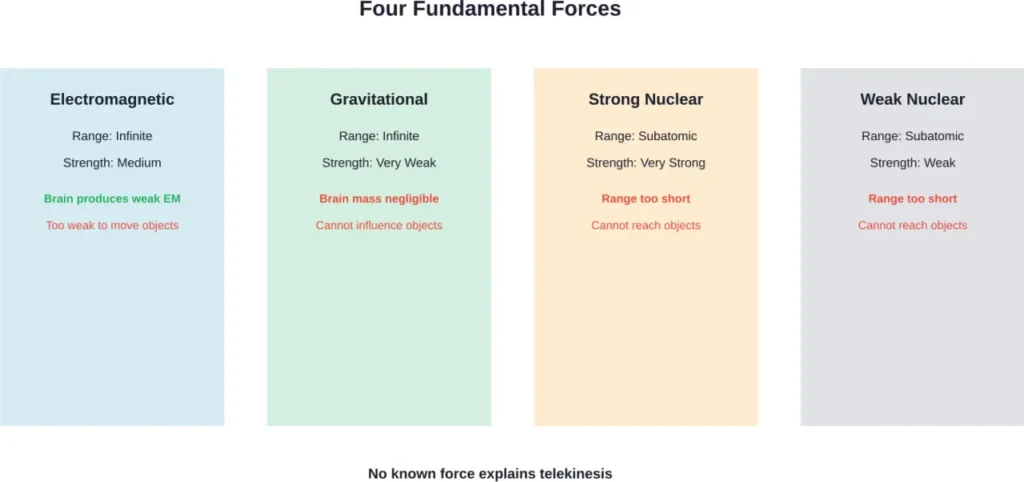
Physics recognizes four fundamental forces: gravitational, electromagnetic, strong nuclear, and weak nuclear. Any genuine telekinetic ability would require operating through one of these forces or discovering an entirely new fundamental force.
The strong and weak nuclear forces only operate at subatomic distances—far too short-range for telekinesis. Gravity, while infinite in range, is incredibly weak. The gravitational effect of a human brain on a nearby object is negligible, orders of magnitude too small to produce observable movement.
That leaves electromagnetism. While the brain does produce electromagnetic fields (detectable via EEG), these fields are:
- Extremely weak—measured in microvolts at the scalp
- Rapidly diminishing with distance
- Insufficient to move non-magnetic objects
- Easily shielded or blocked
No combination of known forces explains how mental activity could move objects across a room.
Famous Telekinesis Claims and Debunking
Despite the physics problems, some individuals have claimed telekinetic abilities. These claims invariably collapse under scrutiny.
The Project Alpha Deception
One of the most instructive cases in telekinesis research involved what became known as “Project Alpha.” According to documented accounts, researchers studying psychokinetic phenomena believed they had found genuine subjects with telekinetic abilities.
The reality proved embarrassing for the research community. James Randi, a professional magician and skeptic, eventually revealed that the subjects were two of his associates—amateur conjurers Steve Shaw and Michael Edwards.
The pair had created all the observed effects using standard magic techniques and tricks. The researchers, unfamiliar with conjuring methods, interpreted these demonstrations as proof of telekinesis.
This incident highlighted a critical flaw in psychokinesis research: scientists trained in physics, psychology, or statistics often lack expertise in detecting deception and illusion. A competent magician can easily fool even brilliant researchers if those researchers don’t understand how tricks work.
Why Controlled Conditions Matter
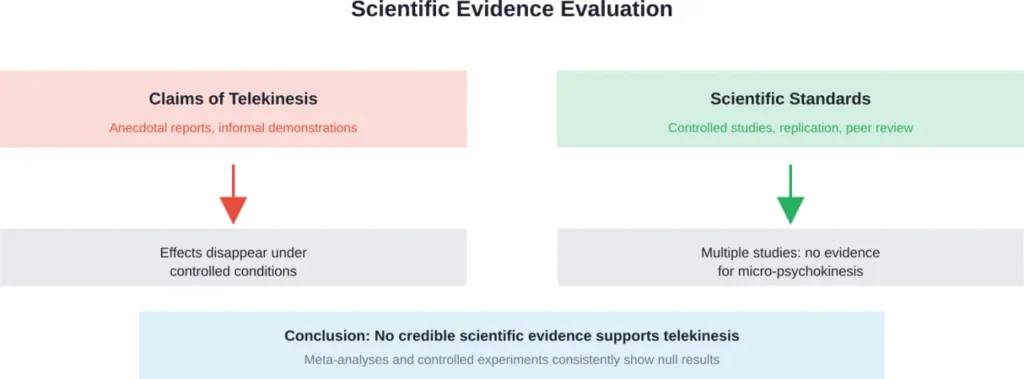
Genuine psychic demonstrations face a consistent pattern: they work under loose conditions but fail under tight experimental controls.
A 2014 study examined this phenomenon systematically. When experimental protocols prevented standard trickery—using methods like:
- Video recording from multiple angles
- Searching subjects before demonstrations
- Having magicians or skeptics present as observers
- Requiring demonstrations in unfamiliar locations
- Prohibiting the subject from touching or approaching target objects
The telekinetic effects disappeared completely.
This pattern appears so consistently that it constitutes strong evidence against genuine telekinesis. Real physical phenomena don’t vanish when observation methods improve—they become easier to measure and verify.
The Psychology Behind Telekinesis Beliefs
If telekinesis isn’t real, why do people believe in it? The answer involves fascinating aspects of human psychology and perception.
Prevalence of Paranormal Beliefs
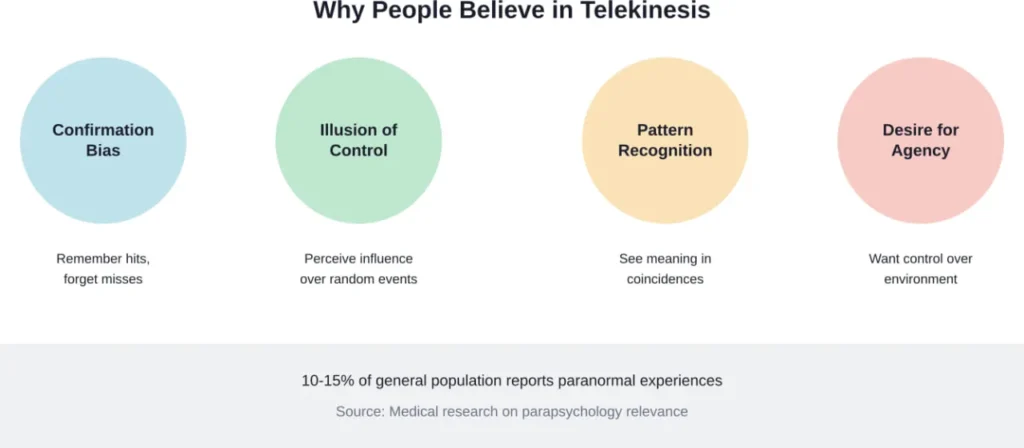
Research published in medical journals reveals that paranormal beliefs are surprisingly common. According to a study examining the relevance of parapsychology in psychiatric practice, independent surveys show that between 10% and 15% of persons reported having had communications from persons not in contact with them.
While this statistic refers to a broader category of paranormal experiences, it demonstrates that unusual subjective experiences occur frequently enough that many people develop explanations involving supernatural or psychic phenomena.
Research on paranormal health beliefs acknowledges that “levels of belief vary as a function of survey questions and respondent types,” and notes the prevalence of paranormal beliefs in contemporary Western societies (approximately 50% in some surveys).
Cognitive Biases That Support Belief
Several psychological mechanisms make telekinesis claims more believable than they should be:
Confirmation bias: People remember instances that seem to support telekinesis while forgetting or dismissing failures. If someone concentrates on a door and it subsequently opens, they may remember this as evidence of psychokinesis—ignoring the hundreds of times they concentrated on doors that didn’t open, or the fact that someone simply walked through.
Illusion of control: Humans tend to perceive control over random events. This bias makes people believe their mental focus influenced an outcome that occurred by chance.
Pattern recognition: Human brains evolved to detect patterns, even when none exist. Random coincidences between thoughts and events can appear meaningful when they’re actually statistical noise.
Desire for agency: The idea that minds can directly influence reality appeals to a fundamental human desire for control and significance. Telekinesis offers an empowering fantasy in an often unpredictable world.
Noetic Experiences and Subjective Reality
Research on noetic experiences—the term comes from Greek “noēsis” meaning inner wisdom or direct knowing—reveals important insights about paranormal beliefs.
A qualitative analysis of first-person accounts examined 521 reports of noetic experiences. The study noted that “strong cultural taboos exist about sharing these experiences,” which means many people have subjective experiences they interpret as paranormal but hesitate to discuss openly.
The research analyzed 364 accounts from the United States, plus reports from Canada, the United Kingdom, Australia, New Zealand, and other countries. These personal experiences feel real to those who have them, even if objective evidence doesn’t support supernatural explanations.
Understanding this distinction matters: people aren’t necessarily lying about their experiences. They’re genuinely interpreting subjective mental states, coincidences, or misperceived events as evidence of telekinetic ability.
What About Quantum Mechanics?
Some telekinesis proponents invoke quantum mechanics, arguing that observer effects in quantum physics prove consciousness can influence physical reality. This represents a fundamental misunderstanding of quantum theory.
The Observer Effect Misinterpretation
In quantum mechanics, “observation” doesn’t mean conscious awareness—it means any interaction that extracts information from a quantum system. A detector, measuring device, or even a stray photon can “observe” a quantum system. Consciousness plays no special role.
The double-slit experiment often gets misrepresented in this context. Particles behave differently when measured versus unmeasured, but the measurement apparatus causes this change, not the consciousness of whoever reads the results later.
Research on intentional observer effects tested whether human consciousness could influence quantum random number generators. The 2018 Bayesian analysis found evidence against such effects, contradicting the claim that consciousness directly affects quantum systems.
Scaling Problems
Even if consciousness somehow influenced quantum systems (which evidence doesn’t support), quantum effects operate at incredibly small scales. Quantum superposition and entanglement collapse almost instantly when systems interact with the warm, noisy environment of everyday macroscopic objects.
This phenomenon, called decoherence, means quantum weirdness doesn’t translate to the classical world of chairs, pencils, and other objects that telekinesis supposedly affects. The bridge between quantum mechanics and macroscopic telekinesis simply doesn’t exist.
Testing Telekinesis: Why Claims Always Fail
Multiple organizations have offered substantial prizes for demonstrated paranormal abilities under controlled conditions. The most famous was James Randi’s One Million Dollar Paranormal Challenge, which ran for decades.
The Challenge That Nobody Won
Randi’s challenge offered one million dollars to anyone who could demonstrate paranormal abilities, including telekinesis, under agreed-upon scientific testing protocols. The rules were straightforward:
- Applicants described what they could do
- Both parties agreed on testing conditions
- Tests were conducted with proper controls
- Results were evaluated objectively
Thousands applied. Nobody collected the prize before the challenge ended in 2015.
The pattern was consistent: applicants who seemed to demonstrate abilities under informal conditions failed when proper controls were implemented. Those who insisted they could only perform under specific conditions inevitably specified conditions that allowed for trickery or coincidence.
Why Experimental Controls Eliminate Telekinesis
Genuine physical phenomena become easier to detect with better experimental design. If gravity exists, improving measurement precision strengthens evidence for it. If electric current flows, better instruments measure it more accurately.
Telekinesis shows the opposite pattern—effects diminish or disappear as experimental rigor increases. This pattern characterizes artifact and error, not real phenomena.
| Experimental Condition | Claimed Telekinetic Success Rate | Explanation |
|---|---|---|
| Informal demonstration, no controls | Often appears successful | Allows for tricks, coincidence, selective reporting |
| Video recording, subject controls setup | Sometimes appears successful | Subject can manipulate conditions, hide methods |
| Independent observation, basic controls | Rarely successful | Reduces but doesn’t eliminate deception opportunities |
| Scientific protocol, magician consultants | No verified successes | Prevents known methods of deception |
| Double-blind, fully controlled conditions | Results indistinguishable from chance | Eliminates all known artifacts and bias |
The Neuroscience Perspective
Understanding how the brain actually works further undermines telekinesis claims. Neuroscience reveals no mechanisms that would allow mental activity to produce external physical effects.
What Brain Activity Actually Does
When someone thinks, electrical and chemical signals pass between neurons. These processes:
- Generate weak electromagnetic fields measurable by EEG
- Consume oxygen and glucose
- Produce heat as a metabolic byproduct
- Create patterns of neural activation visible in fMRI scans
None of these effects extend beyond the immediate vicinity of neural tissue. The electromagnetic fields produced by thought are millions of times too weak to move physical objects, even those directly adjacent to the skull.
No Unknown Energy Fields
Some telekinesis theories propose unknown energy fields or forces emanating from the brain. This hypothesis faces severe problems.
Modern physics has mapped energy and force interactions with extraordinary precision. Experiments at facilities like CERN probe reality at scales billions of times smaller than atoms. Astronomical observations detect phenomena billions of light-years away.
If an unknown force strong enough to move macroscopic objects existed, it would have appeared in countless experiments across multiple fields of physics. The absence of any such detection, despite exquisitely sensitive instruments, strongly suggests no such force exists.
Alternative Explanations for Reported Experiences
When people report telekinetic experiences, alternative explanations consistently prove more plausible than genuine psychokinesis.
Common Misattributions
Environmental factors: Air currents, vibrations, static electricity, and temperature gradients can move lightweight objects in ways that seem mysterious to those unfamiliar with these effects.
Unconscious physical action: People sometimes move objects through minute physical actions they don’t consciously register. Slight vibrations from muscle tension, breathing, or postural shifts can affect delicately balanced items.
Selective memory: The brain remembers surprising coincidences more readily than mundane non-events. Someone might remember the one time they thought about a picture falling and it fell, while forgetting thousands of thoughts that didn’t correspond to physical events.
Priming and expectation: When people attempt telekinesis in controlled settings, they often unconsciously seek situations where random movement is likely—like lightweight objects near air vents or items on unstable surfaces.
The Role of Deception
Not all telekinesis claims involve honest mistakes. Some involve deliberate fraud.
Professional magicians can create convincing telekinesis illusions using:
- Hidden threads or wires
- Magnetic or electrostatic effects
- Concealed air jets
- Clever staging and misdirection
- Accomplices
- Video editing and manipulation
The Project Alpha case demonstrated that even scientists studying psychokinesis can be fooled by relatively simple tricks when they lack expertise in deception detection.
Telekinesis in Popular Culture vs. Reality
The persistence of telekinesis in entertainment media creates a cultural familiarity that influences perception. When people grow up watching characters move objects with their minds, the concept seems more plausible than it actually is.
Fiction’s Impact on Belief
Telekinesis appears throughout popular culture:
- Star Wars’ Force users manipulate objects telekinetically
- Stranger Things features Eleven’s psychokinetic abilities as a central plot element
- X-Men’s Jean Grey demonstrates powerful telekinesis
- Carrie depicts telekinesis emerging from emotional trauma
- The Matrix shows characters bending physical laws through mental focus
These portrayals serve narrative purposes and create compelling drama. But they also normalize an impossible ability, making it seem like an undiscovered human potential rather than pure fantasy.
Science Fiction vs. Science Fantasy
Understanding the distinction matters. Science fiction extrapolates from known science, imagining plausible future technologies or undiscovered phenomena that fit within physical laws. Science fantasy invokes impossible elements for storytelling purposes.
Telekinesis falls firmly into science fantasy. No extrapolation from current physics leads to mind-over-matter capabilities. The concept requires discarding fundamental physical principles, not extending them.
What Science Actually Shows About Mind-Matter Interaction
While direct telekinesis doesn’t exist, the relationship between mind and matter isn’t entirely separate. Understanding genuine mind-matter connections helps clarify what’s real versus what’s fantasy.
Legitimate Mind-Body Connections
The mind demonstrably affects physical reality through normal biological mechanisms:
Voluntary movement: Mental intention causes muscle contractions that move the body and manipulate objects—through entirely understood neural and muscular pathways.
Autonomic responses: Thoughts and emotions trigger measurable physiological changes like heart rate variation, sweating, and hormone release.
Placebo effects: Beliefs and expectations can influence health outcomes through complex neurobiological mechanisms involving immune function, pain modulation, and healing processes.
Stress responses: Mental states affect physical health through documented pathways involving cortisol, inflammation, and immune function.
These represent genuine mind-matter interactions operating through known biological mechanisms. They’re fascinating and powerful—but they’re not telekinesis.
Brain-Computer Interfaces: Technology, Not Psychic Power
Modern brain-computer interfaces allow people to control external devices using neural activity. Someone can think about moving a cursor, and the cursor moves on screen. This might superficially resemble telekinesis.
But the mechanism involves:
- Sensors detecting brain electrical activity
- Computers analyzing those patterns
- Software translating patterns into commands
- Electronic devices executing those commands
At no point does mental activity directly influence matter. Technology mediates every step, using conventional electronics and software. This represents engineering achievement, not paranormal ability.
The Burden of Proof and Extraordinary Claims
Carl Sagan famously stated that extraordinary claims require extraordinary evidence. Telekinesis represents an extraordinary claim—one that violates established physical laws and requires rewriting fundamental science.
What Would Constitute Proof?
Demonstrating telekinesis would require:
- Repeatable demonstrations under controlled conditions
- Results significantly exceeding chance expectations
- Effects that persist when tricks and deception are prevented
- Independent replication by skeptical researchers
- Physical measurements showing force or energy transmission
- A theoretical framework explaining the mechanism
- Consistency with known physics or identification of new physical principles
Despite over a century of research and countless claims, none of these standards have been met.
Why Absence of Evidence Matters
Some argue that absence of evidence isn’t evidence of absence. While technically true in a philosophical sense, this reasoning becomes weaker as the search becomes more thorough.
After thousands of tests, hundreds of studies, decades of investigation, and millions of dollars in research funding, the continued absence of credible evidence becomes highly informative. At some point, failure to find something despite exhaustive searching constitutes strong evidence that it doesn’t exist.
Telekinesis research has reached and surpassed that point.
Implications for Belief and Critical Thinking
Understanding why telekinesis isn’t real offers broader lessons about evaluating extraordinary claims and developing scientific literacy.
Red Flags for Pseudoscience
Telekinesis exhibits classic pseudoscientific characteristics:
- Claims that violate established physical laws without proposing testable alternatives
- Reliance on anecdote and testimony rather than controlled experiments
- Effects that diminish or disappear under rigorous testing
- Immunity to falsification through ever-shifting criteria and excuses
- Appeals to quantum mechanics without understanding quantum theory
- Lack of peer-reviewed publication in mainstream scientific journals
- Conspiracy theories about why mainstream science rejects the claims
Recognizing these patterns helps evaluate not just telekinesis but other extraordinary claims.
The Value of Skepticism
Skepticism doesn’t mean reflexive disbelief—it means proportioning belief to evidence. For well-established phenomena with abundant evidence (like gravity or evolution), skepticism leads to acceptance. For claims lacking credible evidence (like telekinesis), skepticism leads to rejection or suspension of belief.
This approach protects against both gullibility and close-mindedness. It remains open to genuine discoveries while filtering out unsupported claims.
Frequently Asked Questions
No. While some studies have claimed statistical anomalies, no laboratory demonstration of telekinesis has met scientific standards for proof. Meta-analyses combining hundreds of studies show no credible evidence for psychokinetic effects. A 2018 Bayesian analysis examining micro-psychokinesis experiments found evidence against the phenomenon. When proper controls prevent deception and bias, telekinetic effects disappear completely.
This argument faces logical problems. Modern instruments detect incredibly subtle effects—gravitational waves from colliding black holes, individual photons, and quantum effects in single atoms. If telekinesis existed but remained too weak to measure, it would be too weak to move visible objects, making it functionally nonexistent. Additionally, claims of dramatic telekinesis (moving visible objects across rooms) contradict the “too subtle to detect” defense.
Quantum mechanics doesn’t support telekinesis. The “observer effect” in quantum physics refers to measurement interactions, not conscious awareness. Consciousness plays no special role in quantum mechanics according to mainstream physics. Research specifically testing whether human intention influences quantum random number generators found no evidence for such effects. Furthermore, quantum decoherence prevents quantum effects from scaling up to macroscopic objects under normal conditions.
Statistical noise, publication bias, and experimental artifacts explain apparent positive results. With hundreds of studies testing telekinesis, some will show statistically significant results by pure chance—this is what statistics predicts. Studies showing null results often go unpublished, creating a misleading impression when only positive results appear in literature. When proper controls and replication requirements are applied, positive results vanish. The Project Alpha case demonstrated that even researchers can be fooled by simple tricks when they lack expertise in detecting deception.
No. Evolution works through genetic variation and natural selection acting on biologically possible traits. Telekinesis would require mechanisms that violate known physics—no amount of evolutionary time can evolve abilities that contradict fundamental physical laws. Evolution can’t produce organisms that violate conservation of energy, exceed the speed of light, or move objects through nonexistent force carriers. Natural selection optimizes within physical constraints; it can’t override those constraints.
Psychological factors explain widespread belief despite lack of evidence. Confirmation bias causes people to remember apparent successes while forgetting failures. Pattern recognition leads brains to see meaningful connections in random coincidences. The illusion of control makes people perceive influence over random events. Cultural exposure through movies and television normalizes the concept. Research shows 10-15% of people report paranormal experiences, which they may interpret as evidence of abilities like telekinesis even though alternative explanations are more plausible.
Brain-computer interfaces represent the closest legitimate technology. These systems detect brain electrical activity using sensors, then use computers to interpret those signals and control external devices. However, this involves conventional electronics and software, not direct mental influence on matter. Biological examples include voluntary muscle control and autonomic nervous system responses, but these operate through well-understood neural and physiological pathways rather than mysterious forces. None of these represent genuine telekinesis—they’re either technology-mediated or normal biological processes.
Conclusion: The Verdict on Telekinesis
After examining the evidence from multiple angles—physics, neuroscience, psychology, and experimental research—the conclusion is clear: telekinesis is not possible based on current scientific understanding.
No credible scientific evidence supports the existence of psychokinetic abilities. Controlled experiments consistently fail to demonstrate effects exceeding chance. Meta-analyses combining hundreds of studies show no genuine telekinetic phenomena. Research published by authoritative medical and academic institutions, including analyses from the National Institutes of Health, finds evidence against micro-psychokinesis.
The concept violates fundamental physical laws regarding energy, force, and matter. No known mechanism allows mental activity to exert force on external objects. The brain’s electromagnetic output is far too weak to move physical items, and no undiscovered force carriers exist that could mediate such effects.
But understanding why people believe in telekinesis reveals important truths about human psychology. Cognitive biases, the desire for control, pattern recognition tendencies, and cultural influences all contribute to persistent belief despite contrary evidence.
The persistence of telekinesis claims offers valuable lessons in critical thinking and scientific literacy. Learning to evaluate extraordinary claims, recognize pseudoscientific red flags, and proportion belief to evidence creates intellectual tools applicable far beyond this single topic.
Real science offers phenomena more fascinating than fiction—quantum entanglement, neuroplasticity, emergent consciousness, and the genuine mysteries still awaiting discovery. These don’t require abandoning physical laws or critical thinking.
The universe remains wonderfully strange without telekinesis. And honest investigation of what’s actually real proves more rewarding than clinging to comfortable fantasies about impossible abilities.