

Quick Summary: Increasing penile girth is possible through both surgical and nonsurgical methods, with documented outcomes from medical research. Procedures like hyaluronic acid injections, fat grafting, and silicone sleeve implants have shown measurable girth increases ranging from 1.80 to 2.66 cm at various follow-up intervals. Natural methods lack scientific evidence, and the American Urological Association has not endorsed certain procedures as safe or efficacious.
The question of whether girth can be permanently increased has become increasingly common as cosmetic enhancement procedures gain mainstream attention. According to medical research, approximately 12% of the male population perceives their penis to be small, driving demand for enhancement solutions.
But here’s the thing: not all methods are created equal.
Medical literature from institutions like the National Institutes of Health provides concrete data on what actually works, what doesn’t, and what complications might arise. This article examines evidence-based approaches to girth enhancement, separating documented medical outcomes from unsubstantiated claims.
What the Medical Research Actually Shows
Recent studies published in peer-reviewed journals have tracked outcomes for men undergoing various girth enhancement procedures. The data provides realistic expectations rather than marketing promises.
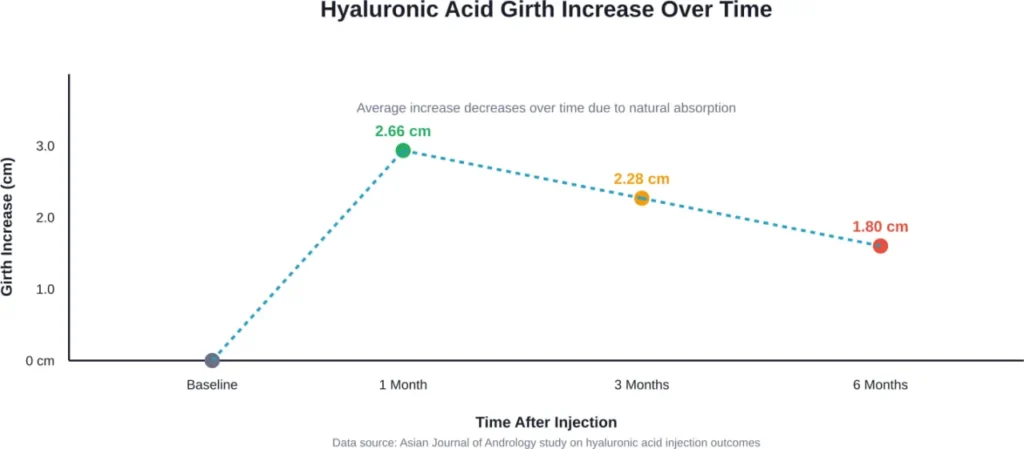
A study published in Asian Journal of Andrology examined hyaluronic acid injection outcomes over a 6-month period. At the 1-month follow-up, penile circumference increased by an average of 2.66 ± 1.24 cm, though results vary by individual. By 3 months, this measured 2.28 ± 1.02 cm, and at 6 months, the increase was 1.80 ± 0.83 cm.
Notice the pattern? The results diminish over time as the body gradually absorbs the filler material.
During the entire 6-month follow-up period, 4.3% of patients experienced complications including subcutaneous bleeding, subcutaneous nodules, and infection. This complication rate is relatively low but not zero.
Psychological Outcomes Matter Too
Research published in Aesthetic Surgery Journal tracked 19 men who underwent nonsurgical penile girth augmentation. Prior to the procedure, 11% met diagnostic criteria for body dysmorphic disorder according to self-reported questionnaires, while 7% met criteria through clinical interview.
The encouraging finding? Those who met the criteria for body dysmorphic disorder before their procedures lost this diagnosis at the 6-month follow-up. Men reported that the perceived discrepancy between their actual and ideal size became significantly smaller after treatment.
The psychological component can’t be ignored. Many men seeking these procedures have physiologically normal anatomy but experience severe preoccupation with size.
Surgical Methods for Girth Enhancement
Several surgical approaches have been studied in clinical settings, each with distinct mechanisms and outcome profiles.
Fat Grafting (Lipofilling)
This procedure harvests fat from another area of the body—typically the abdomen or thighs—processes it, then carefully injects it into the penile shaft to add volume.
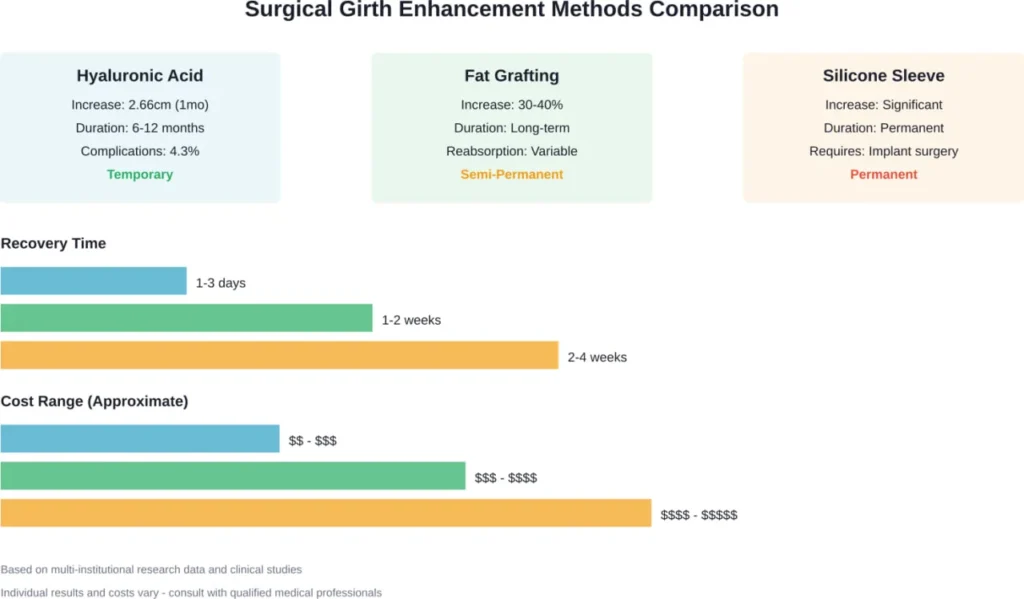
Some clinical sources suggest fat grafting can potentially increase thickness by up to 30-40%, although results vary significantly between patients due to variable fat reabsorption rates.
Real talk: not all the injected fat remains permanently. The body reabsorbs a portion over the months following the procedure, which is why follow-up treatments are sometimes necessary.
Silicone Sleeve Implants
A multi-institutional study published in Therapeutic Advances in Urology examined outcomes for 299 male patients who underwent silicone sleeve implant surgery. The average patient age was 42.5 ± 10.5 years with an average body mass index of 28.5 ± 4.0.
The study measured both flaccid penile length and girth before and after the procedure, tracking complications and patient satisfaction over time. The patient cohort exhibited minimal comorbidities, suggesting these procedures are typically performed on otherwise healthy men.
The increasing popularity of silicone sleeve implants has been accompanied by concerns over potential risks and adverse events, which is why multi-institutional safety data has become increasingly important.
Dermal Fat Grafts
This technique uses a patient’s own dermal and fat tissue to wrap around the penile shaft. The graft is typically harvested from the lower abdomen or buttock area.
Because it uses the patient’s own tissue, rejection isn’t a concern. However, uneven absorption can lead to irregular contours, and the procedure requires more extensive surgery than injectable methods.
Nonsurgical Options and Their Limitations
The appeal of nonsurgical methods is obvious: no incisions, shorter recovery, and typically lower cost. However, the question of lasting results requires careful examination of the evidence.
Hyaluronic Acid Fillers
This is currently one of the most popular nonsurgical approaches. Hyaluronic acid—the same substance used in facial fillers—gets injected beneath the skin of the penile shaft.
The data referenced earlier shows measurable increases, but there’s a catch. The effects are temporary because the body gradually metabolizes the hyaluronic acid. Most patients need repeat treatments every 12-18 months to maintain results.
Complications, while relatively uncommon at 4.3%, can include subcutaneous nodules that create visible or palpable irregularities. Some cases require corrective procedures to resolve.
Platelet-Rich Plasma (PRP)
PRP involves extracting a patient’s blood, concentrating the platelets, and injecting this concentrated plasma into penile tissue. Proponents suggest it stimulates tissue growth and collagen production.
The evidence here is less robust. While some practitioners offer PRP for girth enhancement, large-scale clinical studies documenting efficacy and standardized protocols are limited.
What About Natural Methods?
Community discussions often mention techniques like jelqing, clamping, and pumping. These involve manual manipulation or devices intended to increase blood flow or create tissue expansion.
Here’s where evidence becomes scarce. Peer-reviewed medical literature documenting the safety and efficacy of these approaches is essentially nonexistent. Some techniques carry documented risks including tissue damage, scarring, and vascular injury.
The American Urological Association has stated that certain procedures, including subcutaneous fat injection for increasing penile girth, have not been shown to be safe or efficacious according to their current guidelines.
Understanding Complications and Risks
A review published in Translational Andrology and Urology examined complications across various penile enhancement procedures. The authors noted that as demand for penile enhancement rises, complications are increasingly encountered in urologic practice.
Common complications include:
- Subcutaneous bleeding or hematoma formation
- Infection at injection or surgical sites
- Nodule formation creating visible irregularities
- Asymmetry or uneven contours
- Loss of sensation or altered sensitivity
- Scarring that affects function or appearance
- In rare cases, vascular complications affecting erectile function
A 2019 study in Scientific Reports examined 355 cases of cosmetic penile enhancement surgery at a single center over three years. The research found that while satisfaction rates were generally positive, the 5-item International Index of Erectile Function (IIEF-5) score increased by 6.74% compared to baseline at 12 months post-surgery.
That’s actually a positive outcome. But wait—it highlights an important consideration: any procedure in this anatomical region has the potential to affect sexual function, for better or worse.
Who Actually Seeks These Procedures?
The demographic data provides insight into who pursues girth enhancement. In the study tracking psychological outcomes, the average age was 44.58 years, with a range from 27 to 68 years.
Marital status varied: 47% were married, 21% single, 16% separated, 11% divorced, and 5% widowed. This distribution suggests men in committed relationships—not just single men—seek these procedures.
Most men pursuing girth enhancement have anatomically normal penises. The motivation is often psychological rather than medical, driven by perceived inadequacy or specific relationship dynamics.
| Demographic Factor | Typical Range | Key Consideration |
|---|---|---|
| Age | 27-68 years (avg 44.6) | Spans wide age range |
| Relationship Status | 47% married | Many in committed relationships |
| Body Mass Index | Average 28.5 ± 4.0 | Generally healthy weight range |
| Comorbidities | Minimal in most patients | Typically performed on healthy individuals |
| Baseline Anatomy | Usually within normal range | Motivation often psychological |
The Role of Body Dysmorphic Disorder
Some men seeking girth enhancement meet diagnostic criteria for body dysmorphic disorder specifically related to genital appearance, sometimes called penile dysmorphophobic disorder.
This condition involves persistent preoccupation with perceived defects that aren’t observable or appear only slight to others. The preoccupation causes significant distress or impairment in social, occupational, or other functioning areas.
The research showing that some men lost their body dysmorphic disorder diagnosis after treatment is noteworthy. It suggests that for certain individuals, the procedure addresses genuine psychological distress rather than creating false expectations.
However, careful psychological screening before any cosmetic genital procedure remains essential. Not everyone benefits psychologically, and some individuals may have underlying issues that surgery or injections won’t resolve.
What Professional Organizations Say
The American Urological Association (AUA) has published positions on penile augmentation procedures. According to the AUA Board of Directors (reaffirmed October 2018), subcutaneous fat injection for increasing penile girth is a procedure which has not been shown to be safe or efficacious.
This statement reflects the organization’s assessment of available evidence at the time of their guideline publication. It doesn’t mean the procedures are necessarily dangerous, but rather that sufficient evidence for safety and efficacy hasn’t been established to their standards.
Professional guidelines evolve as more research becomes available. The multi-institutional studies published in recent years are gradually building the evidence base that organizations like the AUA use to formulate recommendations.
Realistic Expectations Matter
Setting appropriate expectations is crucial for patient satisfaction. The data shows measurable increases, but these aren’t dramatic transformations.
A 2.66 cm increase at one month (from hyaluronic acid injection) that diminishes to 1.80 cm by six months represents real change, but the procedure won’t double girth or create proportions that look unnatural.
For fat grafting, the suggestion that thickness can increase by 30-40% sounds impressive. But remember that reabsorption is variable. Some patients might retain most of the grafted fat, while others lose a significant portion.
Silicone sleeve implants provide permanent enhancement but come with the considerations that accompany any implanted medical device: potential for infection, device malformation over time, and the possibility of requiring removal or revision surgery.
The Question of Sexual Function
Does changing girth affect sexual function? This is a legitimate concern for anyone considering these procedures.
The data on erectile function is mixed. Some studies show slight improvements in IIEF-5 scores, possibly because reduced anxiety about size allows for better sexual performance. Other research notes that surgical complications can occasionally impair function.
According to the American Urological Association Erectile Dysfunction Guideline, up to 30 million men in the United States and 150 million men worldwide are estimated to be affected by erectile dysfunction. Risk factors include age, smoking, diabetes mellitus, hypertension, dyslipidemia, depression, obesity, and a sedentary lifestyle.
Men with existing erectile dysfunction should address that condition before considering cosmetic enhancement. Some individuals mistakenly believe girth enhancement will resolve erectile issues, but these are separate concerns requiring different treatments.
Cost Considerations
Prices for girth enhancement vary widely based on geographic location, provider credentials, procedure type, and the amount of material or work involved.
Injectable procedures with hyaluronic acid typically cost less than surgical options but require repeated treatments to maintain results. When calculating lifetime costs, this matters.
Surgical procedures like fat grafting or silicone sleeve implantation involve higher upfront costs but potentially offer longer-lasting results. Insurance rarely covers these cosmetic procedures, so patients pay out of pocket.
Beyond the procedure itself, factor in costs for consultations, follow-up appointments, potential complications, and possible revision procedures.
Finding Qualified Providers
Provider selection significantly impacts outcomes and complication rates. Board-certified urologists with specific training in penile enhancement procedures have the anatomical knowledge and surgical skills to minimize risks.
The rise in demand has unfortunately attracted practitioners with varying levels of expertise. Some clinics aggressively market these procedures without transparent disclosure of complication rates or realistic outcome expectations.
Before committing to any procedure:
- Verify board certification in urology or plastic surgery
- Ask specifically about training and experience with the exact procedure being considered
- Request before-and-after photos of previous patients
- Inquire about complication rates in their practice
- Understand the revision policy if results are unsatisfactory
- Get all cost estimates in writing
Multiple consultations with different providers can provide perspective on approaches, expected outcomes, and costs.
The Future of Girth Enhancement
Clinical trials continue investigating new approaches and refining existing techniques. The ClinicalTrials.gov database lists studies examining various methods including repeat-dose filler formulations and specialized implant designs.
As more data accumulates, procedures may become standardized with clearer protocols, predictable outcomes, and lower complication rates. The multi-institutional research being published represents progress toward evidence-based practice.
Emerging technologies might offer alternatives to current methods. Tissue engineering research explores possibilities for generating new tissue rather than transplanting fat or injecting fillers.
Frequently Asked Questions
Nonsurgical methods like hyaluronic acid fillers provide temporary increases lasting 6-18 months before requiring repeat treatments. True permanent nonsurgical girth increase has not been demonstrated in peer-reviewed medical literature. Fat grafting results can be long-lasting but aren’t guaranteed permanent due to variable reabsorption.
Clinical studies show hyaluronic acid injections increase circumference by an average of 2.66 cm at one month, diminishing to 1.80 cm by six months. Fat grafting sources suggest potential increases of 30-40%, though individual results vary widely. Silicone sleeve implants provide significant permanent enhancement with amounts depending on the device size selected.
Documented complications include subcutaneous bleeding, nodule formation, infection, asymmetry, altered sensation, and scarring. The complication rate in one study was 4.3% for hyaluronic acid injection. More invasive surgical procedures carry higher complication risks. Serious complications like vascular damage or significant erectile dysfunction are rare but possible.
Peer-reviewed medical literature documenting safety and efficacy of manual techniques is essentially absent. The American Urological Association has not endorsed these methods. Community discussions report mixed results with potential for tissue damage. Medical professionals generally do not recommend these approaches due to lack of evidence and potential risks.
Cosmetic penile enhancement is typically not covered by health insurance as it’s considered elective. Exceptions might exist for reconstructive procedures following trauma, cancer treatment, or congenital abnormalities. Patients should expect to pay out-of-pocket for consultations, procedures, and follow-up care.
Recovery varies by procedure. Injectable treatments like hyaluronic acid typically involve minimal downtime of 1-3 days. Fat grafting may require 1-2 weeks of restricted activity. Silicone sleeve implantation involves 2-4 weeks recovery with specific restrictions on sexual activity for 4-6 weeks post-surgery.
Research shows mixed effects on erectile function. Some studies report slight improvements in IIEF-5 scores, possibly due to reduced anxiety. Complications from any penile procedure can potentially impair function, though serious erectile dysfunction from these procedures is uncommon when performed by qualified providers. Existing erectile dysfunction should be addressed separately before considering cosmetic enhancement.
Making an Informed Decision
So—is it possible to increase girth? The medical evidence says yes, through specific surgical and nonsurgical procedures with documented outcomes.
But possible doesn’t automatically mean recommended for everyone. The decision requires weighing realistic expectations against costs, recovery time, complication risks, and psychological factors.
Men with normal anatomy who experience severe distress about size might benefit from psychological evaluation before pursuing enhancement. Some cases of body dysmorphic disorder respond to cognitive-behavioral therapy or medication.
For those who proceed with enhancement, choosing qualified providers and understanding that results vary between individuals sets the foundation for reasonable satisfaction.
The landscape of penile enhancement continues evolving as research accumulates. What remains constant is the need for evidence-based decision-making, transparent communication between patients and providers, and realistic understanding of what these procedures can and cannot achieve.
If considering girth enhancement, start with consultations with board-certified urologists who specialize in this area. Review the actual research rather than relying on marketing materials. And remember that sexual confidence stems from multiple factors beyond measurements.