

Quick Summary: Losing 15 pounds in a month is technically possible but not recommended by health authorities. According to the CDC, safe weight loss occurs at 1-2 pounds per week, meaning 4-8 pounds per month is the medically advised rate. Faster weight loss often leads to muscle loss, nutritional deficiencies, and weight regain.
The question comes up constantly in online forums and doctor’s offices alike: can someone realistically shed 15 pounds in just 30 days?
It’s an ambitious goal. And the answer isn’t a simple yes or no.
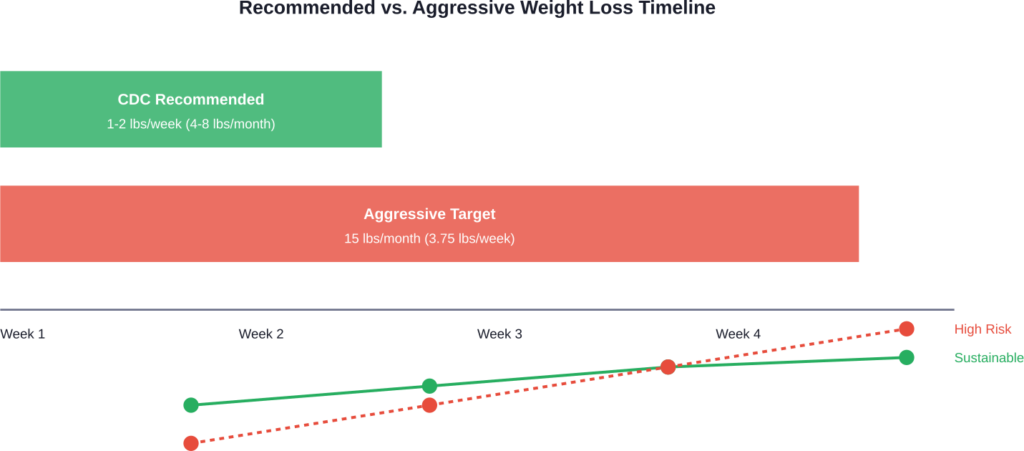
While technically achievable for some individuals, this rate of weight loss significantly exceeds what major health authorities consider safe or sustainable. The CDC recommends a gradual, steady pace of about 1 to 2 pounds per week for healthy weight loss. That translates to roughly 4-8 pounds monthly.
Here’s the thing though—understanding what’s possible versus what’s advisable makes all the difference between short-term success and long-term health.
What Health Authorities Actually Recommend
According to the CDC, healthy weight loss includes a lifestyle with nutritious eating patterns, regular physical activity, adequate sleep, and stress management. This isn’t just about cutting calories aggressively.
The recommended rate of 1-2 pounds weekly exists for good reason. Research documented by the National Institutes of Health shows that rapid weight loss often results in loss of muscle mass alongside fat, which can slow metabolism and make maintaining weight loss significantly harder.
But wait. Does slower weight loss mean better outcomes?
Studies comparing rapid versus gradual weight loss show mixed results. Some research indicates that faster initial weight loss can motivate continued effort. However, the sustainability factor consistently favors the gradual approach.
The Math Behind 15 Pounds in 30 Days
Weight loss fundamentally comes down to creating a caloric deficit. One pound of fat equals approximately 3,500 calories.
To lose 15 pounds in a month, someone would need to create a total deficit of 52,500 calories over 30 days. That’s 1,750 calories daily below maintenance level.
For context, the average adult woman requires about 2,000 calories daily for weight maintenance, while men need roughly 2,500. Creating a 1,750-calorie daily deficit would leave many people consuming dangerously few calories—often below 1,000 per day.
The National Library of Medicine defines rapid weight loss as losing more than 2 pounds per week over several weeks. At 15 pounds monthly (approximately 3.75 pounds weekly), this definitively qualifies as rapid weight loss.
Who Might Lose Weight This Quickly
Real talk: not everyone loses weight at the same rate.
Individuals with higher starting weights often experience faster initial weight loss. Someone weighing 250 pounds will typically lose weight more rapidly than someone at 150 pounds, simply because their body requires more energy for basic functions.
During the first week or two of any weight loss attempt, it’s common to see dramatic drops on the scale. But this isn’t primarily fat loss—it’s water weight. When calorie intake decreases, the body uses stored glycogen, which binds to water. As glycogen depletes, that water is released.
After this initial phase, sustainable fat loss slows to a more predictable rate.
The Real Risks of Aggressive Weight Loss
Losing weight too quickly carries documented health risks that extend beyond simple discomfort.
Muscle Loss and Metabolic Slowdown
When creating extreme caloric deficits, the body doesn’t exclusively burn fat stores. Research shows significant muscle mass loss commonly occurs alongside rapid weight loss. Muscle tissue is metabolically active, meaning losing it reduces daily calorie burn.
This metabolic adaptation makes maintaining weight loss progressively harder.
Nutritional Deficiencies
Very low-calorie diets often fail to provide adequate vitamins, minerals, and essential nutrients. The National Institutes of Health notes that proper nutrition becomes especially challenging when daily intake drops below 1,200-1,500 calories.
Deficiencies can affect everything from bone health to immune function to energy levels.
Increased Risk of Weight Regain
According to CDC data, among people who lost weight and maintained that loss for a year, most continued eating a lower-calorie diet and stayed physically active. Extreme dieting approaches rarely establish these sustainable habits.
Instead, aggressive restriction often leads to a rebound effect once normal eating resumes.
| Weight Loss Rate | Weekly Loss | Monthly Loss | Sustainability Rating |
|---|---|---|---|
| Very Slow | 0.5 lbs | 2 lbs | High – Easy to maintain |
| CDC Recommended (Low) | 1 lb | 4 lbs | High – Sustainable for most |
| CDC Recommended (High) | 2 lbs | 8 lbs | Moderate – Requires consistency |
| Rapid (15 lbs goal) | 3.75 lbs | 15 lbs | Low – High regain risk |
Creating a Realistic Timeline for 15 Pounds
So how long should 15 pounds of weight loss actually take?
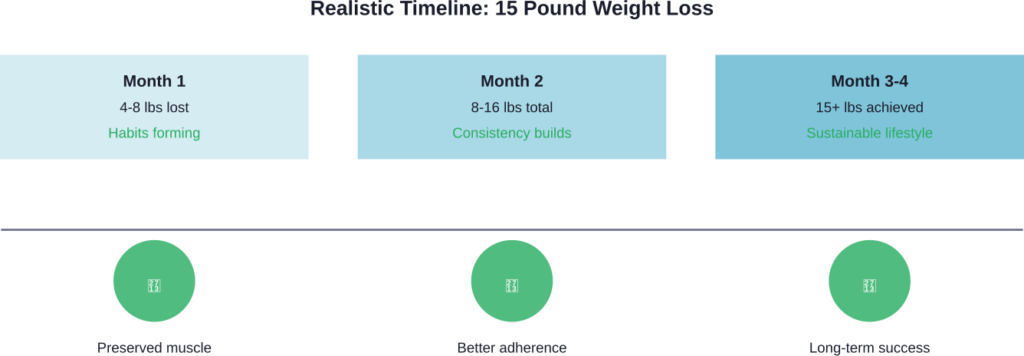
At the recommended rate of 1-2 pounds weekly, losing 15 pounds would require 7.5 to 15 weeks—roughly 2 to 4 months. This timeline allows for sustainable habit formation and minimizes health risks.
The CDC emphasizes that even modest weight loss helps. For someone weighing 200 pounds, a 5% weight reduction (10 pounds) can improve blood pressure, cholesterol, and blood sugar levels. These health benefits don’t require dramatic transformations.
Strategies That Actually Work
Sustainable weight loss isn’t about deprivation—it’s about building habits that stick.
Nutrition Fundamentals
According to CDC guidelines, healthy eating patterns emphasize vegetables, fruits, whole grains, lean proteins, and healthy fats. No single food must be eliminated completely.
Creating a moderate caloric deficit of 500-750 calories daily through improved food choices typically produces the recommended 1-2 pound weekly loss. This deficit is manageable without extreme hunger or restriction.
Research published by the National Institutes of Health on optimal diet strategies indicates that both low-fat and low-carbohydrate approaches can work. The key factor isn’t which diet is chosen, but whether someone can maintain it long-term.
Physical Activity Requirements
The CDC recommends adults get at least 150 minutes of moderate-intensity aerobic activity weekly. That’s roughly 30 minutes daily, five days per week. Examples include brisk walking, swimming, or cycling.
Additionally, adults need muscle-strengthening activities on two or more days weekly. Strength training helps preserve muscle mass during weight loss—critical for maintaining metabolism.
Among people who successfully maintained weight loss long-term, 94% increased their physical activity, with walking being the most common choice.
Sleep and Stress Management
Often overlooked, sleep quality significantly impacts weight management. The CDC notes that adequate sleep is a component of healthy weight loss programs.
Chronic stress can trigger hormonal changes that promote fat storage and increase appetite. Stress management techniques—whether meditation, exercise, or therapy—support the weight loss process.
When Medical Supervision Makes Sense
Very low-calorie diets (VLCDs) providing fewer than 800 calories daily do exist under medical supervision. According to the National Library of Medicine, these approaches may be appropriate for individuals with obesity when significant rapid weight loss provides health benefits.
However, these programs require monitoring by healthcare providers to minimize risks. They’re not appropriate for independent implementation.
Medical conditions including diabetes, heart disease, or eating disorder history warrant professional guidance before beginning any weight loss program. The potential complications from aggressive weight loss increase substantially for these populations.
The Maintenance Challenge
Here’s what community discussions consistently reveal: losing weight is often easier than keeping it off.
CDC data on weight maintenance shows that people who successfully maintained losses continued their healthy eating patterns and stayed physically active. They didn’t return to previous habits once reaching their goal.
This underscores why the method of weight loss matters. Extreme restriction doesn’t teach sustainable behaviors. Gradual change with realistic adjustments does.
| Approach | Average Monthly Loss | Pros | Cons |
|---|---|---|---|
| Moderate calorie reduction | 4-8 lbs | Sustainable, preserves muscle, establishes habits | Slower results, requires patience |
| Very low-calorie diet | 10-15+ lbs | Rapid initial results, may boost motivation | Muscle loss, hard to maintain, nutritional risks |
| Combination diet + exercise | 6-10 lbs | Best for body composition, improves fitness | Time commitment, gradual progress |
| Medical interventions | Varies widely | Professional monitoring, appropriate for severe obesity | Cost, side effects, still requires lifestyle change |
What the Evidence Really Shows
Research comparing rapid versus slow weight loss published in medical journals presents nuanced findings. While some studies show similar total weight loss between fast and slow approaches initially, long-term maintenance consistently favors gradual methods.
A study on rapid versus slow weight loss and metabolic risk factors found that while both approaches produced weight reduction, the sustainability and metabolic effects differed. Rapid weight loss more frequently resulted in muscle loss and metabolic adaptation.
The National Institutes of Health notes that losing more than 5-10% of body weight, or losing weight at faster rates, may improve health markers but increases the possibility of health risks.
Setting Yourself Up for Success
Realistic goal-setting forms the foundation of successful weight loss. Instead of fixating on 15 pounds in 30 days, consider these alternatives:
Aim for 5-10% total body weight reduction over 3-6 months. For a 200-pound person, that’s 10-20 pounds—a significant, achievable goal that produces meaningful health benefits.
Focus on behavior-based goals rather than scale-based outcomes. Examples include eating vegetables with every meal, walking 10,000 steps daily, or strength training twice weekly. These behaviors drive results while remaining within direct control.
Track progress beyond the scale. Measurements, how clothes fit, energy levels, and fitness improvements all indicate success that weight alone doesn’t capture.
Frequently Asked Questions
According to CDC guidelines, safe weight loss occurs at 1-2 pounds weekly, meaning 4-8 pounds monthly is recommended. Losing 15 pounds in 30 days significantly exceeds this rate and carries risks including muscle loss, nutritional deficiencies, and increased likelihood of regaining weight. While technically possible for some individuals, particularly those with higher starting weights, it’s not considered a safe or sustainable approach by health authorities.
At the medically recommended rate of 1-2 pounds per week, losing 15 pounds should take approximately 7.5 to 15 weeks, or roughly 2-4 months. This timeline allows for sustainable habit formation, muscle preservation, and adequate nutrition while minimizing health risks associated with rapid weight loss.
Rapid weight loss frequently results in loss of muscle mass alongside fat, which slows metabolism and makes maintaining weight loss harder. Additional risks include nutritional deficiencies, fatigue, gallstones, dehydration, and increased likelihood of regaining weight once normal eating resumes. Research shows that gradual weight loss produces better long-term maintenance outcomes than aggressive approaches.
Creating a moderate deficit of 500-750 calories below maintenance level typically produces the recommended 1-2 pound weekly loss. For most adults, this means consuming 1,200-1,800 calories daily, though individual needs vary based on age, sex, activity level, and starting weight. The National Library of Medicine cautions that diets providing fewer than 1,200-1,500 calories often fail to provide adequate nutrition without medical supervision.
While weight loss can occur through dietary changes alone, combining nutrition with physical activity produces better outcomes. The CDC recommends at least 150 minutes of moderate-intensity aerobic activity weekly plus muscle-strengthening exercises twice weekly. Exercise helps preserve muscle mass during weight loss, improves body composition, and increases the likelihood of maintaining weight loss long-term. Among people who successfully kept weight off, 94% increased their physical activity.
Research consistently shows higher regain rates following rapid weight loss compared to gradual approaches. Extreme restriction doesn’t establish sustainable eating patterns or address the behavioral factors that contributed to weight gain initially. CDC data indicates that people who maintained weight loss continued their healthy eating patterns and physical activity long-term rather than returning to previous habits once reaching their goal.
Very low-calorie diets providing fewer than 800 calories daily may be appropriate under medical supervision for individuals with severe obesity when significant rapid weight loss provides immediate health benefits. These programs require monitoring by healthcare providers to minimize risks and aren’t suitable for independent implementation. Anyone with medical conditions including diabetes, heart disease, or eating disorder history should consult healthcare providers before beginning any weight loss program.
The Bottom Line
So, is it possible to lose 15 pounds in a month? Technically, yes—for some people under specific circumstances.
But should most people attempt it? The evidence overwhelmingly says no.
Health authorities including the CDC and National Institutes of Health consistently recommend gradual weight loss of 1-2 pounds weekly for good reason. This pace preserves muscle mass, provides adequate nutrition, establishes sustainable habits, and dramatically improves the odds of maintaining weight loss long-term.
The individuals who successfully lose weight and keep it off share common patterns: they make gradual changes, stay physically active, continue healthy eating patterns indefinitely, and view weight management as a lifestyle rather than a temporary project.
Instead of chasing aggressive monthly targets, focus on building habits that support health for years to come. The 2-4 months required to lose 15 pounds sustainably represents a tiny fraction of a lifetime—but the habits formed during that period can last forever.
Ready to start a sustainable weight loss journey? Begin with small, manageable changes: add one serving of vegetables daily, walk for 20 minutes after dinner, or replace one processed snack with whole food. These seemingly minor adjustments compound over time into significant results without the risks associated with extreme approaches.