

Quick Summary: Losing 5 pounds in a single day is technically possible through extreme dehydration and waste removal, but it’s not safe or sustainable. What you’d actually lose is water weight and waste—not body fat. According to the CDC, healthy weight loss occurs at 1-2 pounds per week through balanced nutrition and regular physical activity.
The internet is flooded with promises of rapid weight loss. Search for losing weight quickly and you’ll find countless methods claiming you can drop 5 pounds overnight. But here’s the thing—what’s technically possible and what’s actually healthy are two very different conversations.
Let’s break down the science behind rapid weight loss, what’s really happening when the scale drops dramatically, and whether chasing that number is worth the health risks.
What Happens When You “Lose” 5 Pounds in a Day
First, the physics of weight loss. A pound of body fat contains approximately 3,500 calories. To lose 5 pounds of actual fat in 24 hours, you’d need to create a calorie deficit of 17,500 calories in a single day.
That’s not just difficult—it’s essentially impossible for most people.
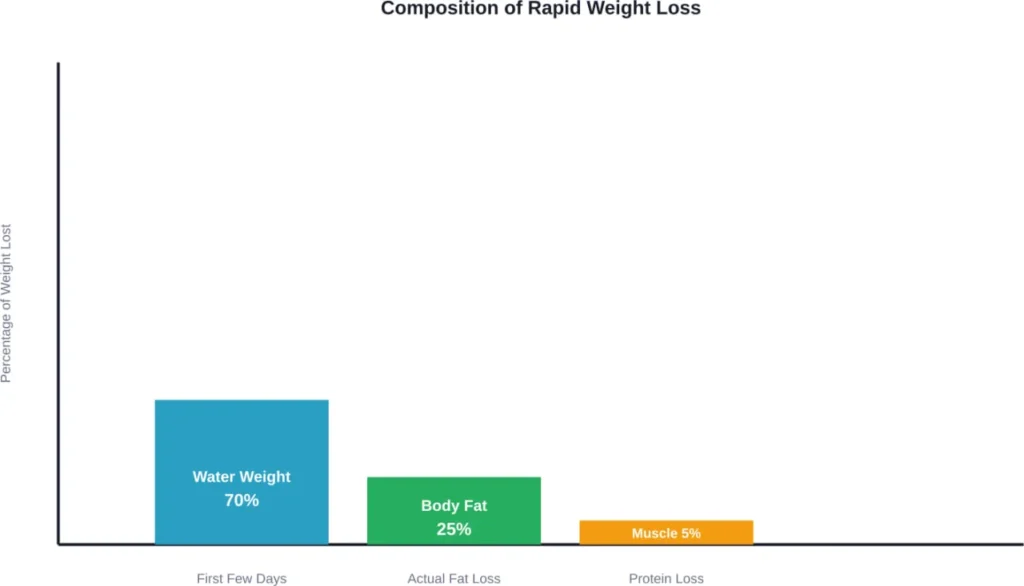
According to research published in academic studies on weight management, about 70% of weight loss during the first few days of extreme dieting comes from body water and glycogen losses. Only about 25% comes from body fat stores, and 5% from body protein (muscle tissue).
When someone claims they lost 5 pounds in a day, they’re almost certainly losing:
- Water weight from dehydration
- Waste material still in the digestive system
- Glycogen stores (which bind to water molecules)
- A tiny fraction of actual body fat
Combat sport athletes have studied this extensively. Research shows that six of the studies on rapid weight loss strategies reported that an RWL strategy of around 5% of body weight loss did not affect performance parameters. For a 200-pound person, that could translate to 10 pounds—but implementation comes with significant considerations.
The Water Weight Phenomenon
Your body is roughly 60% water. That fluid shifts constantly based on what you eat, how much you drink, your sodium intake, and your activity level.
When people dramatically drop their carbohydrate intake, they deplete glycogen stores. Each gram of glycogen binds to approximately 3-4 grams of water. Drain those stores and the scale drops quickly—but that’s not fat loss.
Here’s what actually causes water weight fluctuations:
| Factor | Effect on Water Weight | Potential Scale Change |
|---|---|---|
| Sodium intake | High sodium causes water retention | 2-4 pounds |
| Carbohydrate restriction | Depletes glycogen and bound water | 3-5 pounds |
| Intense sweating | Temporary fluid loss | 2-6 pounds |
| Digestive waste | Food and waste in GI tract | 1-3 pounds |
| Menstrual cycle | Hormonal water retention | 2-5 pounds |
Community discussions on weight loss forums frequently mention people seeing 5-pound drops overnight. What they’re experiencing is the release of retained water—often after a high-sodium meal the day before.
Methods People Use (And Why They’re Risky)
Despite the health warnings, some people attempt extreme measures to drop weight fast. Here’s what those methods actually do:
Severe Calorie Restriction
Eating virtually nothing for 24 hours creates a massive energy deficit. But you won’t burn 17,500 calories in a day through restriction alone.
The average person’s basal metabolic rate ranges from 1,200 to 2,000 calories daily. Even with zero food intake and intense exercise, the math simply doesn’t support 5 pounds of fat loss.
Excessive Exercise
According to the CDC, adults need at least 150 minutes of moderate-intensity aerobic activity weekly for overall health. Some extreme approaches suggest multiple hours of intense cardio in a single day.
That level of activity can burn 1,000-2,000 additional calories—still nowhere near the 17,500 needed for 5 pounds of fat loss. What it does accomplish is dangerous levels of fatigue and potential injury.
Dehydration Methods
This is where things get genuinely dangerous. Methods include:
- Excessive sauna use
- Wearing sweat suits during exercise
- Restricting all fluid intake
- Using diuretics or laxatives
Research on rapid weight loss incorporating hot water immersion shows these methods can achieve significant fluid loss. But that same research confirms the health risks are substantial.
Dehydration affects cognitive function, physical performance, and vital organ function. Studies on body fluid balance and hemoglobin mass during rapid weight loss show decreased plasma volume and concerning changes in blood composition.
The Health Risks You Can’t Ignore
The StatPearls medical database outlines serious risks associated with excessive weight loss. While they define weight loss over 10% of body weight as “large,” rapid loss through extreme methods creates immediate dangers.
Here’s what can happen:
Short-Term Complications
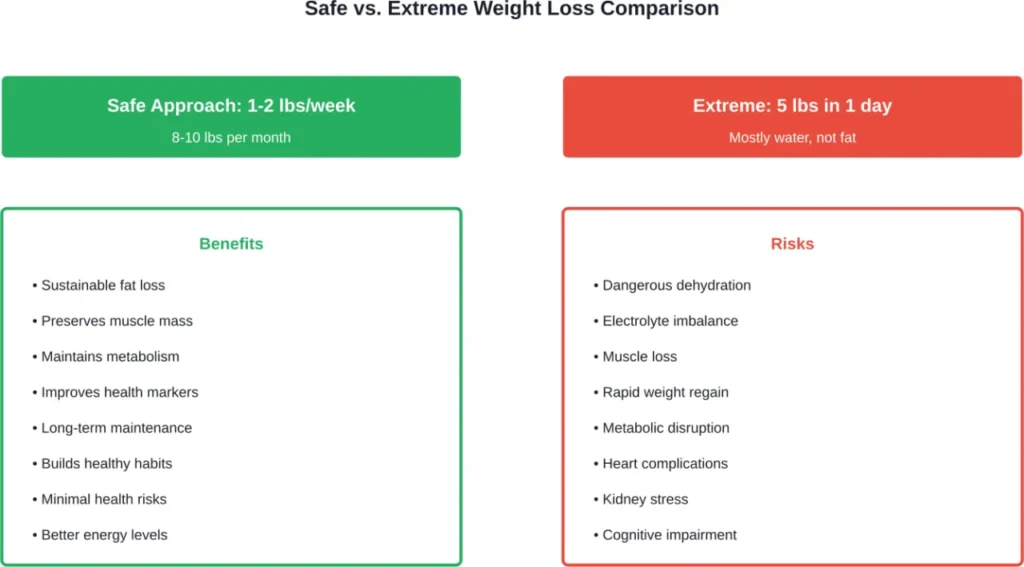
- Severe dehydration and electrolyte imbalances
- Dizziness, confusion, and fainting
- Heart palpitations and irregular heartbeat
- Muscle cramps and weakness
- Kidney stress and potential damage
- Extreme fatigue and impaired cognitive function
Longer-Term Consequences
Research on the metabolic consequences of weight reduction shows that aggressive dieting triggers adaptive responses. Your body fights back by:
- Slowing metabolic rate to conserve energy
- Increasing hunger hormones
- Decreasing satiety signals
- Reducing energy expenditure beyond what’s expected
Studies of weight loss maintenance show sobering statistics. In a 2001 meta-analysis of 29 long-term weight loss studies, more than half of lost weight was regained within two years. By five years, that number climbed to 80%.
But wait—does metabolic adaptation really doom weight loss efforts? Recent research from the University of Alabama at Birmingham challenges this assumption. Scientists found no evidence that metabolic adaptation leads to weight regain, despite the phenomenon being real.
What the CDC Actually Recommends
According to the CDC, healthy weight loss follows a gradual, steady pace of about 1 to 2 pounds per week. That might sound frustratingly slow compared to “lose 5 pounds in a day” promises, but it’s what actually works long-term.
Here’s why that rate matters: losing 1-2 pounds weekly typically requires a calorie deficit of 500-1,000 calories per day. That’s achievable through a combination of dietary changes and increased physical activity without extreme measures.
The CDC emphasizes that even modest weight loss provides significant health benefits. A 5% weight reduction for someone weighing 200 pounds—just 10 pounds—can improve blood pressure, cholesterol, and blood sugar levels.
What Actually Works for Sustainable Weight Loss
So if dropping 5 pounds overnight isn’t the answer, what is?
The CDC outlines five evidence-based steps for weight loss that actually lasts:
1. Make a Specific Plan
Vague goals like “lose weight” don’t work as well as specific, measurable targets. Research shows that setting concrete objectives increases success rates significantly.
2. Focus on Healthy Eating Patterns
The American Heart Association recommends an overall healthy dietary pattern that includes a wide variety of vegetables, fruits, whole grains, and lean proteins. This isn’t about perfection—it’s about consistency.
According to research on total calorie intake, eating less overall may be more effective than time-restricted eating approaches like intermittent fasting. A six-year study found that the time interval from first to last meal wasn’t associated with weight change, but total daily calorie intake was.
3. Get Regular Physical Activity
The CDC recommends at least 150 minutes of moderate-intensity aerobic activity weekly. This could be brisk walking 22 minutes a day; 30 minutes a day, 5 days a week; or what works for your schedule.
Physical activity helps maintain weight loss, but you don’t need marathon training sessions. Research on physical activity and weight management shows that even breaking activity into three 10-minute sessions throughout the day provides benefits.
4. Manage Stress and Sleep
These factors are often overlooked but critically important. Poor sleep disrupts hunger hormones, increasing cravings and making calorie control harder. Chronic stress triggers cortisol release, which affects fat storage patterns.
5. Build Long-Term Habits
Studies of people who successfully maintained weight loss show common patterns. According to CDC data on weight maintenance, successful individuals continued eating a lower-calorie diet, stayed physically active, and monitored their weight regularly.
When Rapid Weight Loss Makes Sense
There are legitimate scenarios where faster weight loss occurs—but it’s supervised and medically appropriate.
Research comparing rapid versus slow weight loss shows that under clinical supervision, more aggressive approaches can be safe for certain individuals. Medical weight loss programs sometimes use very low-calorie diets (800-1,200 calories daily) for people with obesity-related health conditions.
Combat sport athletes also use rapid weight loss strategies, but with important caveats. Studies show that when rapid weight loss is around 5% of body weight and includes proper recovery time, performance impacts are minimal. But these athletes work with sports medicine professionals and follow strict protocols.
That’s vastly different from internet advice promising easy weight loss through extreme DIY methods.
The Bottom Line on Losing 5 Pounds in a Day
Can you technically lose 5 pounds in 24 hours? Through extreme dehydration and emptying your digestive system, yes. Will it be actual fat loss? No. Is it safe? Absolutely not.
Real fat loss requires time. At a healthy pace of 1-2 pounds per week, losing 5 pounds takes 2.5 to 5 weeks. That might not sound exciting, but here’s what matters: that weight is far more likely to stay off.
According to the National Institutes of Health, losing 5-10% of body weight over six months leads to meaningful health improvements. For a 200-pound person, that’s 10-20 pounds—achieved through consistent daily choices, not crash dieting.
If you’re frustrated by the slow pace of healthy weight loss, consider reframing the goal. Instead of chasing a number on the scale, focus on behaviors: eating more vegetables, moving your body regularly, getting adequate sleep, managing stress.
Those habits create lasting change. Extreme methods just create a cycle of loss and regain that damages both physical health and psychological well-being.
Frequently Asked Questions
No, it’s mathematically impossible. One pound of body fat contains approximately 3,500 calories, meaning 5 pounds equals 17,500 calories. Even with zero food intake and intense exercise all day, the human body cannot create that large of a calorie deficit in 24 hours. Any 5-pound loss in a day would be primarily water weight and digestive waste.
Water retention and digestive contents cause most day-to-day weight changes. High sodium intake, carbohydrate consumption, hormonal changes, intense exercise, and the amount of food in your digestive tract can all shift water balance by 2-5 pounds. These fluctuations don’t reflect changes in body fat.
Mild water weight fluctuations are normal, but intentional extreme dehydration is dangerous. Losing significant fluid through methods like excessive sauna use, sweat suits, diuretics, or fluid restriction can cause electrolyte imbalances, heart complications, kidney stress, cognitive impairment, and in severe cases, life-threatening complications. Research on rapid weight loss confirms substantial health risks.
According to the CDC, safe weight loss occurs at 1-2 pounds per week. At this rate, losing 5 pounds would take 2.5 to 5 weeks. This pace allows for actual fat loss while preserving muscle mass, maintaining metabolic rate, and building sustainable habits that support long-term weight maintenance.
Research shows that when done properly under professional supervision with adequate recovery time, weight cuts of around 5% body weight don’t significantly impact performance if rehydration occurs. However, repeated aggressive weight cutting or inadequate recovery between cuts can lead to dehydration-related complications, impaired cognitive function, and long-term metabolic effects.
Almost certainly. Water weight returns as soon as normal eating and hydration resume—often within 24-48 hours. Studies show that over 50% of weight lost through restrictive dieting returns within two years, and 80% returns within five years. Rapid weight loss through extreme methods has even higher regain rates because no sustainable habits are developed.
According to the CDC and National Institutes of Health, losing just 5% of body weight can improve blood pressure, cholesterol, and blood sugar levels. For a 200-pound person, that’s only 10 pounds. Research confirms that even modest, sustained weight loss reduces risk for chronic diseases—you don’t need dramatic transformations to gain meaningful health benefits.
Focus on What Actually Matters
The scale is just one metric, and it’s often misleading. Weight fluctuates constantly based on dozens of factors that have nothing to do with fat gain or loss.
Instead of chasing rapid drops that disappear just as quickly, invest in the boring but effective approach: consistent nutrition, regular movement, adequate sleep, and stress management. According to both CDC guidelines and long-term weight maintenance studies, this is what actually works.
Losing 5 pounds in a day makes for catchy headlines, but it won’t change your life. Building habits that support your health for the next 5 years? That’s where real transformation happens.
If you’re ready to lose weight in a way that actually lasts, start with one small change today. Not a drastic overhaul—just one sustainable improvement to your daily routine. Then add another next week. That’s how lasting change is built.