

Quick Summary: Yes, gold can be created from other elements through nuclear reactions, but the process is extraordinarily expensive and impractical for commercial production. Scientists have successfully transmuted lead and mercury into gold using particle accelerators and nuclear reactors, but the cost far exceeds the value of the gold produced.
The ancient alchemists dreamed of turning lead into gold. They spent centuries mixing chemicals, heating metals, and invoking mystical formulas. They failed, but they weren’t entirely wrong about the possibility.
Modern science has achieved what medieval alchemists couldn’t—creating gold from other elements. But here’s the thing: the process requires nuclear reactions, not chemical ones. And it’s so expensive that you’d lose money on every atom produced.
Why Chemistry Can’t Create Gold
Gold is an element with 79 protons in its nucleus. That atomic number defines what gold is. No amount of chemical reactions can change one element into another because chemistry only rearranges electrons, not protons.
Chemical reactions involve the outer electrons of atoms bonding and breaking. The nucleus stays untouched. This fundamental limitation means traditional chemistry—no matter how advanced—can’t produce gold from other elements.
That’s why we can create synthetic diamonds (they’re just carbon arranged differently) but not synthetic gold. Diamonds are about structure. Gold is about atomic identity.
Nuclear Transmutation: The Real Method
To create gold, scientists must change the number of protons in an atom’s nucleus. This requires nuclear reactions, not chemical ones.
According to Scientific American, physicists at CERN’s Large Hadron Collider briefly created gold ions from lead. The process involves bombarding atoms with high-energy particles in a particle accelerator, causing nuclear reactions that add or remove protons.
There are several proven methods for nuclear gold synthesis:
Particle Accelerator Method
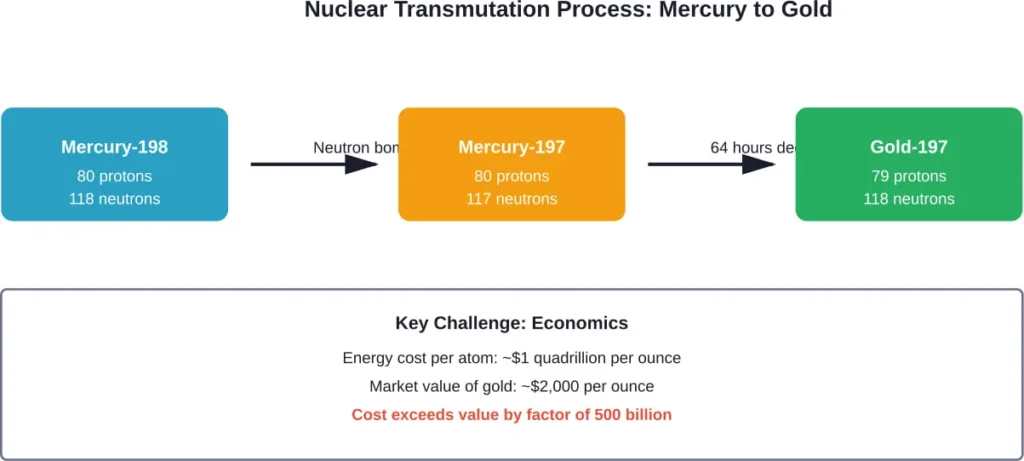
Scientists can bombard mercury-198 (80 protons) with neutrons to create mercury-197, which decays into gold-197 (79 protons) within approximately 64 hours. According to industry sources, this technique could theoretically yield around 5,000 kilograms of gold annually—but at what cost?
Nuclear Fission Products
Gold doesn’t form as a fission product, but related precious metals do. According to Wikipedia’s synthesis of precious metals data, each kilogram of uranium-235 fission products contains 63.44 grams of ruthenium isotopes and smaller amounts of rhodium. These platinum-group metals face the same economic problem as synthetic gold.
The CERN Discovery
About five years before 2018, CERN staff discovered a thin film of precious metals forming on the interior of the Large Hadron Collider. This accidental gold and platinum formation occurred as a byproduct of high-energy particle collisions. The amounts were microscopic, but the discovery proved transmutation happens even in unintended circumstances.
Why Making Gold Isn’t Profitable
The economics are brutal. Running a particle accelerator consumes enormous amounts of energy. The equipment costs millions or billions of dollars. And the amount of gold produced? Microscopic.
The energy required to change even one proton costs exponentially more than the gold’s market value. According to Glenn Seaborg’s particle accelerator experiments, it would cost more than one quadrillion dollars per ounce to produce gold.
That said, the process works. Scientists have done it. The physics is sound. It’s just spectacularly unprofitable.
Natural Gold Formation vs. Laboratory Synthesis
Here’s where it gets interesting. Nature creates gold for free—in supernovas. When massive stars explode, the extreme temperatures and pressures generate nuclear reactions that forge heavy elements, including gold. That gold eventually becomes part of new planetary systems.
Every gold atom on Earth was created in a stellar explosion billions of years ago. Mining simply extracts what nature already made. Laboratory synthesis tries to replicate stellar conditions on Earth, which requires technology that dwarfs the energy budget of any commercial operation.
| Method | Feasibility | Cost vs. Value | Current Status |
|---|---|---|---|
| Chemical synthesis | Impossible | N/A | Cannot change atomic number |
| Particle accelerator | Proven | Cost 500B times higher | Research only |
| Nuclear reactor byproduct | Proven | Cost 100M times higher | Trace amounts only |
| Natural mining | Practical | Profitable | Standard industry method |
Recent Research and Future Possibilities
Nuclear transmutation research continues, but not for gold production. Scientists study these reactions to understand nuclear physics and explore nuclear transmutation applications.
According to IAEA research on gamma ray beam transmutation, scientists achieved transmutation rates of about 1.5-4% for appropriate photon energies when targeting gold-197 and iodine-129. These experiments focus on nuclear waste management, not precious metal synthesis.
A Nature article on transmutation of palladium at electrochemical interfaces was retracted on 11 August 2025, indicating rejected findings. The incident highlights how difficult and controversial transmutation research remains.
Real talk: don’t expect laboratory gold production to become economical. The fundamental physics works against it.
Frequently Asked Questions
Yes, scientists can create gold through nuclear transmutation using particle accelerators or nuclear reactors. The process involves bombarding elements like mercury or lead with high-energy particles to change their atomic structure. However, the cost is prohibitively expensive—far exceeding the value of the gold produced.
Chemistry manipulates electrons, not protons. Since gold’s identity depends on having exactly 79 protons in its nucleus, chemical reactions cannot create gold from other elements. Only nuclear reactions can add or remove protons to transform one element into another.
Yes, physicists at CERN briefly created gold ions from lead using the Large Hadron Collider. The transformation lasted only a fraction of a second and produced microscopic amounts. This proved the concept works but remains economically impractical.
The energy and equipment costs to synthesize gold exceed its market value by a factor of hundreds of millions. While exact figures vary, producing an ounce of gold through nuclear transmutation would cost approximately one quadrillion dollars compared to gold’s market price of around $2,000 per ounce.
All gold on Earth was created in supernova explosions billions of years ago. When massive stars die, the extreme nuclear reactions in their final moments forge heavy elements like gold. This gold became part of the cosmic dust that eventually formed our solar system.
Extremely unlikely. The fundamental physics requires overcoming the strong nuclear force, which demands enormous energy regardless of technological advances. Even theoretical improvements in efficiency wouldn’t close the gap between production costs and gold’s market value. Mining remains vastly more economical.
Nuclear fission doesn’t produce gold as a byproduct. According to research on precious metals synthesis, reactors produce trace amounts of platinum-group metals like ruthenium and rhodium, but not gold. The CERN discovery of gold film was from particle collisions, not fission reactions, and the quantities were too small for recovery.
The Bottom Line
So is it possible to make gold? Absolutely. Scientists have proven methods that work. The physics is settled.
But possible doesn’t mean practical. The alchemists’ dream of profitable gold synthesis remains just that—a dream. The energy costs are astronomical, the equipment is prohibitively expensive, and nature’s method (supernovas) produces gold far more efficiently than any laboratory ever could.
The real magic isn’t in making new gold. It’s in understanding the nuclear physics that makes transmutation possible. That knowledge drives advances in medicine, energy, and materials science that matter far more than synthetic precious metals.
Want to acquire gold? Mining and recycling remain the only economical options. The particle accelerator can stay in the physics lab where it belongs.