
Quick Summary: Raising the Titanic is technically impossible due to extreme structural deterioration from over a century on the ocean floor, metal-eating bacteria that have consumed much of the hull, the ship’s fragmentation into two main pieces, and prohibitive costs estimated in the billions. The wreck also holds protected status as a maritime gravesite, with international agreements preventing disturbance.
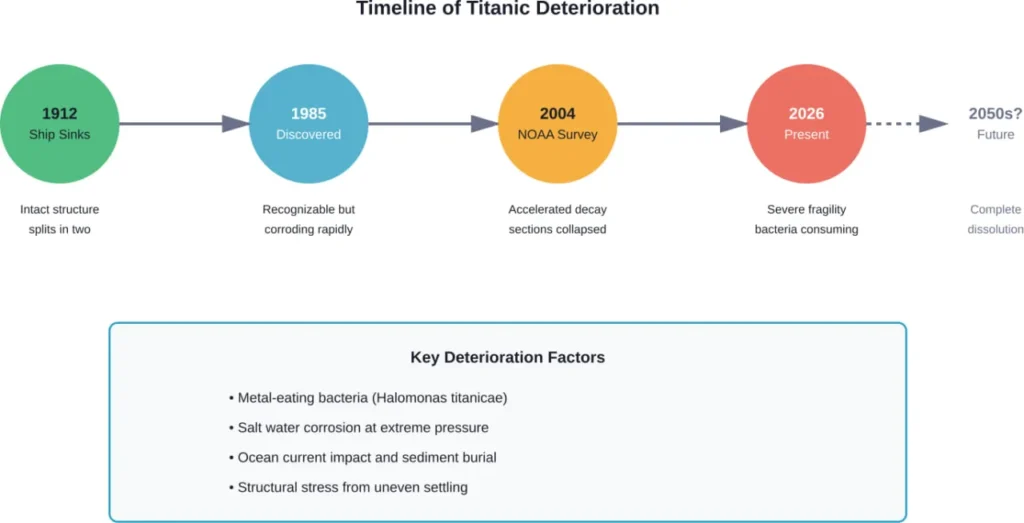
After hitting the iceberg just before midnight on April 14, 1912, the RMS Titanic sank below the North Atlantic’s waves in roughly two and a half hours. More than 1,500 people perished that night, while over 700 survived to tell the tale of the “unsinkable” ship’s tragic end.
For over a century, the question has haunted engineers, historians, and dreamers alike: Could we bring the Titanic back to the surface?
The short answer? No. But the reasons why reveal a fascinating intersection of engineering challenges, biological processes, financial realities, and ethical considerations that make raising the Titanic not just difficult—but genuinely impossible.
The Physical Reality of the Wreck
The Titanic doesn’t rest peacefully intact on the ocean floor. It lies shattered in two main pieces roughly 2,000 feet apart, surrounded by a debris field spanning several hundred yards.
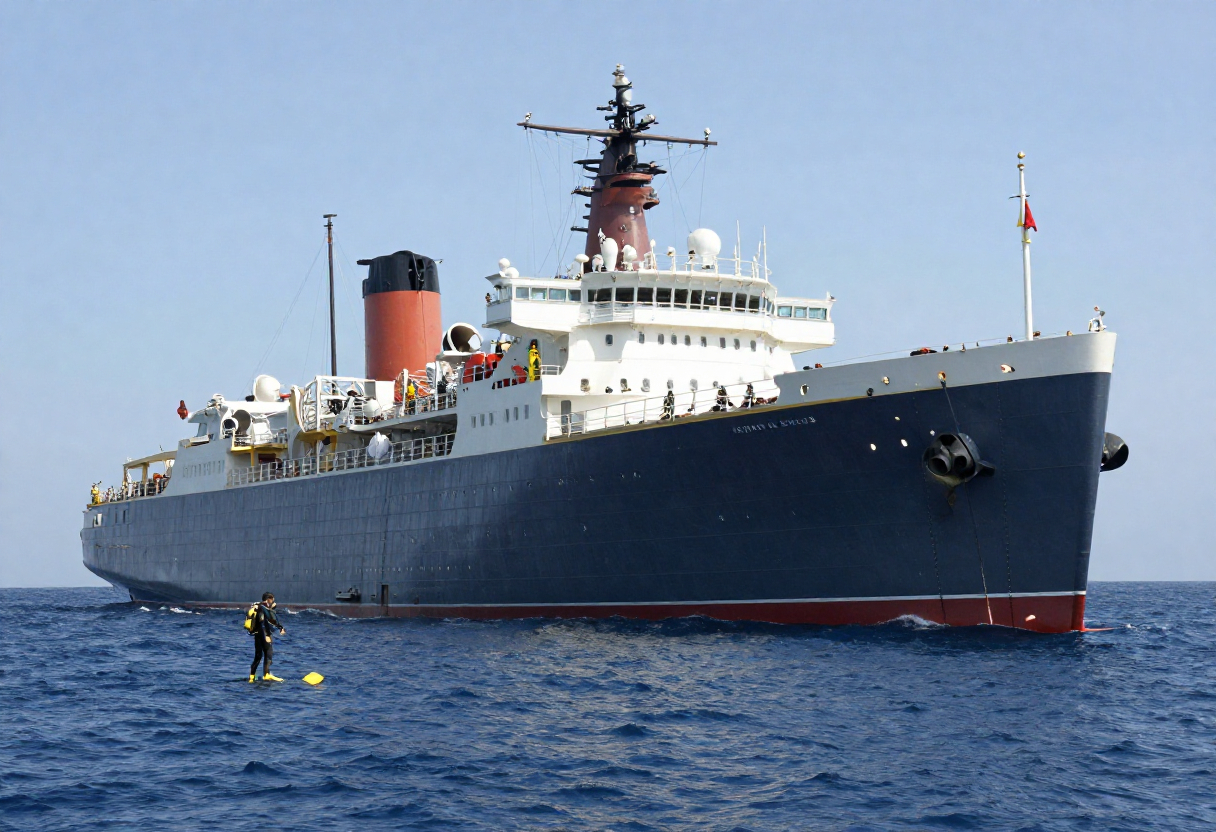
When Robert Ballard discovered the wreck in 1985, followed by NOAA expeditions including a detailed 2004 survey aboard the NOAA Ship Ronald H. Brown, researchers documented the ship’s condition using remotely operated vehicles. What they found wasn’t encouraging for salvage hopes.
The hull has fractured into sections. The bow section, though more recognizable, has suffered extensive damage from the impact with the seabed at speeds estimated around 20-30 mph. The stern section essentially imploded during the descent, leaving it in far worse condition.
Depth Creates Impossible Conditions
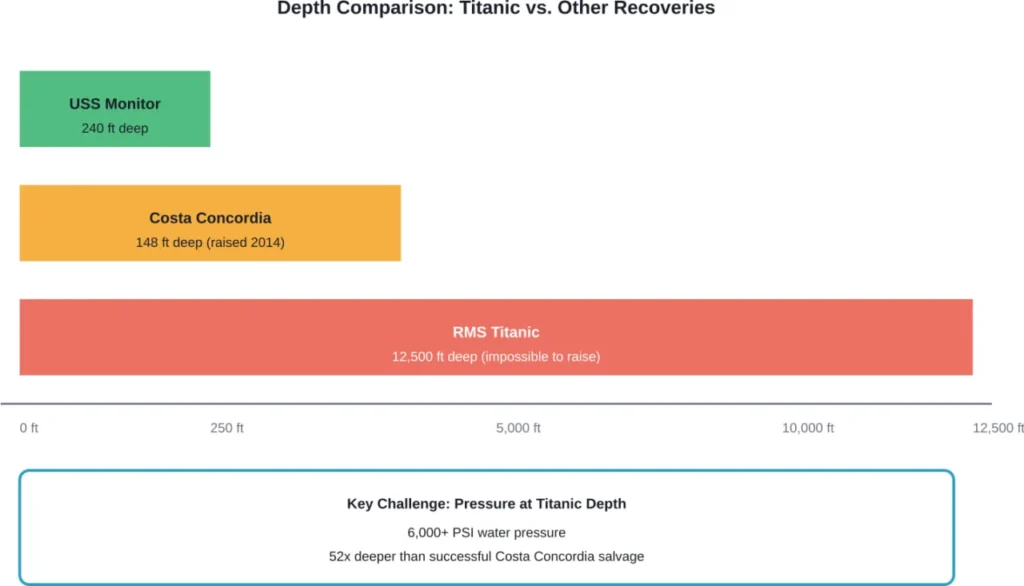
The wreck sits at a depth of 3,840 meters (12,600 feet) below the surface—that’s 2.4 miles down. At this depth, water pressure is extremely high (approximately 6,000 pounds per square inch or more).
Any lifting operation would need to overcome this crushing pressure while manipulating fragile, deteriorated metal structures. The engineering challenges aren’t just difficult—they’re unprecedented in maritime salvage history.
The Biological Time Bomb
Here’s where things get really interesting. The Titanic isn’t just sitting there unchanged—it’s being actively consumed.
Metal-eating bacteria, specifically a species dubbed Halomonas titanicae, feed on the iron in the ship’s hull. These microorganisms create the iconic “rusticles”—rust formations that look like icicles hanging from the wreckage.
These bacteria accelerate corrosion at the extreme depth where the Titanic rests. The cold temperatures and lack of light create perfect conditions for these organisms to thrive.
The Hull Is Disappearing
NOAA’s 2004 expedition, led by marine explorer Robert Ballard nearly 20 years after his initial discovery, found the ship’s deterioration had accelerated significantly. Entire sections that existed in earlier surveys had collapsed or vanished entirely.
The ship’s metal has become so brittle and weakened that touching it with remotely operated vehicles can cause pieces to crumble. Any attempt to attach lifting cables or rigging would likely cause catastrophic structural failure.
The exact timeline for complete dissolution remains uncertain—though exact timelines remain uncertain given the complex biological and chemical processes at work.
The Engineering Impossibility
Even if the metal were intact, the engineering challenges would be staggering.
The Titanic weighed approximately 46,000 tons when it sank—and that’s without accounting for over a century of accumulated sediment, marine growth, and absorbed water in its porous, deteriorated structure.
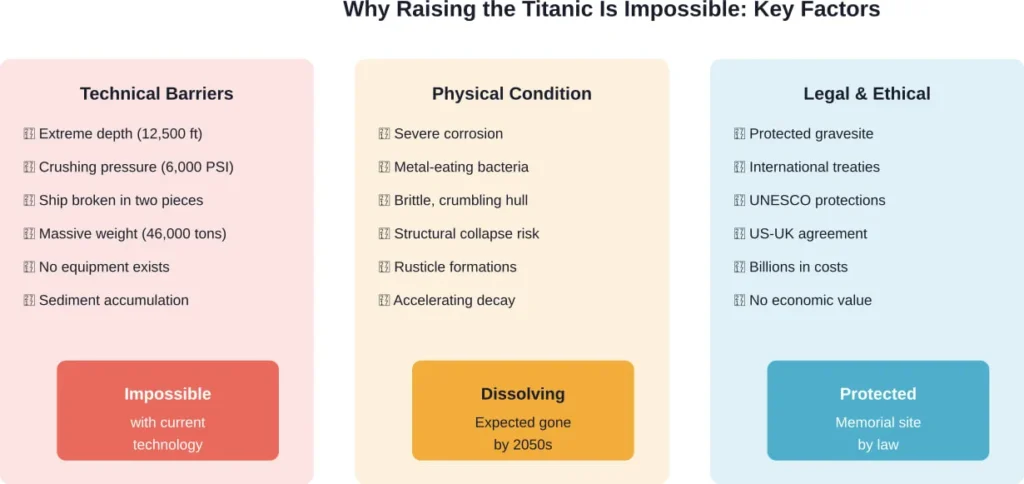
| Challenge Factor | Specific Issue | Why It’s Insurmountable |
|---|---|---|
| Weight | 46,000+ tons to lift | No crane or lifting system exists for this depth and weight combination |
| Structural Integrity | Fragile, corroded metal | Hull would disintegrate under lifting stress |
| Fragmentation | Two main pieces, 2,000 ft apart | Would require simultaneous coordination of multiple impossible operations |
| Depth | 12,500 feet underwater | Exceeds operational limits of conventional salvage equipment |
| Pressure | 6,000+ PSI | Makes attachment of rigging and controlled ascent impossible |
Any lifting operation would need to account for the ship’s tendency to break apart further under stress. The keel and structural supports that once held the ship together have long since failed.
Past Proposals Were Always Fantastical
Over the decades, various schemes to raise the Titanic have been proposed—each more outlandish than the last.
Ideas have ranged from filling the hull with ping-pong balls (to provide buoyancy) to freezing the wreck in a block of ice, to injecting it with petroleum jelly or liquid nitrogen. One proposal even suggested using electromagnetic fields.
None of these ideas account for the fundamental problems: the ship is fragmented, structurally compromised, and at a depth that makes such operations impossible with any known technology.
The Financial Reality
Let’s talk money. Even if raising the Titanic were technically feasible, the costs would be astronomical.
Estimates for such an operation—were it somehow possible—would run into the billions of dollars. For context, the Costa Concordia salvage operation in 2014, which recovered a ship from just 148 feet of water lying on its side near the Italian coast, cost approximately $1.5 billion.
The Titanic sits far deeper, is completely submerged, broken into pieces, and far more deteriorated. Any operation would require developing entirely new technology and equipment.
No Economic Incentive Exists
Unlike some shipwrecks that contain valuable cargo or precious metals, the Titanic’s value lies in its artifacts and historical significance.
Artifacts have been recovered from the debris field over the years, and these items command significant prices at auction. But the ship itself? Its value couldn’t possibly justify the extraordinary costs of an impossible recovery operation.
The Ethical and Legal Barriers
Beyond the technical impossibilities, there’s a crucial ethical dimension. The Titanic is a gravesite.
More than 1,500 people died when the ship went down. Their remains, though likely long since dissolved or consumed by marine life, are part of that site. Many survivors and descendants of victims have long advocated for the wreck to remain undisturbed as a memorial.
International Protections Are in Place
The wreck has protected status under international agreements.
The wreck has protected status through international agreements, restricting who can visit and what can be removed.
Any salvage operation would face significant legal hurdles from multiple countries and international organizations—even if the technical challenges could somehow be overcome.
What About Partial Recovery?
Community discussions have sometimes suggested recovering just parts of the ship rather than the entire wreck. But this faces the same fundamental problems.
Even small sections of the hull have deteriorated to the point where they crumble when touched. The remotely operated vehicles used to survey the wreck must operate with extreme caution to avoid damaging what remains.
Some artifacts from the debris field have been successfully recovered, including dishes, personal items, and small pieces of the ship. These recoveries happen in the debris field surrounding the main wreck sections—not from the hull itself.
Could Modern Technology Ever Change This?
Some might wonder whether future technological advances could make the impossible possible. The reality is sobering.
The problem isn’t just our current limitations—it’s the fundamental physics of the situation combined with the wreck’s deteriorating condition.
Even if we developed revolutionary lifting technology capable of operating at extreme depths, the wreck itself won’t survive long enough. The bacteria consuming the hull won’t stop. The metal won’t suddenly become stronger.
The Window Has Closed
If raising the Titanic were ever possible, it would have been in the years immediately following the sinking—when the hull was still intact and structurally sound.
But even then, the technology didn’t exist. The wreck wasn’t located until 1985, more than seven decades after it sank. By that point, significant deterioration had already occurred.
Real talk: The ocean is winning. And that’s okay.
Frequently Asked Questions
Even if the exact location had been known in 1912, the technology to raise a ship from 12,500 feet didn’t exist. Deep-sea salvage capabilities in the early 20th century were limited to a few hundred feet at most. The ship also broke into two pieces during the sinking, complicating any potential recovery.
Estimates suggest costs would exceed several billion dollars—if it were even technically possible. The Costa Concordia salvage from shallow water cost $1.5 billion. The Titanic sits 84 times deeper, is fragmented, and would require developing entirely new technology. No realistic cost estimate exists because the operation itself is impossible.
A species of bacteria called Halomonas titanicae feeds on the iron in the ship’s hull. These metal-eating microorganisms create rusticles—rust formations that hang from the wreckage. Combined with standard saltwater corrosion and the extreme pressure at depth, these bacteria are accelerating the ship’s dissolution.
Marine scientists estimate the wreck could completely dissolve within the next few decades, possibly by the 2050s. The exact timeline remains uncertain due to the complex interaction of bacterial consumption, chemical corrosion, and structural collapse. Some harder metal components may persist longer than the hull.
Thousands of artifacts from the debris field surrounding the wreck have been recovered, including dishes, personal items, luggage, and small structural pieces. These artifacts come from the scattered debris, not the main hull sections. Some artifacts have been recovered from the debris field surrounding the wreck.
The wreck site is protected under international agreements between the United States and United Kingdom, as well as UNESCO conventions on underwater cultural heritage. Unauthorized salvage operations are illegal. Only expeditions with proper permits and oversight can legally recover artifacts, and such operations face strict regulations.
No. The hull is too fragmented and deteriorated to hold any form of pressurized air or buoyancy material. The structural integrity has been completely compromised after over a century on the ocean floor. Any attempt to pump air into the wreck would simply escape through countless holes, cracks, and corroded sections.
The Legacy That Remains
While we can’t raise the Titanic, we’ve learned enormous amounts from studying the wreck in place.
Expeditions have documented thousands of artifacts, mapped the debris field in extraordinary detail, and provided insights into how the ship broke apart and sank. These findings have improved maritime safety regulations and naval architecture.
The wreck serves as an underwater museum and memorial, visited by specially equipped submersibles on carefully regulated expeditions. These visits allow researchers and filmmakers to document the site while it still exists.
But the clock is ticking. Each year that passes sees more deterioration, more collapse, more dissolution.
Conclusion: Accepting What We Cannot Change
The Titanic will never rise from the ocean floor. The combination of extreme depth, structural deterioration, biological consumption, and astronomical costs creates an insurmountable barrier to any salvage operation.
Perhaps there’s something fitting about that. The ship that was declared unsinkable met its fate in the North Atlantic, and there it will remain—a memorial to the 1,500 souls lost and a reminder of human hubris in the face of nature’s power.
The deep will eventually dissolve the Titanic’s physical form entirely, returning the iron and steel to the ocean that claimed it. What remains is the legacy, the lessons learned, and the stories passed down through generations.
That legacy doesn’t need the physical ship to survive. It lives in the historical record, in the museums that house recovered artifacts, and in the continued fascination with that fateful night in April 1912.
Want to learn more about famous shipwrecks and underwater archaeology? Explore our other articles on maritime history and the cutting-edge technology that allows us to study these underwater time capsules while they still exist.