

Quick Summary: Scientists are making real progress on regrowing human teeth through stem cell therapy, tooth-regrowing drugs, and regenerative medicine. Japanese researchers are testing an antibody drug targeting the USAG-1 protein in human trials starting 2024-2025, with potential availability sometime around 2030. While natural tooth regeneration isn’t yet possible, these breakthroughs could revolutionize dental care within years.
Here’s something that sounds like science fiction: regrowing your own teeth instead of getting painful, expensive implants. But that future might arrive sooner than anyone expected.
According to the World Health Organization, about 7% of people aged 20 and older worldwide experience complete tooth loss. For those over 60, that number jumps to 23%. That’s millions of people dealing with missing teeth from decay, gum disease, injury, or congenital conditions.
The question isn’t whether we want to regrow teeth. It’s whether science can actually pull it off.
The Japanese Breakthrough: A Drug That Regrows Teeth
Japanese researchers have developed something remarkable: an antibody-based medicine that stimulates tooth growth. And it’s not just theoretical anymore—human trials are planned or underway.
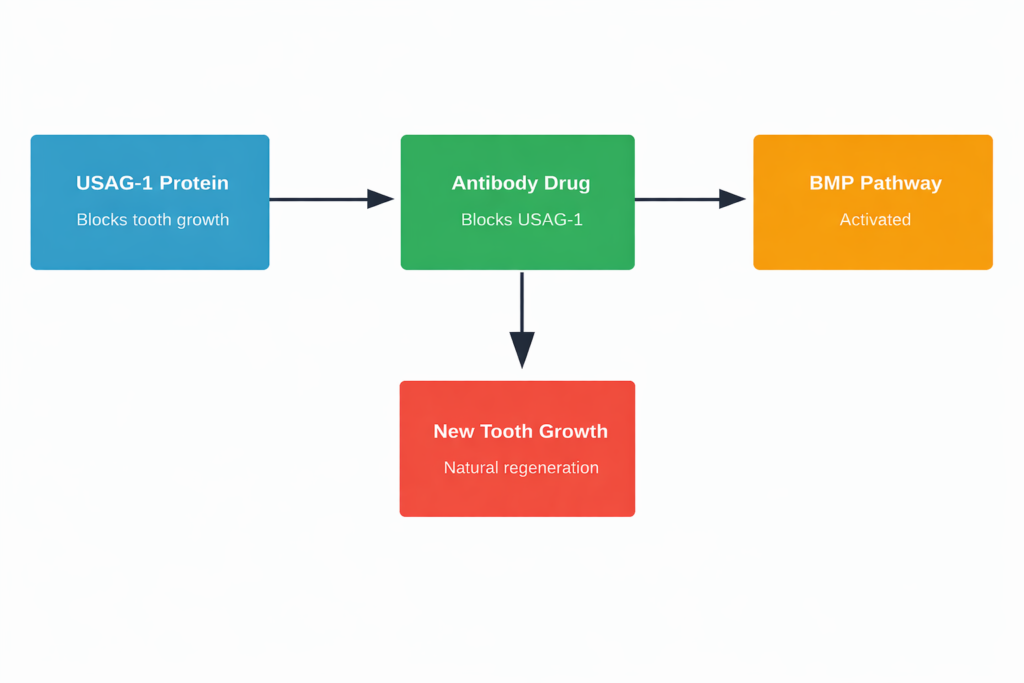
The science centers on a protein called USAG-1. Humans have signaling pathways involving molecules like BMP (bone morphogenetic protein) and Wnt that coordinate tooth development. These pathways shut down after permanent teeth emerge, which is why we don’t naturally grow a third set.
But USAG-1 blocks these pathways. So researchers had a simple idea: what if we blocked the blocker?
The challenge was targeting USAG-1 without affecting other parts of the body. Early tests on mice with certain antibodies led to poor survival rates. Eventually, scientists identified an antibody that specifically blocked USAG-1’s interaction with BMP signaling—and nothing else.
When tested on mice, the treatment successfully grew new teeth. Later trials on ferrets, whose dental patterns closely resemble humans, showed similar success. The next phase involves testing on larger animals like pigs and dogs before moving to human trials.
Stem Cell Research: Growing Teeth in the Lab
While drug therapy shows promise, another approach involves growing teeth from stem cells. Multiple research teams worldwide are racing toward this goal.
According to the National Institute of Dental and Craniofacial Research (NIDCR), regenerative medicine harnesses the body’s growth mechanisms to repair or replace damaged tissues. Researchers are drawing on stem cell biology, bioengineering, materials science, and gene editing to develop these therapies.
Dental stem cells can be isolated from multiple sources: dental pulp of permanent teeth, exfoliated baby teeth, periodontal ligaments, dental follicles, and gingival tissue. These cells have been successfully harvested for nearly 20 years.
A team at the University of Washington created tooth organoids using stem cell-derived ameloblasts and odontoblasts—the cells that produce enamel and dentin. Researchers at Harvard demonstrated using low-power light therapy to trigger stem cells inside the body to regenerate tooth tissue. And scientists at King’s College London are working on implantable biological teeth grown entirely in the lab.
The advantage? Real biological teeth that integrate naturally with your jawbone, respond to stimuli, and potentially last longer than artificial implants.
How Soon Could This Actually Happen?
Let’s talk timelines. The Japanese tooth-regrowing drug entered human trials around 2024-2025. If successful, researchers hope the medicine could become available sometime around 2030.
That’s not decades away. That’s within this decade.
But here’s the reality check: getting a drug from trials to your dentist’s office takes time. Safety must be proven. Efficacy needs confirmation across diverse populations. Regulatory approval takes years. Manufacturing and distribution need infrastructure.
Stem cell approaches face similar hurdles. Growing biological teeth in a lab is one thing. Implanting them safely and ensuring they function properly is another challenge entirely.

What About Natural Tooth Regeneration?
Can teeth regrow naturally without medical intervention? The short answer: not in adult humans.
Sharks can do it. They lose and regrow teeth their entire lives. Some reptiles have similar abilities. But mammals—including humans—lost this capability through evolution.
According to research from the University of Florida, scientists are studying sharks to understand the genetic mechanisms behind continuous tooth regeneration. The goal is to identify whether those genes exist in dormant form in humans.
The NIDCR notes that fluoride can reverse early tooth decay by preventing mineral loss in enamel and replacing lost minerals. But that’s remineralization, not regeneration. Once a tooth is significantly damaged or lost, natural regrowth doesn’t occur.
Current Alternatives to Tooth Regeneration
While waiting for regenerative medicine, people still need solutions. Here’s what’s currently available:
| Option | Process | Longevity | Limitations |
|---|---|---|---|
| Dental Implants | Titanium screw implanted in jawbone | 10-15 years average | Invasive surgery, expensive, degrades faster than natural teeth |
| Bridges | Artificial tooth anchored to adjacent teeth | 5-15 years | Requires modifying healthy teeth, doesn’t preserve jawbone |
| Dentures | Removable prosthetic teeth | 5-10 years | Uncomfortable, affects eating and speech, requires adjustment |
According to NIDCR research, the agency invested over $11 million in dental materials research in fiscal year 2024. The goal: making dental materials stronger and more effective while improving access to oral care.
But even the best implants aren’t as good as biological teeth. Real teeth have nerves that sense pressure and temperature. They’re anchored by living tissue. They repair minor damage naturally through remineralization.
The Broader Impact of Tooth Regeneration Research
Here’s something interesting: tooth regeneration research has applications beyond dentistry.
NIDCR scientists discovered that amelogenin—a tooth-hardening protein—can also prevent bone loss in mice. This finding could inform treatments for osteoporosis and severe gum disease.
Research on dental pulp stem cells shows promise for treating various conditions beyond oral health. Studies suggest these cells could aid in periodontal regeneration, bone repair, and even neurological conditions.
The versatility of dental stem cells makes them particularly valuable. They’re easier to harvest than bone marrow stem cells and can be preserved through cryopreservation for future use.
FAQs About Regrowing Teeth
No, adult humans cannot naturally regrow teeth. Unlike sharks and some reptiles, mammals lost the genetic programming for continuous tooth regeneration. Once adult teeth are lost or severely damaged, natural regrowth doesn’t occur without medical intervention.
Japanese researchers conducting human trials hope their USAG-1 blocking antibody drug could become available sometime around 2030 if trials prove successful. However, regulatory approval, safety testing, and manufacturing infrastructure will determine the actual timeline.
These drugs block the USAG-1 protein, which normally prevents tooth development after permanent teeth emerge. By blocking USAG-1’s interaction with BMP signaling pathways, the drug reactivates the body’s natural tooth growth mechanisms.
Not yet for commercial use. Research teams worldwide are developing stem cell-based tooth regeneration techniques, but these remain in experimental stages. Clinical trials are ongoing, but widespread availability is likely years away.
Fluoride can reverse early tooth decay through remineralization—preventing mineral loss and replacing lost minerals in enamel. However, this isn’t true regeneration. According to the NIDCR, fluoride cannot regrow significantly damaged or lost teeth.
Costs remain unknown since the technology isn’t commercially available. Initial treatments will likely be expensive due to research costs, limited availability, and specialized procedures. Prices may decrease as the technology matures and becomes more widespread.
Common causes include gum disease, tooth decay, injury or trauma, congenital conditions like tooth agenesis, genetics, and poor dental care. The WHO reports that 7% of people aged 20+ experience complete tooth loss, rising to 23% for those over 60.
The Bottom Line on Tooth Regeneration
So can humans regrow teeth? Not naturally—at least not yet. But science is closer than ever to making it possible through medical intervention.
The Japanese drug trials represent the most advanced progress toward clinical tooth regeneration. Stem cell research offers another promising avenue. Both approaches could fundamentally transform dental care within the next decade.
For now, prevention remains the best strategy. Brush twice daily, floss regularly, and see a dentist for checkups. Because even when tooth regeneration becomes available, keeping original teeth will always be the simplest solution.
But for the millions dealing with tooth loss today? The possibility of regrowing biological teeth instead of relying on artificial implants represents genuine hope. And that hope is backed by real science moving through human trials right now.