

Quick Summary: Most people cannot remember being born due to infantile amnesia, a phenomenon caused by the underdevelopment of the hippocampus and language skills needed for autobiographical memory. Research from New York University and other institutions shows that while infants can form memories, they lack the neural maturity and linguistic framework to retain and later recall these early experiences as adults.
Ever tried to recall your very first memory? For most of us, those earliest recollections start around age three or four—maybe a birthday party, a family trip, or the arrival of a younger sibling. But what about before that?
What about your actual birth?
The idea of remembering life in the womb or the moment of delivery seems almost mystical. Some claim they have such memories. But neuroscience tells a different story—one rooted in how our brains develop and how memory systems mature over time.
What Is Infantile Amnesia?
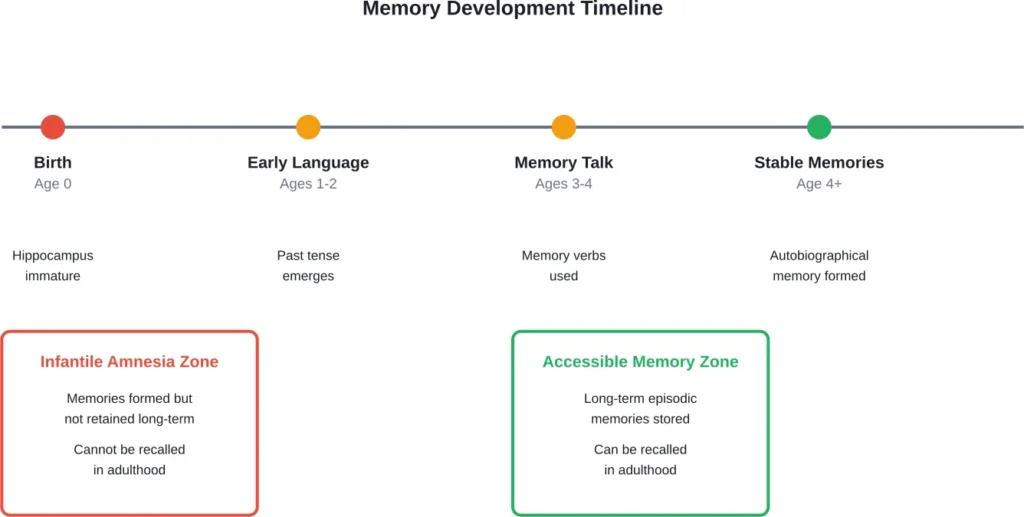
Infantile amnesia refers to the inability of adults to remember episodic memories from early childhood, particularly before age three or four. This isn’t just poor memory—it’s a universal phenomenon observed across cultures and studied extensively by neuroscientists.
Research from the Center for Neural Science at New York University has shown that infantile amnesia is associated with rapid forgetting that occurs in childhood. The phenomenon isn’t about memories never forming. Rather, it’s about those memories becoming inaccessible as the brain matures.
Here’s the thing though—babies can form memories. They’re learning constantly during those early years. Touch a mobile above a crib enough times, and an infant will remember the association. But these aren’t the same as the autobiographical memories adults have of specific life events.
Why Can’t We Remember Being Born?
The answer lies in brain development, particularly in a region called the hippocampus.
The Hippocampus Problem
The hippocampus plays a crucial role in encoding episodic memories—those detailed recollections of specific events with temporal and spatial context. According to research published in Nature Neuroscience, the hippocampus undergoes significant development well into childhood.
During infancy, this brain structure simply isn’t mature enough to create the kind of lasting autobiographical memories adults experience. While babies can encode certain types of information, they lack the neural architecture to form retrievable long-term episodic memories.
Studies on infant memory development reveal that memories formed during the first postnatal period are rapidly forgotten. This isn’t a storage problem—it’s partly a retrieval problem. Recent Yale research from 2025 suggests that infantile amnesia might be more about our inability to access early memories than about those memories never existing at all.
The Language Connection
But wait. There’s another critical piece to this puzzle: language.
Research on developmental changes in memory-related linguistic skills shows that autobiographical memory is deeply connected to language development. Children begin forming lasting memories around the time they develop specific linguistic abilities.
Three key milestones matter here:
- When children start reporting autobiographical memories using past tense (typically between ages 1;10 and 3;4)
- When they begin verbally acknowledging past events (ages 3;1 to 4;0)
- When they spontaneously use memory-related verbs like “remember” and “forget” (ages 3;5 to 4;4)
The second milestone—verbally acknowledging past events—typically correlates with the onset of infantile amnesia ending. This suggests that linguistic meta-cognitive awareness of personal memory is key to forming the kinds of memories we can recall as adults.
What Babies Actually Remember
So if babies can’t form lasting autobiographical memories, what can they remember?
Quite a bit, actually. Research on infant long-term memory shows that babies demonstrate remarkable learning capabilities. They recognize faces, particularly their mother’s. They remember feeding schedules. They learn cause-and-effect relationships.
But these memories work differently than adult memories.
Touch being stronger and emotions playing a bigger role characterizes how infant memory operates, with research indicating emotional responses dominate attention and learning during infancy. This emotional and sensory memory differs fundamentally from the narrative, time-stamped memories adults create.
The Two Memory Systems
Neuroscientists distinguish between implicit memory (procedural memory, emotional responses, learned behaviors) and explicit memory (conscious recall of facts and events). Infants excel at implicit memory but lack the brain development for robust explicit autobiographical memory.
| Memory Type | Available at Birth | Examples | Brain Region |
|---|---|---|---|
| Implicit Memory | Yes | Recognizing mother, learned reflexes, emotional associations | Amygdala, basal ganglia, cerebellum |
| Explicit Memory (Semantic) | Develops gradually | Learning facts, words, concepts | Hippocampus + cortex |
| Explicit Memory (Episodic) | No—requires maturation | Remembering specific personal events | Hippocampus + prefrontal cortex |
Can Anyone Remember Being Born?
Real talk: some people insist they remember their birth or life in the womb.
Community discussions and anecdotal reports surface regularly. Rebecca Sharrock, who has Highly Superior Autobiographical Memory (HSAM), is noted in competitor sources as having exceptional early memories. She describes memories of being placed in a car seat for the first time.
But birth itself? That’s a different matter.
Most memory researchers remain skeptical of birth memories for several reasons. The trauma and stress of birth, combined with the underdeveloped hippocampus, make it neurologically implausible. What people remember as “birth memories” are more likely reconstructed narratives based on family stories, photographs, or confabulation—the brain’s tendency to fill in gaps with plausible details.
Research on childhood amnesia examining memories of datable events (birth of younger siblings, hospitalizations, family moves) found that reliable memories before age two are exceptionally rare, even for significant events that occurred when children were slightly older.
Why Infantile Amnesia Might Be Necessary
Here’s where it gets interesting. Infantile amnesia might not be a bug—it could be a feature.
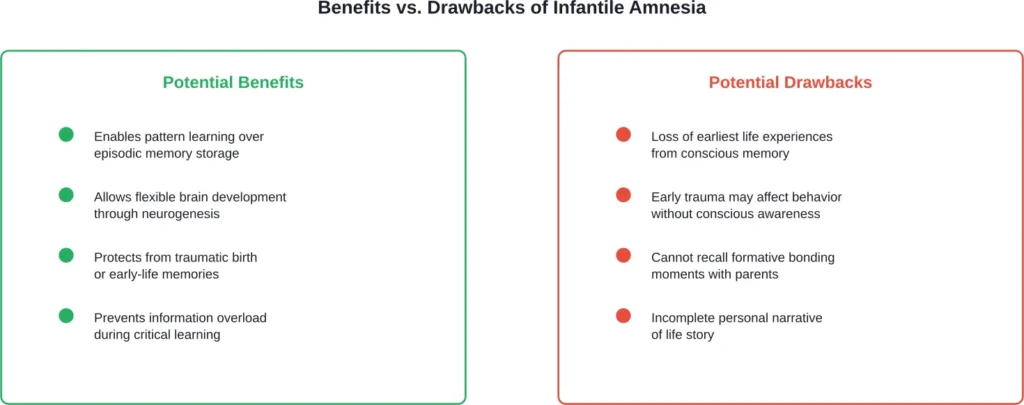
According to research from the Center for Neural Science at New York University, infantile amnesia reflects a critical period for hippocampal learning. During this phase, the brain prioritizes learning patterns and general information over storing specific episodes.
Think about it: a developing brain needs to learn rules about how the world works. Storing every single sensory experience would be overwhelming and potentially counterproductive. Instead, the infant brain extracts patterns and builds foundational knowledge while allowing specific memories to fade.
The rapid neurogenesis (creation of new neurons) happening in the infant hippocampus might actually contribute to memory loss. New neurons integrate into existing circuits, potentially disrupting previously stored information. This process, while causing forgetting, enables the flexible learning necessary for development.
When Do Real Memories Begin?
For most people, reliable autobiographical memories start between ages three and four. Some recall fragments from age two, though these are often less detailed or potentially influenced by family stories and photographs.
Several factors influence when someone’s earliest memory occurs:
- Language development: Children who develop language skills earlier may form lasting memories sooner
- Cultural factors: Cultures that emphasize personal narratives and discuss past events with children may facilitate earlier memory formation
- Significant events: Highly emotional or significant events (both positive and negative) are more likely to be retained
- Parental interaction: Parents who engage in “memory talk”—discussing past events in detail—help children develop stronger autobiographical memory skills
Research on developmental changes shows that the linguistic meta-cognitive awareness of personal memory serves as a key feature in ending infantile amnesia. Children need to understand that they have memories and that memories refer to past experiences.
The Special Case of Highly Superior Autobiographical Memory
A tiny fraction of the population has what researchers call Highly Superior Autobiographical Memory. These individuals can recall an exceptional number of life events with extraordinary detail.
But even people with HSAM don’t typically remember being born. Rebecca Sharrock’s earliest claimed memories begin at around twelve days old—well after birth. The neurological barriers to encoding and retrieving birth memories appear insurmountable even for those with exceptional memory abilities.
Frequently Asked Questions
Completely normal. Infantile amnesia affects virtually everyone, and most people’s earliest reliable memories begin between ages three and four. This reflects typical brain development, particularly of the hippocampus and language centers needed for autobiographical memory formation.
Yes. Infants form implicit memories—learned behaviors, emotional responses, and recognition of familiar people and places. Research shows babies remember routines, cause-and-effect relationships, and develop emotional associations. However, they cannot form the explicit episodic memories that adults recall consciously later in life.
These are likely reconstructed memories rather than genuine recall. The brain often creates plausible narratives based on family stories, photographs, and imagination. Research from neuroscientific institutions confirms that the infant hippocampus lacks the maturity needed to encode retrievable birth memories. What feels like a memory of birth is more likely confabulation.
Infantile amnesia typically ends between ages three and four, coinciding with language development milestones. Specifically, when children begin using memory-related verbs and can verbally acknowledge past events, they start forming the lasting autobiographical memories they’ll retain into adulthood. Individual variation exists based on language development and cultural factors.
Absolutely. Early experiences shape brain development, attachment patterns, and behavioral responses even without conscious memory. Implicit memories formed during infancy influence how people respond to situations, form relationships, and regulate emotions throughout life. The absence of explicit recall doesn’t mean those experiences had no impact.
Research from New York University suggests that early memories may exist in some form but are inaccessible for retrieval. However, no reliable method exists to recover genuine infant or birth memories. Techniques claiming to access these memories often produce confabulations rather than accurate recall. The neural pathways simply weren’t mature enough during infancy to create the kind of memories that can be consciously retrieved later.
Beyond infantile amnesia affecting the first few years, childhood memories in general are fewer and less detailed than adult memories. This relates to ongoing brain development, particularly in the prefrontal cortex, which continues maturing into the mid-twenties. Memory consolidation processes, narrative skills, and the frameworks for organizing personal experiences all develop gradually throughout childhood.
The Bottom Line
Can anyone remember being born? The scientific consensus says no.
The combination of an immature hippocampus, undeveloped language systems, and the unique memory processes of early infancy make encoding and retaining birth memories essentially impossible. While infants learn and remember in certain ways, they lack the neural architecture for the autobiographical memories adults experience.
And that’s probably okay. Infantile amnesia appears to serve important developmental functions, prioritizing the pattern learning and flexible brain development necessary for a child’s growth. Rather than a limitation, it represents an adaptive feature of how memory systems mature.
The earliest memories most people can reliably access begin around age three or four—and those memories tell the story of where conscious, narrative memory begins. Everything before that remains part of who we are, influencing behavior and responses in ways we can’t consciously recall.
So while remembering your birth makes for an intriguing thought experiment, the reality is that those first moments of life exist outside the reach of conscious memory—and probably always will.