

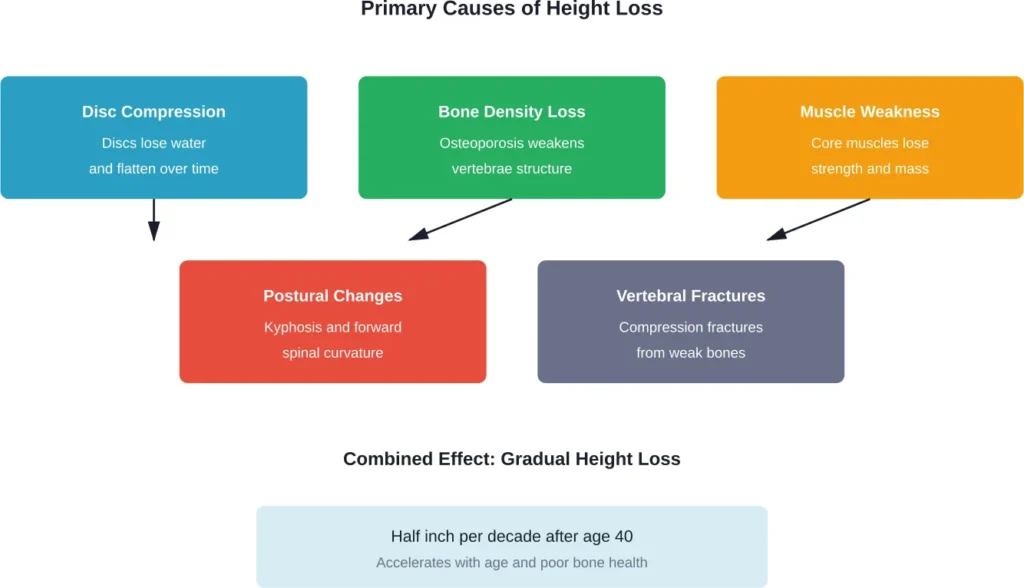
Quick Summary: Yes, most people shrink in height starting as early as their 30s or 40s, typically losing about half an inch per decade after age 40. Men can lose around one inch between ages 30-70, while women may lose approximately two inches during the same period. This shrinkage accelerates with age and is caused by spinal disc compression, vertebral changes, bone density loss, muscle weakness, and postural changes.
Height loss isn’t just something that happens in cartoons. It’s a real phenomenon that affects nearly everyone as they age. Around age 40, most people begin losing some height, and the decline accelerates as the years pile up.
But here’s the thing—not everyone loses height at the same rate. Some people experience significant shrinking, while others barely notice a change. Understanding why this happens can help you take steps to minimize it.
When Does Height Loss Begin?
Most people start shrinking in their 30s, though the changes are subtle at first. The more noticeable decline typically begins around age 40.
Men can gradually lose about one inch between ages 30 and 70. Women face a steeper decline, potentially losing around two inches during the same period. After age 80, both men and women may continue to shrink further.
Research on height loss shows that 1.6% of men and 4.0% of women lost more than 2 cm over four years, with faster bone mineral density decline observed in women with rapid height loss.
What Causes People to Shrink?
Height loss happens for several different reasons, all related to changes in the spine and musculoskeletal system.
Spinal Disc Compression
The spine contains over 20 vertebrae separated by soft, gel-like discs. These discs act as shock absorbers and maintain space between vertebrae. As people age, the discs gradually lose water content and compress.
This compression reduces the space between vertebrae, causing measurable height loss. Even small changes in multiple discs add up to noticeable shrinking over time.
Vertebral Fractures and Osteoporosis
Osteoporosis weakens bones and makes vertebrae more susceptible to compression fractures. These fractures often occur without causing pain—research shows that two-thirds to three-quarters of vertebral fractures are asymptomatic.
The connection between height loss and bone health is significant. NIH research demonstrates that height loss serves as an indicator for vertebral fractures and low bone mineral density. Women with height loss who don’t know about earlier spinal fractures should be evaluated for osteoporosis.
Muscle Mass Decline
Core muscles support the spine and help maintain upright posture. As people age, they naturally lose muscle mass—a condition called sarcopenia. Research shows a clear association between height loss and sarcopenia in community-dwelling older women.
Weaker back and abdominal muscles can’t support the spine as effectively, leading to compression and postural changes that reduce height.
Kyphosis and Postural Changes
Kyphosis refers to excessive forward rounding of the upper back. According to Mayo Clinic, this condition is often caused by weakness in spinal bones that compress or crack. The resulting hunched posture makes people appear—and actually measure—shorter.
Poor posture throughout life can accelerate these changes. Slouching puts additional stress on spinal structures, speeding up degeneration.
Health Implications of Height Loss
Height loss isn’t just cosmetic. It can signal serious health issues.
Research found that people who lose 0.5 cm or more over two years face an increased risk of mortality compared to those with less height loss. The adjusted hazard ratio was 1.26 (95% confidence interval: 1.13–1.41).
Rapid height loss also correlates with increased fracture risk. Women who lost more than 2 cm over four years showed faster bone mineral density decline. Another study from UConn Health found that men who shrank by an inch or more over 20 years faced higher risks of early death and heart disease.
| Amount of Height Loss | Time Period | Associated Health Risk |
|---|---|---|
| More than 2 cm (0.8 inches) | 4 years | Faster bone density decline, higher fracture risk |
| 0.5 cm or more | 2 years | 26% increased mortality risk |
| 1 inch or more | 20 years | Higher risk of early death and heart disease |
| 3-4 cm loss | Lifetime | Increased fall risk and sarcopenia |
Can Height Loss Be Prevented or Slowed?
While some height loss is inevitable, several strategies can slow the process.
Getting adequate calcium and vitamin D helps maintain bone density. Strength exercises targeting the back and abdominal muscles improve posture and support spinal structures. Weight-bearing activities also help preserve bone mass.
Harvard Health notes that preventing osteoporosis and improving posture can significantly slow height loss. Regular monitoring of height changes can help identify problems early—medical professionals use height loss as a screening tool for vertebral fractures and bone health issues.
Frequently Asked Questions
Most people begin losing height in their 30s, though the changes are minimal. Noticeable shrinking typically starts around age 40, when individuals lose about half an inch per decade.
Men generally lose around one inch between ages 30 and 70, while women may lose approximately two inches during the same period. After age 80, both sexes may continue to shrink further.
Height loss can indicate osteoporosis or vertebral fractures. Research shows that prospective height loss is an effective tool to identify patients with vertebral fractures and low bone mineral density. Anyone experiencing significant height loss should be evaluated for bone health issues.
Nearly everyone experiences some degree of height loss with age, though the amount varies significantly between individuals. Factors like bone health, muscle strength, posture, and overall health influence how much someone shrinks.
Height lost due to poor posture may be partially recoverable through posture improvement exercises and strengthening the back and core muscles. However, height lost from disc compression or vertebral fractures is typically permanent.
Losing more than 2 cm (0.8 inches) over four years is considered rapid height loss and may signal serious health concerns including accelerated bone density decline, vertebral fractures, or increased mortality risk. Medical evaluation is recommended.
Height should be measured using a stadiometer with proper technique—standing barefoot with heels together, back straight, and looking forward. Measurements taken at the same time of day (morning is best, as people are slightly taller) provide the most accurate comparison over time.
Conclusion
Height loss is a normal part of aging that affects nearly everyone, but the extent varies widely. Understanding the causes—from disc compression to bone density loss—helps people take preventive action.
Maintaining bone health through adequate calcium and vitamin D, strengthening core muscles, and practicing good posture can slow the shrinking process. More importantly, monitoring height changes provides valuable insight into overall health status.
If you’ve noticed significant height loss, don’t ignore it. Talk with a healthcare professional about bone density testing and strategies to protect your spine health.