

Quick Summary: Quantum teleportation is scientifically possible and has been demonstrated in laboratories, but it only transfers information about quantum states, not physical matter. Scientists at NIST and other institutions have successfully teleported quantum states over distances exceeding 100 kilometers. Human teleportation remains firmly in science fiction territory due to fundamental physical limitations.
The idea of teleportation captures imaginations worldwide. From Star Trek’s transporter room to countless science fiction stories, the concept of instantly moving from one location to another represents the ultimate transportation dream.
But here’s the thing—teleportation isn’t entirely fiction anymore.
Scientists have achieved real teleportation in laboratories. The catch? It’s nothing like what you see in movies. Quantum teleportation transfers information, not matter. No one’s beaming up to starships anytime soon.
So what’s actually possible? What remains in the realm of fantasy? And where is the science heading?
What Quantum Teleportation Actually Is
Quantum teleportation sounds exotic, but it’s fundamentally about transferring information.
The process doesn’t move physical matter from point A to point B. Instead, it transfers the quantum state—the specific properties—of a particle to another particle somewhere else. Think of it as sending the “instructions” for recreating something, not the thing itself.
According to the National Institute of Standards and Technology (NIST), quantum teleportation involves transferring the quantum state of atoms or photons. The quantum state describes properties like energy, motion, and magnetic fields. In NIST’s early experiments from 2004, researchers used laser beam manipulations to transfer quantum states between beryllium atoms within microscale traps, achieving a 78 percent success rate.
The process relies on quantum entanglement—a phenomenon where two particles become linked such that measuring one instantly affects the other, regardless of distance. This “spooky action at a distance,” as Einstein called it, forms the backbone of quantum teleportation.
How the Process Works
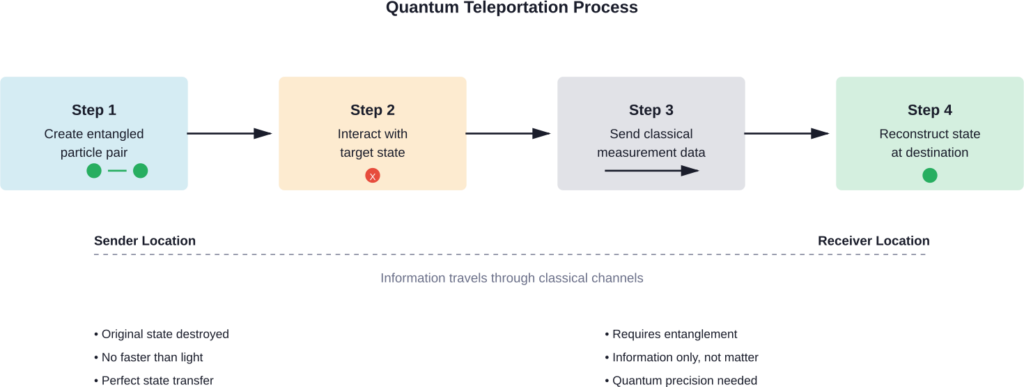
Quantum teleportation follows a specific protocol. Two particles become entangled first. One stays with the sender, the other goes to the receiver.
The sender then interacts their entangled particle with the particle they want to teleport. This interaction produces measurement results that get sent to the receiver through classical communication channels.
The receiver uses this information to manipulate their entangled particle, transforming it into an exact copy of the original particle’s quantum state. The original particle’s state gets destroyed in the process—you can’t clone quantum information.
Real talk: this doesn’t break the speed of light. The classical information still travels at normal speeds.
What Scientists Have Actually Achieved
The progress in quantum teleportation has been substantial. Researchers moved from theoretical concepts to practical demonstrations across increasingly impressive distances.
NIST researchers achieved a major breakthrough in 2015 when they successfully teleported quantum information carried in light particles over 100 kilometers of fiber optic cable. According to NIST’s Marty Stevens, only about 1 percent of photons made it through the entire 100 km distance. The experiment only became possible thanks to advanced single-photon detectors designed and manufactured at NIST.
More recently, researchers demonstrated teleporting logic operations between separated ions. NIST physicist Dietrich Leibfried reported in 2019 that their team verified quantum logic operations on all input states of two quantum bits with 85 to 87 percent probability. Not perfect, but a solid foundation.
Nature journal reported in 2022 that researchers enhanced quantum teleportation efficacy using noiseless linear amplification, achieving a 92 percent fidelity for teleporting coherent states. Experimental implementations have extended from laboratory settings to intercontinental configurations and even ground-to-satellite deployments.
Breaking Distance Records
Distance represents one of the biggest challenges in quantum teleportation. Quantum states are fragile—they degrade over distance as particles interact with their environment.
Research published through NASA’s Astrophysics Data System examined quantum energy teleportation without distance limits. The theoretical work proved that introducing squeezed vacuum states with local vacuum regions between protocol users could overcome the limitation where extracted energy was inversely proportional to distance.
Ground-to-satellite quantum teleportation demonstrates the technology’s potential. Scientists have successfully transmitted quantum states from Earth-based stations to satellites in orbit, proving the concept works over vast distances when properly implemented.
Why Human Teleportation Remains Impossible
Now for the reality check about human teleportation.
The gap between teleporting photons and teleporting people isn’t just large—it’s astronomical. Several fundamental barriers make human teleportation practically impossible with any foreseeable technology.
First, the information problem. A human body contains approximately 7 × 10^27 atoms (roughly 7 octillion atoms). Each atom has multiple quantum states that would need to be measured, transmitted, and reconstructed. The amount of information is staggering.
Second, the measurement destroys the original. Quantum teleportation isn’t copying—it’s transferring. The original quantum state gets destroyed during measurement. For a human, this means complete disassembly at the atomic level.
Third, quantum decoherence. Maintaining quantum states in something as warm and chaotic as a human body presents nearly impossible challenges. Quantum computers require near-absolute-zero temperatures precisely because quantum states are so fragile.
The Energy Requirements
Theoretical discussions often address the massive energy requirements for hypothetical human teleportation. While exact calculations vary, the energy needed to scan, disassemble, transmit information about, and reassemble a human at the quantum level would be enormous.
Beyond energy, there’s the philosophical question: would the reassembled person be “you”? If every atom gets replaced with a different atom in the same quantum state, is that continuation of consciousness or death followed by creating a copy?
These aren’t just technical problems. They’re fundamental questions about identity and physics that may never have satisfactory answers.
What Quantum Teleportation Means for Technology
Just because we can’t teleport humans doesn’t mean quantum teleportation is useless. Far from it.
The technology has profound implications for quantum computing and communications. Quantum computers require moving quantum information between different parts of the processor. Quantum teleportation provides a method to do this reliably.
According to research highlighted by Hampshire College, NASA tested SuperDense quantum teleportation theory developed by physics professor Herbert Bernstein. This work pushes the boundaries of quantum physics and has practical applications for quantum information systems.
The Quantum Internet
Nature journal reported in 2026 that the quantum internet has simultaneously arrived and hasn’t. Networks that harness entanglement and teleportation could enable leaps in security, computing, and science.
Stephanie Wehner, part of the team building a quantum network across Europe, represents the cutting edge of this research. Quantum networks would allow perfectly secure communication—any eavesdropping would destroy the quantum states and be immediately detectable.
The Department of Energy supports quantum information research through various programs. Quantum Shannon theory explores the ultimate physical limits of communication when everything operates according to quantum mechanics. This research examines fundamental resources like quantum bits (qubits), entanglement units (ebits), and classical bits (cbits).
Practical Applications Today
Current applications focus on quantum communication and computing rather than transporting matter. Research teams worldwide are developing:
- Quantum encryption systems using teleportation principles
- Quantum repeaters to extend communication distances
- Quantum computing gates that use teleported operations
- Satellite-based quantum communication networks
The technology remains in development stages, but progress continues steadily. Commercial quantum communication systems already exist for specialized applications, primarily in secure communications for financial institutions and governments.
The Physics That Makes It Work
Understanding why quantum teleportation works requires grasping some counterintuitive quantum mechanics.
Quantum entanglement forms the foundation. When two particles become entangled, they share a quantum state. Measuring one particle instantaneously determines the state of the other, even across vast distances.
But wait—doesn’t this allow faster-than-light communication? No. The measurement results appear random unless you have the classical information sent through normal channels. The quantum correlation only becomes apparent when you compare both sides of the experiment.
This is where teleportation gets clever. The sender’s measurement collapses their local quantum state but creates a correlation with the distant entangled particle. By sending the measurement results classically, the receiver can perform operations that transform their particle into an exact copy of the original state.
The No-Cloning Theorem
Quantum mechanics forbids copying quantum states. This no-cloning theorem prevents duplicating unknown quantum information.
Teleportation respects this fundamental limit. The original quantum state gets destroyed during the measurement process. What arrives at the destination is a transfer, not a copy.
This has implications for information security. Quantum states can’t be intercepted and copied without detection—the act of measurement changes them. This property makes quantum communication inherently secure.
| Aspect | Classical Information | Quantum Information |
|---|---|---|
| Copying | Unlimited copies possible | No-cloning theorem prevents copying |
| Measurement | Doesn’t disturb the information | Irreversibly changes the state |
| Eavesdropping | Can be undetectable | Always leaves detectable traces |
| Transmission Speed | Speed of light limit | Still limited by classical channels |
| Information Density | One bit per physical bit | Continuous parameters, but limited extraction |
Current Research Frontiers
Research in quantum teleportation continues pushing boundaries across multiple fronts.
Scientists are working to increase the distance, fidelity, and complexity of teleported systems. Recent work published on arXiv examined impossibility via W states and feasibility via W-like states for perfect quantum teleportation, exploring the fundamental limits of different quantum resources.
The Department of Energy supports research through programs like the DOE QuantiSED Consortium, focused on quantum computing and quantum field theory applications. This research examines how quantum teleportation principles apply to fundamental physics questions.
Emerging Applications
Beyond communication and computing, researchers explore quantum energy teleportation. This exotic concept allows extracting energy at one location based on measurements at another location, using quantum entanglement.
Research highlighted by NASA’s Astrophysics Data System showed quantum energy teleportation has connections to black hole physics, Maxwell’s demon thought experiments, and condensed matter physics. While the energy amounts remain small, the concept demonstrates how quantum mechanics enables seemingly impossible operations.
The Advanced Scientific Computing Research office at the Department of Energy funds work on qudits—higher-dimensional cousins to qubits. Researchers successfully measured high-dimensional qudits in 2023, opening possibilities for more efficient quantum information processing.
Separating Science From Science Fiction
Science fiction has shaped public understanding of teleportation—and created misconceptions.
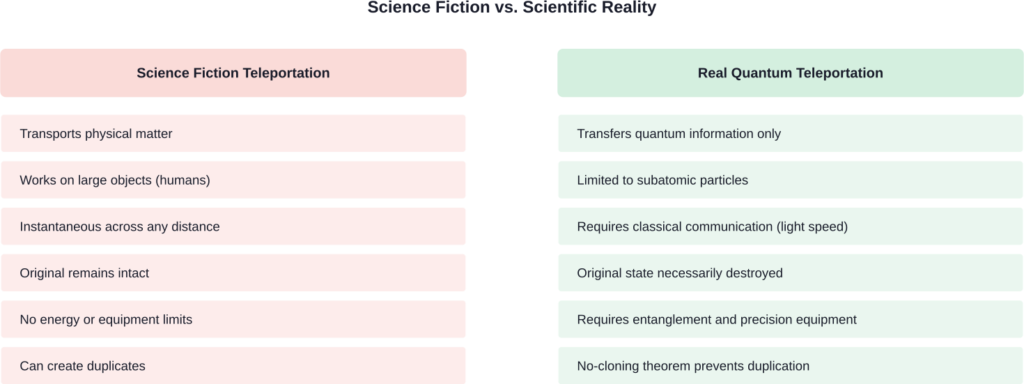
Star Trek’s transporter represents the popular conception: step onto a pad, get scanned, dematerialize, and rematerialize elsewhere. This conception bears little resemblance to actual quantum teleportation.
The Wikipedia entry on teleportation covers both the science fiction concept and the scientific reality. The cultural impact of fictional teleportation far exceeds the current scientific achievement, creating expectations that science cannot meet.
What Remains Pure Fiction
Several concepts from science fiction will almost certainly never become reality:
- Instantaneous teleportation without classical communication
- Transporting macroscopic objects like humans
- Creating duplicate copies through teleportation
- Time travel through teleportation
- Teleportation without destroying the original
These limitations aren’t just technical challenges requiring better engineering. They’re fundamental constraints imposed by the laws of physics as we currently understand them.
National Geographic Kids explains teleportation for younger audiences, helping separate scientific reality from science fiction fantasy. Educational outreach helps manage expectations while maintaining interest in genuine quantum physics achievements.
The Future of Teleportation Research
Where does the field go from here?
Near-term research focuses on practical quantum communication systems. Building a functional quantum internet requires solving engineering challenges around maintaining entanglement, error correction, and scaling to many users.
Researchers are also exploring teleportation of increasingly complex quantum states. Moving from single photons to multiple entangled particles to small atomic systems represents the progression. Each step adds complexity but also capability.
Realistic Expectations
Don’t expect human teleportation announcements. The fundamental barriers make it extraordinarily unlikely.
Do expect quantum teleportation to become a standard tool in quantum information technology. Within decades, quantum networks using teleportation protocols may handle secure communications globally.
The technology will remain invisible to end users—it’s infrastructure, not a consumer experience. But its impact on computing and communications could be profound.
Research institutions worldwide continue pushing boundaries. The National Science Foundation notes that quantum teleportation represents an important step in improving quantum computing. Progress happens incrementally, through careful experimentation and theoretical development.
Frequently Asked Questions
Yes, quantum teleportation is scientifically possible and has been demonstrated in numerous laboratory experiments. However, it only works for transferring quantum information about subatomic particles, not physical matter. Scientists at NIST and other institutions have successfully teleported quantum states over distances exceeding 100 kilometers. Human teleportation remains impossible due to fundamental physical and philosophical barriers.
No person has ever been teleported, and it’s extremely unlikely anyone ever will be. The only successful teleportation involves quantum states of individual particles like photons and atoms. The complexity of a human body—with approximately 7 × 10^27 atoms (roughly 7 octillion atoms)—combined with the destructive nature of quantum measurement and issues of consciousness and identity, makes human teleportation practically impossible with any foreseeable technology.
Quantum teleportation works by transferring the quantum state of a particle to another particle through quantum entanglement. Two particles are first entangled, then separated. The sender interacts their particle with the state to be teleported and performs measurements. These measurement results are sent through classical communication to the receiver, who uses them to manipulate their entangled particle into an exact copy of the original state. The original state is destroyed in the process.
Human teleportation faces insurmountable barriers. The information needed to describe every quantum state of every atom in a human body is astronomical. Quantum decoherence would destroy quantum states in a warm, complex biological system. The measurement process would completely destroy the original, raising philosophical questions about whether reassembly creates the same person or just a copy. Additionally, the energy requirements would be enormous, and the technology would need impossibly precise control over individual atoms.
Quantum teleportation is currently used in research on quantum computing and quantum communication systems. It enables transferring quantum information between different parts of quantum computers and forms the basis for quantum networks. Practical applications include quantum cryptography for ultra-secure communications and quantum repeaters that extend the distance quantum information can travel. The technology remains primarily in research and specialized applications rather than consumer products
NIST researchers demonstrated quantum teleportation over 100 kilometers of fiber optic cable in 2015. Ground-to-satellite quantum teleportation has been achieved, successfully transmitting quantum states from Earth to satellites in orbit—distances potentially exceeding 1,000 kilometers. Recent research explores removing distance limitations entirely through advanced techniques like squeezed vacuum states, though practical implementations face significant technical challenges.
No. Quantum teleportation doesn’t violate causality or enable time travel. The process still requires classical information to be transmitted at or below the speed of light, maintaining the usual time ordering of cause and effect. While quantum entanglement creates instantaneous correlations between particles, these correlations can’t be used to send information faster than light or backward in time. Time travel remains in the realm of science fiction with no connection to real quantum teleportation technology.
Looking Ahead
Teleportation splits into two worlds: the scientifically achieved and the forever fictional.
Real quantum teleportation continues advancing. Researchers break distance records, improve fidelity rates, and develop practical applications for quantum networks. The technology will likely become a foundational element of future quantum information systems.
Human teleportation remains where it’s always been—in the imagination. The physics doesn’t support it, the engineering challenges are insurmountable, and the philosophical problems may have no answers.
And you know what? That’s okay.
The real quantum teleportation happening in laboratories today is fascinating enough. It challenges our understanding of reality, enables new technologies, and pushes the boundaries of what physics allows.
Sometimes the truth is stranger than fiction. Just in different ways than Star Trek imagined.
Want to learn more about cutting-edge quantum physics? Follow developments from research institutions like NIST and NASA, read publications in Nature and other scientific journals, and stay curious about what’s actually possible versus what makes for good television. The real science may not let us beam aboard starships, but it’s taking us places just as remarkable.