

Quick Summary: Yes, it is possible to tighten loose skin through both non-surgical and surgical methods. Non-surgical options like radiofrequency therapy and ultrasound treatments stimulate collagen production and can improve mild to moderate skin laxity, with clinical studies showing over 50% of patients reporting significant improvement. For severe loose skin—especially after major weight loss—surgical procedures like body lifts remain the most effective solution.
Loose skin is one of those frustrating realities that can happen after significant weight loss, pregnancy, or simply as part of aging. The question isn’t whether loose skin exists—it’s whether anything can actually fix it.
The short answer? Yes. But the approach depends entirely on how much loose skin exists and what caused it in the first place.
Some methods work through stimulating the body’s natural collagen production. Others physically remove excess tissue. And then there are plenty of overhyped options that promise miracles but deliver minimal results.
This guide breaks down what actually tightens loose skin, which treatments have clinical evidence behind them, and when surgical intervention becomes the only realistic option.
What Causes Skin to Lose Elasticity
Skin isn’t static. It stretches during pregnancy, weight gain, or muscle growth—then ideally snaps back when the underlying tissue shrinks.
But here’s the thing: skin elasticity depends on collagen and elastin fibers in the dermis. When skin remains stretched for extended periods, these fibers break down. Age makes this worse since collagen production naturally declines over time.
Major weight loss is the most common trigger for loose skin. When someone loses 50+ pounds, especially rapidly, the skin simply can’t contract fast enough to match the new body size.
Factors that influence how much loose skin develops include:
- Amount of weight lost (more weight loss = more excess skin)
- Speed of weight loss (rapid loss gives skin less time to adapt)
- Age at time of weight loss (older skin has less elasticity)
- Genetics and skin quality
- Sun exposure history (UV damage degrades collagen)
- Smoking (reduces blood flow and collagen synthesis)
Pregnancy, aging, and certain medical conditions also contribute to skin laxity. The underlying mechanism remains the same: stretched skin that’s lost its ability to contract.
Non-Surgical Skin Tightening: What Actually Works
Non-surgical treatments have improved dramatically over the past decade. These methods won’t replicate surgical results, but they can produce measurable improvements for mild to moderate skin laxity.
Radiofrequency (RF) Treatments
Radiofrequency therapy uses electromagnetic energy to heat deeper skin layers, triggering collagen contraction and new collagen formation.
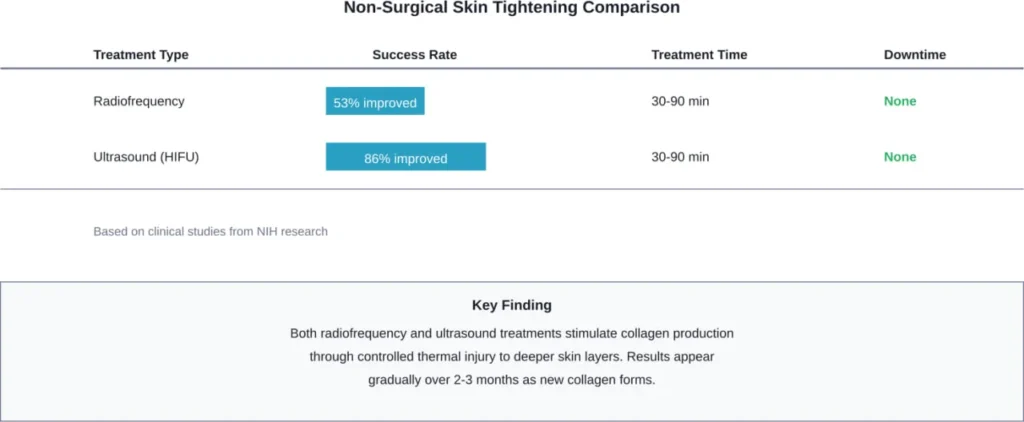
Research on monopolar radiofrequency treatment for skin laxity found histological evidence of reduced dermal inflammation, decreased sebaceous gland volume, and enhanced collagen and elastic fiber density. At 2 months post-treatment, 53.1% of patients reported over 50% improvement in skin tightness.
According to research in the Journal of the American Academy of Dermatology, RF treatments produced statistically significant increases in collagen types I and III, with improvements lasting at least 3 months post-treatment.
The American Board of Cosmetic Surgery notes that RF treatments typically take 30 to 90 minutes with no downtime required. Multiple sessions usually produce better results than single treatments.
Ultrasound Skin Tightening
High-intensity focused ultrasound (HIFU) delivers precise thermal energy to targeted tissue depths without damaging the skin surface.
Ultherapy, the most widely used ultrasound tightening device, received FDA clearance to treat the face, neck, décolletage, and brow. The American Board of Cosmetic Surgery reports that ultrasound treatments are effective for patients looking for mini facelift results without surgery and for younger patients wanting to maintain their skin profile.
A systematic review published in Cureus examined micro-focused ultrasound for skin rejuvenation and tightening. Among 35 individuals with an average age of 44 years, evaluators considered 86% to have clinically significant brow-lift 90 days following treatment. The average change in eyebrow height measured 1.7 mm based on photographic analysis.
Treatment times range from 30-90 minutes depending on the area treated.
How These Technologies Compare
Microneedling with Radiofrequency
RF microneedling combines physical needle penetration with radiofrequency energy delivery directly into the dermis.
However, the FDA issued a safety communication in October 2025 warning that serious complications have been reported with certain uses of radiofrequency microneedling devices. The agency specifically noted concerns about off-label uses and complications when devices are used outside their cleared indications.
Standard microneedling (without RF) has FDA authorization for specific body areas. The FDA emphasizes that patients should verify their provider is using devices within approved guidelines.
Lifestyle Approaches to Improve Skin Firmness
Natural methods won’t eliminate significant loose skin, but they can support skin health and potentially improve minor laxity.
Resistance Training
Building muscle beneath loose skin can fill out some of the excess tissue. Resistance training won’t tighten skin directly, but increased muscle mass can improve the appearance of mild skin laxity, particularly in the arms, legs, and abdomen.
The key is progressive overload—gradually increasing weight, reps, or training volume over time.
Nutrition for Skin Health
According to WebMD, specific nutrients support collagen production and skin firmness:
- Omega-3 fatty acids from salmon, tuna, walnuts, almonds, and edamame help restore collagen
- Vitamins C and E from fruits and vegetables support skin protection and repair
- Adequate protein intake provides amino acids for collagen synthesis
- Proper hydration maintains skin elasticity
These nutritional strategies won’t reverse severe loose skin but may support overall skin quality during and after weight loss.
Gradual Weight Loss
Losing weight slowly gives skin more time to adapt to the changing body size. While this doesn’t guarantee prevention of loose skin—especially with major weight loss—rapid weight loss from crash diets or medications can exacerbate the problem.
Maintaining stable weight after reaching a goal also allows skin time to contract naturally, though this process can take months to years.
When Surgery Becomes the Best Option
Real talk: non-surgical treatments have limits. For significant loose skin—particularly after losing 100+ pounds or following bariatric surgery—surgical removal is often the only effective solution.
According to Scripps Health, surgical options for loose skin removal include:
| Procedure | Target Area | What It Addresses |
|---|---|---|
| Abdominoplasty (tummy tuck) | Abdomen | Excess abdominal skin and separated muscles |
| Brachioplasty | Upper arms | Hanging skin on arms |
| Thigh lift | Inner/outer thighs | Sagging thigh skin |
| Lower body lift | Abdomen, hips, thighs, buttocks | Circumferential loose skin |
| Facelift | Face and neck | Facial skin laxity and jowls |
These procedures physically remove excess tissue and tighten remaining skin. Results are immediate and dramatic compared to non-surgical options.
The trade-off? Surgery involves anesthesia, recovery time, scarring, and higher costs. But for individuals with substantial loose skin affecting quality of life or causing hygiene issues, surgery often provides life-changing improvements.
Understanding Treatment Costs and Expectations
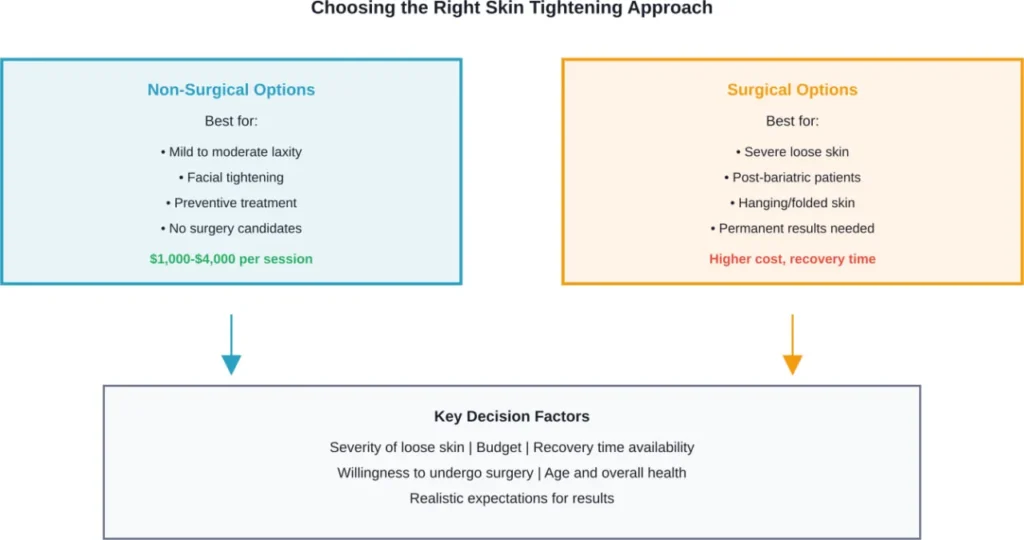
Non-surgical skin tightening treatments may cost $1,000 to $4,000 per session according to the American Board of Cosmetic Surgery. Most patients need multiple sessions for optimal results.
Surgical procedures cost significantly more, with pricing varying based on the extent of tissue removal, geographic location, and surgeon experience. Many insurance plans don’t cover cosmetic procedures, though some may cover skin removal after major weight loss if medical necessity is documented.
Setting realistic expectations is crucial. Non-surgical treatments produce subtle to moderate improvements. They work best for:
- Mild to moderate skin laxity
- Preventive maintenance in younger patients
- Patients who can’t or won’t undergo surgery
- Specific facial areas like brows or jawline
Severe loose skin—the kind that hangs in folds or causes rashes—requires surgical intervention. Non-surgical treatments won’t address that level of excess tissue.
Safety Considerations and Provider Selection
Not all skin tightening providers are equal. The FDA has issued multiple warnings about certain devices and off-label uses.
In May 2023, the FDA provided an update on the Renuvion/J-Plasma device system, clarifying current indications and instructions for use. The agency previously warned against off-label use of this device for certain aesthetic procedures.
When considering any skin tightening treatment:
- Verify the provider is board-certified in dermatology or plastic surgery
- Confirm the device has FDA clearance for the intended treatment area
- Ask about the provider’s experience with the specific technology
- Request before-and-after photos of actual patients
- Understand potential side effects and complications
- Get cost estimates in writing, including number of recommended sessions
The American Board of Cosmetic Surgery emphasizes choosing providers who can offer multiple treatment modalities rather than those who only offer one specific technology. This ensures recommendations are based on the best option for individual needs rather than what equipment the provider owns.
Frequently Asked Questions
Mild loose skin may improve somewhat over 1-2 years as collagen remodels, especially in younger individuals with good skin elasticity. However, significant loose skin—particularly after major weight loss—rarely resolves completely without intervention. Building muscle through resistance training can fill out minor skin laxity, but won’t eliminate substantial excess tissue.
Results appear gradually as new collagen forms. According to clinical studies, most improvement occurs over 2-3 months following treatment. Some patients notice subtle changes within weeks, but optimal results typically require 3-6 months. Multiple treatment sessions spaced weeks apart often produce better outcomes than single treatments.
Insurance coverage varies significantly. Purely cosmetic procedures typically aren’t covered. However, some insurance plans may cover skin removal when excess skin causes medical problems like chronic rashes, infections, or mobility limitations. Documentation from healthcare providers showing medical necessity is usually required. Patients should verify coverage details with their specific insurance plan before proceeding.
At-home radiofrequency and LED devices operate at much lower energy levels than professional treatments. While some may produce subtle improvements in skin texture and minor tightening, they can’t replicate results from professional-grade equipment. For moderate to severe loose skin, at-home devices won’t provide meaningful improvement. They may serve as maintenance between professional treatments but shouldn’t replace them for significant concerns.
Skin tightening specifically targets skin laxity by stimulating collagen production or surgically removing excess tissue. Body contouring includes both skin tightening and fat reduction procedures. Some devices combine both functions—reducing fat deposits while also tightening overlying skin. Patients with both excess fat and loose skin may benefit from combination treatments, while those at a stable weight with primarily loose skin need focused tightening procedures.Skin tightening specifically targets skin laxity by stimulating collagen production or surgically removing excess tissue. Body contouring includes both skin tightening and fat reduction procedures. Some devices combine both functions—reducing fat deposits while also tightening overlying skin. Patients with both excess fat and loose skin may benefit from combination treatments, while those at a stable weight with primarily loose skin need focused tightening procedures.
Complete prevention isn’t always possible, especially with major weight loss. However, certain strategies may reduce severity: lose weight gradually (1-2 pounds per week), build muscle through resistance training, stay hydrated, eat adequate protein and nutrients that support skin health, avoid smoking and excessive sun exposure, and maintain stable weight once reaching goals. Younger individuals with better skin elasticity generally experience less loose skin than older adults losing the same amount of weight.
Non-surgical treatments range from $1,000-$4,000 per session according to the American Board of Cosmetic Surgery, with most patients needing 2-4 sessions. Surgical procedures cost significantly more—often $8,000-$15,000 or higher depending on the extent of surgery. Whether it’s worth it depends on individual circumstances. For mild laxity affecting confidence, non-surgical options may provide satisfactory improvement. For severe loose skin causing physical discomfort or hygiene issues, surgery often delivers life-changing results that patients consider invaluable.
Making Your Decision
So, is it possible to tighten loose skin? Absolutely. But the right approach depends on how much loose skin exists, where it’s located, overall health, budget, and realistic expectations.
Non-surgical technologies backed by clinical research—particularly radiofrequency and ultrasound treatments—can produce measurable improvements in mild to moderate skin laxity. These treatments work gradually by stimulating the body’s natural collagen production.
Lifestyle approaches like resistance training, proper nutrition, and gradual weight loss support skin health but won’t eliminate significant loose skin on their own.
For severe loose skin, especially after major weight loss, surgical removal remains the gold standard. While more invasive and expensive, surgery provides immediate, dramatic results that non-surgical methods can’t match.
The best first step? Consult with a board-certified dermatologist or plastic surgeon who can assess individual circumstances and recommend appropriate options. Look for providers who offer multiple treatment modalities rather than those promoting only one specific technology.
Whether choosing non-surgical treatments, surgery, or a combination approach, addressing loose skin is definitely possible—and for many people, the improvement in both appearance and quality of life makes treatment absolutely worthwhile.