

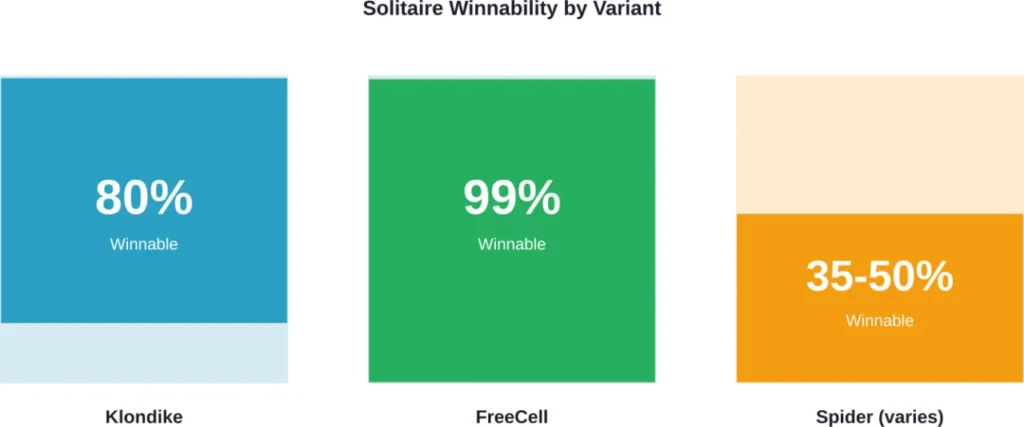
Quick Summary: No, it’s not possible to win every game of solitaire. Around 80% of Klondike Solitaire games are winnable, meaning roughly 20% are mathematically impossible to solve regardless of skill. FreeCell has the best odds at approximately 99% winnability, while Spider Solitaire ranges from 35-50% depending on difficulty.
Ask any solitaire player who’s hit a frustrating losing streak, and the question inevitably comes up: is this game even winnable? Here’s the truth that might surprise casual players and veterans alike.
Not every game of solitaire can be won. Period.
Some shuffles create mathematically impossible scenarios where no sequence of moves leads to victory. But the percentage of unwinnable games varies dramatically depending on which solitaire variant is being played.
Why Some Solitaire Games Are Mathematically Impossible
A standard 52-card deck can be arranged in approximately 8 × 10⁶⁷ different permutations. That’s 8 followed by 67 zeros—an incomprehensibly massive number. Within this astronomical range of possibilities, certain card arrangements create situations where critical cards get buried with no legal moves to access them.
Think about it this way: if the cards needed to build a foundation are trapped beneath other cards with no way to move those blocking cards, the game hits a dead end. No amount of skill, strategy, or clever sequencing can overcome a fundamentally broken initial deal.
The complexity goes even deeper. According to research from the University of St Andrews published on arXiv, determining the winnability of Klondike Solitaire has been described as “one of the embarrassments of applied mathematics”.
Klondike Solitaire: The Classic 80% Winnability Rate
When most people say “solitaire,” they’re talking about Klondike. This is the version that came bundled with Windows for decades, cementing its status as the default solitaire experience.
Research from the University of St Andrews reports the winnability of Klondike as 81.945% ±0.084% (in the ‘thoughtful’ variant where all card positions are known).
But here’s where things get tricky. Winnability doesn’t equal actual win rate. Just because a game has a solution doesn’t mean players will find it. The odds of winning through actual gameplay sit much lower—around 12.09% for random games, depending on whether playing with one-card or three-card draw.
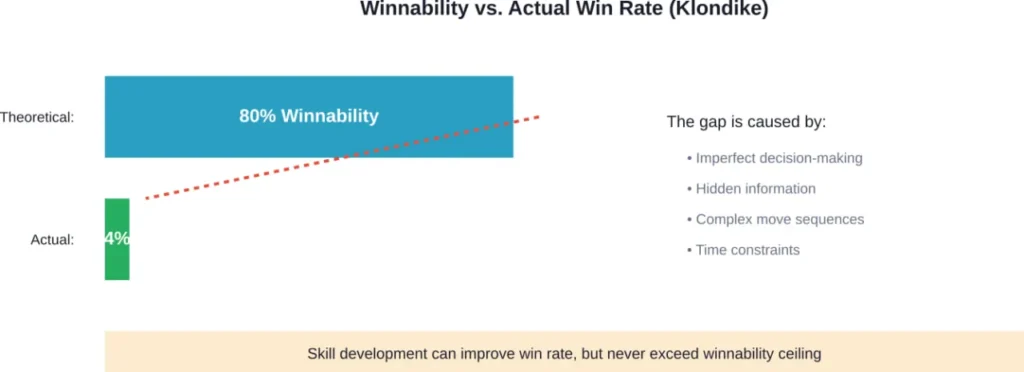
Why such a gap between winnability and win rate? Human error, imperfect decision-making, and the fact that many critical choices must be made without complete information about how the remaining deck will unfold.
Draw Style Makes a Huge Difference
The draw method fundamentally changes Klondike difficulty:
- One-card draw: Significantly easier, as every card in the stock becomes accessible on each pass through the deck
- Three-card draw: Much harder, since cards in unfavorable positions may never become playable
The three-card variant adds layers of complexity that push actual win rates toward the lower end of that range.
FreeCell: The Most Winnable Solitaire Variant
FreeCell stands apart from other solitaire games with its remarkably high winnability rate of approximately 99%. Nearly every deal can be solved with optimal play.
What makes FreeCell different? Perfect information. All cards are visible from the beginning, eliminating the luck factor that dominates other variants. Success comes down almost entirely to strategic planning and execution.
The four free cells create temporary storage that enables complex card maneuvering. Skilled players can calculate multiple moves ahead, creating sequences that gradually untangle even the most challenging initial layouts.
That said, even with 99% winnability, achieving a 99% win rate requires exceptional skill. Most players win far less frequently because finding the optimal solution path demands significant mental effort and foresight.
Spider Solitaire: Difficulty Scales with Suits
Spider Solitaire introduces a unique difficulty scaling system based on how many suits are in play. The winnability percentage shifts dramatically:
| Spider Variant | Number of Suits | Winnability Rate | Difficulty Level |
|---|---|---|---|
| Easy Spider | 1 suit (Spades only) | ~50% | Beginner-friendly |
| Medium Spider | 2 suits (Spades & Hearts) | ~40% | Moderate challenge |
| Hard Spider | 4 suits (Full deck) | ~35% | Expert difficulty |
The suit count matters because complete sequences (King through Ace of the same suit) must be built to clear columns. More suits mean fewer opportunities to create these complete runs, drastically reducing both winnability and practical win rates.
Understanding Winnability vs. Win Rate
This distinction trips up many players. Winnability refers to whether at least one path to victory exists. Win rate measures how often players actually achieve victory.
A game with 80% winnability might have a 4% win rate. The gap represents the difference between theoretical possibility and practical execution. Even when solutions exist, finding them requires skill, experience, and sometimes a bit of luck in making the right choices at critical decision points.
The Computational Challenge of Proving Winnability
Determining whether a specific solitaire deal is winnable presents a fascinating computational problem. For games with hidden cards, researchers typically analyze the “thoughtful” variant where all card positions are known from the start.
Research from the University of St Andrews has made significant progress in calculating winnability percentages for various solitaire games. Their work involved analyzing massive numbers of random deals using sophisticated algorithms to explore all possible move sequences.
The computational complexity is staggering. Many solitaire variants are NP-complete problems—a class of problems where finding solutions becomes exponentially harder as the problem size increases. This means that even with modern computing power, analyzing every possible game state for complex deals can be impractical.
Strategies to Increase Win Rate (Within Winnability Limits)
While unwinnable games stay unwinnable, several strategies can help players achieve win rates closer to the theoretical winnability ceiling:
Play Aces and Twos Immediately
Low cards rarely provide strategic value in the tableau. Moving them to foundations early frees up space and reduces clutter without sacrificing future options.
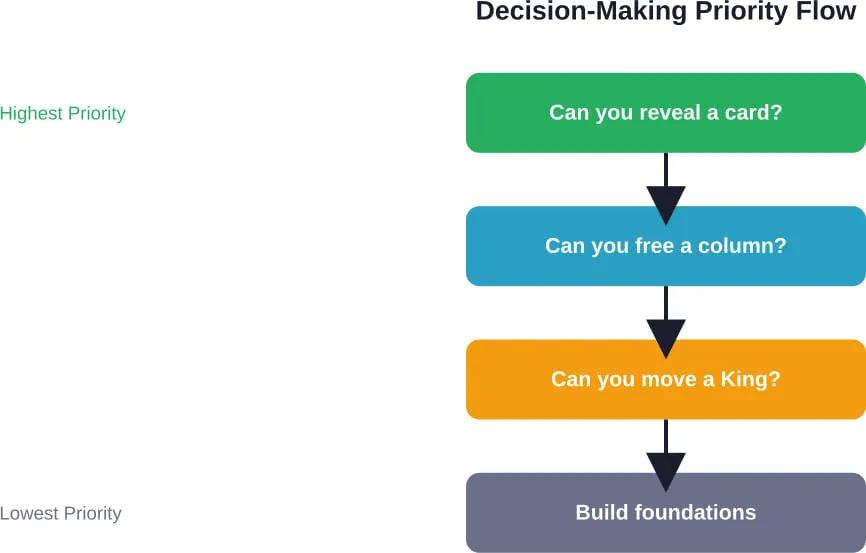
Prioritize Revealing Face-Down Cards
Every face-down card represents unknown information. Moves that flip hidden cards should generally take priority over moves that don’t, as they expand available options and provide better decision-making information.
Build Tableau Columns Evenly
Avoid creating one very long column while leaving others short. Balanced columns maintain flexibility and prevent situations where critical cards become inaccessible.
Don’t Rush to Build Foundations
Cards in the tableau remain flexible—they can be moved around as needed. Once moved to foundations, they’re locked in place. Premature foundation-building can eliminate crucial intermediate moves needed to untangle complex situations.
Think Multiple Moves Ahead
The difference between average and skilled players often comes down to planning depth. Consider how each move affects future possibilities, not just immediate gains.
The Role of Luck vs. Skill
Solitaire sits in an interesting space between pure luck and pure skill. The initial shuffle is entirely luck-based—some deals are winners, others are mathematically impossible.
But within winnable games, skill determines whether victory is actually achieved. FreeCell demonstrates this clearly: with 99% winnability but much lower average win rates, the gap between theoretical and practical results comes down almost entirely to player skill.
Klondike leans more heavily toward luck due to hidden cards and the draw pile. Even skilled players often lose winnable games because critical information stays hidden until it’s too late to adjust strategy.
Community discussions on platforms like Reddit frequently feature frustrated players questioning whether their losses stem from bad luck or poor play. The honest answer? Usually both. Some games are unwinnable, but even in winnable games, suboptimal moves can lead to defeat.
Why Unwinnable Games Matter
The existence of unwinnable games shapes solitaire’s appeal. If every game could be won, solitaire would lose much of its challenge and replayability.
The uncertainty creates tension. When staring at a difficult position, players must evaluate: is this unwinnable, or am I missing something? That question drives engagement and keeps players coming back.
Modern digital implementations sometimes filter out provably unwinnable deals to reduce player frustration. But purists argue this removes an essential element of the solitaire experience—the acceptance that sometimes, the cards just don’t cooperate.
Frequently Asked Questions
No, even perfect play cannot overcome mathematically unwinnable deals. Approximately 20% of Klondike games and 1% of FreeCell games have no solution regardless of strategy.
It varies by variant. Klondike has roughly 80% winnability, FreeCell reaches 99%, and Spider Solitaire ranges from 35-50% depending on the number of suits in play.
Yes, approximately 99% of FreeCell games have at least one solution path. The high winnability comes from perfect information—all cards are visible from the start, eliminating luck as a major factor.
Winnability measures whether a solution exists, not whether players will find it. Hidden information, complex decision trees, and human error create a large gap between theoretical winnability and actual win rates.
Yes, significantly. One-card draw makes more cards accessible and increases practical win rates. Three-card draw creates situations where cards in unfavorable positions never become playable, pushing actual win rates to the lower end of the range.
Absolutely. When needed cards are buried beneath long sequences with no legal moves to access them, the game becomes unwinnable. The specific arrangement of cards matters enormously for winnability.
Some digital implementations use algorithms to verify winnability before presenting a deal. However, this computational analysis is extremely resource-intensive, so many apps simply shuffle randomly and accept that some deals will be impossible.
The Bottom Line on Winning Every Game
The straightforward answer: no, winning every game of solitaire is mathematically impossible. The initial shuffle creates some deals with no solution path, regardless of how skillfully they’re played.
But that’s not a failure of the game—it’s a fundamental feature. The blend of chance and skill creates the engaging challenge that has kept solitaire popular for over a century. Knowing that some losses are inevitable removes some pressure and allows players to focus on improving decision-making within winnable games.
For players looking to maximize their win rate, the key is understanding which variant matches their preferences. Want the highest winnability? Play FreeCell. Prefer the classic experience with a reasonable winnability rate? Stick with Klondike. Seeking a serious challenge? Spider Solitaire with four suits provides exactly that.
The real goal isn’t winning every game—it’s getting better at recognizing which games are winnable and executing the strategy needed to solve them. That’s where the genuine satisfaction of solitaire lives.