
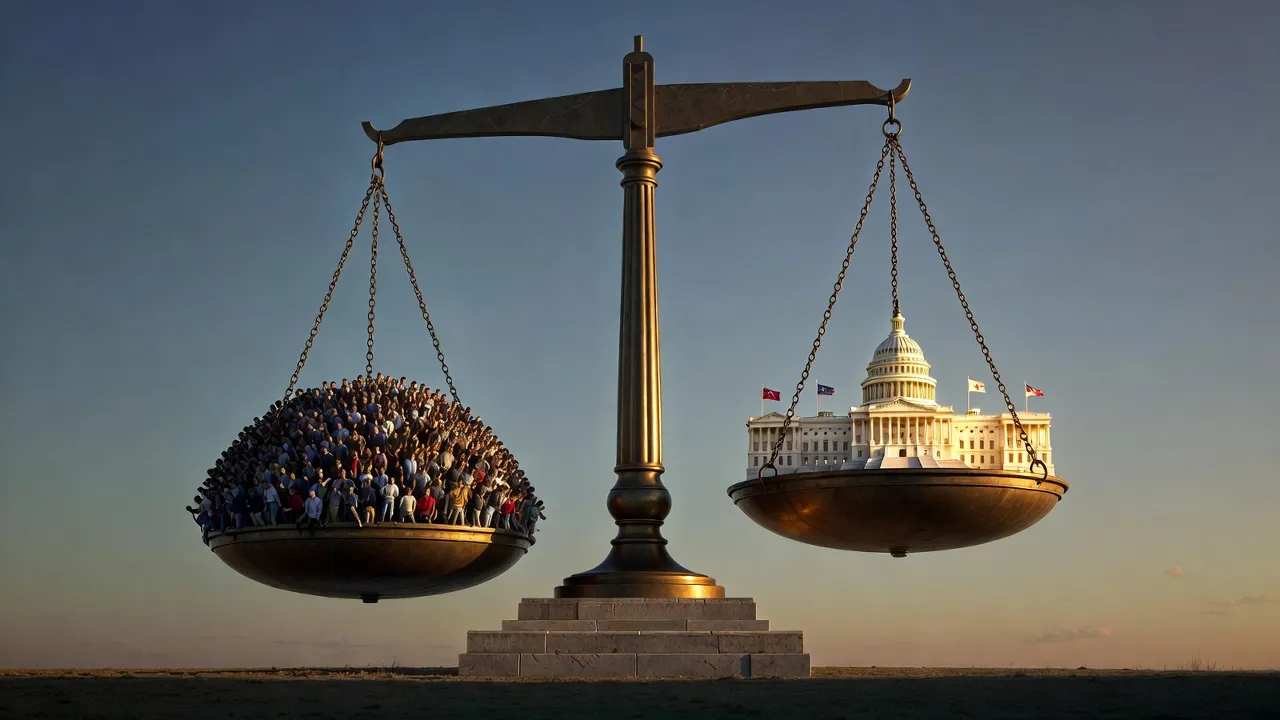
Quick Summary: Yes, a candidate can win the popular vote but lose the presidential election due to the Electoral College system. This has happened five times in U.S. history, most recently in 2016, because the Electoral College awards state-by-state victories rather than counting all votes nationally.
When Americans cast their ballots for president, they’re not actually voting directly for their chosen candidate. Instead, they’re voting for a slate of electors who will represent their state in the Electoral College. This system creates a scenario that baffles many voters: a candidate can receive millions more votes nationwide yet still lose the presidency.
Sound counterintuitive? It’s happened five times in American history, and understanding why requires a deeper look at how the Electoral College actually functions.
How the Electoral College Works
The Electoral College is outlined in Article II, Section 1 of the U.S. Constitution. The Founding Fathers established this system as a compromise between having Congress elect the president and letting a direct popular vote decide the outcome.
Here’s how it operates today. Each state gets a number of electors equal to its total congressional representation—senators plus House members. That means every state gets at least three electoral votes (two senators plus at least one representative), regardless of population size.
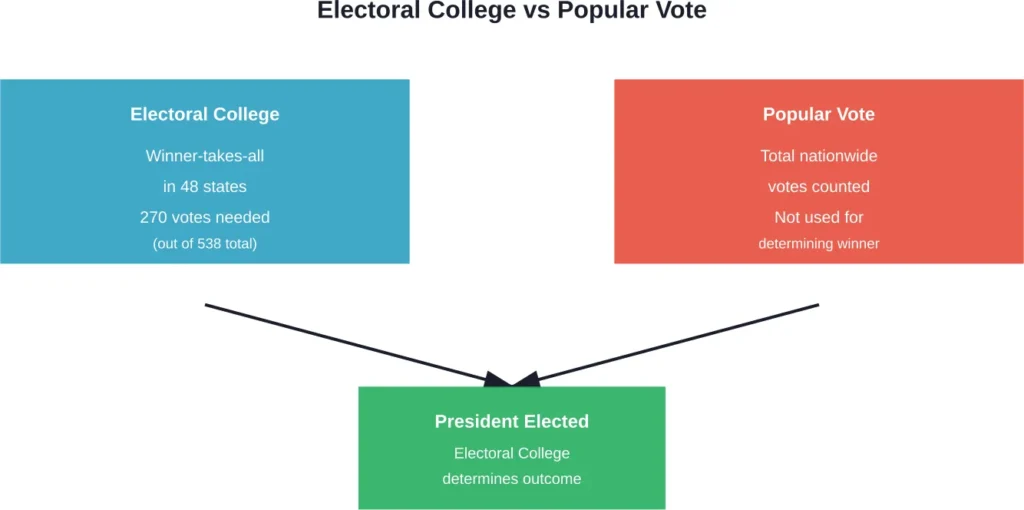
According to the National Archives, 48 out of 50 states award Electoral votes on a winner-takes-all basis. For example, all of California’s electoral votes go to the winner of the state election, even if the margin of victory is only 50.1 percent to 49.9 percent. Only Maine and Nebraska use a different system, allocating some electors by congressional district.
To win the presidency, a candidate needs 270 electoral votes out of 538 total. But here’s the catch—those 270 votes don’t necessarily represent the majority of American voters.
Why the Popular Vote Doesn’t Always Match
The winner-takes-all system creates significant distortions. A candidate could win narrow victories in several large states while losing by huge margins in others. They’d rack up massive popular vote totals in their losing states, but those extra votes wouldn’t translate into additional electoral votes.
Consider this scenario: Candidate A wins California by 10 million votes but loses Wyoming by 100,000 votes. Candidate A gets zero electoral votes from Wyoming despite receiving votes there, while Candidate B gets all of Wyoming’s electoral votes. The 10 million vote margin in California doesn’t help Candidate A beyond securing California’s electors.
This mathematical quirk means candidates focus campaign efforts on competitive swing states rather than running up margins in states they’ll win or lose anyway. That strategic reality has increased dramatically over time, with campaigns concentrating resources on an ever-shrinking number of battleground states.
The Five Times It Actually Happened
This isn’t just theoretical. The popular vote winner has lost the Electoral College five times in American history.
1824: The First Split Decision
According to the National Archives, the 1824 presidential election resulted in no candidate receiving a majority of electoral votes. Andrew Jackson had a plurality of both the electoral and popular votes, but the House of Representatives ultimately elected John Quincy Adams as president on February 9, 1825. This controversial outcome became known as the “Corrupt Bargain.”
1876: The Most Contested Election
Rutherford B. Hayes lost the popular vote to Samuel Tilden but won the presidency after a disputed electoral count that wasn’t resolved until days before inauguration. The election involved accusations of fraud and voter suppression in several Southern states.
1888: Harrison Over Cleveland
Benjamin Harrison defeated incumbent Grover Cleveland in the Electoral College despite Cleveland winning the popular vote. Cleveland won back the presidency four years later, making him the only president to serve non-consecutive terms.
2000: Bush vs. Gore
George W. Bush won the Electoral College 271-266 after a Supreme Court decision halted Florida’s recount. Al Gore won the national popular vote by over 500,000 votes. This election exposed flaws in voting machine technology and ballot design that many Americans hadn’t realized existed.
2016: The Most Recent Example
Donald Trump secured 304 electoral votes while Hillary Clinton won the popular vote by nearly 3 million ballots. Trump won key swing states by narrow margins—Michigan by just 10,704 votes, Wisconsin by 22,748, and Pennsylvania by 44,292. Those three states alone provided 46 electoral votes.
| Year | Electoral Winner | Popular Vote Winner | Popular Vote Margin |
|---|---|---|---|
| 1824 | John Quincy Adams | Andrew Jackson | ~38,000 votes |
| 1876 | Rutherford B. Hayes | Samuel Tilden | ~250,000 votes |
| 1888 | Benjamin Harrison | Grover Cleveland | ~90,000 votes |
| 2000 | George W. Bush | Al Gore | ~540,000 votes |
| 2016 | Donald Trump | Hillary Clinton | ~2,900,000 votes |
The Debate Over Reform
According to Brookings Institution research, there have been more proposals for Constitutional amendments on changing the Electoral College than on any other subject. The American Bar Association has criticized the system as “archaic” and “ambiguous,” with polling showing 69 percent of lawyers favored abolishing it in 1987.
Recent Pew Research Center polling found that nearly two-thirds of U.S. adults (65%) say the way the president is elected should be changed so the winner of the popular vote nationwide wins the presidency.
But here’s the thing—abolishing the Electoral College would require a Constitutional amendment. That means two-thirds approval in both the House and Senate, plus ratification by three-fourths of state legislatures. Small states that benefit from disproportionate representation are unlikely to support such changes.
What About the National Popular Vote Interstate Compact?
Some states have tried an end-run around Constitutional amendment through the National Popular Vote Interstate Compact. States joining this agreement pledge to award their electoral votes to the national popular vote winner, regardless of their own state results.
The compact only takes effect once states representing 270 electoral votes join. As of the last update, it has not reached that threshold and faces legal challenges about whether it violates the Constitution’s Compact Clause.
Frequently Asked Questions
No. Of the five elections where the Electoral College winner lost the popular vote, none involved a landslide in the Electoral College. These were all relatively close Electoral College outcomes, with 2000 being decided by just five electoral votes.
Mathematically, yes. By winning the smallest states by one vote each while losing the largest states by massive margins, a candidate could win 270 electoral votes while receiving far less than half the popular vote. In practice, this extreme scenario has never happened and likely never will.
Very few. Most democracies elect their head of government through parliamentary systems or direct popular vote. The American Electoral College is largely unique among modern democracies.
The Electoral College emerged as a compromise between those who wanted Congress to select the president and those who wanted direct popular election. The founders also worried about voters lacking information about candidates from distant states and wanted to balance the interests of large and small states.
Sometimes. These “faithless electors” have occasionally voted for someone other than their pledged candidate, but this has never changed an election outcome. Many states now have laws binding electors to vote for their state’s winner.
Small states get disproportionate power relative to their population. Wyoming has one electoral vote per 193,000 residents, while California has one per roughly 720,000 residents. Swing states also benefit tremendously because campaigns focus resources and attention on competitive states.
According to the National Archives, if no candidate receives a majority of electoral votes, the House of Representatives elects the president, with each state delegation getting one vote. This happened in 1824 when the House chose John Quincy Adams.
The Bottom Line
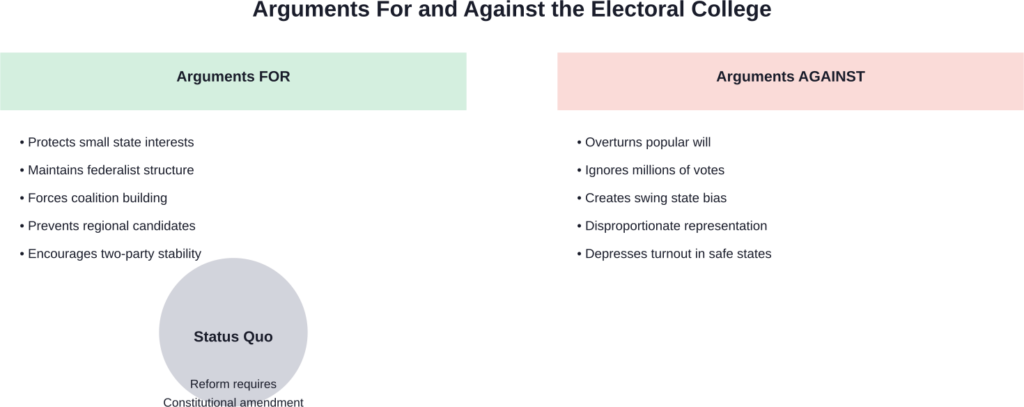
Yes, winning the popular vote but losing the election is absolutely possible under America’s Electoral College system. It’s happened five times, and mathematical analysis suggests it could easily happen again.
The winner-takes-all approach in 48 states means that narrow victories in key swing states matter far more than massive margins in safe states. A candidate can lose the national vote count by millions yet still secure the 270 electoral votes needed for victory.
Whether this system should continue is a matter of ongoing debate. Supporters argue it protects federalism and prevents candidates from ignoring less populous regions. Critics contend it’s fundamentally undemocratic and distorts campaign strategies in ways that don’t serve voters.
What’s certain? Understanding the Electoral College is essential for anyone trying to make sense of American presidential elections. The popular vote winner doesn’t always get the job—and that’s by constitutional design, not accident.