

Quick Summary: The top Jamstack development companies in 2026 combine expertise in modern static site generators like Next.js and Gatsby with headless CMS integration capabilities. This guide profiles 15 leading agencies based on their platform breadth, migration experience, and documented client outcomes—without focusing on hourly rates or pricing tiers.
Jamstack development has become the foundation for performance-focused websites in 2026. Next.js dominates professional Jamstack development in 2026, but the ecosystem has expanded far beyond a single framework. The architecture cuts server dependency, reduces complexity, and delivers faster load times without sacrificing dynamic functionality.
But here’s the thing though—choosing the right Jamstack development partner isn’t just about technical chops. The best agency for your project recommends the right platform for your context, not the one they’re most comfortable with.
This guide ranks agencies on verifiable expertise, platform breadth, migration track records, and documented editorial outcomes. No fluff, no invented metrics—just the companies leading the way in 2026.
What Makes a Great Jamstack Development Company
Real talk: not every agency calling itself a Jamstack shop actually delivers on the architecture’s promises. Some treat it like a buzzword. Others build exclusively with one framework and call it platform expertise.
The agencies that stand out share a few characteristics.
Multi-Platform Competence
Great Jamstack developers work across multiple static site generators and headless CMS platforms. They might prefer Next.js for most builds, but they also know when Gatsby’s data layer makes more sense. Or when Nuxt fits a Vue-focused team better.
This matters because structured content has quietly become the foundation of editorial teams that can publish once and distribute everywhere. Locking into a single platform early creates technical debt later.
Migration Experience
Many brands are still running on WordPress or Drupal. Moving to Jamstack isn’t just a code rewrite—it’s data transformation, URL mapping, SEO preservation, and editor training.
Agencies with real migration experience know how to phase the transition. They document the editorial impact. They plan for dynamic personalization with edge logic instead of treating every page as purely static.
According to industry reports, migrations with content modeling redesign typically start at $30,000 and can reach $150,000. That investment only pays off if the agency understands both the old stack and the new one.
Headless CMS Depth
The Jamstack frontend is only half the story. The content layer determines whether editors can actually use the system without developer intervention.
Top agencies have documented practices across multiple platforms—Contentful, Sanity, Strapi, Directus, Payload, DatoCMS. They know which one fits editorial workflows that need localization. Which one handles complex taxonomies. Which one makes sense for teams that want self-hosting.
Top 15 Jamstack Development Companies in 2026
These agencies represent the current state of professional Jamstack development. Each brings something different to the table. Some focus on enterprise migrations. Others specialize in performance optimization or multi-platform builds.
What they share: verifiable expertise, documented client work, and a track record of delivering projects that actually ship.
1. Oski
Oski builds smart, well-engineered software solutions for enterprises and ambitious startups. Their frontend practice covers React, Vue, Angular, Nuxt, Next.js, and UI/UX design, paired with cloud, serverless, and CMS capabilities including Umbraco and WordPress.
What sets them apart: they prioritize innovative design, seamless integration, and AI-accelerated development while maintaining focus on scalability, security, and Core Web Vitals performance.
Their solutions serve industries including travel, logistics, e-commerce, education, fintech, and insurance. Builds emphasize cloud-native architectures, personalized experiences, and reliable content management that support business operations and digital transformation goals.
Contact Information:
- Website: oski.site
- Phone: +48571282759
- Email: [email protected]
- Address: Kaupmehe tn 7, 10114 Tallinn, Estonia
- LinkedIn: www.linkedin.com/company/oski-solutions
2. Lengreo
Lengreo operates at the intersection of digital marketing performance and modern web development, with strong capabilities in headless CMS implementations and website builds. Their practice includes website development services that support eCommerce, business sites, landing pages, and content-driven platforms.
What sets them apart: they combine technical website development with B2B lead generation and SEO strategy from day one. Not the other way around.
Their client portfolio features measurable growth outcomes across software development companies, architecture firms, event tech, sports tech, and IT services. Documented results include 400% increases in annually acquired clients, 6X reduction in cost per lead, and conversion rate boosts of 53.6%. Lengreo focuses on solutions that drive both performance and qualified opportunities.
Contact Information:
- Website: Lengreo.com
- Phone: +31 686 147 566
- Email: [email protected]
- Address: Vrijstraat 9 C/D, 5611 AT Eindhoven, Netherlands
- LinkedIn: Lengreo
- Twitter: @Lengreo
- Instagram: @lengreo
3. Mobian Studio
Mobian Studio specializes in dedicated engineering teams for mobile and AI-powered digital products. Their full-stack delivery covers modern architectures, scalable systems, clean code practices, and integration suitable for high-performance web and mobile experiences.
What sets them apart: they offer both outsourcing (end-to-end ownership) and outstaffing models with senior-level execution, clean architecture, and post-launch partnership.
Their expertise serves IT, healthcare, fintech, and logistics companies. Projects emphasize end-to-end development, AI systems, scalable architecture, and domain-specific solutions that deliver production-ready software on time and on budget.
Contact Information:
- Website: mobian.studio
- Phone: [email protected]
- Address: Harju maakond, Tallinn, Kesklinnalinnaosa, Masina tn 22, 10113
- LinkedIn: www.linkedin.com/company/mobian-studio
4. Gilzor
Gilzor delivers custom software development with a focus on modern web and mobile solutions for startups, SMBs, and product studios. Their practice spans full-cycle web development, React and Next.js frontend work, scalable backends, and integration of modern architectures.
What sets them apart: they emphasize idea validation, user-centric UI/UX, and go-to-market readiness alongside technical delivery. Structured content and performance form the foundation for both product success and business growth.
Their project work includes web and mobile applications for airlines, e-commerce grocery platforms, brain-training apps, and flight-tracking tools. Outcomes feature rapid user acquisition (1000+ uploads in the first month), revenue growth (X3 MRR in months), and efficient, maintainable solutions that connect products with audiences.
Contact Information:
- Website: www.gilzor.com
- Email: [email protected]
- Address: Poland, Warsaw, Office 58, street Adama Mickiewicza 37, 01-625
- LinkedIn: www.linkedin.com/company/gilzor-softwaredevelopment
5. A-listware
A-listware provides software development, dedicated teams, and consulting with strong expertise in modern web technologies, cloud solutions, and full-stack delivery. Their practice includes frontend frameworks like React, Angular, Vue, cloud application development, and enterprise-grade solutions.
What sets them apart: they combine team augmentation with full project delivery, ensuring seamless integration and high-quality, secure, responsive digital products.
Their client work spans enterprise, SMB, and startup contexts across multiple industries. They deliver custom software, cloud applications, UX/UI, data analytics, and infrastructure services that focus on performance, scalability, and measurable operational improvements.
Contact Information:
- Website: a-listware.com
- Phone: +1 (888) 337 93 73
- Email: [email protected]
- Address: North Bergen, NJ 07047, USA
- LinkedIn: www.linkedin.com/company/a-listware
- Facebook: www.facebook.com/alistware
6. Webstacks

Webstacks publishes in-depth comparisons of Jamstack CMS platforms, frameworks, and tooling. Their editorial content reflects hands-on experience with Strapi, Sanity, Contentful, and self-hosted options.
Their guides explain how to match a CMS to specific use cases: which platform fits startups building custom content APIs, which one handles complex permissions for enterprise editorial teams, which one offers the right balance of flexibility and ease for mid-market brands.
Webstacks positions itself as a technical partner for companies that need more than a simple brochure site. Their projects involve custom integrations, API-driven workflows, and content architectures that scale.
7. DevsData

DevsData operates across both Jamstack development and technical recruitment. Their agency arm delivers projects while their staffing side places specialized developers with brands that want to build internal teams.
Their Jamstack services emphasize Next.js and Gatsby—the two frameworks that dominate production deployments in 2026. They’ve documented expertise in React-based static generation, incremental static regeneration, and hybrid rendering strategies.
DevsData’s dual model suits companies in transition: outsource the first build to prove the concept, then hire embedded developers to maintain and extend it.
8. DesignRush
DesignRush curates agency rankings across multiple disciplines, including Jamstack development. Their listings highlight agencies based on portfolio quality, client reviews, and verified project outcomes.
While DesignRush itself is a directory rather than a dev shop, their editorial coverage reflects the current state of the Jamstack agency landscape. They track which agencies specialize in enterprise migrations, which ones focus on e-commerce, which ones lead with performance optimization.
Their platform offers filtered search by location, budget range, and technical specialization—useful for brands that need to shortlist candidates quickly.
9. Allusive Digital
Allusive Digital focuses on Jamstack builds for content-heavy brands. Their practice emphasizes editorial workflows, content modeling, and CMS integrations that reduce friction for non-technical users.
Their projects often involve publishers, media companies, and content platforms where editors need to ship articles, multimedia, and updates without developer involvement. The Jamstack architecture enables that independence while maintaining performance and security.
Allusive Digital’s case studies highlight reduced time-to-publish, better content reuse across channels, and cleaner separation between content and presentation.
10. ArticleTed

ArticleTed publishes tech-focused editorial content alongside agency services. Their Jamstack coverage includes framework comparisons, CMS evaluations, and implementation guides.
Their agency work spans web development, content strategy, and technical SEO—a combination that reflects the reality that Jamstack projects aren’t purely technical. Editorial planning, IA design, and search optimization all matter.
ArticleTed’s articles serve as a proxy for their technical depth: they write knowledgeably about Next.js vs. Gatsby trade-offs, when to choose Nuxt, how to evaluate Qwik for performance-critical projects.
11. FocusReactive

FocusReactive operates at the intersection of Jamstack architecture and headless CMS integration. Their practice spans Sanity, Storyblok, Contentful, Payload, Directus, and DatoCMS—a platform breadth that few agencies match.
What sets them apart: they lead with frontend architecture, then adapt the CMS to fit. Not the other way around.
Their client portfolio includes multi-platform builds where content needs to flow to web, mobile apps, and digital signage from a single source. They’ve documented localization projects that handle 12+ languages without breaking editorial workflows.
FocusReactive doesn’t pitch a favorite platform. They assess the editorial team’s needs first, then recommend the CMS that fits. That vendor-agnostic stance matters when the wrong platform choice creates technical debt three months in.
12. The Frontend Company

The Frontend Company built their reputation on frontend-led headless CMS integration. Their documented practice covers Contentful, Sanity, Strapi, and Directus—platforms that span cloud-hosted to fully self-hosted options.
Here’s what makes them notable: they treat structured content as the foundation for both editorial efficiency and technical performance. Their builds prioritize content modeling that makes sense to editors, not just developers.
Their migration work focuses on brands moving from monolithic CMSs to decoupled architectures. They handle the data transformation, URL preservation, and SEO continuity that make or break these transitions.
The Frontend Company’s case studies show measured outcomes—faster page loads, improved Core Web Vitals scores, reduced server costs. Not vague promises.
13. StaticMania

StaticMania positions itself squarely in the Jamstack migration space. Their published guides cover tool selection, phased migration strategies, data transformation, and SEO preservation during the move from WordPress or Drupal.
Community discussions highlight their work with marketing sites, content hubs, and SaaS landing pages—projects where performance directly impacts conversion rates.
StaticMania’s approach emphasizes incremental migration. Not a big-bang rewrite. They move high-traffic pages first, validate the performance gains, then phase in the rest. This reduces risk and proves ROI early.
Their documented experience includes dynamic personalization using edge logic—proving that Jamstack doesn’t mean sacrificing the dynamic features users expect.
14. Nimap Infotech
Nimap Infotech runs a developer staffing model alongside full project delivery. Their Jamstack practice emphasizes speed, security, and SEO optimization—the core benefits of static site generation.
According to their client data, they’ve delivered projects across information technology, enterprise, and startup contexts. Their case studies mention 50% faster billing processes and measurable improvements in site performance.
Nimap’s model offers flexibility: augment an existing team with Jamstack experts, or hand off the entire build. That dual capability suits brands that want to maintain some internal development capacity while accessing specialized skills.
15. Amra & Elma

Amra & Elma approaches Jamstack development through the lens of digital marketing performance. Their campaigns generate measurable traffic and engagement—one documented project shows 16.7 million impressions in three months.
Their average click-through rate sits at 0.7%, above typical industry benchmarks. Organic search traffic for their clients reaches 73.6K monthly visits with 177% growth trajectories.
What this means: they don’t just build fast sites. They build sites that rank, convert, and scale. Their Jamstack implementations optimize for search visibility from the ground up—structured data, clean URLs, fast Core Web Vitals, mobile-first rendering.
Amra & Elma’s selective client approach focuses on brands ready to invest in performance. They’re not chasing volume.
How to Choose the Right Jamstack Development Partner
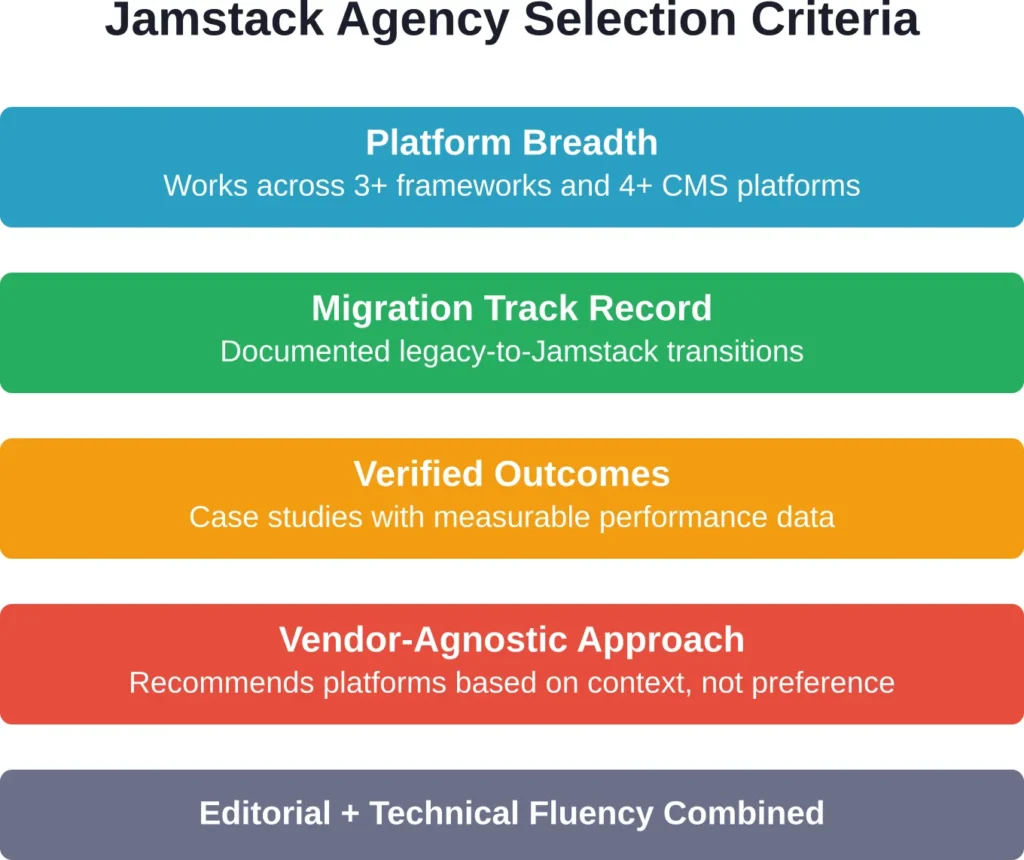
Now, this is where it gets interesting. The agency with the best portfolio might not be the best fit for your project. The one with the most platforms might overcomplicate your build. The migration specialists might be overkill if the site is new.
Matching agency strengths to project needs matters more than chasing the biggest name.
Assess Platform Requirements First
Before contacting agencies, map out the editorial workflow. How many content types? How many editors? What kind of publishing cadence—daily updates or monthly campaigns?
Do editors need in-context preview? Does content flow to multiple channels? Are there localization requirements?
These questions determine whether the project needs a visual CMS like Storyblok, a developer-friendly option like Strapi, or a structured content platform like Sanity. Agencies with deep experience in the right platform deliver better outcomes than those learning on your dime.
Evaluate Migration Complexity
Greenfield builds are straightforward. Migrations from WordPress, Drupal, or proprietary CMSs require different expertise.
Look for agencies that document their migration process. They should talk about content audits, URL mapping, redirect strategies, metadata preservation, and phased rollouts. If they pitch a full rewrite without phasing, that’s a red flag.
Migrations typically start at $30,000 for straightforward content transfers. Projects that include content modeling redesign, custom integrations, and complex editorial workflows can reach $150,000 for enterprise projects. Agencies experienced in this work scope the project realistically.
Check for Performance Documentation
Fast sites aren’t magic. They’re the result of intentional architecture choices: image optimization, lazy loading, efficient JavaScript bundling, CDN configuration, edge caching strategies.
Great agencies show Core Web Vitals scores from real client sites. They explain what they did to achieve sub-second Largest Contentful Paint. They talk about Cumulative Layout Shift mitigation and First Input Delay optimization.
Vague promises about “blazing fast” performance mean nothing without data.
Prioritize Communication Fit
Technical skill is baseline. Communication determines whether the project ships smoothly or turns into a struggle.
Does the agency explain technical trade-offs in language that non-developers understand? Do they document decisions? Do they involve stakeholders at the right checkpoints?
Agencies that treat clients as partners rather than ticket-submitters deliver better experiences. And better outcomes.
Common Jamstack Frameworks Used by Top Agencies
Next.js dominates professional Jamstack development in 2026, but the ecosystem includes several other frameworks worth understanding. Agencies often work across multiple options depending on project requirements.
| Framework | Best For | Key Strength | Typical Use Cases |
|---|---|---|---|
| Next.js | Most projects | Hybrid rendering, broad ecosystem | Marketing sites, SaaS, e-commerce |
| Gatsby | Content-heavy sites | GraphQL data layer, plugin ecosystem | Blogs, documentation, media |
| Nuxt | Vue.js teams | Vue integration, server-side rendering | Progressive web apps, dashboards |
| Astro | Performance-critical builds | Partial hydration, framework-agnostic | Content sites, landing pages |
| Qwik | Instant interactivity needs | Resumability, zero JavaScript by default | High-traffic consumer apps |
Next.js dominates professional Jamstack development in 2026. That dominance reflects its versatility—incremental static regeneration, API routes, server-side rendering, and edge middleware all ship in one framework.
Gatsby remains strong for content-heavy sites where the GraphQL data layer simplifies pulling content from multiple sources. Publishers and documentation sites often choose Gatsby for this reason.
Nuxt serves Vue-focused teams that want the same capabilities Next.js offers React developers. The framework matured significantly over the past two years and now handles production workloads at scale.
Astro emerged as the performance-first option. Its partial hydration approach ships zero JavaScript by default, only adding interactivity where needed. For content sites that don’t require heavy client-side logic, Astro delivers exceptional Core Web Vitals scores.
Qwik represents the newest generation—designed for resumability rather than rehydration. This architectural choice eliminates the startup cost that even optimized React apps carry. Early adoption is growing, especially for consumer-facing applications where instant interactivity matters.
Performance Benefits of Jamstack Architecture
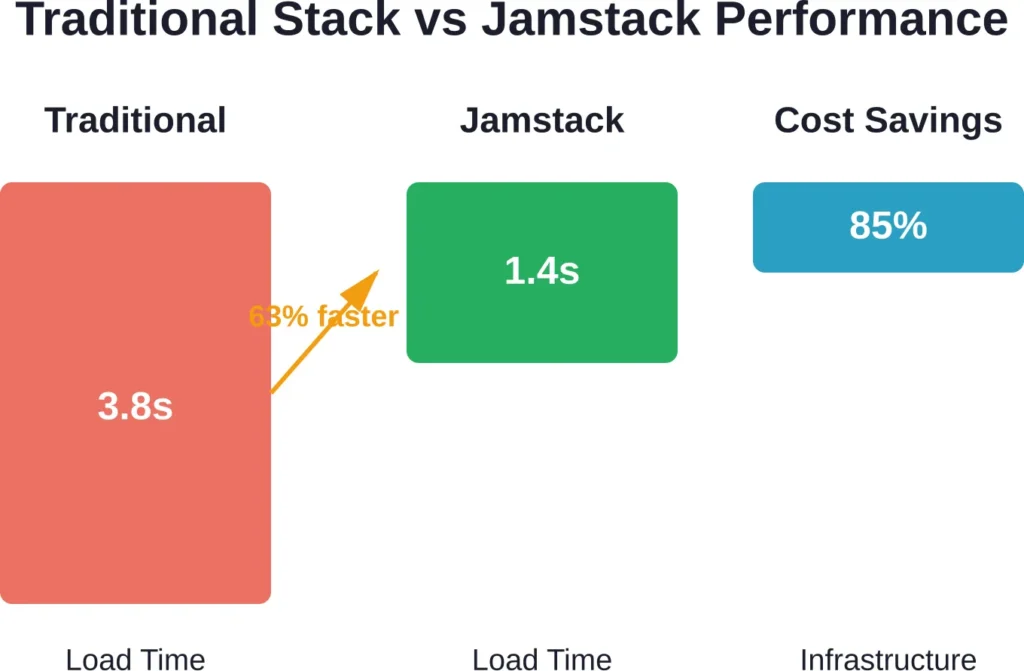
The performance advantage of Jamstack isn’t theoretical. It’s measurable in Core Web Vitals, conversion rates, and infrastructure costs.
Faster Load Times
Pre-rendered HTML eliminates server processing time. When a user requests a page, the CDN serves a static file—no database queries, no template rendering, no server-side logic.
Well-optimized Jamstack sites can achieve strong Largest Contentful Paint scores. Traditional server-rendered sites struggle to hit that target.
Better Core Web Vitals Scores
Google’s ranking algorithm increasingly weighs Core Web Vitals. Jamstack architecture naturally optimizes for these metrics when implemented correctly.
Cumulative Layout Shift stays low because layouts are determined at build time. First Input Delay improves because less JavaScript executes on the client. Largest Contentful Paint benefits from CDN distribution and optimized asset delivery.
Reduced Infrastructure Costs
Static files don’t require application servers, load balancers, or database clusters. Hosting costs drop to CDN bandwidth charges—often 70-90% cheaper than traditional hosting.
Case studies show significant infrastructure cost reductions from moving to Jamstack.
Improved Security Posture
No server-side execution means no server-side vulnerabilities. There’s no admin interface exposed to the internet. No database to compromise. No login endpoints to brute-force.
The attack surface shrinks to static assets and APIs, both of which are easier to secure than full application stacks.
When Jamstack Might Not Be the Right Fit
Look, Jamstack solves specific problems exceptionally well. But it’s not the right architecture for every project. Being honest about limitations matters.
Highly Dynamic User-Specific Content
Sites where every user sees completely personalized content face challenges with static generation. Social networks, complex dashboards, and real-time collaboration tools don’t map cleanly to pre-rendered pages.
Edge functions and client-side data fetching can handle some personalization, but at a certain complexity threshold, server-side rendering makes more sense.
Massive Content Volumes with Frequent Updates
Build times matter. Sites with hundreds of thousands of pages that update constantly can hit build time constraints. While incremental static regeneration helps, there’s still a practical limit.
News sites publishing dozens of articles per hour sometimes need hybrid approaches—Jamstack for evergreen content, server-side rendering for breaking news.
Teams Without Frontend Expertise
Jamstack requires comfort with modern JavaScript, build tools, and API integration. Teams without those skills face a steeper learning curve than WordPress or traditional CMS platforms offer.
The right agency can bridge this gap during migration, but long-term maintenance requires either training or ongoing agency support.
Frequently Asked Questions
Jamstack is an architectural approach where sites are pre-rendered into static HTML at build time and served from CDNs. Dynamic functionality comes from APIs and JavaScript rather than server-side processing. The name originally stood for JavaScript, APIs, and Markup.
Migrations typically start at $30,000 for straightforward content transfers. Projects that include content modeling redesign, custom integrations, and complex editorial workflows can reach $150,000. Enterprise migrations with multiple sites and legacy system integration can exceed that range.
Next.js dominates professional Jamstack development in 2026 and works well for most use cases. Gatsby fits content-heavy sites where the GraphQL data layer adds value. Nuxt serves Vue-focused teams. Astro and Qwik optimize for maximum performance. The right choice depends on team skills, project requirements, and editorial workflow needs.
Yes. Headless commerce platforms like Shopify, BigCommerce, and Commercetools integrate well with Jamstack frontends. Product catalogs render statically while cart, checkout, and account management use client-side APIs. This approach delivers fast browsing with secure transaction processing.
Headless CMS platforms provide editorial interfaces separate from the frontend. Editors work in tools like Contentful, Sanity, or Strapi—publishing triggers a rebuild that updates the live site. Modern platforms support preview environments where editors see changes before publishing.
Incremental static regeneration allows individual pages to rebuild without regenerating the entire site. On-demand builds triggered by webhooks update specific content within seconds. For extremely high-frequency updates, hybrid rendering combines static pages with server-side rendering for specific dynamic sections.
Not necessarily, but specialized agencies deliver better outcomes. Jamstack requires expertise in static site generators, headless CMS integration, build optimization, CDN configuration, and edge functions. Generalist agencies often miss performance opportunities or create editorial friction. Specialists understand the architecture deeply and avoid common pitfalls.
Evaluating Agency Fit: What to Ask
Before signing a contract, ask questions that reveal actual expertise rather than marketing claims.
Request case studies with measurable outcomes. Not just “we built this site” but “we reduced load time from 4.2s to 1.1s” or “we cut hosting costs by 78%” with data to back it up.
Ask which headless CMS platforms they’ve implemented in production. If they only mention one, that’s a platform vendor, not a vendor-agnostic partner.
Inquire about their migration process. What’s their approach to URL preservation? How do they handle redirects? What’s their SEO continuity strategy? Vague answers are red flags.
Request references from clients who completed migrations. Talk to those teams about communication quality, timeline adherence, and post-launch support.
Ask about their approach to performance optimization. Do they measure Core Web Vitals? How do they handle image optimization? What’s their strategy for JavaScript bundling?
These questions separate experienced Jamstack agencies from those adding it to their service list because it’s trendy.
The Future of Jamstack Development
The Jamstack ecosystem continues to evolve rapidly. Edge computing is pushing more logic closer to users. Incremental static regeneration is becoming more sophisticated. New frameworks are optimizing for even faster load times.
But the core principles remain: pre-render what you can, fetch dynamically what you must, and distribute everything through CDNs. This architecture delivers performance, security, and developer experience improvements that traditional stacks can’t match.
The agencies leading in 2026 understand that Jamstack isn’t just about technical architecture. It’s about editorial workflows, business outcomes, and measurable performance gains.
Choosing the right partner means finding an agency that asks about your content team before recommending a framework. One that shows you data instead of promising vague improvements. One that treats platform selection as a strategic decision, not a default choice.
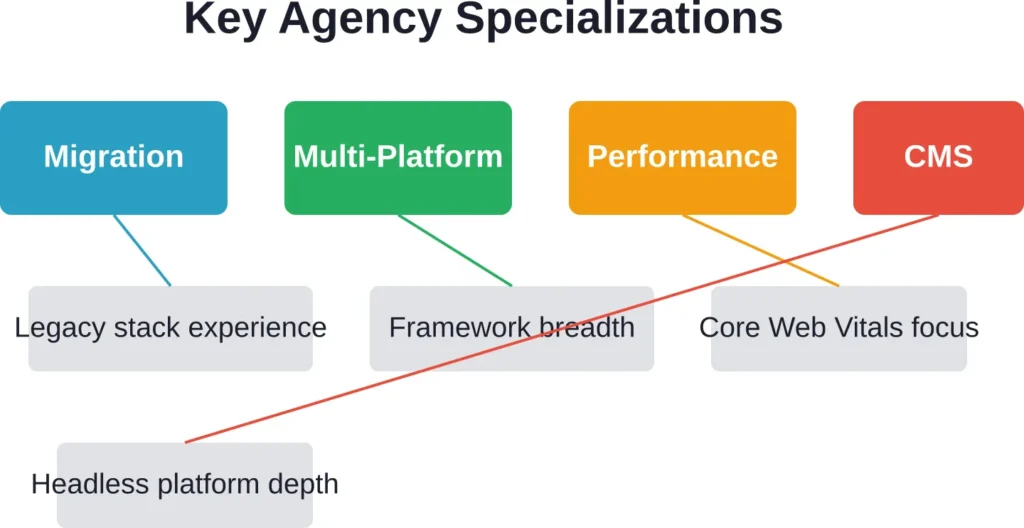
The 15 agencies profiled here represent different approaches and specializations. Some focus on migrations, others on multi-platform builds, others on performance optimization. What they share: documented expertise, verifiable outcomes, and a track record of shipping projects that work.
The right agency for your project is the one whose specialization aligns with your needs. Not the biggest name. Not the one with the slickest website. The one with proven experience in the specific challenges your project faces.
Ready to move forward? Start by mapping your editorial requirements, assessing migration complexity, and defining performance targets. Then reach out to agencies whose documented work matches those needs. Ask the hard questions. Request case studies. Talk to references.
The investment in finding the right partner pays dividends throughout the project—and for years after launch.