

Quick Summary: Selecting the right manufacturing web design agency is critical for industrial B2B companies that need websites showcasing technical capabilities, managing complex product catalogs, and generating qualified leads. This guide profiles 15 top agencies specializing in manufacturing website design and development, based on industry expertise, proven client results, and B2B-focused digital strategies—no pricing or hourly rates included.
Manufacturing companies face unique digital challenges that generic web design agencies simply don’t understand. Unlike consumer-facing businesses, industrial firms sell complex products through lengthy B2B sales cycles involving multiple decision-makers, technical specifications, and compliance documentation.
Your website isn’t just a digital brochure. It’s a lead generation engine, a technical resource library, and often the first touchpoint where procurement managers evaluate whether your company belongs on their shortlist.
But here’s the thing—according to web design research, a significant majority of online consumers will not return to a website with poor user experience. For manufacturers, that insight translates directly into lost RFQs, abandoned quote requests, and prospects who choose competitors with better digital experiences.
The agencies profiled here specialize in manufacturing and industrial B2B website design. They understand product configurators, CAD file management, technical SEO for industrial search terms, and how to structure navigation for distributors, OEMs, and end users simultaneously.
What Makes Manufacturing Web Design Different?
Manufacturing website design requires specialized knowledge that goes beyond aesthetic layouts and brand messaging. Industrial buyers have distinct needs.
Technical credibility matters more than visual flair. Engineers and procurement specialists need immediate access to specifications, certifications, material data sheets, and compliance documentation. They’re evaluating your operational capabilities, not just your marketing promises.
Product complexity demands smart information architecture. Many manufacturers offer hundreds or thousands of SKUs across multiple product lines, custom configurations, and industry-specific applications. Organizing this without overwhelming visitors requires expertise in taxonomy design and faceted search.
Lead capture works differently in B2B manufacturing. The goal isn’t immediate e-commerce transactions—it’s moving prospects into sales conversations. Quote request forms, sample ordering, technical consultation bookings, and distributor locators replace shopping carts.
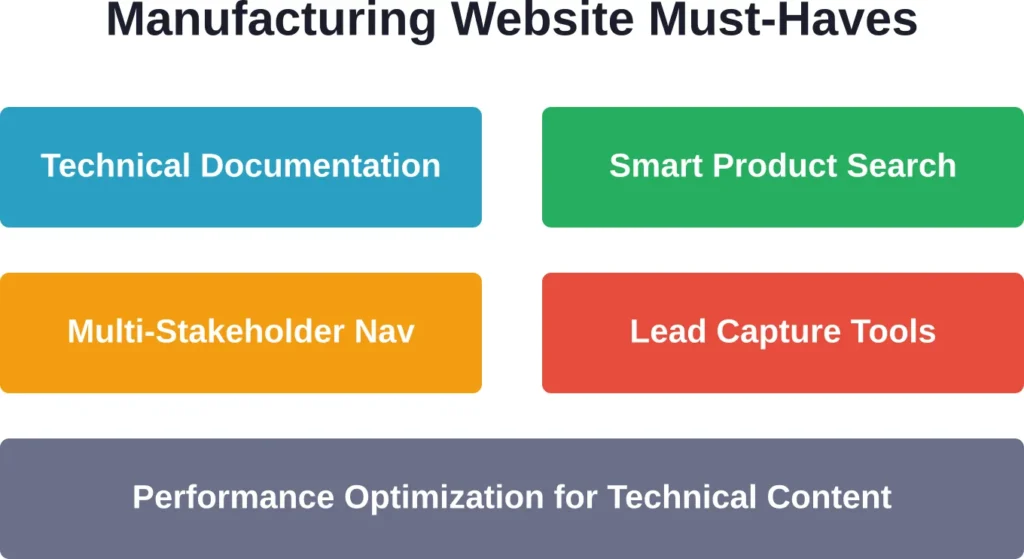
And performance matters. Technical buyers won’t wait. When your site hosts large CAD files, high-resolution product imagery, and video demonstrations, load speed optimization becomes critical infrastructure, not a nice-to-have.
How We Evaluated These Agencies
This list draws from evaluation methodologies used across the industry to rank manufacturing-focused agencies. Analysis included portfolio review, client testimonials, industry recognition, and documented case study results.
Manufacturing industry expertise received the highest weighting. Agencies with proven track records serving industrial clients understand the sector’s unique requirements—complex sales cycles, technical content management, compliance considerations, and distributor relationship dynamics.
Digital capabilities beyond design matter equally. The best agencies offer integrated services: SEO for industrial search terms, content strategy for technical audiences, analytics implementation, and ongoing optimization based on conversion data.
Client results provide the most honest assessment. Documented improvements in lead volume, quote request conversions, and qualified inquiry quality demonstrate real-world effectiveness beyond attractive portfolio pieces.
Top 15 Manufacturing Web Design Companies
1. Gilzor

Gilzor builds custom digital products that help manufacturing companies launch new digital channels, automate operations, and improve customer engagement.
They provide full-cycle web and mobile development services backed by thorough discovery, business analysis, and user-centric UI/UX design. This allows manufacturers to create intuitive product catalogs, customer portals, and internal tools that solve real operational challenges.
Their strength lies in delivering scalable, high-performance solutions that manufacturers can rely on long-term, including seamless integration with existing systems and ongoing support after launch.
Gilzor has successfully delivered projects for companies in industrial sectors, helping them enhance efficiency and create better digital experiences for both B2B clients and internal teams.
Contact Information:
- Website: www.gilzor.com
- Email: [email protected]
- Address: Poland, Warsaw, Office 58, street Adama Mickiewicza 37, 01-625
- LinkedIn: www.linkedin.com/company/gilzor-softwaredevelopment
2. Oski

Oski designs, develops, and maintains well-engineered software solutions for tech-forward manufacturing enterprises and industrial companies with ambitious digital transformation goals.
They offer comprehensive capabilities across cloud architecture, modern frontend solutions, and artificial intelligence integrations. This enables manufacturers to build robust websites, internal systems, and smart digital tools that improve operational efficiency and customer experience.
What distinguishes Oski is their ability to deliver fast, high-quality development using AI-accelerated engineering while maintaining enterprise-grade standards for security, scalability, and reliability.
The company serves manufacturers in industries such as logistics, industrial equipment, and advanced technology production, helping them reimagine how technology supports their core business operations.
Contact Information:
- Website: oski.site
- Phone: +48571282759
- Email: [email protected]
- Address: Kaupmehe tn 7, 10114 Tallinn, Estonia
- LinkedIn: www.linkedin.com/company/oski-solutions
3. Lengreo

Lengreo serves as a complete marketing and technology partner for manufacturing companies seeking to accelerate lead generation and strengthen their digital presence.
Their approach combines deep business analysis with full-cycle website development and targeted B2B marketing strategies. They create conversion-focused websites, landing pages, and technical content platforms that help industrial buyers quickly find needed information and contact suppliers.
What sets Lengreo apart is their strong emphasis on measurable lead generation results. They implement hyper-personalized outreach, LinkedIn campaigns, and demand generation strategies specifically tailored for manufacturing decision-makers.
The agency works with manufacturers across various sectors including industrial technology, engineering services, and specialized equipment providers, delivering both website solutions and ongoing performance marketing.
Contact Information:
- Website: lengreo.com
- Phone: +31 686 147 566
- Email: [email protected]
- Address: Vrijstraat 9 C/D, 5611 AT Eindhoven, Netherlands
- LinkedIn: www.linkedin.com/company/lengreo
- Instagram: www.instagram.com/lengreo.agency
- Twitter: x.com/Lengreo
4. Mobian Studio
Mobian Studio builds dedicated engineering teams that deliver production-ready digital solutions for manufacturing companies that demand speed, quality, and reliability.
They specialize in full-stack development, including mobile applications, AI-powered systems, and scalable architecture specifically suited for industrial environments. Their teams handle everything from initial design to post-launch support.
What makes them different is their dual model of outsourcing and outstaffing, allowing manufacturing clients to either delegate entire projects or strengthen existing teams with senior engineers who understand industry requirements.
Mobian works with companies in industrial technology, logistics, and advanced manufacturing, helping them ship high-quality digital products faster and more efficiently.
Contact Information:
- Website: mobian.studio
- Phone: [email protected]
- Address: Harju maakond, Tallinn, Kesklinnalinnaosa, Masina tn 22, 10113
- LinkedIn: www.linkedin.com/company/mobian-studio
5. A-listware

A-listware provides software development and dedicated teams to manufacturing companies that need reliable technical execution and scalable digital solutions.
They specialize in building enterprise applications, custom software, and modern digital platforms while offering full support across UX/UI design, testing, and infrastructure services. Their teams integrate seamlessly with client organizations to deliver complex manufacturing-related projects.
The agency stands out through their focus on end-to-end project management and the ability to quickly assemble skilled teams tailored to specific manufacturing technology needs.
A-listware works with enterprise manufacturers, mid-sized industrial companies, and technology-driven production businesses looking to strengthen their digital capabilities.
Contact Information:
- Website: a-listware.com
- Phone: +1 (888) 337 93 73
- Email: [email protected]
- Address: North Bergen, NJ 07047, USA
- LinkedIn: www.linkedin.com/company/a-listware
- Facebook: www.facebook.com/alistware
6. StraightNorth

StraightNorth delivers data-driven web design and digital marketing services with particular strength in manufacturing SEO and lead generation.
Their approach starts with comprehensive keyword research identifying the technical terms, product categories, and application-specific phrases industrial buyers actually search. This intelligence informs site architecture, URL structures, and content development ensuring strong organic visibility.
StraightNorth implements rigorous conversion rate optimization methodologies. They A/B test form layouts, call-to-action placements, page structures, and content presentations to systematically improve lead capture rates.
The agency serves manufacturers across industrial sectors with demonstrated success improving both traffic volume and lead quality. Their transparent reporting provides clear visibility into how digital investments produce measurable returns.
7. Weidert Group

Weidert Group brings inbound marketing methodology and manufacturing industry specialization together, making them ideal for companies embracing content-driven lead generation strategies.
Their website design work integrates tightly with content strategy, marketing automation, and lead nurturing programs. Weidert builds sites architected for ongoing content publishing, premium resource gating, progressive profiling, and behavioral tracking that feeds sales intelligence.
The agency understands manufacturing sales cycles. Their lead scoring models account for the multiple touchpoints and extended research periods typical in industrial buying. They help manufacturers distinguish between early-stage researchers and near-term opportunities.
Weidert’s client portfolio emphasizes mid-market manufacturers in specialized niches—precision machining, industrial components, process equipment, and technical services. Their case studies frequently show double-digit improvements in qualified lead volume.
8. Thomas Marketing Services

Thomas Marketing Services (part of the Thomasnet.com industrial network) offers insider knowledge of how industrial buyers research suppliers and make sourcing decisions.
Their data advantage comes from operating the largest industrial sourcing platform. Thomas analyzes millions of product searches, supplier discovery patterns, and buyer behavior signals that inform their web design recommendations for manufacturing clients.
The agency designs websites optimized for industrial buyer workflows—quick access to specifications, easy RFQ submission, clear manufacturing capabilities presentation, and prominent quality certifications and compliance documentation.
Thomas serves manufacturers seeking better visibility in industrial search ecosystems, both on Thomasnet.com and through organic SEO. Their integrated approach connects website design with broader industrial marketing strategies.
9. Industrial Strength Marketing

Industrial Strength Marketing focuses exclusively on manufacturing and industrial B2B clients, bringing specialized knowledge that generalist agencies can’t match.
Their team includes former manufacturing executives who understand industry pain points firsthand. This insider perspective shapes websites addressing real business challenges—distributor conflict management, technical support resource requirements, aftermarket parts accessibility, and complex product configuration.
Industrial Strength emphasizes practical functionality over design awards. Their sites prioritize rapid information access, clear capability communication, and straightforward lead capture—exactly what time-pressed engineers and procurement professionals need.
The agency serves manufacturers across industrial verticals with particular depth in capital equipment, industrial supplies, and OEM components. Client engagements typically include ongoing digital marketing support beyond initial website projects.
10. Sagefrog Marketing Group

Sagefrog Marketing Group delivers integrated branding and digital marketing for manufacturers, combining strategic positioning with technical web development capabilities.
Their brand-first approach proves valuable for manufacturers facing commoditization pressure or entering new markets. Sagefrog develops distinctive positioning strategies, then builds websites that communicate differentiation clearly to multiple stakeholder audiences.
The agency’s manufacturing practice includes extensive experience with complex sales channels—direct sales forces, independent distributors, rep networks, and OEM partnerships. They design site experiences and content journeys accommodating each channel’s unique needs.
Sagefrog serves middle-market and enterprise manufacturers across diverse sectors. Their full-service model spans brand strategy, web development, content creation, marketing automation, and sales enablement—useful for companies seeking consolidated agency relationships.
11. Orbit Media Studios

Orbit Media Studios brings award-winning design work and content strategy expertise to manufacturing clients seeking both aesthetic excellence and measurable business results.
Their approach emphasizes research-driven design decisions backed by user testing and analytics. Rather than imposing template solutions, Orbit conducts stakeholder interviews and customer journey mapping to understand how different buyer personas interact with manufacturing content.
The agency’s content strategy services particularly benefit manufacturers transitioning from brochure-style websites to inbound marketing platforms. They help industrial companies develop editorial calendars, technical resource libraries, and SEO-optimized content that attracts buyers early in research phases.
Orbit’s client portfolio spans manufacturing verticals including industrial equipment, components suppliers, and specialty materials producers. Their work demonstrates sophistication in balancing technical depth with user-friendly presentation.
12. Thrive Internet Marketing Agency

Thrive offers full-service digital marketing alongside web design, making them a strong choice for manufacturers who need integrated campaigns connecting website performance to broader marketing initiatives.
Their manufacturing practice focuses on lead generation optimization. Thrive designs conversion-focused landing pages, implements marketing automation workflows, and creates PPC campaigns targeting high-intent industrial keywords.
What sets Thrive apart is their emphasis on measurable ROI. They establish clear KPIs during project kickoff and provide detailed monthly reporting showing how website improvements translate to business outcomes—quote requests, whitepaper downloads, consultation bookings.
The agency serves manufacturers of varying sizes, from regional job shops to national distributors. Their scalable service model accommodates companies at different digital maturity stages.
13. Americaneagle.com
Americaneagle.com delivers enterprise-grade web solutions for large manufacturers requiring robust functionality, complex integrations, and multi-site management capabilities.
Their technical architecture expertise proves valuable for manufacturers with challenging requirements: product configurators, dealer portals, B2B e-commerce platforms, ERP integrations, and multi-language sites for global operations.
The agency employs in-house development teams across multiple specializations—UX design, front-end development, back-end engineering, database architecture, security, and hosting infrastructure. This comprehensive capability means manufacturers work with a single partner rather than coordinating multiple vendors.
Americaneagle.com’s client roster includes Fortune 500 manufacturers and established industrial brands. Their project management methodology accommodates the governance structures and approval processes typical in large organizations.
14. Lform Design

Lform Design specializes in manufacturing and industrial B2B website design with a portfolio demonstrating deep sector knowledge and technical sophistication.
Their design philosophy balances form and function. Lform creates visually compelling interfaces that don’t sacrifice the information density and technical access industrial buyers require. Product pages integrate specifications, applications, case studies, and related resources without overwhelming navigation.
The agency excels at complex product catalog organization. They implement smart filtering systems, industry-specific search functionality, and product comparison tools that help buyers navigate extensive inventories efficiently.
Lform’s manufacturing clients span industries including metal fabrication, industrial automation, specialty chemicals, and precision components. Their case studies demonstrate consistent improvements in user engagement metrics and lead quality.
15. LLT Group

LLT Group combines strategic thinking with technical execution, serving mid-market and enterprise manufacturers seeking comprehensive digital transformation.
Their discovery process digs deep into business objectives, competitive positioning, and customer insights before design work begins. LLT maps current state customer journeys, identifies friction points, and architects solutions addressing specific business challenges rather than applying generic best practices.
The agency offers ongoing optimization and growth services beyond initial website launches. They monitor performance data, conduct quarterly strategy reviews, and implement continuous improvements based on user behavior patterns and conversion analytics.
LLT’s manufacturing expertise includes industrial equipment, building products, engineered materials, and contract manufacturing. Their client relationships often span multiple years as manufacturers evolve digital capabilities.
Key Capabilities to Look For
When evaluating manufacturing web design companies, certain capabilities separate specialists from generalists who happen to have a few industrial clients.
Product information management expertise matters significantly. Manufacturing sites often integrate with PLM systems, ERP databases, or custom product catalogs. Agencies should demonstrate experience architecting these connections, managing data synchronization, and presenting complex technical information in user-friendly formats.
Technical content strategy proves equally important. Industrial buyers consume different content than consumer audiences—application guides, technical specifications, material certifications, compliance documentation, and detailed case studies. Agencies should offer content development services tailored to these technical requirements.
Industrial SEO knowledge makes a measurable difference. The keywords engineers and procurement specialists search differ from consumer search patterns. Manufacturing-focused agencies understand how to optimize for long-tail technical terms, specification searches, and application-specific queries that drive qualified traffic.
| Capability | Why It Matters | Red Flag |
|---|---|---|
| Manufacturing Portfolio | Demonstrates understanding of industrial B2B buyer behavior and technical content requirements | Generic portfolio with mostly B2C or service businesses |
| Technical Integration | Enables product data synchronization, configurators, dealer portals, and custom functionality | Only offers template-based platforms with limited customization |
| Industrial SEO | Drives qualified traffic from engineers and buyers searching technical specifications and applications | Generic SEO approach focused on broad keywords instead of technical long-tail terms |
| Lead Generation Focus | Optimizes for RFQs, quote requests, and sales-qualified leads rather than vanity metrics | Emphasizes design awards and traffic volume without conversion data |
| Ongoing Optimization | Continuously improves performance based on user behavior and conversion analytics | Treats launch as project completion without ongoing support |
Lead generation optimization should be foundational, not an afterthought. The best agencies design entire experiences around moving prospects toward quote requests, sample orders, consultation bookings, or other conversion goals specific to manufacturing sales processes.
Questions to Ask During Agency Selection
The agency selection process benefits from asking pointed questions that reveal depth of manufacturing expertise and cultural fit.
Start with portfolio inquiries. Request case studies from companies with similar products, sales models, or technical complexity. Ask about specific challenges encountered and solutions implemented. Generic answers suggest surface-level experience.
Probe their discovery methodology. Manufacturing websites fail when agencies skip research and jump straight to design. Strong agencies conduct stakeholder interviews, customer journey mapping, competitive analysis, and technical audits before proposing solutions.
Understand their approach to technical content. Ask how they handle specification management, documentation organization, and content updates as product lines evolve. Manufacturing sites require ongoing content maintenance—not one-time population.
Clarify integration capabilities. If connections to ERP systems, product databases, CRM platforms, or marketing automation tools matter, confirm the agency has relevant technical experience and can provide integration references.
Discuss post-launch support. Websites are never truly finished. Understand what ongoing optimization, performance monitoring, content updates, and technical support the agency provides after initial launch.
Common Mistakes When Choosing a Design Partner
Manufacturers frequently make predictable mistakes during agency selection that lead to disappointing outcomes.
Prioritizing aesthetics over functionality tops the list. Beautiful designs win awards, but manufacturing buyers care more about finding specifications quickly than gradient backgrounds. The flashiest portfolio doesn’t guarantee industrial effectiveness.
Selecting based solely on cost creates problems. The cheapest proposal typically comes from agencies who don’t understand manufacturing complexity and will cut corners on research, strategy, and technical implementation. Underfunding digital presence in a sector where websites drive qualification decisions proves penny-wise and pound-foolish.
Working with generalist agencies lacking industrial experience backfires. Consumer-focused designers impose retail patterns—large hero images, minimal text, simplified navigation—that frustrate technical buyers seeking detailed information. Manufacturing requires specialized knowledge.
Treating the website as a one-time project rather than ongoing platform limits long-term value. Digital presence requires continuous optimization, content updates, technical maintenance, and strategic evolution. Agencies offering only launch services leave manufacturers stranded.
Failing to involve sales teams during requirements gathering creates disconnects. Sales professionals understand customer questions, objections, information needs, and decision processes. Their input shapes more effective lead generation experiences than designer assumptions.
The B2B Manufacturing Buyer Journey
Understanding how industrial buyers research solutions helps explain why specialized manufacturing web design matters.
The journey starts with problem identification or project specification. Engineers face technical challenges or procurement teams receive RFQs requiring specific capabilities. Initial research focuses on solution categories, technical approaches, and available supplier types.
Next comes supplier discovery. Buyers search technical specifications, application requirements, industry certifications, or geographic parameters. They compile shortlists of potential suppliers worth investigating further. Websites that surface quickly in technical searches and clearly communicate capabilities earn consideration.
Deep research follows. Buyers download specification sheets, review case studies, assess certification documentation, watch demonstration videos, and evaluate technical content. They’re building confidence in technical fit and operational capabilities.
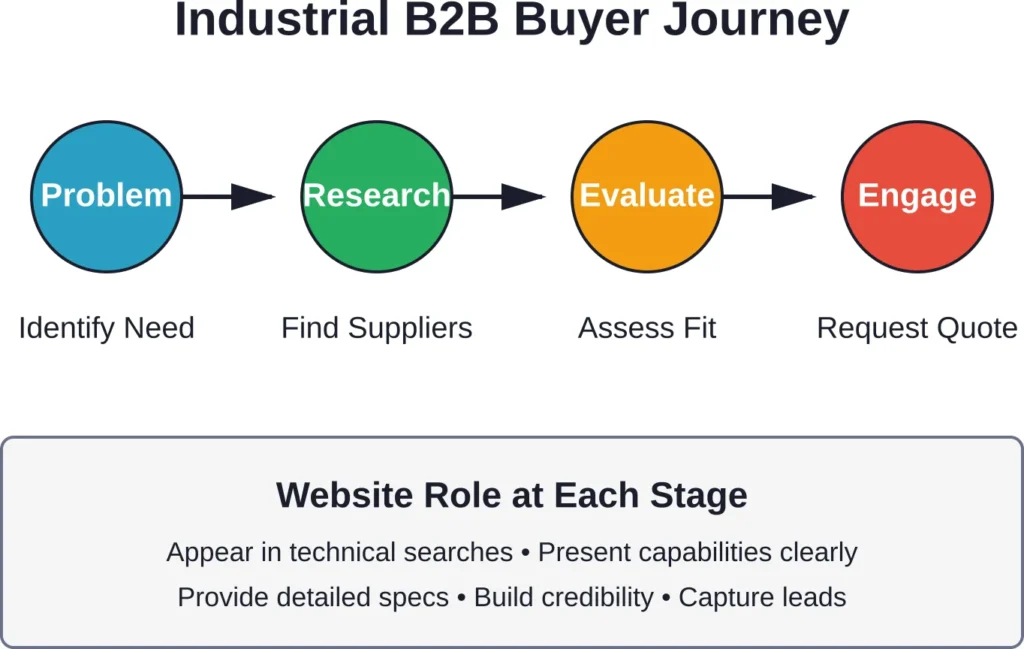
Stakeholder validation occurs as buyers share findings with colleagues, managers, or technical specialists. Multiple people review supplier options, raising questions and concerns. Websites must address diverse stakeholder needs—engineers want specs, managers want business stability, procurement wants competitive pricing indicators.
Finally comes engagement. Buyers submit quote requests, request samples, schedule consultations, or contact sales. The website has done its job by qualifying the prospect and initiating sales conversations with informed, interested buyers.
Manufacturing websites must support every journey stage. That requires sophisticated content strategy, smart information architecture, technical SEO, and conversion optimization—exactly what specialized agencies deliver.
ROI Metrics That Actually Matter
Measuring manufacturing website success requires tracking metrics aligned with B2B sales realities, not vanity statistics.
Lead volume and quality matter most. Track quote requests, sample orders, consultation bookings, technical inquiries, and whitepaper downloads. More importantly, measure what percentage become qualified opportunities and closed sales. A website generating 100 monthly leads that convert at 2% outperforms one generating 50 leads at 10% conversion.
Technical content engagement reveals buyer interest. Monitor which specification sheets get downloaded, which case studies get read, which product videos get watched. This behavioral data helps sales teams understand prospect interests before initial conversations.
Organic search visibility for technical terms drives long-term value. Track rankings for specification-based keywords, application searches, and industry-specific phrases. Improved visibility here indicates the site effectively reaches buyers early in research phases.
Site search behavior exposes navigation issues and content gaps. What do visitors search for on your site? Frequent searches for product categories, specifications, or resources that should be easily accessible suggest information architecture problems worth addressing.
Time on page for key content indicates engagement quality. Visitors spending several minutes with technical resources demonstrate serious interest. Those bouncing quickly suggest content misalignment or poor presentation.
| Metric Category | What to Track | Why It Matters |
|---|---|---|
| Lead Generation | Quote requests, sample orders, consultation bookings, technical inquiries | Direct measure of website effectiveness at driving sales conversations |
| Lead Quality | Conversion rate to qualified opportunities and closed sales | Distinguishes valuable leads from tire-kickers and non-target visitors |
| Organic Visibility | Rankings for technical specifications, applications, industry terms | Indicates ability to reach buyers during early research phases |
| Content Engagement | Downloads, video views, page time for technical resources | Reveals what information buyers value and consume before engaging sales |
| User Behavior | Site search queries, navigation patterns, exit pages | Exposes information architecture issues and content gaps to address |
Industry-Specific Considerations
Different manufacturing verticals present unique web design challenges that generic approaches miss.
Industrial equipment manufacturers need configurator tools, application guides, and service network information. Buyers research compatibility with existing systems, installation requirements, and long-term support availability. Technical specifications matter, but so do total cost of ownership considerations and operational implications.
Component suppliers face catalog complexity challenges. With thousands of SKUs across multiple product families, smart filtering, parametric search, and cross-reference tools become essential. Engineers need to quickly find exact specifications matching their requirements.
Process equipment manufacturers must communicate complex capabilities. Buyers evaluate production capacity, process flexibility, quality control capabilities, and technical expertise. Case studies showing successful installations in similar applications prove particularly valuable.
Contract manufacturers need to showcase operational capabilities—certifications, quality systems, equipment lists, material expertise, capacity, and engineering support. Buyers assess whether the manufacturer can handle their specific requirements and volume needs.
Material suppliers balance technical data with application guidance. Chemical compositions, physical properties, and compliance certifications matter, but buyers also need help understanding which materials suit specific applications and environments.
The Future of Manufacturing Websites
Several trends are reshaping manufacturing web design as technology advances and buyer expectations evolve.
AI-powered search and recommendations improve product discovery. Rather than browsing catalogs or using basic filters, buyers describe requirements in natural language and receive intelligent suggestions. This proves especially valuable for complex product catalogs where traditional navigation overwhelms users.
Interactive configuration tools let buyers customize products online, seeing real-time pricing and availability. What previously required back-and-forth sales conversations now happens through sophisticated product configurators that handle options, dependencies, and pricing logic.
Virtual showrooms and augmented reality experiences help buyers visualize equipment in their facilities. Instead of guessing how machinery fits existing layouts, buyers place virtual models in actual spaces using AR technology.
Personalization engines deliver different content experiences based on visitor characteristics—industry, role, previous interactions, or identified interests. Engineers see technical specifications prominently; managers see business cases and ROI calculators.
Integration with sales tools creates seamless handoffs. When leads convert, CRM systems receive complete behavioral data—pages visited, content consumed, products viewed, specifications downloaded—equipping sales teams with intelligence for more relevant initial conversations.
Making Your Decision
Choosing among these top manufacturing web design companies requires evaluating fit across multiple dimensions.
Start by clarifying objectives. Are you launching a new site, redesigning an underperforming one, or adding specific functionality? Do you need ongoing marketing support or just design and development? Clear goals focus the selection process.
Evaluate relevant experience. Review portfolio work from companies with similar products, complexity, sales models, or technical requirements. Generic B2B experience doesn’t automatically translate to manufacturing expertise.
Assess chemistry and communication style. Web projects require sustained collaboration. Choose agencies whose working style, communication approach, and project management methodology align with internal expectations and processes.
Consider service breadth. Some manufacturers need comprehensive digital marketing partners handling strategy, design, content, SEO, advertising, and analytics. Others want specialized web design firms focused solely on site development. Match agency capabilities to actual needs.
Check references thoroughly. Don’t just review portfolio pieces—speak with actual clients about their experience, challenges encountered, results achieved, and whether they’d work with the agency again.
The agencies profiled here represent proven manufacturing web design expertise. Each brings different strengths, specializations, and approaches. The right choice depends on specific requirements, company size, budget considerations, and strategic objectives.
But here’s what matters most: choosing a specialized manufacturing agency rather than a generalist firm. Industrial B2B buyers behave differently than consumers. Technical products require different presentation than simple services. Complex sales cycles demand different conversion strategies than e-commerce transactions.
Manufacturers investing in digital presence need partners who understand these distinctions and design accordingly.
Frequently Asked Questions
Manufacturing websites serve B2B buyers conducting technical research and evaluation over extended sales cycles. They require sophisticated product catalog organization, technical specification presentation, documentation management, multi-stakeholder navigation, and lead capture mechanisms aligned with complex purchasing processes. Generic business websites prioritize aesthetics and simplicity; manufacturing sites balance visual appeal with information density and technical functionality that engineers and procurement professionals need.
Timeline varies based on scope and complexity. Basic manufacturing sites with standard features typically require 3-4 months from kickoff to launch. Mid-complexity sites with custom functionality, product configurators, or system integrations take 4-6 months. Enterprise projects with extensive product catalogs, multiple integrations, and custom applications can extend 6-12 months. Discovery and strategy phases consume 4-6 weeks, design and development 8-16 weeks, and testing and refinement another 2-4 weeks.
Platform choice depends on specific requirements and technical resources. WordPress and similar content management systems work well for many manufacturers, offering flexibility, extensive plugin ecosystems, and reasonable total cost. Custom development makes sense when requirements include complex product configurators, sophisticated ERP integrations, unique workflows, or functionality beyond platform capabilities. Many successful manufacturing sites use WordPress or similar platforms with custom development for specialized features.
Mobile responsiveness proves critical despite the perception that industrial buyers work primarily from desktops. Field engineers access specifications on job sites, managers review supplier options during travel, and procurement specialists research on tablets during meetings. Mobile traffic represents 30-40% of visitors for many manufacturing sites. Responsive design ensures technical content remains accessible and functional across all devices without requiring separate mobile site development.
Manufacturing sites need continuous attention beyond initial launch. Product information requires regular updates as specifications change, new models launch, and discontinued items phase out. Technical content needs expansion based on customer questions and sales feedback. Security patches and software updates maintain platform stability. Performance monitoring identifies issues before they impact user experience. SEO optimization responds to algorithm changes and competitive dynamics. Budget for ongoing maintenance representing 15-25% of initial development investment annually.
Manufacturing lead generation focuses on moving prospects into sales conversations rather than immediate transactions. Effective mechanisms include quote request forms, sample ordering systems, consultation booking calendars, technical inquiry forms, whitepaper downloads, webinar registrations, distributor locators, and specification downloads. The goal is capturing contact information and qualifying interest level while providing value that advances buyer research. Strategic placement of these conversion tools throughout content creates multiple engagement opportunities aligned with different buyer journey stages.
SEO proves fundamental for manufacturing websites because industrial buyers begin research with search engines, not brand-specific site visits. Technical specifications, application requirements, certification needs, and material properties generate highly qualified search traffic. Industrial SEO targets long-tail keywords that competitors often ignore—specific part numbers, technical specifications, application-specific phrases, and compliance terms. Site architecture, URL structures, content organization, and technical implementation must support SEO objectives from the start rather than bolting optimization onto completed designs.
Conclusion
Manufacturing web design requires specialized expertise that generic agencies simply can’t provide. Industrial B2B buyers evaluate suppliers differently than consumers shop products, following research-intensive processes spanning weeks or months and involving multiple stakeholders.
The 15 agencies profiled here bring proven manufacturing experience, technical capabilities, and strategic understanding necessary for creating websites that generate qualified leads and support complex sales cycles.
Orbit Media Studios, Thrive Internet Marketing Agency, Americaneagle.com, Lform Design, LLT Group, StraightNorth, Weidert Group, Thomas Marketing Services, Industrial Strength Marketing, and Sagefrog Marketing Group each offer distinct strengths serving different manufacturer needs.
Your selection should align with specific requirements—company size, technical complexity, integration needs, content strategy, ongoing support expectations, and strategic objectives. Request detailed proposals, review relevant portfolio work, check references, and assess cultural fit before committing.
But make one decision confidently: choose a specialized manufacturing agency over a generalist firm. The difference between agencies who understand industrial B2B dynamics and those who don’t shows immediately in website effectiveness, lead quality, and ultimately sales results.
Your website represents your company to buyers conducting initial research, often before sales teams know prospects exist. That first impression determines whether you earn further consideration or get eliminated from shortlists.
Invest in specialized expertise that ensures your digital presence communicates technical credibility, operational capabilities, and industry knowledge as effectively as your best salespeople.