
The comparison between OpenClaw, ChatGPT, and Claude gets misunderstood constantly. Most people frame it as “which chatbot is better?” But that’s not the right question.
ChatGPT and Claude are cloud-based AI assistants you access through a browser or app. OpenClaw is something fundamentally different—it’s a self-hosted agent framework that runs on your own server.
Here’s what actually matters: where your data goes, what you pay, and what trade-offs you accept.
What ChatGPT and Claude Actually Are
Both ChatGPT and Claude are conversational AI assistants. You sign up, log in, and start chatting. Everything happens on their servers.
ChatGPT offers several subscription tiers. According to the official OpenAI website, the Free plan provides limited access to GPT-5.2. ChatGPT Go costs $8/month in the US (pricing is localized in some markets) and offers expanded access to GPT-5.2 Instant with higher limits for messages, uploads, and image creation. ChatGPT Plus runs $20/month with advanced reasoning models, expanded message limits, and features like deep research and agent mode.
Claude has a similar structure. The Free plan works for occasional use. Claude Pro costs $20/month (or $200/year with an annual discount) and provides at least five times the usage per session compared to free access. Claude also offers Max plans: Max 5x at $100/month and Max 20x at $200/month, designed for frequent and daily users respectively.
Both platforms introduced agentic features in early 2026. Claude Code and Claude Cowork allow the AI to interact with your desktop, execute code, and perform tasks autonomously. ChatGPT has agent mode in Plus and higher tiers.
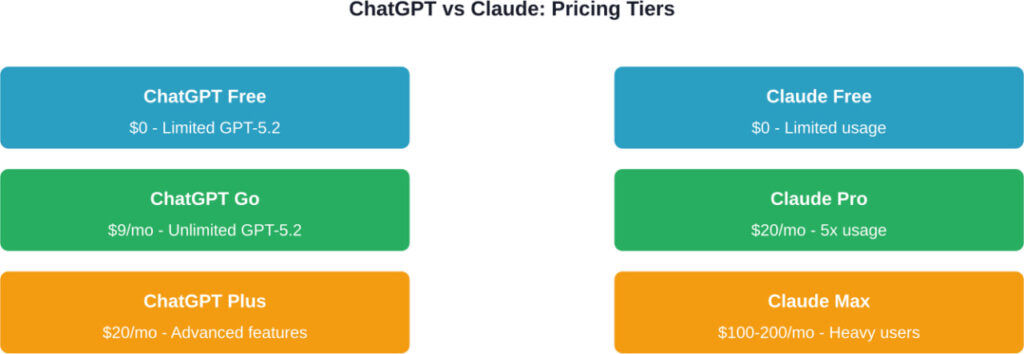
Official pricing tiers for ChatGPT and Claude as of February 2026
What OpenClaw Actually Is
OpenClaw isn’t a chatbot. It’s an open-source framework for running AI agents on your own infrastructure.
You need a VPS (virtual private server), some technical setup, and 30-60 minutes if you know what you’re doing. OpenClaw connects to AI models through APIs—originally designed for Claude’s API, but it now supports ChatGPT and other models.
The critical difference? Your conversations never leave your server. You control the data, the logs, and the infrastructure.
But here’s where it gets complicated. In February 2026, Anthropic updated their terms of service. OAuth authentication tokens from Claude Free, Pro, and Max accounts are explicitly intended only for Claude Code and Claude.ai. Using those tokens with third-party tools like OpenClaw violates the TOS.
That means OpenClaw users need to switch to API access (which Anthropic charges separately) or use ChatGPT’s API instead.
Privacy and Data Control
This is the core difference that actually matters.
ChatGPT sends your conversations to OpenAI’s servers, subject to OpenAI’s privacy policy and US law. Claude does the same with Anthropic’s infrastructure.
OpenClaw keeps everything on your server. If you’re handling sensitive data—legal documents, proprietary code, confidential business information—that’s a meaningful distinction.
According to a 2025 arXiv paper documenting agentic AI systems, 62% of companies surveyed were at least experimenting with AI agents. As adoption grows, data governance becomes a bigger concern.
|
Platform |
Data Location |
Privacy Control |
Compliance
|
|---|---|---|---|
|
ChatGPT |
OpenAI servers (US) |
Limited |
OpenAI policy |
|
Claude |
Anthropic servers (US) |
Limited |
Anthropic policy |
|
OpenClaw |
Your infrastructure |
Complete |
Your policy |
Setup and Ease of Use
ChatGPT and Claude win this category by a mile.
Zero setup. Create an account, pick a plan, start chatting. That’s it.
OpenClaw requires a VPS, configuration files, API authentication, and some command-line comfort. It’s not rocket science, but it’s not one-click either.
For non-technical users, this is a dealbreaker. For developers or teams with existing infrastructure, it’s just another deployment.
Cost Comparison
The cost structure is completely different.
ChatGPT charges per user per month: $9 for Go, $20 for Plus. Claude charges $20/month for Pro, $100-200/month for Max tiers.
OpenClaw has no platform subscription fee—it’s open source. But you pay for server hosting (typically $10-50/month depending on specs) plus API usage. Claude API pricing for Opus 4.6 is $5 per million input tokens for base input. ChatGPT API costs vary by model.
If you’re a single user running occasional queries, ChatGPT Go at $8/month in the US (localized elsewhere) is a low-cost option. If you’re running hundreds of automated tasks per day, OpenClaw with API access might cost less at scale.
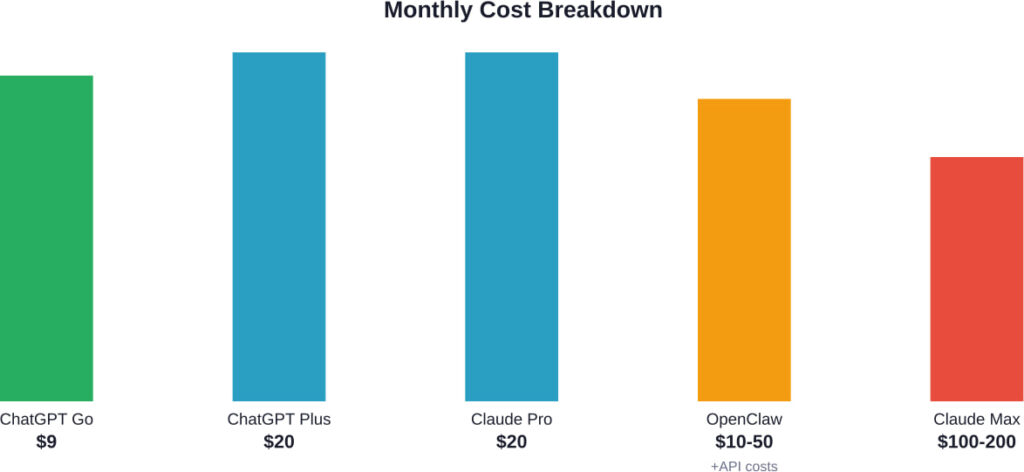
Comparative monthly costs across platforms (OpenClaw costs vary based on usage)
Capabilities and Features
- ChatGPT Plus offers advanced reasoning models, expanded message limits, image generation, deep research, and agent mode. According to OpenAI’s official help center, GPT-5.2 is available as a ChatGPT model as of February 2026.
- Claude Pro provides five times the usage of free tier, projects, knowledge bases, and access to Claude Code—an agentic feature that can execute code and interact with your desktop.
- OpenClaw doesn’t have built-in models. It’s a framework that connects to whatever API you configure. You get the capabilities of the underlying model (Claude Opus 4.6, ChatGPT GPT-5.2, etc.) but with your own orchestration and control logic.
The trade-off is flexibility versus convenience. ChatGPT and Claude come pre-configured with polished interfaces. OpenClaw requires you to build the interface and workflow you want.
When to Use Each
- Use ChatGPT or Claude if you want zero friction. Sign up, start chatting, done. They’re perfect for individual users, knowledge workers, and anyone who values convenience over infrastructure control.
- Use OpenClaw if you need data sovereignty. If you’re handling regulated data, building custom workflows, or integrating AI into existing systems, the self-hosted approach makes sense.
Real talk: most people should just use ChatGPT or Claude. The convenience is worth it.
OpenClaw is for technical users who have specific infrastructure requirements or privacy constraints that cloud services can’t satisfy.
The Hallucination Problem
Here’s something that affects all three options: none of these models are 100% reliable.
A research team led by RIT created a framework to stress test LLMs and tested them with over 40,000 questions. The conclusion? None of the models were 100 percent self-consistent, meaning they could not consistently distinguish between self-generated truths and falsehoods.
That’s not unique to ChatGPT or Claude or OpenClaw—it’s a fundamental limitation of current LLM architecture. Whether your AI runs in the cloud or on your server, you need to verify critical outputs.
Switching from Claude to ChatGPT in OpenClaw
Since Anthropic’s TOS update, many OpenClaw users are switching to ChatGPT APIs.
The process takes about five minutes. Run the onboard command, authenticate with ChatGPT, set the model (GPT-5.2 or another variant), and verify. The technical documentation on OpenClaw’s GitHub repository walks through the exact steps.
Some users ask whether ChatGPT’s models will perform as well as Claude’s Opus models. Based on community discussions, performance is comparable for most tasks, though Claude still has advantages for certain coding workflows.
Bottom Line
The comparison isn’t about which tool is “better.” It’s about which trade-offs you’re willing to accept.
ChatGPT and Claude offer polished, convenient experiences with zero setup. They’re perfect for most users. OpenClaw offers control, privacy, and infrastructure flexibility at the cost of complexity.
If you’re not sure which you need, start with ChatGPT or Claude Free. You can always move to a self-hosted solution later if your requirements change.
And if you’re handling sensitive data or building production systems, check the official documentation for current pricing, TOS requirements, and feature availability before committing to any platform.
Frequently Asked Questions
ChatGPT is a cloud-hosted AI assistant that runs on OpenAI’s servers. OpenClaw is a self-hosted framework that runs on your own infrastructure and connects to AI models through APIs. The key difference is data control: ChatGPT sends data to OpenAI, OpenClaw keeps it on your server.
OpenClaw is free and open source, but you pay for server hosting (typically $10-50/month) plus API usage costs. ChatGPT Go costs $8/month in the US (localized elsewhere), and Plus costs $20/month.Total costs depend on your usage volume.
As of February 2026, Anthropic’s updated terms of service restrict OAuth tokens from Claude Free, Pro, and Max plans to official Claude applications only. You can still use Claude’s paid API with OpenClaw, but not the consumer subscription tokens.
Yes. ChatGPT and Claude require zero setup—just create an account and start chatting. OpenClaw requires a VPS, configuration, and 30-60 minutes of technical setup. It’s designed for users comfortable with command-line tools and server management.
OpenClaw provides complete data control because everything runs on your infrastructure. Claude and ChatGPT both send data to their respective companies’ servers. For regulated industries or sensitive data, OpenClaw’s self-hosted approach offers stronger privacy guarantees.
Yes. ChatGPT Plus includes agent mode, and Claude offers Claude Code and Claude Cowork—agentic features that can execute code, interact with your desktop, and perform autonomous tasks. These features were rolled out in early 2026.
Yes. OpenClaw is model-agnostic. You can configure it to use ChatGPT, Claude, or other AI models through their respective APIs. This flexibility is one of OpenClaw’s advantages over single-vendor solutions.