

Quick Summary: The top PrestaShop web development companies in 2026 include Lengreo, Gilzor, OSKI Solutions, A-listware, Mobian Studio, iCreative Technologies, Wildnet Edge, BrainSpate, Cygnet Infotech, IOGOOS, WPWeb Infotech, Promodo, Loungelizard, BigDrop Inc., and Doozy Agenzia Digitale. These agencies specialize in custom PrestaShop store development, module creation, migration services, and performance optimization for B2B and B2C ecommerce businesses.
Finding the right PrestaShop development partner isn’t about scanning a list and picking a name. It’s about matching your specific ecommerce needs with an agency that has proven technical depth, industry experience, and a track record of delivering stores that actually convert.
PrestaShop remains one of the most flexible open-source ecommerce platforms in 2026, but its true power comes through expert customization. The wrong development partner can lead to months of delays, broken modules, poor SEO structure, and checkout issues that quietly drain revenue every single day.
This guide presents 15 PrestaShop development companies that have demonstrated consistent technical capability across custom module development, store design, migration projects, and long-term support. The selection is based on verified client reviews, documented project outcomes, technical specialization, and official PrestaShop partner status where applicable.
What Makes a PrestaShop Development Company Worth Hiring
Not every web agency that claims PrestaShop expertise can actually deliver enterprise-grade results. The platform’s modular architecture requires developers who understand not just PHP and Symfony, but also PrestaShop’s specific hook system, database structure, and performance optimization strategies.
Here’s what separates competent PrestaShop agencies from the rest.
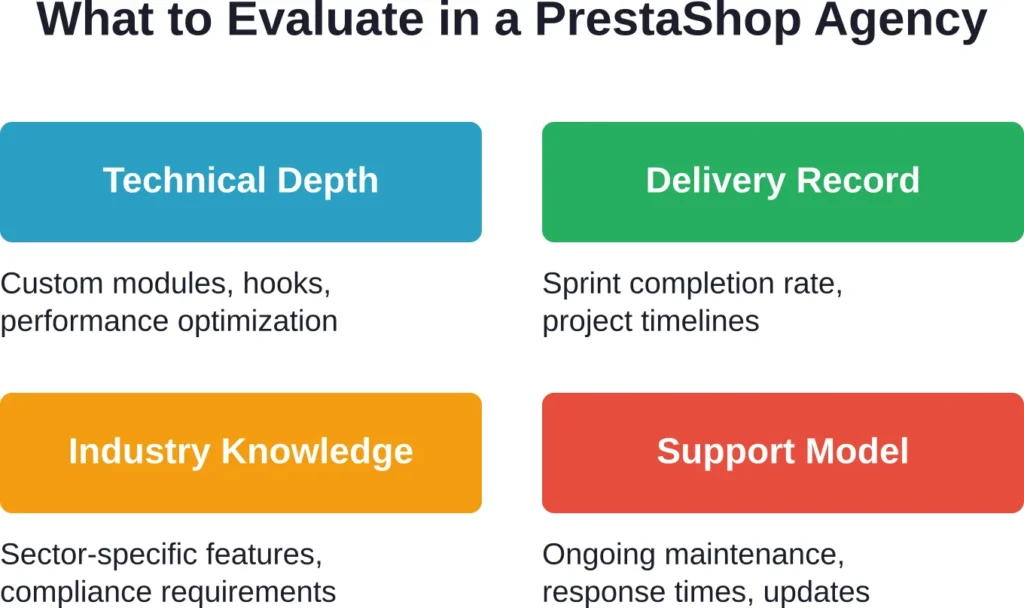
Technical Expertise Beyond Basic Setup
Installation and theme selection represents maybe 5% of what a professional PrestaShop build requires. Real technical capability shows up in custom module development, third-party system integrations, multi-store configurations, and performance tuning that keeps page loads under two seconds even with thousands of products.
The best agencies maintain developers who contribute to the PrestaShop community, understand the differences between PrestaShop 1.7 and 8.x architecture, and can troubleshoot complex issues involving payment gateways, shipping carriers, and ERP synchronization.
Proven Project Delivery Process
According to available data, agencies with high client retention maintain a 95% sprint delivery rate tracked internally across all active engagements. That level of consistency comes from structured project management, not just talented developers.
Look for agencies that document their development workflow, provide staging environments, conduct proper testing before deployment, and offer clear communication channels throughout the project lifecycle.
Industry-Specific Experience
B2B wholesale operations have completely different requirements than B2C retail stores. Fashion ecommerce needs different features than electronics or industrial equipment sales.
Agencies that have worked within your specific industry understand regulatory requirements, common integration needs, and user experience patterns that drive conversions for your customer type.
Top 15 PrestaShop Development Companies for 2026
The following agencies have demonstrated consistent capability in PrestaShop development through verified client work, technical specialization, and documented project outcomes. The list presents companies serving different market segments, from small business stores to enterprise multi-store implementations.
1. Lengreo

Lengreo operates as a specialized PrestaShop development company with strong expertise in building high-conversion ecommerce stores. The agency combines deep platform knowledge with advanced custom development to deliver tailored solutions for demanding clients.
Their technical team focuses on B2B and B2C ecommerce projects with particular strength in custom module development, complex integrations, and performance optimization from the ground up. The company’s approach emphasizes clean architecture, SEO-ready builds, and conversion-focused features implemented during initial development.
Core services include custom PrestaShop store development, theme customization, module creation, third-party system integrations, migration projects, and long-term technical support. Lengreo has delivered projects across fashion, electronics, home goods, and B2B wholesale sectors.
Contact Information:
- Website: Lengreo.com
- Phone: +31 686 147 566
- Email: [email protected]
- Address: Vrijstraat 9 C/D, 5611 AT Eindhoven, Netherlands
- LinkedIn: Lengreo
- Twitter: @Lengreo
- Instagram: @lengreo
2. Gilzor

Gilzor positions itself as a full-cycle PrestaShop development agency specializing in custom ecommerce solutions for growing businesses and enterprises. The company excels at turning unique business requirements into robust PrestaShop implementations.
Their technical team focuses on advanced custom development, including complex product configuration systems, dynamic pricing engines, and multi-vendor marketplace features. The company’s approach prioritizes scalable architecture and seamless user experience across devices.
Core services include PrestaShop custom development, module and plugin creation, theme design and customization, ERP/CRM integrations, performance optimization, and ongoing maintenance. Gilzor has successfully completed projects in retail, manufacturing, and service-based ecommerce verticals.
Contact Information:
- Website: www.gilzor.com
- Email: [email protected]
- Address: Poland, Warsaw, Office 58, street Adama Mickiewicza 37, 01-625
- LinkedIn: www.linkedin.com/company/gilzor-softwaredevelopment
3. Oski

Oski operates as a PrestaShop development company with a strong focus on enterprise-grade ecommerce solutions and technical innovation. The agency delivers powerful, customized PrestaShop stores designed for high performance and future growth.
Their technical team specializes in building sophisticated B2B portals, custom checkout flows, and advanced inventory management systems. The company’s approach emphasizes AI-enhanced features, automation, and mobile-first responsive design within the PrestaShop ecosystem.
Core services include full custom PrestaShop development, advanced module development, multi-store and multi-language setups, payment and shipping integrations, security hardening, and dedicated support packages. Oski has experience across multiple industries including logistics, fashion, and technical equipment.
Contact Information:
- Website: oski.site
- Phone: +48571282759
- Email: [email protected]
- Address: Kaupmehe tn 7, 10114 Tallinn, Estonia
- LinkedIn: www.linkedin.com/company/oski-solutions
4. A-listware

A-listware operates as a dedicated PrestaShop development partner known for delivering secure, scalable, and highly customized ecommerce platforms. The company focuses on long-term technical partnerships rather than one-off projects.
Their technical team focuses on complex PrestaShop implementations requiring deep custom logic, API integrations, and enterprise system connectivity. The company’s approach emphasizes code quality, documentation, and solutions that evolve together with client business needs.
Core services include custom PrestaShop store builds, legacy platform migrations, custom module and extension development, UX/UI optimization, performance tuning, and dedicated development teams. A-listware has worked with clients in wholesale, retail, and specialized B2B sectors.
Contact Information:
- Website: a-listware.com
- Phone: +1 (888) 337 93 73
- Email: [email protected]
- Address: North Bergen, NJ 07047, USA
- LinkedIn: www.linkedin.com/company/a-listware
- Facebook: www.facebook.com/alistware
5. Mobian

Mobian operates as a PrestaShop development company specializing in fast, reliable, and conversion-oriented ecommerce solutions. The agency combines strong technical expertise with practical business understanding.
Their technical team focuses on creating stores with excellent user experience, fast loading times, and powerful backend functionality. The company’s approach emphasizes clean, maintainable code and features that directly impact sales and operational efficiency.
Core services include PrestaShop website development, custom theme creation, module development, checkout and cart optimization, multi-currency and multi-language setups, and post-launch technical maintenance. Mobian has delivered successful PrestaShop projects in consumer goods, electronics, and home & garden categories.
Contact Information:
- Website: mobian.studio
- Phone: [email protected]
- Address: Harju maakond, Tallinn, Kesklinnalinnaosa, Masina tn 22, 10113
- LinkedIn: www.linkedin.com/company/mobian-studio
6. WPWeb Infotech

WPWeb Infotech maintains a multi-platform ecommerce development practice with specialized PrestaShop expertise. The company’s technical team handles both new store implementations and migration projects from other platforms to PrestaShop.
Service offerings include complete store development, custom module creation, responsive design implementation, payment gateway integration, and ongoing maintenance support. The agency’s approach focuses on delivering technically sound implementations that meet specific business requirements rather than template-based solutions.
Their project portfolio demonstrates experience across various ecommerce categories with documented capability in handling international stores requiring multi-language and multi-currency functionality.
7. Promodo

Promodo operates as a digital agency combining ecommerce development with PPC and SEO services. Their PrestaShop practice benefits from this integrated approach, delivering stores optimized for search visibility and paid advertising from the initial build.
The company’s technical services cover PrestaShop development, custom functionality implementation, and platform optimization. Industry experience spans retail and consumer goods categories with particular focus on stores that require strong digital marketing integration.
Promodo’s development approach emphasizes technical SEO best practices, structured data implementation, and conversion optimization strategies that support overall digital marketing objectives.
8. Loungelizard

Loungelizard positions itself as a digital agency with ecommerce development capability including PrestaShop implementations. The company combines web development with branding and digital strategy services, providing a broader scope than pure development shops.
Their PrestaShop services include custom store development, design implementation, and technical optimization. The agency’s approach integrates brand strategy with technical implementation, which can benefit businesses launching new ecommerce operations or rebranding existing stores.
Loungelizard’s project work demonstrates experience in building visually distinctive PrestaShop stores that maintain strong technical foundations and conversion-focused user experiences.
9. BigDrop Inc.

BigDrop Inc. operates as a digital agency with technical capability across multiple ecommerce platforms including PrestaShop. The company’s service model combines strategy, design, and development into integrated project delivery.
Their PrestaShop practice focuses on custom implementations that require significant design work and brand integration. Services span the full project lifecycle from initial strategy through design, development, and post-launch optimization.
BigDrop’s approach suits businesses that need both technical PrestaShop expertise and creative direction for their ecommerce presence. Their project portfolio includes work across various retail and B2C categories.
10. Doozy Agenzia Digitale

Doozy Agenzia Digitale operates as an official PrestaShop Expert, meaning they participate in the official PrestaShop partner program and meet the platform’s certification requirements. The agency specializes in building customized PrestaShop ecommerce solutions that are integrable and designed for growth.
Their technical services cover strategy, development, customization, and integration work. The company positions itself as particularly strong in medium-sized and large online shop implementations that require advanced features and complex system integrations.
Doozy’s development approach emphasizes flexibility and control, allowing merchants to grow their online presence with technical infrastructure that can scale with business demands.
11. iCreative Technologies

iCreative Technologies operates as a specialized PrestaShop development company with documented experience building over 280+ successful PrestaShop projects. The agency maintains offices in both the United States and France, providing coverage across North American and European markets.
Their technical team focuses on B2B and B2C ecommerce builds with particular strength in custom module development and third-party system integrations. The company’s approach emphasizes SEO-ready architecture from the initial build phase, which reduces the need for later structural modifications.
Core services include custom PrestaShop store development, migration from other platforms, performance optimization, and long-term maintenance contracts. The agency has worked across retail, wholesale, and manufacturing sectors with documented projects in fashion, electronics, and industrial equipment categories.
12. Wildnet Edge

Wildnet Edge positions itself as an enterprise-focused PrestaShop development firm with capabilities extending beyond standard ecommerce implementation. The agency combines PrestaShop expertise with artificial intelligence integration, B2B marketplace development, and custom extension creation.
Their service portfolio covers multiple ecommerce platforms, but PrestaShop remains a core specialization. Industry experience spans retail, manufacturing, and healthcare sectors, with technical capability in handling complex product catalogs, custom pricing rules, and multi-warehouse inventory systems.
The company maintains a documented track record in enterprise PrestaShop implementations requiring integration with ERP systems, PIM platforms, and custom business logic. Their development approach includes mobile app development for PrestaShop stores and progressive web app implementations.
13. BrainSpate

BrainSpate operates as a full-service PrestaShop development company with emphasis on building stores that are 100% personalized, fast-responding, and easily manageable according to available documentation. The agency’s technical team handles custom aesthetics combined with conversion-focused features.
Core services encompass PrestaShop store development, UI/UX design specifically for ecommerce, mobile app development for PrestaShop backends, module development, theme customization, and ongoing support. The company’s development process focuses on ROI improvement through technical optimization and user experience refinement.
BrainSpate’s project portfolio includes work across various ecommerce categories with documented capability in both new store builds and existing store optimization projects. Their approach combines technical development with conversion rate optimization strategies.
14. Cygnet Infotech

Cygnet Infotech brings 17+ years of technology company experience with a team exceeding 500 professionals. While the company operates across multiple technology domains, PrestaShop development represents a significant service line within their ecommerce practice.
The agency’s scale allows them to assemble dedicated PrestaShop teams for larger projects while maintaining the technical depth required for complex custom development. According to available data from Wadline, minimum project sizes at enterprises serving enterprise clients start at $10k+ but complex implementations extend well beyond that baseline.
Their PrestaShop services cover custom internet solutions tailored to specific business requirements, with documented capability in building stores that integrate with existing business systems and workflows.
15. IOGOOS

IOGOOS operates as a PrestaShop-focused development agency with documented expertise in unlocking the platform’s full potential through professional customization. The company’s technical approach emphasizes modular architecture and scalable solutions that can grow with business requirements.
Their development team specializes in feature-rich ecommerce stores built on PrestaShop’s flexible foundation. Services include custom development, theme design, module creation, and technical optimization for performance and conversion.
The agency has worked across multiple ecommerce verticals with particular strength in building stores that require complex product configurations, custom checkout flows, and specialized shipping logic.
How PrestaShop Development Services Are Structured
PrestaShop agencies typically organize their services around several core offerings, though the specific structure varies by company size and market focus.
Custom Store Development
Complete store builds represent the foundational service most agencies provide. This includes PrestaShop installation and configuration, custom theme development or significant theme customization, essential module integration, payment gateway setup, shipping method configuration, and basic SEO structure.
Custom development projects typically involve discovery and planning phases, design mockups and approval cycles, development sprints, testing periods, and deployment with training. Project timelines for new stores range from 6-12 weeks for straightforward implementations to 4-6 months for complex B2B or multi-store projects.
Module Development and Customization
PrestaShop’s modular architecture means that unique business requirements often demand custom module development. Agencies with strong technical depth can build modules that extend core functionality without modifying PrestaShop’s base code, which simplifies future updates.
Common custom modules include specialized product configurators, custom pricing rules for B2B scenarios, unique checkout workflows, inventory management extensions, and integrations with proprietary business systems.
Migration Services
Moving an existing store from another platform to PrestaShop requires careful data mapping, careful consideration of URL structure for SEO preservation, product catalog migration with all attributes and images, customer account and order history transfer, and payment and shipping configuration replication.
According to the official Portátil Móvil case study on PrestaShop.com, SEO structure 100% preserved, with no loss of visibility or traffic through proper migration execution. Professional migration services typically include pre-migration audits, data mapping documentation, staged migration with testing, and post-migration validation.
Performance Optimization
PrestaShop stores can experience performance degradation as product catalogs grow, modules accumulate, and traffic increases. Specialized optimization services address database query optimization, image compression and CDN implementation, caching strategy configuration, code-level performance improvements, and server environment tuning.
Performance work often delivers measurable improvements in Core Web Vitals scores, which directly impact both user experience and search rankings. According to BelVG’s technical documentation on Core Web Vitals, ecommerce stores need to deliver fast, responsive experiences for at least 75% of visitors to pass Core Web Vitals assessment.
Ongoing Maintenance and Support
PrestaShop stores require regular attention to maintain security, performance, and functionality. Maintenance services typically cover security updates and patches, PrestaShop core updates, module compatibility testing and updates, backup management, security monitoring, and technical support for merchant users.
Support models vary from hourly on-demand arrangements to monthly retainer packages with defined support hours and response time commitments.
Cost Considerations for PrestaShop Development
Development costs vary significantly based on project scope, customization requirements, agency location, and technical complexity. Understanding the factors that drive costs helps set realistic budgets.
What Influences Development Costs
Several variables determine final project costs for PrestaShop development work.
Store complexity represents the primary driver. A straightforward B2C store with standard features costs substantially less than a B2B marketplace requiring custom pricing, quote systems, and ERP integration. Product catalog size and complexity matters too—stores with simple products need less development than those with complex configurations, variants, or custom product builders.
Custom functionality requirements directly impact development time. Each custom module, unique workflow, or specialized integration adds development hours. Design requirements influence costs as well, with fully custom designs requiring more investment than premium theme customization.
Third-party integrations add complexity and cost. Connecting to ERP systems, PIM platforms, custom CRMs, specialized shipping carriers, or unique payment processors requires integration development and testing time.
Typical Project Budget Ranges
Based on available data from review platforms, PrestaShop development projects typically fall into several budget ranges.
Small business stores with relatively standard requirements and moderate customization often fall in the $10,000 to $25,000 range. These projects typically involve theme customization, essential module integration, and straightforward functionality.
Mid-market implementations with custom features, significant design work, and multiple integrations commonly range from $25,000 to $75,000. These projects involve more custom development, sophisticated functionality, and longer timelines.
Enterprise projects requiring extensive custom development, complex integrations, and multi-store configurations can exceed $100,000. These complex implementations extend well beyond the baseline starting point for development investment.
Beyond Initial Development Costs
According to official PrestaShop resources, calculating total cost of ownership for an online store extends well beyond the platform and initial development investment.
Operating costs include hosting infrastructure, which varies by traffic and performance requirements. Marketing and acquisition costs can represent 8% or less of revenue after launch according to official guidance. Shipping costs vary significantly by category and can represent 11% to 30% of revenue depending on product weight and complexity.
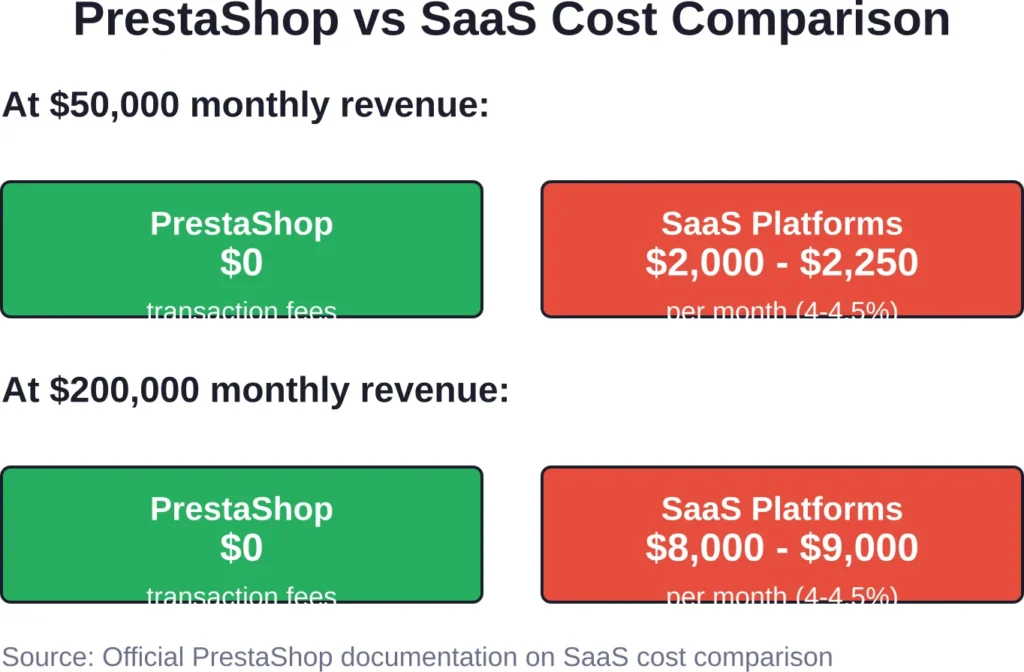
For SaaS alternatives to open-source PrestaShop, variable commissions and mandatory payment-gateway fees can elevate costs to 4–4.5% of sales according to official PrestaShop documentation. Open-source PrestaShop avoids these ongoing percentage-based fees, though it requires hosting and maintenance investment.
| Cost Category | Typical Range | Key Variables |
|---|---|---|
| Basic Store Build | $10,000 – $25,000 | Theme customization, standard features |
| Mid-Market Store | $25,000 – $75,000 | Custom development, integrations |
| Enterprise Implementation | $75,000+ | Complex systems, multi-store, custom modules |
| Monthly Maintenance | Varies widely | Support hours, update frequency, hosting |
| Marketing Costs | 8% of revenue (max) | Channel mix, competition, maturity |
| Shipping Costs | 11-30% of revenue | Product weight, category, fulfillment model |
Why Businesses Choose PrestaShop in 2026
PrestaShop maintains a strong position in the ecommerce platform landscape despite competition from both SaaS solutions and other open-source alternatives. Several factors drive continued PrestaShop adoption.
True Open-Source Flexibility
PrestaShop provides complete access to source code without licensing restrictions. This means businesses can modify any aspect of the platform to match specific requirements. For companies with unique business processes or specialized needs, this flexibility proves invaluable.
The platform’s modular architecture allows developers to extend functionality through modules without modifying core code, which simplifies updates and maintenance. This architecture supports everything from simple feature additions to complex custom workflows.
No Transaction Fees or Revenue Sharing
Unlike SaaS platforms that charge percentage-based transaction fees, PrestaShop doesn’t take a cut of sales. For high-volume stores, this difference becomes significant. Official PrestaShop documentation notes that SaaS costs including commissions and mandatory gateway fees can reach 4–4.5% of sales, while PrestaShop merchants can choose payment processors based purely on rates and features.
Strong Multi-Store Capabilities
PrestaShop’s multi-store functionality allows businesses to manage multiple storefronts from a single installation. This capability suits companies operating multiple brands, serving different geographic markets, or running separate B2B and B2C operations.
Each store can maintain its own catalog, pricing, design, and configuration while sharing backend infrastructure and optionally sharing product data.
Robust International Commerce Features
Built-in support for multiple languages, currencies, and tax rules makes PrestaShop well-suited for international commerce. The platform handles complex tax scenarios, supports various shipping methods by region, and allows different product catalogs and pricing by market.
Active Ecosystem and Community
The PrestaShop marketplace includes thousands of modules and themes. An active developer community provides support, extensions, and continuous platform improvements. Official PrestaShop partner programs ensure businesses can find certified development resources.
Questions to Ask When Evaluating Agencies
The right questions during agency evaluation help identify which development partner can truly deliver on your specific requirements.
About Technical Capability
Ask about their experience with PrestaShop-specific technical challenges. Can they explain how PrestaShop’s hook system works? Have they built custom modules that survive platform updates? What’s their approach to performance optimization for large catalogs?
Request examples of complex functionality they’ve implemented. Look for evidence of work beyond theme installation and basic configuration.
About Project Process
How do they structure projects? What does their typical timeline look like? How do they handle change requests? What testing processes do they follow before deployment?
Understanding their project methodology helps set expectations for communication, timeline, and how issues get resolved when they arise.
About Industry Experience
Have they built stores in your specific industry? Can they discuss common challenges or requirements for your type of business? Do they have case studies or references from similar projects?
Industry-specific experience means the agency understands your challenges and can recommend solutions based on what has worked for similar businesses.
About Support and Maintenance
What happens after launch? What support options do they offer? How do they handle emergency issues? What are their typical response times?
Long-term success requires ongoing support. Understanding their maintenance and support model before signing contracts prevents surprises later.
About Integration Capabilities
What experience do they have integrating PrestaShop with your required systems? Have they worked with your ERP, PIM, CRM, or other critical business systems?
Integration complexity often determines project success. Agencies with relevant integration experience can provide realistic estimates and identify potential challenges early.
Common PrestaShop Project Challenges
Understanding typical challenges helps set realistic expectations and evaluate how well agencies handle common issues.
Performance at Scale
PrestaShop stores can experience performance issues as product catalogs grow beyond several thousand items, especially with complex attributes and variations. Proper database indexing, caching configuration, and code optimization become critical.
Experienced agencies know how to structure product data, optimize queries, and implement caching strategies that maintain fast page loads even with large catalogs.
Module Compatibility
Third-party modules don’t always play nicely together. Conflicts between modules can cause functional issues or performance problems. Updates to PrestaShop core sometimes break module compatibility.
Professional agencies test module combinations thoroughly, maintain staging environments for testing updates, and know how to resolve conflicts when they occur.
Custom Functionality Scope Creep
Custom development projects often expand beyond initial scope as stakeholders identify additional requirements during development. Without proper change management processes, this leads to timeline delays and budget overruns.
Well-structured agencies maintain clear scope documentation, formal change request processes, and transparent communication about how changes impact timeline and budget.
Migration Data Quality Issues
Migrating from legacy platforms often reveals data quality problems—incomplete product information, inconsistent categorization, orphaned customer records. These issues complicate migration and require cleanup work.
Thorough discovery and data audits before migration begins help identify these issues early when they’re easier to address.
How to Prepare for a Successful PrestaShop Project
Businesses can significantly improve project outcomes through proper preparation before engaging a development agency.
Document Your Requirements Thoroughly
Create comprehensive documentation of required features, integrations, user roles, workflows, and business rules. The more clearly you can articulate requirements, the more accurate estimates will be and the fewer surprises you’ll encounter during development.
Include examples of functionality from other sites when possible. Visual references and concrete examples communicate requirements more effectively than abstract descriptions.
Audit Your Product Data
For migration projects or new stores pulling data from existing systems, audit your product data quality. Identify missing information, inconsistent formatting, and data cleanup needs before development begins.
Clean data makes development faster and reduces post-launch issues.
Identify Integration Requirements Early
Make a complete list of systems that need to integrate with your PrestaShop store. For each integration, understand what data needs to flow in which direction and with what frequency.
Early integration identification allows agencies to provide accurate estimates and identify potential technical challenges before they become blocking issues.
Establish Decision-Making Processes
Determine who will make decisions about design, functionality, and scope changes. Establish approval processes and timelines for providing feedback on deliverables.
Clear decision-making authority and responsive feedback loops keep projects moving forward efficiently.
Plan for Post-Launch Activities
Think beyond launch. What content needs to be created? Who will manage products? What training do team members need? How will you handle support questions?
Post-launch planning prevents the common scenario where a technically perfect store sits idle because operational details weren’t addressed.
Frequently Asked Questions
PrestaShop is open-source software that provides complete control over code and functionality without transaction fees. Unlike Shopify’s hosted SaaS model with monthly fees and transaction charges, PrestaShop requires your own hosting but avoids percentage-based fees. Compared to WooCommerce, which extends WordPress, PrestaShop is purpose-built for ecommerce with stronger multi-store capabilities and more sophisticated B2B features out of the box.
Timeline varies significantly based on complexity. Straightforward stores with moderate customization typically require 6-12 weeks from kickoff to launch. Mid-complexity projects with custom features and integrations commonly take 3-4 months. Enterprise implementations with extensive custom development, complex integrations, and multi-store configurations can extend to 6 months or longer. Timeline depends on scope, responsiveness during review cycles, and how well requirements are documented upfront.
Yes, when properly configured and optimized. PrestaShop can manage catalogs with tens of thousands of products, though performance optimization becomes increasingly important as catalogs grow. Database optimization, proper indexing, caching strategies, and server resources all impact performance at scale. Experienced development agencies know how to configure PrestaShop for optimal performance with large catalogs.
PrestaShop works well for B2B implementations and includes features that support B2B requirements like customer-specific pricing, quote systems, custom order workflows, and bulk ordering. Many agencies specialize in B2B PrestaShop implementations and have built custom modules for features like approval workflows, credit limits, and ERP integration that B2B operations commonly require.
PrestaShop stores need regular security updates and patches, periodic core version updates, module compatibility testing and updates, regular backups, security monitoring, and performance optimization as traffic and catalog grow. Many businesses establish monthly maintenance retainers with their development agency to handle these ongoing needs rather than managing them internally.
Budget depends heavily on project scope and complexity. Small business stores with standard features typically start around $10,000 to $25,000. Mid-market implementations with custom development commonly range from $25,000 to $75,000. Enterprise projects requiring extensive customization can exceed $100,000. Beyond initial development, budget for hosting, ongoing maintenance, and operational costs. The advantage of PrestaShop’s open-source model is avoiding the 4-4.5% of revenue that SaaS platforms often charge in transaction fees and payment gateway requirements.
Official PrestaShop Partner status indicates an agency has met certain criteria and participates in PrestaShop’s partner program. This provides some assurance of technical capability and platform familiarity. However, many highly capable PrestaShop agencies operate without official partner status. Evaluate agencies based on demonstrated technical expertise, relevant project experience, client reviews, and their specific approach to your project requirements rather than partner status alone.
Making Your Final Agency Selection
After researching agencies and conducting initial conversations, several final considerations help ensure you select the right development partner.
Verify Technical Claims
Ask for references from projects similar to yours. Contact those references directly to ask about their experience, how the agency handled challenges, and whether they’d work with them again.
Request access to live examples of their work. Explore functionality, test performance, and evaluate whether the quality matches what you need.
Evaluate Communication Quality
Pay attention to how agencies communicate during the evaluation process. Responsive, clear communication during sales typically continues during project delivery. Poor communication early often gets worse once contracts are signed.
Can they explain technical concepts in ways you understand? Do they ask good questions about your business? Do they identify potential challenges proactively?
Compare Total Value, Not Just Price
The lowest bid rarely delivers the best outcome. Compare what’s included in each proposal—level of customization, included features, post-launch support, training, and warranty periods.
An agency that charges more but delivers higher quality, better communication, and stronger post-launch support often provides better total value than a cheaper alternative that cuts corners.
Trust Your Instincts
Beyond technical evaluation and price comparison, consider which team you’d actually want to work with for several months. Projects go smoother when there’s good chemistry between client and agency teams.
If something feels off during the sales process—pressure tactics, unwillingness to explain their approach, vague answers to direct questions—those concerns often prove valid during project delivery.
Conclusion
PrestaShop remains a powerful ecommerce platform in 2026, particularly for businesses that value flexibility, want to avoid transaction fees, or need sophisticated B2B functionality. The platform’s true potential emerges through professional development by agencies with deep PrestaShop expertise.
The 15 companies profiled here represent different strengths and market positions—from enterprise-focused agencies handling complex multi-store implementations to specialized shops focusing on specific industries or technical challenges. No single agency represents the best choice for every business.
Select your PrestaShop development partner based on relevant project experience, demonstrated technical capability, clear communication, and alignment with your specific requirements. Take time to verify claims through references and live project examples. Consider total value rather than just initial cost.
The difference between a mediocre PrestaShop store and an exceptional one comes down to the expertise and approach of the development team behind it. Choose carefully.
Ready to move forward with your PrestaShop project? Start by documenting your requirements thoroughly, then reach out to agencies that have demonstrated relevant experience. Request detailed proposals that address your specific needs, and use the evaluation criteria outlined in this guide to compare options systematically.