

Quick Summary: The best professional web design companies in 2026 combine deep UX expertise, proven track records with enterprise clients, and the ability to translate brand vision into high-performing digital experiences. This curated list spotlights 15 leading agencies—from boutique studios specializing in startups to global firms serving Fortune 500 brands—each evaluated for design quality, technical capability, and real-world results. Finding the right agency means matching project scope, industry focus, and design philosophy to business goals.
The web design industry has evolved dramatically. What worked in 2023 won’t cut it in 2026. Today’s professional web design companies don’t just make things look pretty—they architect experiences that convert visitors, reinforce brand positioning, and scale as businesses grow.
Awwwards recognizes the talent and effort of the best designers, web developers, and digital agencies worldwide. This recognition matters because design quality directly impacts business outcomes. A well-designed website isn’t optional anymore. It’s the first product experience most customers interact with, and often the deciding factor in whether they convert or bounce.
According to Web Professionals Global’s 2025 Industry Report, the web design and development industry is experiencing accelerating demand for web professionals with specialized skills in performance optimization and accessibility, with emerging priorities around sustainable web development and privacy-first design.
But here’s the thing: not every agency is right for every project. Some excel at SaaS products. Others specialize in e-commerce or brand storytelling. The challenge isn’t finding a web design company—it’s finding the right one for the specific business goals, budget constraints, and timeline requirements.
This guide cuts through the noise. The following 15 agencies represent the best professional web design companies operating in 2026, each evaluated for design quality, technical capability, client outcomes, and industry recognition.
What Makes a Web Design Company “Professional” in 2026
Professional web design companies in 2026 share several defining characteristics that separate them from freelancers or template-based solutions.
First, they approach web design through a product-first lens. The focus shifts from surface-level aesthetics to clarity, structure, and conversion. Design decisions tie directly to business objectives rather than subjective preferences.
Second, they combine multiple disciplines under one roof. The best agencies integrate UX research, interface design, branding, motion design, and development. This eliminates the coordination overhead that comes from working with separate vendors for each discipline.
Third, they build systems that scale. Instead of delivering a static website, professional agencies create design systems with reusable components, documentation, and governance models. This approach reduces long-term maintenance costs and ensures visual consistency as the product evolves.
Industry reports suggest that sustainable web development has emerged as a business priority, alongside growing emphasis on privacy-first design and data sovereignty. Professional agencies now incorporate these considerations into the design process rather than treating them as afterthoughts.
15 Best Professional Web Design Companies in 2026
The following agencies represent the top tier of professional web design companies operating in 2026. Each has been evaluated for design quality, technical capability, client results, and industry recognition.
1. Mobian Studio
Mobian Studio builds dedicated engineering teams that deliver production-ready mobile and AI solutions for companies in IT, healthcare, fintech, and logistics.
The studio operates through outsourcing and outstaffing models, enabling clients to ship high-quality software faster while maintaining control and quality standards.
Mobian’s approach focuses on clean architecture, senior-level execution, and long-term partnership. The process includes dedicated team formation, full-stack development, legacy integration, and post-launch support with clear documentation.
Deliverables cover end-to-end product development, custom AI systems, scalable architecture, and domain-specific solutions with regulatory compliance where needed.
Mobian Studio works best for companies that require reliable technology execution and cannot afford delays or quality issues in their digital products.
Contact Information:
- Website: mobian.studio
- Phone: [email protected]
- Address: Harju maakond, Tallinn, Kesklinnalinnaosa, Masina tn 22, 10113
- LinkedIn: www.linkedin.com/company/mobian-studio

2. Gilzor
Gilzor specializes in custom software development, helping startups launch products and established businesses scale through high-quality web and mobile applications.
The studio has supported projects that achieved significant outcomes, including X3 MRR growth for partners and products that quickly gained substantial user adoption in competitive markets.
Gilzor’s process emphasizes user-centric design, technical excellence, and business alignment. Projects move from idea validation and business analysis through UI/UX design, full-cycle development, quality assurance, and go-to-market strategy.
The studio delivers complete digital products including secure mobile apps for iOS and Android, robust web applications, and supporting services like R&D, consulting, and ongoing maintenance.
Gilzor works particularly well for startups validating ideas and scaling businesses that need reliable custom software solutions.
Contact Information:
- Website: www.gilzor.com
- Email: [email protected]
- Address: Poland, Warsaw, Office 58, street Adama Mickiewicza 37, 01-625
- LinkedIn: www.linkedin.com/company/gilzor-softwaredevelopment
3. Lengreo
Lengreo stands as a complete marketing and technology partner, delivering B2B digital marketing, lead generation, and website development solutions that drive measurable business growth.
The agency has achieved remarkable results for clients across multiple industries, including increasing annually acquired clients by 400% for a US software development company, generating 50+ business opportunities for a UK architecture firm, and boosting conversion rates by 53.6% for a Ukrainian IT company.
Lengreo’s approach combines deep strategy with precise execution. The process begins with comprehensive audits and strategy development, followed by implementation across SEO, paid advertising, hyper-personalized outreach, and content marketing.
Deliverables typically include full website development with prototyping and design, ongoing optimization, lead generation campaigns, and performance reporting. The team maintains close collaboration with clients to ensure tactics align directly with business objectives.
Lengreo works best for B2B companies, technology providers, and service businesses seeking scalable digital marketing and web solutions that deliver clear ROI.
Contact Information:
- Website: lengreo.com
- Phone: +31 686 147 566
- Email: [email protected]
- Address: Vrijstraat 9 C/D, 5611 AT Eindhoven, Netherlands
- LinkedIn: www.linkedin.com/company/lengreo
- Instagram: www.instagram.com/lengreo.agency
- Twitter: x.com/Lengreo

4. A-listware
A-listware provides software development, UX/UI design, and dedicated teams that empower businesses with secure, responsive digital solutions.
The company has successfully supported enterprise clients, small and medium businesses, and startups across various sectors with custom development and technology consulting.
A-listware’s approach centers on seamless integration, quality delivery, and acting as a true extension of the client’s team. The process includes software consulting, team augmentation, UI/UX design, testing, and full project management.
Key deliverables include custom software development, responsive web and SaaS design, application services, data analytics, and comprehensive IT solutions with strong focus on security and performance.
A-listware works best for organizations seeking reliable development partners for custom software, team extension, and digital transformation initiatives.
Contact Information:
- Website: a-listware.com
- Phone: +1 (888) 337 93 73
- Email: [email protected]
- Address: North Bergen, NJ 07047, USA
- LinkedIn: www.linkedin.com/company/a-listware
- Facebook: www.facebook.com/alistware
5. Oski
Oski delivers smart, well-engineered software solutions, combining web development, cloud infrastructure, and artificial intelligence for enterprises and ambitious startups.
The studio creates scalable digital experiences across multiple industries including travel, logistics, e-commerce, education, fintech, and insurance.
Oski’s process integrates innovative design with robust technical implementation. Projects emphasize intuitive user experiences, seamless performance, and forward-thinking technologies like AI and modern cloud architectures.
The team provides comprehensive services from frontend development and CMS solutions to full AI integrations and cloud deployments, ensuring solutions are both aesthetically strong and technically reliable.
Oski works particularly well for tech-forward companies and startups looking to build or enhance high-quality digital platforms and internal tools.
Contact Information:
- Website: oski.site
- Phone: +48571282759
- Email: [email protected]
- Address: Kaupmehe tn 7, 10114 Tallinn, Estonia
- LinkedIn: www.linkedin.com/company/oski-solutions
6. Funtown Studio
Funtown Studio is a digital design agency building bold brands and UI systems that help global tech startups stand out, ship confidently, and scale with clarity. The agency received Awwwards Honorable Mention recognition in December 2025.
Funtown’s design work emphasizes visual boldness combined with systematic thinking. The agency creates design systems that maintain consistency while allowing flexibility for future growth and evolution.
The studio specializes in brand identity development alongside product interface design. This dual focus ensures visual consistency across all customer touchpoints, from marketing websites to product interfaces to sales collateral.
Funtown’s client base consists primarily of technology startups and scale-ups requiring both brand development and product design capabilities. The agency understands the resource constraints and rapid timelines typical in startup environments.
Design deliverables include brand strategy, visual identity systems, component libraries, prototypes, and implementation support. Funtown maintains close collaboration with client teams throughout the engagement.

7. Yes Now Creative Agency
Yes Now creative agency specializes in custom illustrated websites brought to life with Rive and Lottie animations, built in Framer. The agency’s work earned Awwwards Honorable Mention recognition in March 2026.
Yes Now’s design approach emphasizes playful motion and storytelling that reflect the studio’s magical and creative character. This makes the agency particularly well-suited for brands that want to stand out through distinctive visual personality.
The agency leverages modern animation tools to create sophisticated interactions that would have required custom code in previous years. This approach delivers high-end visual experiences within reasonable budgets and timelines.
Yes Now works best for creative agencies, design studios, entertainment brands, and lifestyle companies where visual differentiation drives business value. The agency’s style may not suit conservative industries or enterprise B2B brands.
Projects typically emphasize visual storytelling, brand personality, and memorable interactions over conversion optimization or systematic scalability. Organizations should match project goals to agency strengths accordingly.
8. The Agency of Love & Logic
The Agency of Love & Logic earned Awwwards Site of the Day recognition in April 2026 for its agency rebrand presenting the duality behind the work through the lens of love and logic.
The agency’s philosophy combines emotional resonance with rational strategy. This balanced approach prevents designs from becoming either sterile and functional or beautiful but ineffective.
The Agency of Love & Logic works across brand strategy, digital design, and content creation. The integrated offering allows the agency to maintain consistent quality and messaging across all deliverables.
The firm’s portfolio demonstrates strong visual craft combined with strategic thinking. Case studies articulate clear business objectives and measurable outcomes alongside design work.
The agency works well for brands undergoing repositioning or entering new markets where both emotional connection and rational differentiation matter. The balanced approach prevents overemphasis on either dimension at the expense of the other.
9. Cluma
Cluma operates as the first modular design subscription, reinventing the function of an agency with unique branding that combines Pixar/Disney playfulness with Rams/Ive rigor. The agency earned Awwwards Honorable Mention in April 2026.
Cluma’s subscription model provides ongoing design support rather than project-based engagements. This approach works particularly well for companies with continuous design needs who want predictable costs and rapid turnaround.
The agency’s design philosophy balances whimsical charm with minimalist discipline. This combination prevents designs from becoming either childish or sterile, creating approachable interfaces that don’t sacrifice sophistication.
Cluma specializes in design services delivery rather than strategic consulting or extensive research phases. Organizations seeking deep discovery work may need to supplement Cluma’s execution-focused model with strategic partners.
The subscription structure works best for startups and scale-ups with ongoing design needs across multiple projects. Companies requiring only occasional design work may find traditional project-based agencies more cost-effective.
10. Procreator Design
Procreator Design operates from multiple locations including Navi Mumbai, India (51-200 employees) and Los Angeles, California (11-50 employees). This distributed structure allows the agency to serve clients across time zones while maintaining cost efficiency.
The agency offers comprehensive services spanning web design, UI/UX design, and branding. Procreator focuses on transforming businesses into market leaders through innovative design solutions.
Procreator’s client roster includes both startups and established enterprises across multiple industries. The agency’s process emphasizes understanding business context and competitive positioning before beginning design work.
The firm maintains competitive engagement structures while delivering high-quality design work. This positioning makes Procreator accessible for mid-market companies that need professional design capabilities without enterprise-level budgets.
Procreator works well for organizations seeking comprehensive design services with flexible engagement models. The agency can scale involvement from focused projects to ongoing partnership depending on client needs.
11. IDEO
IDEO stands as one of the most influential design firms globally, with over three decades of experience helping leading organizations reinvent products, services, and experiences through deep research and creativity.
With offices worldwide and a team of 500+ employees, IDEO operates at a scale few agencies can match. The firm pioneered human-centered design methodology and continues to shape how businesses and societies approach complex challenges.
IDEO’s work spans multiple industries including healthcare, financial services, retail, and technology. The firm combines strategic consulting with hands-on design and prototyping, making it particularly well-suited for organizations undertaking major digital transformation initiatives.
The agency’s approach integrates ethnographic research, iterative prototyping, and cross-functional collaboration. Projects typically involve embedded teams working closely with client stakeholders over extended engagements.
IDEO works best for large enterprises and established brands with complex challenges and substantial budgets. Startups and smaller companies may find the engagement model and overhead prohibitive.

12. Ramotion
Ramotion specializes in brand identity, UX design, and product development for SaaS, B2B, technology startups, and enterprise digital products. The agency focuses on creating design systems that scale as products grow.
The firm has worked with startups that collectively raised $750 million in funding and achieved $3.5 billion in total exit value. This track record demonstrates Ramotion’s ability to design products that resonate with investors and customers alike.
Ramotion’s design process emphasizes clarity and conversion over decorative elements. The agency builds comprehensive design systems with reusable components, style guides, and documentation that development teams can implement consistently.
The agency’s client roster includes technology companies at various stages, from seed-funded startups to established enterprises. Ramotion works particularly well for B2B SaaS products where user experience directly impacts retention and expansion revenue.
Design deliverables typically include user research, information architecture, high-fidelity prototypes, design systems, and developer handoff documentation. The agency maintains close collaboration with client engineering teams to ensure smooth implementation.
13. EIGHT25MEDIA
EIGHT25MEDIA focuses on startups that have raised between $50 million and $250 million in funding. This specialization allows the agency to understand the unique pressures and opportunities facing venture-backed companies.
The agency designs websites, builds mobile applications, and executes marketing campaigns. Client work includes major technology companies like Google, Samsung, and Hyundai, alongside numerous high-growth startups.
EIGHT25MEDIA’s process begins with strategic discovery to understand business objectives, competitive positioning, and target audience needs. Design work emphasizes conversion optimization and growth metrics rather than purely aesthetic considerations.
The agency offers ongoing support beyond initial launch, including A/B testing, analytics implementation, and iterative optimization. This approach treats web design as a continuous improvement process rather than a one-time project.
EIGHT25MEDIA works best for venture-backed startups preparing for rapid scaling. The agency understands the urgency and resource constraints typical in high-growth environments.
14. Excited Agency
Excited Agency approaches web design through a product-first lens, combining UX research, web design, branding, and motion design to create websites that scale with the product and support long-term growth.
The agency maintains a team of 20-50 employees and has earned a 5/5 rating on Clutch based on 52 reviews. This consistent client satisfaction reflects the agency’s focus on clear communication and meeting deadlines.
Excited specializes in clarity, structure, and conversion rather than surface-level aesthetics. Design decisions tie directly to business metrics like user engagement, conversion rates, and customer lifetime value. Excited works particularly well for B2B SaaS companies, technology platforms, and digital products where user experience directly impacts business outcomes. The agency’s product-focused approach aligns well with companies that view their website as a core product experience rather than a marketing afterthought.

15. MetaLab
MetaLab operates as a product design studio specializing in UI design, branding, and product experience. The agency maintains a team of 50-249 employees and has worked with high-profile clients across multiple industries.
MetaLab’s design philosophy emphasizes simplicity and functionality. The agency strips away unnecessary complexity to create interfaces that users understand intuitively without training or documentation.
The studio has designed products used by millions of people daily, including work for Slack, Coinbase, and other technology leaders. This portfolio demonstrates MetaLab’s ability to design at scale for mass-market audiences.
MetaLab’s process combines strategic thinking with visual craft. Projects begin with discovery and strategy phases to understand user needs and business constraints, then move into iterative design and testing cycles.
The agency works well for established technology companies launching new products or refreshing existing ones. MetaLab’s focus on brand-product alignment makes them particularly valuable when visual identity and product experience need to work together seamlessly.
How to Evaluate Web Design Agencies
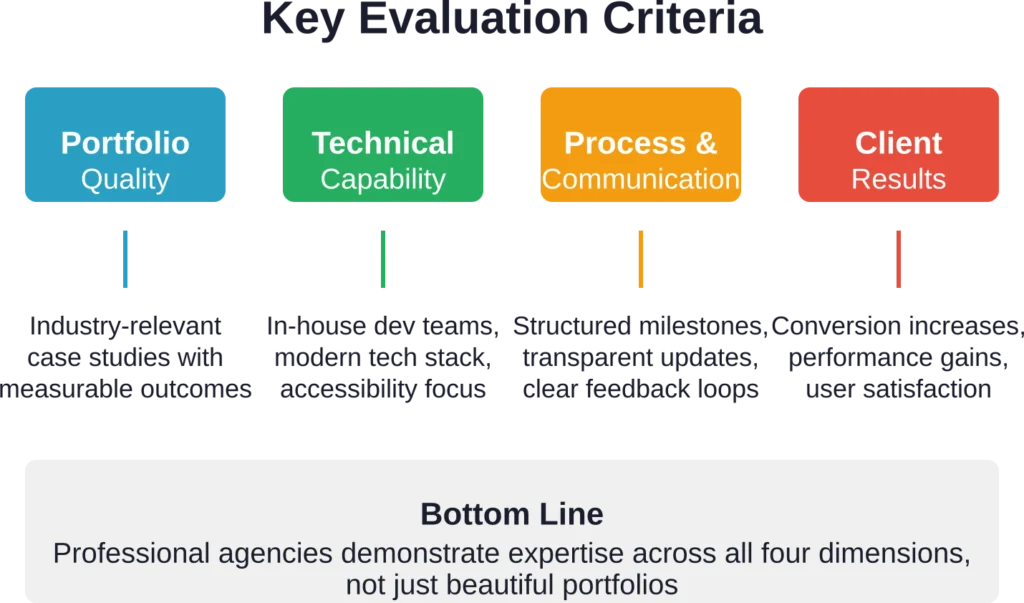
Selecting a web design partner requires evaluating several dimensions beyond portfolio aesthetics.
Portfolio Quality and Relevance
Look for agencies with demonstrated experience in the relevant industry vertical. An agency that excels at fintech products may not be the best fit for consumer retail. Portfolio case studies should clearly articulate the business problem, design approach, and measurable outcomes—not just showcase visual designs.
Technical Capability
The best web design companies maintain in-house development teams rather than outsourcing to third parties. This ensures designers understand technical constraints and developers can implement sophisticated interactions without compromise. Ask about the tech stack, performance optimization strategies, and accessibility compliance processes.
Process and Communication
Professional agencies follow structured processes with defined milestones, deliverables, and feedback loops. Transparent updates and consistent communication patterns prevent the confusion and delays that plague many design projects. The agency should be able to articulate its process clearly before the engagement begins.
Team Size and Structure
Company size matters, but bigger isn’t always better. Boutique agencies with 11-50 employees often provide more senior attention and flexibility. Global firms with 500+ employees bring deeper bench strength and specialized expertise but may have more rigid processes and higher overhead.
Client Results
Look beyond testimonials to concrete business outcomes. Did the redesign increase conversion rates? Reduce bounce rates? Improve customer satisfaction scores? The best agencies track and report these metrics as part of the engagement.
Comparing Agency Approaches
Professional web design companies differ not just in aesthetic style but in fundamental approach to projects. Understanding these differences helps match agency to project requirements.
| Approach | Best For | Characteristics | Example Agencies |
|---|---|---|---|
| Strategy-First | Complex enterprise initiatives | Extensive discovery, research, stakeholder alignment before design begins | IDEO, The Agency of Love & Logic |
| Product-Focused | SaaS and digital products | UX research, design systems, conversion optimization, scalability | Ramotion, Excited Agency, MetaLab |
| Execution-Oriented | Projects with clear requirements | Rapid turnaround, minimal discovery, strong implementation focus | Cluma, Procreator Design |
| Brand-Driven | Visual differentiation priorities | Storytelling, animation, distinctive personality, emotional connection | Yes Now, Funtown Studio |
Strategy-first agencies invest heavily in upfront research and discovery. These engagements typically span several weeks before design work begins. This approach works well for complex projects with multiple stakeholders, unclear requirements, or significant organizational change implications.
Product-focused agencies treat websites as products rather than marketing assets. The emphasis shifts to user flows, conversion optimization, and systematic scalability. These agencies work well for B2B SaaS companies, platforms, and digital products where user experience directly impacts business metrics.
Execution-oriented agencies minimize discovery overhead and focus on rapid delivery. This approach works when requirements are clear, stakeholder alignment exists, and speed matters more than extensive research. Subscription models like Cluma fit this category.
Brand-driven agencies prioritize visual storytelling and emotional resonance. These firms work well for consumer brands, creative agencies, and organizations where visual differentiation creates competitive advantage. The approach may not suit conservative industries or enterprise B2B contexts.
What to Expect During the Design Process
Professional web design engagements typically follow structured phases, though specific timelines and deliverables vary by agency and project scope.
Discovery and Strategy
The engagement begins with discovery to understand business objectives, target audiences, competitive landscape, and technical constraints. This phase typically includes stakeholder interviews, user research, competitive analysis, and requirements documentation.
Strategy-first agencies may spend 4-8 weeks in this phase. Product-focused agencies typically complete discovery in 2-4 weeks. Execution-oriented agencies may condense discovery to a single week or integrate it into the design phase.
Information Architecture and Wireframing
Designers create information architecture documenting site structure, navigation patterns, and content hierarchy. Wireframes visualize page layouts without final visual design, allowing stakeholders to evaluate structure before investing in high-fidelity mockups.
This phase establishes the foundation for all subsequent work. Changes to information architecture late in the project cascade through all designs and development work, creating expensive rework.
Visual Design and Prototyping
Designers apply visual identity to wireframe structures, creating high-fidelity mockups that represent the final product. Interactive prototypes allow stakeholders to experience flows and interactions before development begins.
Professional agencies typically design key templates and component libraries rather than designing every possible page. This systematic approach ensures consistency while allowing flexibility for future content.
Development and Implementation
Developers translate designs into functional websites. Professional agencies maintain close designer-developer collaboration during this phase to ensure implementations match design intent.
The best agencies provide detailed developer documentation, component libraries, and ongoing support during implementation. This reduces implementation questions and ensures visual consistency.
Testing and Optimization
Before launch, the team conducts cross-browser testing, accessibility audits, performance optimization, and quality assurance. Post-launch, many agencies provide ongoing optimization based on analytics data and user feedback.
Organizations should clarify which testing activities are included in the engagement and which require separate agreements. Assumptions about scope often cause friction during this phase.
Budget Considerations for Professional Web Design
Professional web design engagements vary significantly in cost based on agency positioning, project scope, and engagement model. Understanding typical ranges helps set realistic expectations, though specific fees should be obtained directly from agencies.
Boutique agencies with specialized expertise typically structure engagements differently than large global firms. Subscription models like Cluma offer predictable monthly costs in exchange for ongoing access rather than project-based fees.
When evaluating budget, consider total cost of ownership rather than just initial design fees. A more expensive engagement that delivers strategic clarity, systematic documentation, and efficient implementation may cost less overall than a cheaper engagement that requires extensive revision and creates ongoing maintenance headaches.
Professional agencies should clearly articulate what’s included in quoted fees: discovery work, number of design rounds, revision limits, development support, post-launch optimization, and ongoing maintenance. Unclear scope assumptions cause most budget conflicts.
Industry-Specific Considerations
Different industries have unique requirements that affect agency selection and project approach.
Financial Services and Fintech
Financial services websites must balance user experience with security, compliance, and trust-building. Agencies working in this space should understand regulatory requirements, security best practices, and the psychology of financial decision-making.
Design must convey credibility and professionalism while remaining accessible to non-expert users. Extensive user research helps identify where users need reassurance, education, or simplification.
Healthcare and Life Sciences
Healthcare websites often serve multiple audiences—patients, providers, administrators—each with different needs and priorities. HIPAA compliance, accessibility requirements, and privacy considerations constrain design choices.
Agencies should understand healthcare workflows, medical terminology, and the regulatory environment. User research with actual patients and providers reveals usability issues that designers without domain expertise often miss.
E-commerce and Retail
E-commerce design prioritizes conversion optimization, product discovery, and checkout flow efficiency. Agencies should demonstrate expertise in A/B testing, analytics implementation, and systematic optimization.
Mobile experience matters particularly in retail, where significant traffic originates from smartphones. Responsive design isn’t optional—it’s the baseline expectation.
B2B SaaS and Technology
B2B SaaS websites must communicate complex value propositions clearly while supporting long sales cycles with multiple stakeholders. Design should address different personas—end users, technical evaluators, and economic buyers—with tailored content and flows.
Product-market fit and positioning clarity matter more than visual creativity in most B2B contexts. Agencies should prioritize strategic clarity and conversion optimization over aesthetic experimentation.
Red Flags When Evaluating Agencies
Certain warning signs indicate potential problems with agencies under consideration.
Portfolios showing only visual mockups without case studies or business context suggest the agency prioritizes aesthetics over outcomes. Professional agencies articulate the business problem, design approach, and measurable results for portfolio work.
Vague pricing or reluctance to discuss budget ranges early in conversations often indicates unclear processes or hidden costs that emerge later. Professional agencies provide transparent pricing structures and clearly define what’s included.
Promises of specific rankings, traffic numbers, or conversion improvements without understanding the business context are unrealistic. Professional agencies set expectations based on research and testing rather than making guarantees.
Limited questions during discovery conversations suggest the agency uses templated approaches rather than customizing solutions to specific needs. The best agencies ask extensive questions about business objectives, target audiences, and success metrics.
Outsourcing key functions—particularly development—to third parties introduces coordination overhead and quality risks. Professional agencies maintain core capabilities in-house to ensure quality control and efficient collaboration.
Questions to Ask During Agency Evaluation
The following questions help evaluate whether an agency is the right fit for specific project needs.
Can you walk through your typical process from engagement start to launch? Listen for structured phases, clear deliverables, and defined decision points. Vague answers suggest inconsistent processes.
How do you handle projects when requirements change mid-engagement? Changes inevitably occur. Professional agencies have defined change management processes rather than treating every change as a crisis.
What happens if we’re not satisfied with initial design directions? Understand revision processes, limits, and costs before signing agreements. Assumptions about unlimited revisions cause most project conflicts.
Who will actually work on our project? Meet the team members who will handle the work, not just senior staff who appear in sales conversations then disappear after contracts are signed.
Can you provide references from clients with similar project types? Speaking with past clients reveals how the agency handles challenges, communicates during difficult phases, and supports clients post-launch.
How do you measure project success? Agencies focused on business outcomes track metrics like conversion rates, user engagement, and customer satisfaction. Agencies focused on creative awards may not prioritize measurable business impact.
What post-launch support do you provide? Clarify what’s included in the engagement versus what requires separate agreements. Assumptions about ongoing support cause friction after launch.
The Future of Professional Web Design
Web design continues evolving rapidly as technologies, user expectations, and business requirements change.
Sustainable web development has emerged as a business priority rather than a nice-to-have consideration. Professional agencies now incorporate performance optimization, efficient code practices, and reduced resource consumption into standard design processes.
Privacy-first design and data sovereignty have become central concerns as regulations tighten and consumers become more aware of data practices. Design decisions that previously focused solely on user experience now must balance multiple stakeholder interests including privacy, security, and compliance.
Accessibility has shifted from optional compliance checkbox to fundamental design requirement. Professional agencies now integrate accessibility considerations throughout the design process rather than auditing for compliance at the end.
Design systems have become standard deliverables rather than premium add-ons. Organizations increasingly recognize that systematic documentation and reusable components reduce long-term maintenance costs and ensure consistency.
AI-assisted design tools are changing how designers work without replacing human judgment. Professional agencies leverage AI for routine tasks like generating variations or optimizing layouts while maintaining human oversight for strategic decisions.
Making the Final Decision
After evaluating multiple agencies, making the final selection requires weighing several factors beyond design quality.
Cultural fit matters as much as technical capability. Web design projects involve close collaboration over extended periods. Personality conflicts or communication style mismatches create friction that undermines even technically excellent work.
Trust matters. The agency will make numerous judgment calls throughout the engagement. Organizations must trust the agency’s expertise and judgment enough to accept recommendations even when they contradict internal preferences.
Availability matters. The best agencies often have limited availability. Starting timelines may extend several weeks or months depending on current workload. Organizations with aggressive deadlines may need to adjust timelines or consider agencies with more immediate availability.
Chemistry matters. Some agency-client relationships develop natural rhythm and mutual understanding. Others feel forced despite everyone’s best efforts. Initial discovery conversations usually reveal whether the relationship will work smoothly.
The decision should balance objective criteria—portfolio quality, technical capability, process structure, references—with subjective factors like cultural fit, communication style, and gut feeling about the relationship.
Frequently Asked Questions
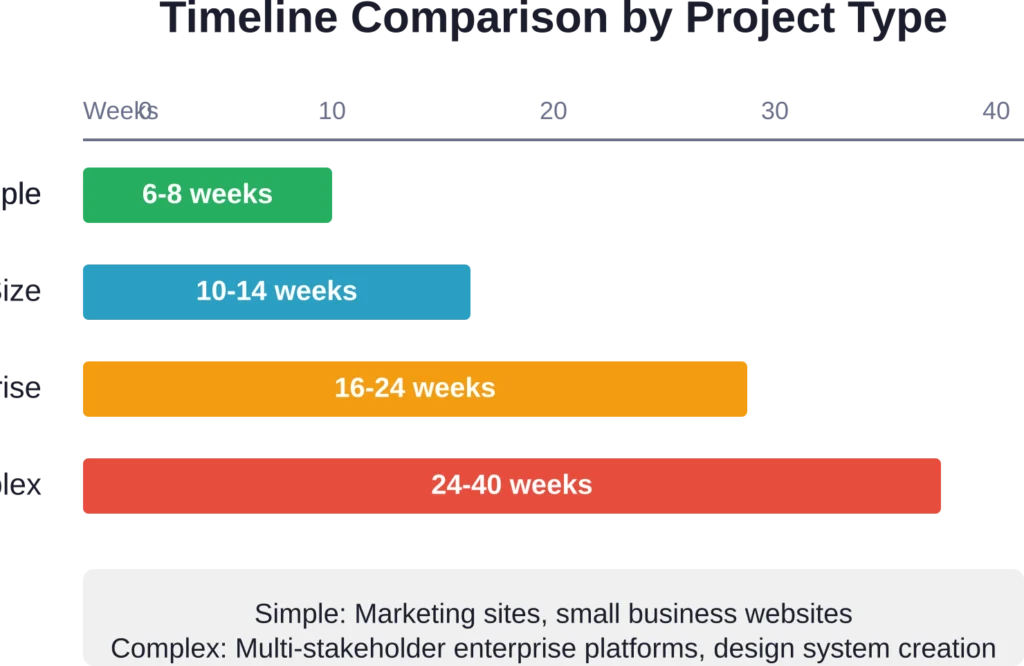
Professional web design projects typically range from 6-8 weeks for straightforward marketing websites to 16-24 weeks for complex enterprise platforms. Mid-size projects with moderate complexity usually span 10-14 weeks. Timeline depends on project scope, stakeholder availability, content readiness, and agency process. Strategy-heavy engagements with extensive discovery phases take longer than execution-focused projects with clear requirements. Organizations should add buffer time to agency estimates to account for internal review cycles and stakeholder coordination.
Professional web design agencies maintain teams with specialized roles—strategists, researchers, designers, developers, project managers—providing deeper expertise across disciplines than individual freelancers. Agencies offer more reliable availability, structured processes, quality assurance, and business continuity if team members leave. Freelancers often cost less and provide more direct access to the person doing the work, but may lack breadth of expertise for complex projects. Agencies work better for enterprise projects with multiple stakeholders. Freelancers can be ideal for focused projects with clear requirements and single decision-makers.
Location matters less than it once did. Professional agencies collaborate effectively with remote clients using video conferencing, project management tools, and structured communication processes. Local agencies offer easier in-person meetings for discovery workshops and stakeholder presentations, which some organizations value highly. Remote agencies expand the potential partner pool beyond geographic constraints, increasing the likelihood of finding specialized expertise that matches project needs. Consider whether the project requires regular in-person collaboration or whether remote work is acceptable. Most professional agencies now operate effectively in remote or hybrid models.
Professional web design costs vary significantly based on agency positioning, project scope, and complexity. Organizations should check agency websites directly for current engagement structures, as these change frequently. Generally speaking, straightforward marketing websites cost less than complex enterprise platforms or product interfaces requiring extensive user research and testing. Budget should include not just initial design fees but also development, content creation, photography, ongoing maintenance, and future optimization. Professional agencies provide transparent pricing structures during initial conversations. Organizations should request detailed proposals that clearly define scope, deliverables, timeline, and total investment required.
Professional web design engagements typically deliver discovery documentation, user research findings, information architecture, wireframes, high-fidelity visual designs, interactive prototypes, design systems with component libraries, developer documentation, and implementation support. Specific deliverables vary by agency process and project scope. Organizations should clarify exactly what’s included before signing agreements. Some agencies provide extensive documentation and systematic design systems. Others deliver final designs with minimal supporting materials. Clarify expectations about file formats, source files, documentation, training, and post-launch support. Assumptions about deliverables cause most project disputes.
Review agency portfolios for work in similar industries or with similar project types. Industry experience helps agencies understand domain-specific requirements, regulations, and user expectations without extensive education. However, fresh perspectives from agencies without industry experience sometimes produce more innovative solutions. During evaluation conversations, assess how quickly the agency grasps business context and asks informed questions. Strong agencies can ramp up on new industries when they have solid strategic processes and research capabilities. Request references from clients with similar project types to understand how the agency approaches unfamiliar domains and whether they deliver despite limited industry experience.
Client involvement is essential for successful outcomes. Internal teams provide business context, review deliverables, make decisions, and gather stakeholder feedback. Professional agencies structure projects with defined review milestones and decision points. Organizations should designate a primary point of contact with decision-making authority to prevent delays from distributed stakeholder coordination. Internal teams typically review and approve discovery findings, information architecture, design directions, and final designs before development begins. The best partnerships balance agency expertise with client knowledge. Agencies need enough autonomy to apply professional judgment while maintaining client alignment on strategic decisions.
Conclusion
Professional web design companies in 2026 offer far more than aesthetic expertise. The best agencies combine strategic thinking, user research, systematic design, and technical implementation to create digital experiences that drive measurable business outcomes.
The 15 agencies highlighted in this guide represent different specializations, engagement models, and positioning strategies. IDEO brings enterprise-scale resources and three decades of design leadership. Ramotion and Excited Agency excel at SaaS product design with emphasis on scalability. EIGHT25MEDIA understands venture-backed startup dynamics. MetaLab balances brand and product design. Funtown Studio and Yes Now creative agency bring distinctive visual personality. Cluma offers subscription-based design access. Procreator Design provides comprehensive services with flexible engagement structures. The Agency of Love & Logic balances emotional and rational design thinking.
The right choice depends on project scope, industry context, budget constraints, timeline requirements, and organizational culture. Strategy-first agencies work best for complex enterprise initiatives. Product-focused agencies excel at B2B SaaS and digital products. Execution-oriented agencies deliver rapid results when requirements are clear. Brand-driven agencies create distinctive visual personalities for consumer-facing brands.
Organizations should evaluate agencies across multiple dimensions: portfolio quality and relevance, technical capability, process structure, team composition, and client results. Red flags include vague pricing, limited discovery questions, outsourced core functions, and portfolios without business context.
Web design continues evolving. Sustainable development, privacy-first design, accessibility, design systems, and AI-assisted tools are reshaping how professional agencies approach projects. The best agencies stay current with these trends while maintaining focus on fundamental business objectives.
The decision ultimately balances objective criteria with subjective factors like cultural fit, communication style, and relationship chemistry. Start by clarifying project objectives, success metrics, budget parameters, and timeline constraints. Then evaluate agencies against these requirements while staying open to agencies that challenge assumptions productively.
Ready to transform your digital presence with professional web design expertise? Research the agencies in this guide, review their portfolios, and initiate conversations with those whose specialization matches project needs. The investment in professional web design pays dividends through improved user experience, stronger brand positioning, and measurable business outcomes.