
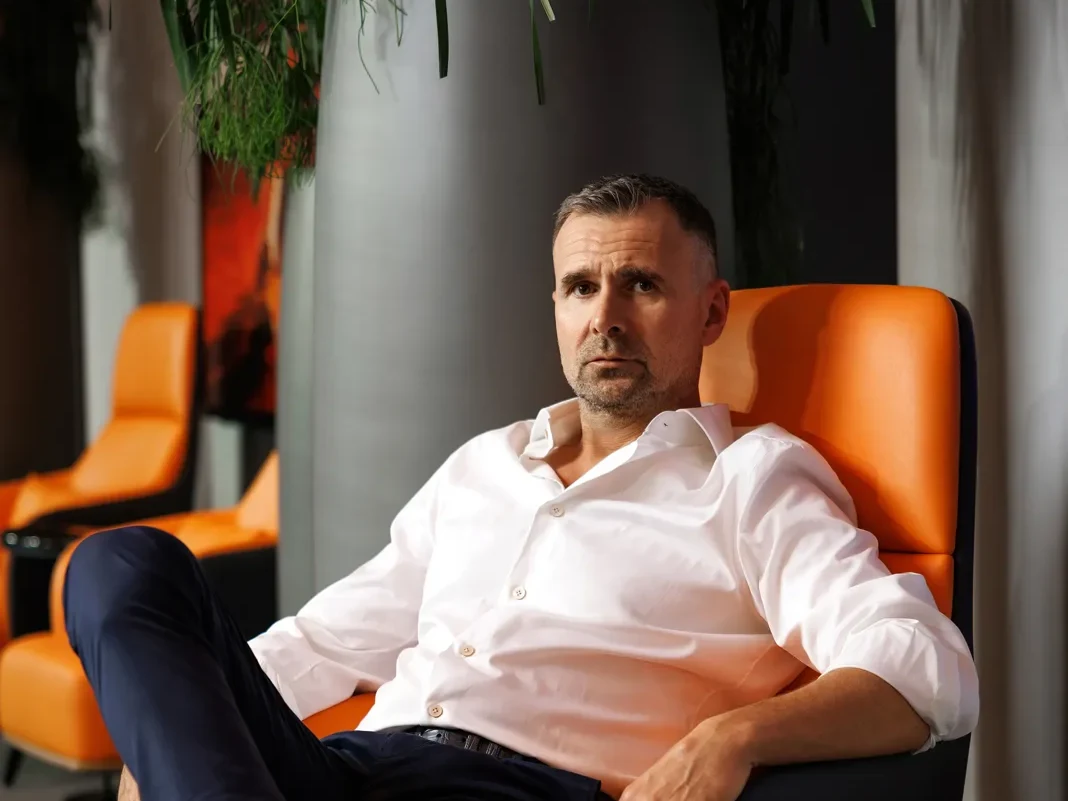
When someone launches a business after two decades of success in a completely different field, profit is not what drives him. He arrives with a lifetime of being a customer, a memory full of small disappointments and a very clear picture of how things should be done. Investor and entrepreneur Sergey Kurenev sold his food holding, spent ten years looking for a project that matched his way of life and finally built an enormous “city within a city” at Cityland Mall in Dubai. At ORIGIN Fitness, training stops being an act of willpower and becomes simply a pleasant part of the day.
We came to Dubai as a family in 2022, planning to stay for a few weeks. Four months later we were still here, and one day my wife suggested we stay for good — so we did. At the beginning I mostly watched: I visited fitness clubs, parks and restaurants to understand how people lived. I reflected on it all, and slowly the idea of a project that fitted my own life began to form.
I have played sport all my life and been into fitness for many years, and I have lived in more than ten countries, so I know sports clubs well — including the ones advertised as outrageously luxurious. Almost every one had something wrong with it. Changing rooms were too small for the size of the gym. Showers were cramped for a club of that scale. Day passes were sold to anybody, so a newcomer could end up next to a long-time member without any idea of his habits or the spot he considers his own. Respect only comes when you feel the club is yours, a second home. You never feel that in a gym rented by the hour.
ORIGIN had a single purpose from the start: to get rid of everything I remembered as unnecessary, wrong or irritating. I wasn’t trying to beat anyone. I respect our competitors — the more good options there are, the better for everybody. I simply decided to remove every detail that had ever bothered me.
Twelve thousand square metres may sound ambitious, but the size is pure arithmetic. A small club is always short of something, and that shortage spreads through the building. First the changing rooms get squeezed, then the showers, and before long you are at your locker with someone’s elbow in your side, or waiting your turn for a machine. We planned it the other way round. Everything was calculated in advance — studio sizes, the number of machines and the space between them, changing rooms, showers and toilets. Our data show that thirty per cent of members attend group classes, and membership numbers, studios and the timetable are all built around that. We keep a buffer of almost thirty per cent, so missing your favourite class is practically impossible. If the timetable starts to feel the strain, the model has one answer: stop selling memberships. Yes, we lose revenue, but we keep the comfort and the atmosphere. A packed club is no longer the club people paid for.
At 5.30 every morning the club has to look new — I mean that literally. We have our own construction company and a night crew from it: every shoe mark on a wall, every scratch, is repaired before sunrise. Members should walk in each morning to find the club exactly as it was the day they joined, with no sign of yesterday.
There are no membership levels — no VIP cards and no budget ones. What matters to me is a community of people who share values and a way of living, who are comfortable in the same space and like being around each other. Even more interesting is the challenge of making people stay and return for the atmosphere and the feeling that the club was made for them. Our members spend more than three hours with us on average: they come in the morning to work out, stay for breakfast and linger. I can’t imagine better feedback.
I spent a long time on the details and still do. Good hypoallergenic New Zealand cosmetics in the showers, so nobody has to bring their own. Dyson hairdryers, because there was really no alternative — they are the best. Once a female member mentioned, quite discreetly, that there were no feminine hygiene products. Two hours later the issue was solved, and the following morning she came up to me and said: “Now everything is perfect, thank you.” That is why we do it.
I chose equipment for the biomechanics of the movement, not for how shiny the metal looked: Panatta and Technogym, Booty Builder, Rogue, Primal and other brands, all in their most advanced versions. The gym floor is divided into zones and equipped so that even at peak times there is enough kit and enough space for everyone.
Women in Dubai often complain about the water. We have three-stage filtration, a closed loop and hot water constantly circulating, with no tank above your head. Personally I’d like the shower pressure to be a bit stronger still, and we are working on it. It sounds trivial, but a woman with long hair under a weak stream wastes time and water and walks out annoyed. Nothing is trivial.
The restaurant isn’t there for marketing. It has a proper production kitchen, an excellent chef and a menu for every appetite, from a light bowl for those watching their diet to lobster pasta for those who are starving. And service doesn’t stop at the restaurant: beside the padel courts there are comfortable lounges with tables where you can order a bowl, a salad or a drink and eat right by the court. I don’t know any other club in Dubai like that. I would come to ORIGIN for the atmosphere alone — the machines and classes would be a bonus.
After his first visit an older gentleman said to me: “I feel there is love here.” I didn’t know what to reply, because it is simply true. The whole project began at an ordinary dining table at home, with a pencil drawing that gradually became a full design. I discussed every detail, and every stone and every floor tile was my own choice. With the team, we picked the cosmetics too — researching brands, comparing formulas and scents, reading labels and instructions carefully — so that we ended up with products that are genuinely good.
I live on Palm Jumeirah, and every morning when I arrive at ORIGIN it feels like coming home. I see members, many of whom I now know personally, their smiles and good mood, and it warms me. It is a huge motivation. I train at the club six times a week, shower there and have breakfast from the same menu as everyone else, and when I notice something that could be better, I try to improve it for all our members, myself included. It is one of the best forms of quality control I know: use what you have built and see the club through a customer’s eyes. On average the drive from the Palm takes me about twenty-five minutes, which I think is perfectly comfortable given Dubai’s traffic, especially in high season.
As a father of five, I couldn’t leave children out. We have taken another three and a half thousand square metres and are preparing to open ORIGIN Junior. We want it to be special — a place where the important thing is not so much the sports themselves as how the children feel, how harmoniously they develop and who is next to them. That matters enormously.
I have seen it with my own daughters: a former athlete with psychological scars becomes a coach and pushes one child to the top at everyone else’s expense, while the rest of the group becomes collateral. So all our coaches go through specialised psychological assessment. The first round screens out those who should never work with children; the second establishes which ages a person is suited to. The work is exhausting and you have to love it — and that means loving other people’s children, which is far from easy. Every coach passes through my own test: would I leave my child with this person? If the answer isn’t an instant yes, we don’t hire them.
ORIGIN Junior is not a champion factory. If we spot real talent, we will tell the parents that their child is gifted and should move to a specialist club. Our goal is different. A child’s physical development should be built on joy, curiosity and the pleasure of moving — never on pressure or a coach’s demands. Childhood flies by, and our job as adults is to fill each day of it with happiness, strong emotions and good memories.
By the end of the year we plan to open a Longevity Center of about sixteen hundred square metres within the club: hyperbaric chambers, cryosaunas, physiotherapy and more. Prices will be reasonable, because some prices here baffle me — a procedure that costs two and a half thousand rubles in Moscow costs nearly three thousand dirhams in Dubai on exactly the same equipment. In our concept recovery after training has a special place; we treat it as an essential part of training, as important as the workouts themselves, so it has to be affordable enough to use every day.
For several years I have been watching the longevity market and the products it produces very closely. It is clearly a global trend. But, as usual, wherever there is a trend there is plenty of shallow and unreliable information, so I want to dig deep, understand the details and find out what actually works. I talk to scientists, doctors and geneticists doing research and development in this area, and when you get information of that calibre, you want to build projects that really help people and extend their active years. My eldest son is nineteen and my youngest is eight months. I will do everything I can to make sure that when he is five, I can still gallop around with him on my shoulders, just as I did with his brother.
My father told me when I was a boy: if you do something, do it well for people and the money will follow. He was never involved in business and kept well away from that world, yet his advice became my only strategy.
For sixteen years my company held fifty-four per cent of the meat-processing market in my region without paying the retail chains the fees everyone else paid. Our products were in such demand that no chain could afford to drop them. I made the best sausage in our part of Russia. It sounds naive, but that is precisely what worked, year after year, for twenty years.
The holding operated in several regions with a full production cycle, its own logistics and hundreds of points of sale. I have experience of managing large organisations and delivering big projects, so ORIGIN Fitness is far from my first venture of this kind. I have done fitness projects before, and some of them are still operating.
If I had to sum up my principles in a single word, it would be “fairness”. Everything has to be fair. It is engraved somewhere deep inside me and can’t be changed. In business you can’t treat people dishonestly, and no management textbook will change that. Without fairness you can’t look people in the eye and smile. In business you either create value or you just make money — and it is the first that has always interested me.