

Quick Summary: Dubai hosts a thriving ecosystem of structural steel detailing companies that combine advanced software expertise with deep knowledge of local building codes. The ten agencies profiled here deliver shop drawings, BIM coordination, and fabrication-ready documentation for high-rise, industrial, and infrastructure projects across the UAE. Selection criteria include software proficiency, DM approval familiarity, and proven track records on complex builds.
Dubai’s construction boom demands precision at every stage—and structural steel detailing sits at the heart of that accuracy. Whether it’s a forty-storey tower in Downtown or an industrial warehouse in JAFZA, the difference between smooth fabrication and costly rework often traces back to the quality of shop drawings and connection details.
Steel detailing companies in Dubai do more than draft. They coordinate with architects, engineers, and fabricators to ensure every beam, column, and connection is buildable, code-compliant, and optimised for the UAE’s procurement and approval workflows. The right partner will save weeks on-site and prevent expensive field modifications.
Below is a curated list of ten agencies that have earned reputations for delivering fabrication-ready documentation on time and within Dubai Municipality and Civil Defence standards. No pricing is listed—scope and complexity vary too widely—but each profile highlights core capabilities, software tools, and the types of projects where the firm excels.
Why Structural Steel Detailing Matters in Dubai
The UAE building sector moves fast. Contractors face tight schedules, and steel fabrication shops need drawings yesterday. A delay in detailing cascades: fabrication stalls, site crews wait, and liquidated damages loom.
But speed without accuracy is worse. Errors in connection design, bolt schedules, or weld callouts can halt erection entirely. DM approval requires compliance with Dubai Building Code, fire-rating documentation, and seismic provisions. An experienced detailing firm anticipates these checkpoints and submits authority-ready packages the first time.
Industry reports suggest that projects using advanced BIM coordination and clash-detection workflows reduce on-site rework by significant margins compared to traditional 2D methods. The companies below leverage STAAD.PRO, ETABS, Tekla Structures, and Revit to deliver that precision.
1. Powerkh

Powerkh is a UK-based BIM and VDC consultancy with offices in the United States and Ukraine, supporting contractors, fabricators, engineers, and consultants on structural steel projects in Dubai and other international markets. The company provides structural steel detailing, BIM modelling, and coordination services for commercial, industrial, and mixed-use developments. Their work includes fabrication-ready 3D models, shop drawings, connection detailing, and coordination between structural, architectural, and MEP systems.
Powerkh uses Autodesk Revit, Tekla, and Navisworks to support steel detailing and project coordination during design and construction stages. The company also works on clash detection, constructability reviews, scan-to-BIM workflows, and point cloud-based modelling for existing structures and renovation projects. Their approach is focused on accurate detailing, coordination between disciplines, and providing clear fabrication information that supports installation and construction workflows.
Best suited for: Contractors, fabricators, and engineering teams that need structural steel detailing, BIM coordination, and fabrication-ready models for commercial and industrial project
Contact Information:
- Website: www.powerkh.com
- Email: [email protected]
- Facebook: www.facebook.com/100064039650167
- LinkedIn: www.linkedin.com/company/powerkh
- Instagram: www.instagram.com/powerkh_com
- Address: 3, Lavinia Walk, Taw Hill, Swindon SN25 1AP
- Phone: +44 7490 426678
2. Structural Designs
Structural Designs operates across Dubai and the wider UAE, specialising in structural engineering, BIM coordination, and authority-ready documentation. The team works with STAAD.PRO, ETABS, CSI SAFE, IDEA StatiCa, and Revit to produce compliant, buildable designs.
Their workflow integrates analysis and detailing, so connection capacities are verified during the drawing phase rather than discovered in review. This approach suits high-rise residential, commercial towers, and mixed-use developments where coordination between disciplines is critical.
With over 500 projects successfully delivered and a 50+ engineer team, Structural Designs handles both design-build packages and detailing-only scopes. The firm’s familiarity with UAE approval processes—DM, Civil Defence, and consultant submissions—means fewer resubmissions and faster approvals.
Best suited for: Mid-to-large commercial projects, high-rise coordination, and clients who need structural analysis bundled with detailing.
3. Silicon Engineering Consultants

Silicon Engineering Consultants brings a multi-discipline approach, offering structural, MEP, and architectural services under one roof. For steel detailing, the firm leverages Revit and Navisworks to coordinate across trades and catch clashes before fabrication.
Their detailing team produces shop drawings, erection sequences, and material procurement schedules. The BIM environment means that changes propagate automatically—when an architect shifts a grid line, the steel model updates, and clash reports regenerate.
Silicon’s portfolio includes retail fit-outs, hospitality projects, and mixed-use developments. The integrated service model appeals to clients who prefer a single point of coordination rather than juggling separate detailing, MEP, and architectural consultants.
Best suited for: Mixed-use developments, hospitality projects, and clients seeking BIM-coordinated multi-discipline packages.
4. Engisoft Engineering
Engisoft specialises in structural design and detailing for complex geometries—curved facades, long-span atriums, and exposed architectural steel. The firm’s engineers use ETABS for analysis and Tekla for detailing, ensuring connection designs match the calculated loads.
Engisoft’s strength lies in non-standard projects where off-the-shelf connections won’t work. They design custom nodes, verify them with finite-element software, and produce fabrication drawings that steel shops can follow without guesswork.
The agency also provides value engineering input, suggesting alternate connection types or member optimisations that can reduce tonnage without compromising performance. This consultancy layer differentiates them from pure drafting services.
Best suited for: Architecturally exposed steel, long-span structures, stadium canopies, and projects requiring custom connection engineering.
5. Advenser
Advenser operates globally but maintains a strong UAE presence, with teams experienced in Gulf building codes and fabrication practices. The firm offers both design and detailing, and their outputs are tailored for DM and Civil Defence submissions.
Their detailing workflow includes 3D modelling in Tekla, automated drawing generation, and detailed erection plans. Advenser’s QA process includes internal peer reviews and client coordination meetings at key milestones—foundation anchor checks, major connection approvals, and pre-fabrication reviews.
The company handles high-rise towers, industrial plants, and infrastructure—bridges, pedestrian links, and metro station canopies. Their multi-sector experience means they adapt quickly to project-specific requirements.
Best suited for: High-rise towers, infrastructure projects, and clients who need both design authority and detailing execution from one provider.
6. Wrenze Steel Design
Wrenze Steel Design is a boutique firm specialising in exposed structural steel and architecturally driven projects. The team works hand-in-hand with architects to translate concept sketches into fabrication-ready models.
Their detailing includes 3D visualisations for client presentations, which helps secure design approvals before fabrication commitments. Wrenze uses Rhino for complex geometries and Tekla for production drawings, bridging the gap between architectural intent and shop-floor reality.
The firm’s portfolio features retail interiors, restaurant fit-outs, and signature building lobbies where steel is a design feature rather than hidden behind cladding. That aesthetic focus requires extra coordination—finishes, tolerances, and weld grinding all matter.
Best suited for: Architecturally exposed steel, high-end retail, hospitality interiors, and projects where aesthetics are as critical as structure.
7. Ventura Salasar

Ventura Salasar provides structural design and detailing with a focus on industrial and infrastructure projects. The firm’s engineers understand heavy loading scenarios—crane runways, equipment platforms, conveyor supports—and detail connections accordingly.
Their detailing packages include anchor bolt plans, base plate designs, and erection sequences that account for site access constraints. Ventura Salasar also coordinates with mechanical and electrical consultants to ensure steel supports align with equipment mounting requirements.
The company’s client base includes logistics developers, manufacturing facilities, and utilities. Their experience with industrial standards—AISC, Eurocode adaptations for UAE, and ASTM material specifications—ensures details meet both local authority and end-user operational needs.
Best suited for: Industrial facilities, logistics centers, crane-supported structures, and projects requiring heavy equipment coordination.
8. BIM Connect
BIM Connect positions itself as a full-spectrum BIM consultancy, with structural steel detailing as one service line. The firm’s strength is model coordination—detecting clashes between steel, MEP, architectural elements, and façade before they reach site.
Their workflow includes federated model reviews, where all disciplines share a common coordination environment. Clash reports are generated weekly, issues are logged, and resolution meetings follow. This proactive approach prevents the classic scenario where ductwork collides with steel bracing mid-construction.
BIM Connect uses Revit for structural modelling and Navisworks for coordination. They also provide 4D scheduling integration, linking the steel erection sequence to the project timeline so site teams can visualise the build order.
Best suited for: Multi-discipline coordination, design-build projects, and clients who prioritise clash-free documentation over rapid drafting turnaround.
9. ESS Detailing Services

ESS Detailing Services has built a reputation as a reliable partner for steel detailing across the UAE. The firm offers shop drawings, connection design, and material take-offs for a range of project types—commercial, residential, and light industrial.
Their team uses Tekla Structures and AutoCAD, with outputs tailored for local fabricators. ESS coordinates directly with steel shops to confirm plate availability, bolt grades, and welding procedures, reducing the risk of substitutions or delays during fabrication.
The agency’s responsiveness—quick turnaround on RFIs, willingness to accommodate mid-project changes—makes them a go-to for contractors managing compressed schedules. ESS also provides quantity estimates and material optimisation suggestions during the detailing phase.
Best suited for: Commercial and residential projects, contractors seeking responsive communication, and scopes requiring close fabricator coordination.
10. Memaar Building Systems
Memaar Building Systems (MBS) specialises in pre-engineered metal buildings but also offers custom steel detailing for warehouse expansions, industrial annexes, and hybrid structures. The firm’s leadership includes executives with over 25 years of career experience in pre-engineered steel fabrication and engineering, with deep UAE experience.
MBS detailing services cover primary framing, secondary members, cladding supports, and mezzanine platforms. Their engineers understand the interplay between pre-engineered components and custom steel, which is common in UAE projects where existing PEB structures are expanded or modified.
The firm’s integrated approach—design, detailing, fabrication oversight, and erection support—appeals to clients who want a single point of accountability from concept through commissioning.
Best suited for: Pre-engineered building projects, warehouse expansions, industrial retrofits, and clients seeking turnkey steel solutions.
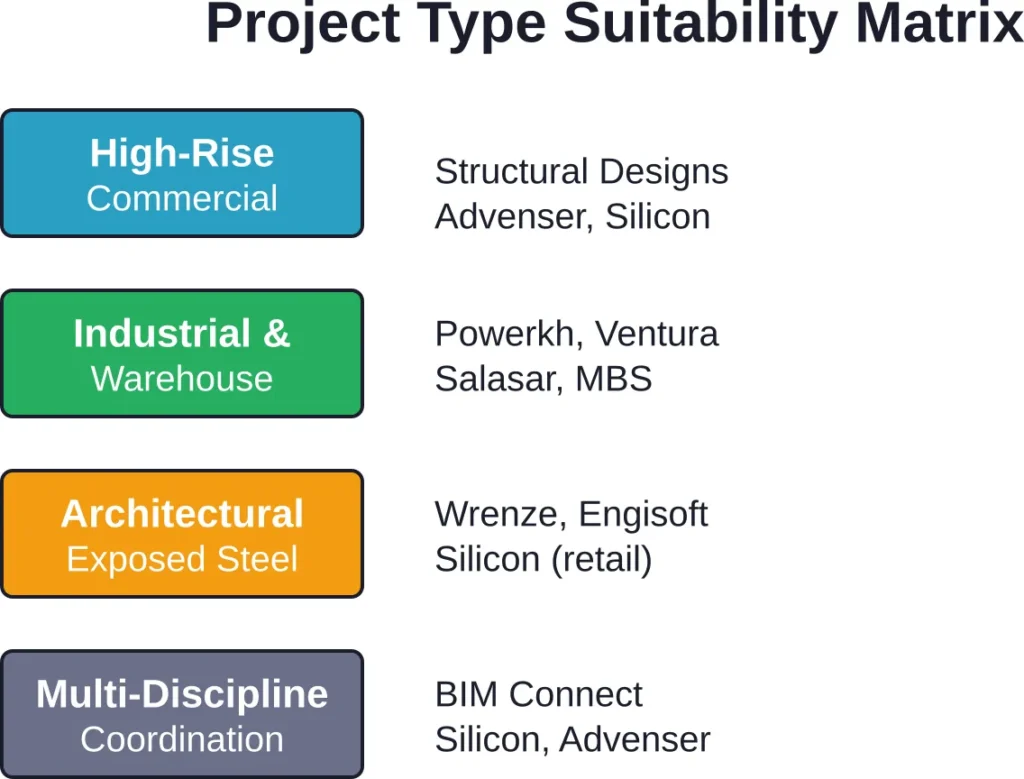
How to Choose the Right Detailing Partner
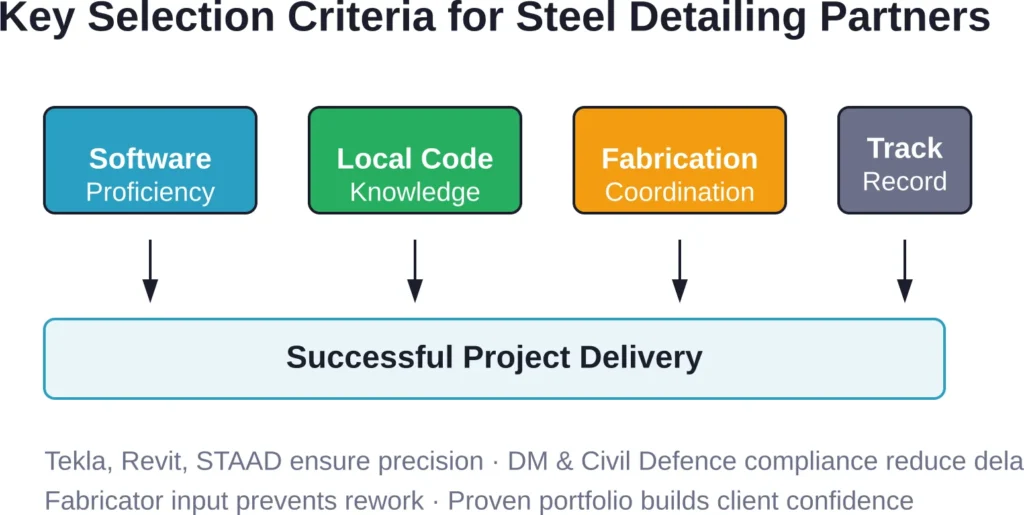
Not every firm on this list will suit every project. Here’s what to evaluate during your shortlist:
Software compatibility: If your fabricator uses Tekla and your detailer uses Revit, confirm they can export native formats or provide IFC models without geometry loss. Mismatched software causes rework.
Check their team’s fluency with UAE building codes. Ask how they handle DM submissions, what documentation they provide for fire ratings, and whether they’ve worked with your structural engineer’s preferred analysis software. A detailer who’s never dealt with Dubai Civil Defence will slow approvals.
Request recent project references in your building type. A firm that excels at warehouses may struggle with high-rise core coordination. Conversely, a high-rise specialist may overkill a simple industrial shed with unnecessary detail.
Clarify turnaround expectations upfront. Some firms batch work and take three weeks for initial submissions. Others offer phased releases—foundations first, then columns, then framing—so fabrication can start while upper floors are still being detailed.
Common Detailing Deliverables in UAE Projects
Understanding what you’ll receive helps set expectations. Typical packages include:
- General arrangement drawings: Overall steel layout, gridlines, member marks, and elevations.
- Connection details: Moment connections, simple shear tabs, base plates, splice plates—dimensioned and with bolt/weld callouts.
- Anchor bolt plans: Coordinated with foundation drawings, showing embedment depths and tolerances.
- Erection drawings: Simplified plans for site crews, showing piece marks and installation sequences.
- Material lists: Tonnage summaries, bolt schedules, weld consumable estimates, and paint areas.
- 3D models: Native Tekla or Revit files, plus IFC exports for coordination.
Authority submissions require additional documentation—design basis reports, load summaries, fire-rating certificates, and seismic details. Confirm your detailer includes these or coordinates with your engineer to produce them.
| Company | Primary Software | Best Project Type | Key Strength |
|---|---|---|---|
| Structural Designs | STAAD.PRO, Revit, ETABS | High-rise, commercial | Integrated analysis and detailing |
| Powerkh | Tekla, AutoCAD | Industrial, warehouses | Fast turnaround, fabricator coordination |
| Silicon Engineering | Revit, Navisworks | Mixed-use, hospitality | Multi-discipline BIM coordination |
| Engisoft Engineering | ETABS, Tekla | Complex geometry, long-span | Custom connection engineering |
| Advenser | Tekla, STAAD.PRO | High-rise, infrastructure | Global standards, DM compliance |
| Wrenze Steel Design | Rhino, Tekla | Architectural exposed steel | Aesthetic detailing, visualizations |
Frequently Asked Questions
Structural steel detailing translates engineering designs into fabrication and erection drawings. It specifies every connection, bolt, weld, and plate dimension so steel shops can cut, drill, and assemble components accurately. In Dubai, precise detailing prevents costly site delays and ensures compliance with DM and Civil Defence standards.
The most common platforms are Tekla Structures, Autodesk Revit, AutoCAD, STAAD.PRO, and ETABS. Tekla is preferred for complex steel-only projects, while Revit excels in multi-discipline BIM coordination. Analysis software like STAAD.PRO and ETABS verify connection capacities before detailing begins.
Timelines vary by project complexity. A simple warehouse might need two to three weeks for initial shop drawings. A high-rise tower can take several months, with phased releases—foundations, then columns, then floor framing—so fabrication overlaps detailing. Rush services are available but require early engagement.
Most agencies on this list prepare documentation for Dubai Municipality and Civil Defence approvals, including load summaries, fire-rating details, and seismic provisions. Confirm during procurement whether the detailer coordinates directly with authorities or hands off to your engineer of record.
Shop drawings are detailed fabrication instructions—dimensions, hole locations, weld symbols, material specs—used by the steel shop to manufacture components. Erection drawings are simplified site plans showing piece marks, installation sequences, and temporary bracing requirements, used by site crews during assembly.
Several companies on this list coordinate with overseas fabricators, especially for specialised or high-tonnage projects where UAE capacity is limited. They adapt details to match fabricator shop standards—metric vs. imperial, bolt grades, welding codes—and manage export documentation.
Request a portfolio of similar projects—building type, tonnage, and complexity. Ask for references from recent clients and fabricators they’ve worked with. Review sample drawings to assess clarity, completeness, and adherence to standards like AISC or Eurocode as adopted in UAE practice.
Final Thoughts
Choosing a structural steel detailing partner in Dubai isn’t just about finding someone who can draw. It’s about finding a team that understands the rhythm of UAE construction—the procurement cycles, the approval workflows, the fabrication constraints, and the site realities.
The ten companies profiled here each bring distinct strengths. Some excel at speed, others at coordination, still others at handling architectural complexity. Match your project’s priorities—schedule, aesthetics, multi-discipline integration—to the firm’s proven capabilities, and you’ll set the stage for smooth fabrication and erection.
Steel detailing done right is invisible. The beams arrive on schedule, connections fit the first time, and inspectors sign off without drama. That’s the standard these agencies aim for—and it’s the standard Dubai’s construction pace demands.
Ready to move forward? Reach out to two or three firms from this list, share your project scope, and compare their approach. The right partner will ask questions about your schedule, your fabricator, and your approval timeline—because great detailing starts with understanding the full picture.