

Quick Summary: Third-party API integration companies specialize in connecting disparate software systems, enabling seamless data flow without building and maintaining integrations in-house. The top agencies in 2026 combine robust platform capabilities, extensive connector libraries, and specialized expertise across industries like HR tech, marketing analytics, and enterprise systems. Selecting the right partner depends on your technical requirements, industry focus, scale needs, and whether you need pre-built connectors or custom API development services.
Modern software doesn’t exist in isolation. Your CRM needs to talk to your marketing automation platform. Your payroll system has to sync with benefits providers. Your analytics tools require data from a dozen different sources.
Building these connections yourself? That’s a full-time engineering commitment that never really ends. APIs change. Authentication protocols get updated. Error handling becomes increasingly complex as you scale.
That’s where third-party API integration companies come in. These specialized agencies and platforms handle the technical complexity of connecting systems, maintaining those connections, and ensuring data flows reliably between your business applications.
But here’s the thing—not all integration companies are built the same. Some excel at marketing data consolidation. Others specialize in HR and payroll systems. Some offer pre-built connectors through unified APIs, while others provide custom development services for complex enterprise requirements.
What Third-Party API Integration Companies Actually Do
Integration companies bridge the gap between disparate software systems. They handle the technical implementation, ongoing maintenance, and troubleshooting that would otherwise consume significant engineering resources.
Most operate through one of three models. Platform-based companies like Zapier provide self-service tools where teams can configure integrations without writing code. These work best for standard workflows between popular applications.
Unified API providers offer a different approach—they maintain pre-built integrations to entire software categories. Connect once to their API, and you instantly access dozens or hundreds of underlying platforms. This model works particularly well for SaaS companies building native integrations into their product.
Then there are custom development agencies. These teams build bespoke integration solutions for complex enterprise requirements that don’t fit into standard platform offerings.
The value proposition is straightforward. Instead of dedicating 2-3 engineers to building and maintaining integrations indefinitely, companies delegate that responsibility to specialists who’ve already solved the authentication, error handling, rate limiting, and version management challenges.
Research indicates that nearly 90% of developers use APIs in some capacity, and 84% of businesses rely on API integrations for core operations. That widespread adoption means integration expertise has become a specialized discipline rather than something every engineering team handles internally.
In-House Development vs. Integration Partners
The build-versus-buy decision for API integrations has shifted significantly. Five years ago, most engineering teams defaulted to building connections themselves. Now the calculation looks different.
Building in-house provides maximum control. Engineers can optimize for specific performance requirements, implement custom business logic, and maintain complete ownership of the codebase. That control comes at a cost.
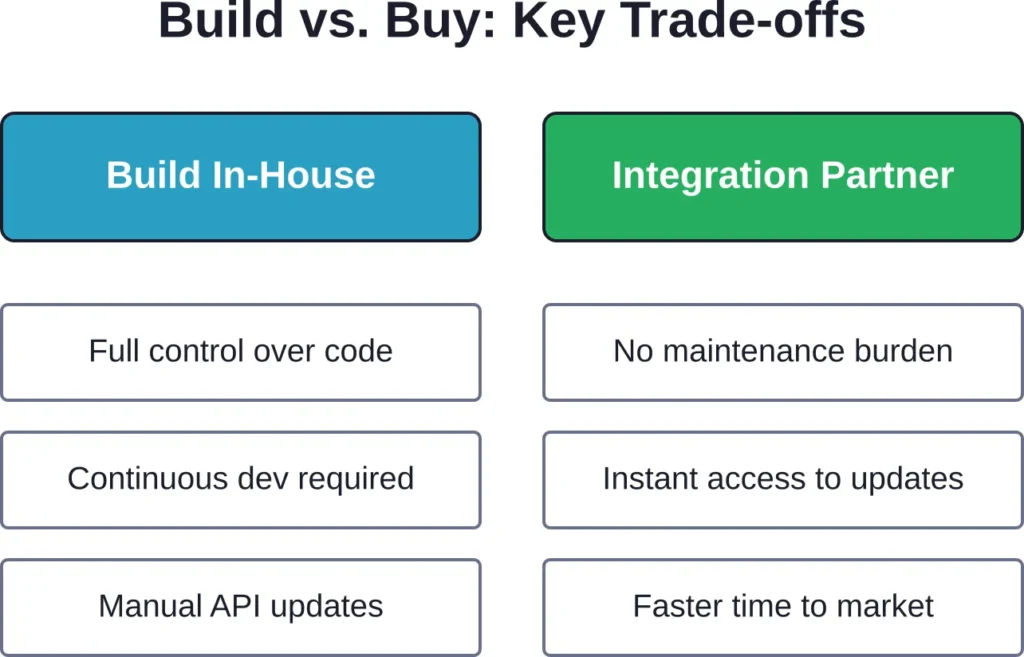
Maintenance becomes the hidden expense. APIs evolve constantly. Authentication methods change. Endpoints get deprecated. Rate limits shift. Each upstream API change requires engineering time to investigate, update code, test, and deploy fixes.
Multiply that across 15, twenty, or fifty integrations, and the maintenance burden becomes substantial. One engineering team reported spending 40% of their integration development time on maintenance rather than new features.
Integration partners absorb that maintenance cost across all their customers. When Salesforce updates their API, the platform provider updates once and all customers benefit. When building in-house, every company maintains that update independently.
The expertise factor matters too. Integration specialists have encountered and solved edge cases most internal teams won’t see until production. They’ve optimized retry logic, built robust error handling, and implemented monitoring that catches issues before customers notice.
Real talk: the decision often comes down to core competency. Does building and maintaining API integrations represent a competitive advantage for your business? For most companies, the answer is no. Integrations are necessary infrastructure, not differentiation.
Top 15 Third-Party API Integration Companies for 2026
The integration market has matured significantly. Specialized providers now dominate specific niches while horizontal platforms compete on breadth and ease of use.
These 15 companies represent the current leaders across different integration use cases and technical approaches. Each brings distinct strengths to particular scenarios.
1. A-listware
A-listware provides software development and consulting with dedicated expertise in application integration. They help companies connect enterprise systems, modernize legacy applications, and build seamless data flows between platforms.
The company offers application integration services alongside custom development, cloud solutions, and dedicated teams that become extensions of client organizations. Their approach includes API development, system connectivity, and infrastructure management that ensures different tools and platforms work together effectively.
A-listware stands out for delivering production-grade integrations for enterprise applications, ERP, CRM, and other business-critical systems.
Where A-listware fits best: Enterprises needing robust application and system integration, companies building or extending ERP/CRM solutions, organizations requiring dedicated teams for complex API and cloud integrations, businesses modernizing legacy systems with new third-party connections.
Contact Information:
- Website: a-listware.com
- Phone: +1 (888) 337 93 73
- Email: [email protected]
- Address: North Bergen, NJ 07047, USA
- LinkedIn: www.linkedin.com/company/a-listware
- Facebook: www.facebook.com/alistware
2. Lengreo

Lengreo operates as a complete marketing and tech partner for B2B companies. They combine digital strategy, lead generation, website development, and paid advertising into unified campaigns that connect multiple platforms and data sources.
The team builds hyper-personalized outreach systems, integrates CRM and marketing automation tools, and creates seamless data flows between advertising platforms, email systems, and sales pipelines. Their approach includes LinkedIn outreach campaigns, email marketing solutions, and demand generation strategies that pull together performance data from various channels.
Lengreo excels at turning fragmented marketing efforts into coordinated systems that drive qualified leads and measurable ROI for tech, architecture, event tech, and sports tech companies.
Where Lengreo fits best: B2B companies needing integrated marketing technology stacks, lead generation platforms, demand generation systems, businesses connecting advertising, CRM, and sales tools.
Contact Information:
- Website: Lengreo.com
- Phone: +31 686 147 566
- Email: [email protected]
- Address: Vrijstraat 9 C/D, 5611 AT Eindhoven, Netherlands
- LinkedIn: Lengreo
- Twitter: @Lengreo
- Instagram: @lengreo
3. Mobian

Mobian specializes in building dedicated engineering teams that deliver production-ready software with strong focus on legacy integration and third-party system connectivity. They create scalable architectures that connect new applications with existing infrastructure.
The studio covers end-to-end development including mobile, backend, APIs, cloud infrastructure, and AI systems. Their legacy integration capabilities allow companies to connect modern solutions with older systems without disruptive replacements. They emphasize clean architecture, documented APIs, and domain-specific integrations in healthcare, fintech, and logistics.
Mobian excels at HL7/FHIR integrations, payment flows, route optimization, and other industry-specific API connections.
Where Mobian fits best: Companies in healthcare, fintech, logistics and IT requiring complex system integrations, businesses needing legacy modernization through API connections, organizations building scalable solutions with multiple third-party services.
Contact Information:
- Website: mobian.studio
- Phone: [email protected]
- Address: Harju maakond, Tallinn, Kesklinnalinnaosa, Masina tn 22, 10113
- LinkedIn: www.linkedin.com/company/mobian-studio
4. Oski

Oski builds smart, well-engineered software solutions with strong emphasis on integrations across cloud platforms, frontend systems, and artificial intelligence. They design and implement solutions that connect enterprise systems, enable seamless data exchange, and incorporate modern technologies.
The platform supports hybrid and multi-cloud architectures, custom AI integrations, and reliable CMS implementations. Their expertise helps businesses create unified experiences by connecting various services, databases, and third-party tools while maintaining security and performance.
Oski delivers solutions across industries including fintech, insurance, logistics, and e-commerce, where robust API connections and system interoperability are essential.
Where Oski fits best: Tech-forward enterprises and startups requiring cloud and AI integrations, companies building multi-system solutions in fintech, insurance, logistics and travel, organizations needing reliable frontend and backend API connections.
Contact Information:
- Website: oski.site
- Phone: +48571282759
- Email: [email protected]
- Address: Kaupmehe tn 7, 10114 Tallinn, Estonia
- LinkedIn: www.linkedin.com/company/oski-solutions
5. Gilzor

Gilzor delivers custom software development focused on building digital products that connect with third-party systems and services. They specialize in full-cycle development including web and mobile applications, API integrations, and go-to-market strategies.
The company creates secure, scalable solutions that aggregate data from multiple sources, automate processes, and integrate with external platforms. Their services cover everything from idea validation and architecture consulting to production-ready applications that communicate effectively with external APIs and services.
Gilzor particularly shines in projects requiring clean connections between custom products and existing ecosystems, such as e-commerce aggregators, airline systems, or specialized mobile applications.
Where Gilzor fits best: Startups and SMBs launching products that require third-party API connections, companies building web and mobile apps with external service integrations, businesses needing custom solutions that aggregate data from multiple platforms.
Contact Information:
- Website: www.gilzor.com
- Email: [email protected]
- Address: Poland, Warsaw, Office 58, street Adama Mickiewicza 37, 01-625
- LinkedIn: www.linkedin.com/company/gilzor-softwaredevelopment
6. Kong

Kong takes a different approach than most integration platforms—they focus on API gateway and service mesh capabilities rather than pre-built connectors. The platform helps organizations manage, secure, and monitor APIs at scale.
The company has received substantial funding including a $175 million Series E round, reflecting growing demand for API infrastructure as companies adopt microservices architectures and expose APIs to external partners. Kong sits between API consumers and backend services, handling authentication, rate limiting, logging, and transformations.
The open-source foundation gives Kong flexibility. Developers can extend functionality through plugins, customize behavior for specific requirements, and deploy in any environment—cloud, on-premises, or hybrid architectures.
Kong excels when companies need fine-grained control over API traffic, comprehensive security policies, and detailed observability into API usage patterns. The platform supports both REST APIs and modern protocols like GraphQL and gRPC.
Where Kong fits best: Platform engineering teams, companies building API-first products, organizations with microservices architectures, businesses requiring sophisticated API security and governance.
7. Integrate.io

Integrate.io focuses on data integration pipelines, particularly ETL (extract, transform, load) and reverse ETL workflows. The platform helps data teams move information between databases, data warehouses, and business applications.
The company maintains integrations to major data sources and destinations—databases like PostgreSQL and MySQL, cloud data warehouses like Snowflake and BigQuery, and business applications across categories. That coverage enables end-to-end data pipeline orchestration.
Visual pipeline builders let data engineers construct complex transformations without extensive coding. But when custom logic is required, the platform supports SQL and Python for more sophisticated data manipulation.
Reverse ETL capabilities have become increasingly important. After data gets processed and enriched in warehouses, teams need to sync it back to operational systems. Integrate.io handles that bidirectional flow, keeping customer data platforms, CRMs, and marketing tools updated with warehouse-derived insights.
Where Integrate.io fits best: Data engineering teams, companies with significant ETL requirements, organizations building data warehouses, teams needing both traditional ETL and reverse ETL capabilities.
8. Nexonta Technologies

Nexonta operates as a custom development agency rather than a platform provider. With over two decades of experience, they build bespoke integration solutions for clients with requirements that don’t fit standard platform offerings.
The agency model works well when integration needs involve legacy systems without modern APIs, complex business logic that requires custom development, or unique workflows that pre-built connectors can’t accommodate. Nexonta handles the full development lifecycle from requirements gathering through implementation and ongoing support.
Their low-code automation expertise helps organizations balance custom development with configurable solutions. Rather than writing everything from scratch, they leverage automation platforms where appropriate and build custom components only where necessary.
The consulting approach means longer timelines compared to self-service platforms but provides solutions tailored precisely to client requirements. For organizations with complex integration landscapes, that customization often justifies the additional investment.
Where Nexonta fits best: Enterprises with legacy systems, companies requiring custom integration logic, organizations needing consulting guidance beyond platform implementation, businesses with unique industry-specific integration requirements.
9. Apideck

Apideck provides unified APIs across multiple software categories—CRM, HRIS, ATS, file storage, accounting, and more. SaaS companies building native integrations into their product integrate once with Apideck’s API and immediately access dozens of platforms in each category.
The unified API model accelerates integration development significantly. Instead of building and maintaining individual connectors to Salesforce, HubSpot, Pipedrive, and twenty other CRMs, companies integrate with Apideck’s CRM API and access all supported platforms through a consistent interface.
Apideck handles the complexity of different authentication methods, API rate limits, data model variations, and versioning across underlying platforms. That abstraction layer simplifies integration development and dramatically reduces ongoing maintenance.
The platform works particularly well for SaaS companies where native integrations represent a competitive requirement. Customers expect their tools to connect with the specific platforms they already use. Unified APIs make supporting that diversity economically feasible.
Where Apideck fits best: B2B SaaS companies building product integrations, platforms requiring broad coverage across software categories, teams wanting to ship integrations quickly without individual connector development.
10. DCKAP
DCKAP specializes in distribution and manufacturing integrations, particularly connecting ERP systems, ecommerce platforms, and EDI networks. Their industry focus gives them deep expertise in the specific integration challenges distributors face.
Distributors operate complex technology environments. Legacy ERP systems manage inventory and order processing. Ecommerce platforms serve B2B buyers expecting Amazon-like experiences. EDI connections handle automated ordering with large customers. Mobile apps enable field sales. Integrating these systems reliably is business-critical.
DCKAP’s platform provides pre-built connectors for common distribution technology stacks—major ERP systems, ecommerce platforms like Magento and BigCommerce, and EDI standards. The industry specialization means they understand distributor workflows and can implement integrations that match actual business processes.
Beyond platform capabilities, DCKAP provides implementation services and ongoing support. For distributors without extensive technical teams, that combination of technology and service delivers complete integration solutions rather than just software tools.
Where DCKAP fits best: Wholesale distributors, manufacturing companies, B2B businesses requiring ERP-to-ecommerce integration, organizations managing EDI alongside modern API integrations.
11. MuleSoft (Anypoint Platform)

MuleSoft operates at enterprise scale. Their Anypoint Platform serves organizations managing complex integration architectures across hundreds of systems, APIs, and business partners.
The platform combines API management, integration platform as a service (iPaaS) capabilities, and B2B partner management through Anypoint Partner Manager. That breadth makes MuleSoft particularly strong for manufacturers, distributors, and large enterprises with extensive partner ecosystems.
Their API Experience Hub creates centralized API catalogs that help large organizations avoid API sprawl—a common problem when different teams build APIs independently without coordination. The consolidated approach provides developers a single source of truth for discovering and consuming enterprise APIs.
MuleSoft excels when integration requirements span both internal systems and external B2B connections. The platform handles both API-based integrations and legacy EDI transactions, making it suitable for industries still dependent on traditional electronic data interchange.
Where MuleSoft fits best: Large enterprises, manufacturing companies, B2B-heavy businesses requiring both modern API and legacy EDI support, organizations managing complex partner networks.
12. Zapier

Zapier pioneered no-code workflow automation and remains the market leader for teams without dedicated developers. The platform connects over 9,000 apps through pre-built integrations called Zaps.
The value proposition is simplicity. Non-technical users can configure multi-step workflows connecting their business applications without writing code. When a new lead enters your CRM, Zapier can automatically add them to your email marketing platform, create a task in your project management tool, and send a Slack notification.
That accessibility comes with limitations. Zapier works beautifully for standard workflows between popular applications but struggles with complex business logic, high-volume data processing, or custom API requirements that don’t fit their pre-built connector model.
The platform has evolved beyond simple trigger-action workflows. Multi-step Zaps, conditional logic, and path branching enable more sophisticated automation. But fundamentally, Zapier optimizes for ease of use rather than unlimited flexibility.
Where Zapier fits best: Small to mid-sized teams, marketing departments, operations roles, businesses needing quick wins connecting popular SaaS tools without developer involvement.
13. Workato
Workato bridges the gap between no-code platforms like Zapier and enterprise iPaaS solutions like MuleSoft. The platform provides low-code development capabilities that let both business users and developers build integrations.
The company has attracted substantial investment, reaching a $5.7 billion valuation. That capital fuels expansion into AI-powered integration capabilities and deeper enterprise features.
Workato’s recipe-based approach lets users build complex integration workflows with conditional logic, error handling, and custom functions. The platform supports both real-time and batch processing, making it versatile for different integration patterns.
Bot automation represents another Workato strength. Teams can trigger integrations through conversational interfaces in Slack, Teams, or other collaboration platforms. That accessibility helps drive adoption across non-technical departments.
Where Workato fits best: Mid-market to enterprise companies, organizations wanting both business user accessibility and developer power, teams building complex workflows with significant business logic.
14. Bindbee

Bindbee takes a specialized approach, focusing exclusively on employment data integrations for HR tech, benefits platforms, and fintech companies. Instead of being a horizontal platform, they’ve built deep expertise in HRIS, payroll, ATS, and benefits administration systems.
The unified API model means SaaS companies integrate once with Bindbee and immediately access dozens of underlying HR and payroll platforms. That’s particularly valuable for employee benefits providers, HR analytics tools, and fintech applications that need accurate employment and payroll data.
Employment data brings unique challenges. Payroll systems handle sensitive information under strict compliance requirements. Data models vary significantly between platforms. Field standardization becomes complex when one system calls it “gross_pay” and another uses “total_earnings.”
Bindbee handles that complexity, providing normalized data models and managing the authentication, security, and compliance requirements specific to employment data. For companies building in this vertical, that specialization eliminates months of integration development.
Where Bindbee fits best: HR tech SaaS platforms, employee benefits companies, B2B fintech requiring employment data, insurance platforms serving employers.
15. Improvado

Marketing analytics teams face a specific integration challenge—consolidating data from dozens of advertising platforms, analytics tools, and marketing automation systems into unified reporting. Improvado built their entire platform around solving that problem.
The company focuses on marketing data pipeline management. They maintain integrations to 100+ marketing and advertising platforms, extracting granular metrics that general-purpose integration tools often miss. Facebook Ads alone exposes hundreds of performance metrics; Improvado captures the depth marketers actually need for analysis.
Data transformation represents another core capability. Raw data from different platforms arrives in inconsistent formats with varying naming conventions. Improvado normalizes that data, maps it to consistent schemas, and loads it into data warehouses or BI tools ready for analysis.
The platform serves marketing operations teams, agencies managing multiple client accounts, and enterprises consolidating marketing performance across brands or regions. The focus on marketing data means deeper integration quality for that specific use case compared to horizontal platforms.
Where Improvado fits best: Marketing analytics teams, agencies managing client reporting, enterprises needing cross-channel marketing attribution, companies requiring granular advertising metrics.
How to Select the Right Integration Partner
Choosing an integration company isn’t just about features and connector counts. The right partner depends on your specific requirements, technical capabilities, and business context.
Start by mapping your integration landscape. Which systems need to connect? How many integrations will your team manage—five, fifty, five hundred? What’s the volume of data flowing through these connections? Those fundamentals determine whether you need a simple workflow tool or enterprise-grade infrastructure.
Evaluate Your Technical Resources
How much developer involvement can your integrations reasonably consume? Teams with limited engineering capacity benefit from no-code platforms or unified API providers that minimize custom development. Organizations with strong technical teams might prefer platforms offering more flexibility and control.
That said, even technically sophisticated teams often prefer delegating integration maintenance to specialists. The opportunity cost matters—what else could your engineers build if they weren’t maintaining API connections?
Match Specialization to Your Domain
Industry-specific integration companies bring substantial advantages when your use case aligns with their focus. Bindbee understands employment data nuances that horizontal platforms don’t. Improvado captures marketing metrics that general integration tools miss. DCKAP knows distributor workflows intimately.
Specialized providers have encountered and solved the edge cases specific to their domains. They’ve built normalized data models, handled compliance requirements, and optimized for the performance characteristics that matter in particular industries.
Horizontal platforms provide broader coverage but shallower depth. Zapier connects to 9,000+ apps, but those integrations expose basic functionality rather than deep feature sets. That breadth works perfectly for simple workflows; specialized providers serve complex use cases better.
Consider Your Integration Architecture
Are you building integrations into your product for customers, or connecting internal systems? Product integrations favor unified API providers—customers expect to connect with the specific tools they use, and supporting that diversity requires broad connector coverage.
Internal integrations often work well with workflow platforms. Marketing operations connecting their tech stack benefits from Zapier’s simplicity. Data teams consolidating warehouse pipelines need ETL-focused platforms like Integrate.io.
Enterprise architecture initiatives requiring comprehensive API management, service mesh capabilities, and governance frameworks push toward platforms like MuleSoft or Kong. These serve organizations where integration infrastructure represents a strategic technology investment.
Assess Scalability Requirements
Volume matters. Platforms handle different throughput levels, and performance characteristics vary significantly. Processing a few thousand API calls daily differs fundamentally from managing millions.
Rate limiting becomes increasingly complex at scale. APIs impose different rate limits, and orchestrating requests across dozens of endpoints while respecting those constraints requires sophisticated queueing and retry logic. Enterprise platforms build that infrastructure; simpler tools may struggle.
Data transformation performance matters too. Moving large volumes requires efficient processing. Batch operations need different optimization than real-time sync. Evaluate whether platforms can handle your volume today and scale as usage grows.
Evaluate Support and Documentation
Integration projects inevitably hit edge cases. How quickly can you get help when problems arise? Platform providers vary dramatically in support quality.
Documentation depth matters just as much as support responsiveness. Comprehensive API references, integration guides, and troubleshooting resources enable teams to solve problems independently rather than waiting for support tickets.
Community resources provide another support dimension. Active user communities, integration templates, and shared solutions accelerate implementation. Platforms with established ecosystems offer more resources for common integration scenarios.
| Selection Criteria | Small Teams | Mid-Market | Enterprise |
|---|---|---|---|
| Technical Resources | Limited dev capacity | Small engineering team | Dedicated integration team |
| Integration Count | 5-15 connections | 15-50 connections | 50+ complex integrations |
| Preferred Approach | No-code platforms | Low-code or unified APIs | iPaaS or custom development |
| Support Needs | Self-service documentation | Email support, tutorials | Dedicated account management |
| Best Fit Examples | Zapier | Workato, Apideck, Bindbee | MuleSoft, Kong, Nexonta |
Integration Market Trends Shaping 2026
The API integration landscape continues evolving rapidly. Several trends are reshaping how companies approach connecting systems.
AI-Powered Integration Development
Artificial intelligence is beginning to automate aspects of integration development that previously required manual coding. AI can suggest data field mappings, generate transformation logic, and even write connector code based on API documentation.
The technology remains early but shows promise for accelerating integration development. What currently takes hours of mapping fields between systems might eventually become automated suggestions that developers review and approve.
Embedded Integration Platforms
SaaS companies increasingly embed integration capabilities directly into their products rather than sending customers to separate integration platforms. Unified API providers enable this by offering white-labeled integration experiences that feel native to the host application.
From the customer perspective, integrations become a seamless product feature rather than a separate tool to learn. That improved experience drives higher integration adoption and reduces support burden.
Real-Time Data Synchronization
Batch processing is giving way to real-time sync for many integration scenarios. Businesses need immediate data consistency rather than waiting for scheduled jobs to propagate changes.
Webhooks, event streams, and bidirectional sync enable near-instant updates across systems. When a customer updates their email address, that change reflects immediately everywhere rather than waiting hours for batch processing to complete.
The shift toward real-time requires different infrastructure than traditional batch ETL. Integration platforms are adapting with improved event handling, streaming capabilities, and optimized real-time data pipelines.
Industry-Specific Integration Networks
Vertical specialization is accelerating. Rather than horizontal platforms trying to serve all industries, specialized providers are building deep expertise in particular domains and capturing significant market share.
The API integration platform market demonstrates this growth trajectory—industry analyses suggest the API integration platform market is projected to grow from $15.63 billion in 2025 to $78.28 billion by 2032, representing a 25.9% CAGR. That explosive growth creates room for both horizontal platforms and vertical specialists to thrive.
Common Integration Challenges and Solutions
Even with experienced integration partners, certain challenges arise repeatedly. Understanding these upfront helps set realistic expectations and plan accordingly.
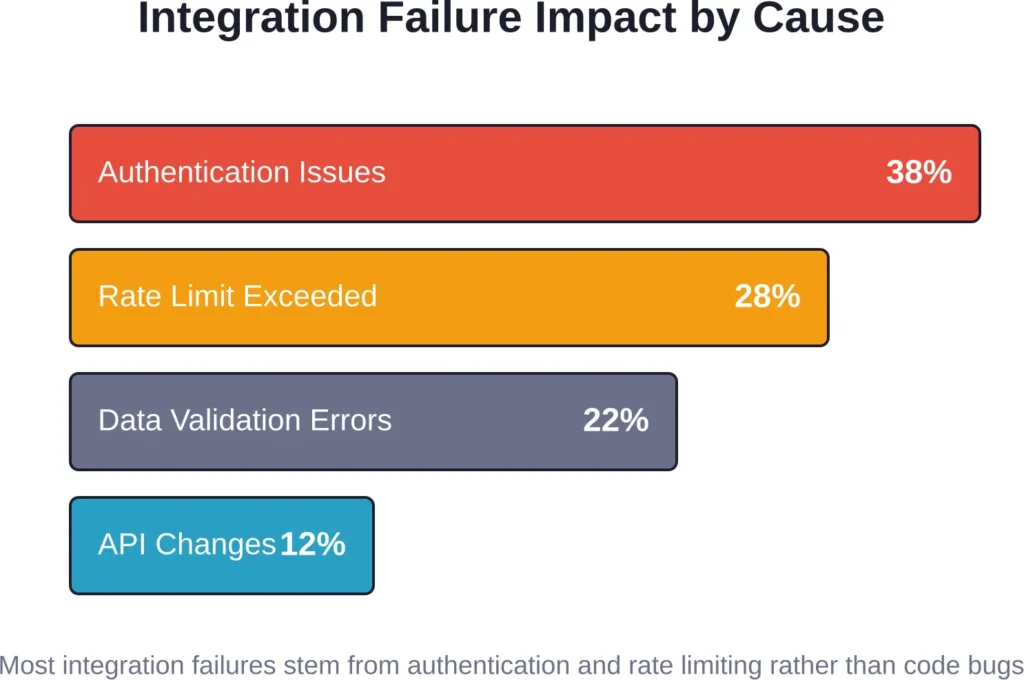
Authentication Complexity
Different APIs use different authentication methods—OAuth 2.0, API keys, JWT tokens, basic authentication, custom schemes. Managing credentials securely while enabling smooth user experiences requires careful implementation.
OAuth flows create particular UX challenges. Users must leave your application, authenticate with the external service, and return—a process that introduces friction and potential abandonment. Integration platforms handle this complexity, but the fundamental UX challenge remains.
Data Model Mismatches
No two systems model data identically. One CRM might store phone numbers as a single field; another splits them into country code, area code, and number. Mapping between these representations requires transformation logic that accounts for all variations.
Field optionality creates another headache. System A requires a field that System B doesn’t collect. How should the integration handle that mismatch? Default values? Error states? Skip the record? The right answer depends on business requirements, not just technical capabilities.
Rate Limiting and Throttling
APIs impose rate limits to protect their infrastructure. Exceed those limits and requests fail. Managing sync operations within rate limits while maintaining acceptable performance requires sophisticated queuing and retry strategies.
Rate limits vary—some APIs limit requests per second, others per hour or day. Some count per user, others per organization. Integration platforms abstract these complexities, but they constrain what’s possible nonetheless.
Error Handling and Monitoring
Integrations fail in creative ways. Networks hiccup. APIs return unexpected responses. Data validation fails. Services go down for maintenance. Robust integration infrastructure requires comprehensive error handling, logging, and monitoring.
But here’s what matters more than just detecting failures—recovery strategies. When an API call fails, should the system retry immediately? Back off exponentially? Alert someone? Queue for manual review? Different failure scenarios demand different responses.
Version Management
APIs evolve over time. Providers release new versions, deprecate old ones, and eventually sunset outdated endpoints. Managing this lifecycle across multiple integrations becomes a continuous maintenance burden.
Integration platforms provide significant value here. When an API provider releases a breaking change, the platform updates once and all customers benefit. Internal teams managing integrations directly must monitor deprecation notices, plan updates, and execute migrations individually for each integration.
Frequently Asked Questions
Integration platforms like Zapier provide tools for connecting applications through workflows. Users configure trigger-action sequences that move data between systems. Unified API providers like Bindbee or Apideck offer a single API that connects to multiple underlying platforms in a category. Developers integrate once and access many platforms through a consistent interface. Integration platforms target business users configuring workflows; unified APIs serve developers building product integrations.
Timeline varies dramatically based on approach and complexity. Self-service platforms like Zapier enable simple integrations in hours. Unified APIs typically require 1-2 weeks for initial implementation plus testing. Custom development projects span weeks to months depending on requirements. Enterprise iPaaS implementations can take several months including architecture design, development, and migration from existing systems. The integration count, data volume, and complexity of business logic significantly impact timelines.
Reputable integration companies implement strong security practices including encryption in transit and at rest, secure credential storage, and access controls. However, compliance responsibility ultimately remains with the data owner. Companies must verify that integration partners meet their specific compliance requirements—HIPAA for healthcare data, SOC 2 for general security practices, GDPR for EU data processing. Review each provider’s security documentation and certifications before handling sensitive data through their platform.
Switching is possible but involves effort proportional to integration complexity. Simple workflow automations on platforms like Zapier can be rebuilt on alternatives relatively quickly. Custom integrations built through unified APIs require code changes but maintain similar logic. Enterprise iPaaS migrations represent substantial projects involving architecture redesign, connector rebuilding, testing, and careful cutover planning. Before committing to a provider, evaluate not just current fit but also exit complexity if requirements change.
Integration platforms typically monitor partner API updates and handle version management on behalf of customers. When providers announce deprecations, platform companies update their connectors and migrate customers to new versions. This represents major value—internal teams managing integrations directly must track each API’s changelog, plan updates, modify code, test changes, and deploy updates independently. That maintenance burden compounds across dozens of integrations. Platform providers absorb that work across their entire customer base.
Several situations favor internal development. When integration logic represents core product differentiation rather than commodity connectivity, building in-house maintains competitive advantage. Organizations with truly unique requirements that no platform addresses may need custom solutions. Companies already maintaining substantial integration infrastructure sometimes find incremental additions more efficient than platform migration. Security-sensitive scenarios requiring air-gapped environments or specialized compliance controls might necessitate internal development. But for most businesses, platforms or partners prove more efficient than building and maintaining integrations internally.
Pricing models vary significantly. Self-service platforms typically charge subscription fees based on usage—task counts, API call volume, or connected app quantities. Unified API providers often use per-connection or per-transaction models. Custom development agencies bill project fees or retainer arrangements. Enterprise platforms combine platform subscriptions with implementation services and ongoing support contracts. Evaluate total cost of ownership including platform fees, implementation effort, and ongoing maintenance rather than comparing subscription costs alone.
Making Your Integration Decision
Selecting the right integration partner represents a strategic technology decision with long-term implications. The wrong choice leads to maintenance headaches, scalability problems, or limitations that constrain business growth.
Start by clearly defining requirements. Which systems must connect? What data needs to flow between them? How much volume? What latency is acceptable? What compliance standards apply? Clear requirements enable meaningful platform evaluation rather than comparing features abstractly.
Match partner specialization to your needs. Vertical specialists bring domain expertise but limited breadth. Horizontal platforms offer wide coverage with less depth. Enterprise iPaaS solutions provide comprehensive capabilities at higher complexity and investment.
Consider the total ownership equation. Platform subscription costs represent just one component. Implementation effort, ongoing maintenance, support quality, and internal resource requirements all factor into the real cost and value delivered.
Test before committing. Most platforms offer trials or pilot programs. Build a representative integration on shortlisted platforms. Evaluate development experience, documentation quality, performance, and support responsiveness with real implementation experience rather than sales demonstrations.
The integration landscape will continue evolving. API standards mature, new platforms emerge, and existing providers expand capabilities. Building relationships with integration partners who invest in their platforms and adapt to market changes positions organizations well for that evolution.
Third-party API integration companies solve a fundamental challenge in modern software development—connecting disparate systems reliably at scale without consuming unlimited engineering resources. Choosing the right partner depends on matching their strengths to specific business requirements, technical context, and organizational capabilities.
The companies profiled here represent current market leaders across different integration approaches and specializations. From enterprise-scale iPaaS platforms to vertical-specific unified APIs, the right solution exists for virtually any integration requirement. Success comes from clear requirements definition, honest assessment of internal capabilities, and selecting partners whose expertise aligns with specific business needs.
Ready to streamline your integration strategy? Start by mapping your current integration landscape, identifying the highest-priority connections, and evaluating which approach—no-code platform, unified API, or custom development—best fits your team’s technical capabilities and business objectives. The right integration partner can transform connectivity from a persistent engineering burden into a solved problem that enables faster product development and better business outcomes.