

Quick Summary: The best ecommerce website development companies in 2026 combine platform expertise, custom development capabilities, and proven track records with major brands. This curated list features 15 top agencies specializing in Shopify, WooCommerce, custom builds, and enterprise solutions—helping businesses find the right development partner based on technical skills, industry focus, and project complexity.
Running an online store isn’t just about listing products and hoping people buy. It’s about creating an experience that feels effortless, looks professional, and converts browsers into buyers.
A poorly designed checkout flow or a sluggish mobile experience can send potential customers running to competitors. That’s where specialized ecommerce development companies come in—they build stores that don’t just look good but actually drive sales.
Choosing the right development partner can make or break your online business. The global ecommerce market surged from $4.408 trillion in 2024 to $4.932 trillion in 2025, with projections pointing toward $7.034 trillion by 2029. That growth brings fierce competition.
This guide profiles 15 leading ecommerce website development companies in 2026, examining their platform specializations, technical capabilities, and the types of businesses they serve best. Whether building a first Shopify store or migrating an enterprise platform, the right agency makes all the difference.
What Makes a Top Ecommerce Development Company in 2026
Not every web development shop can handle the complexities of modern ecommerce. The best agencies bring more than coding skills—they understand conversion optimization, payment gateway integrations, inventory systems, and the particular quirks of platforms like Shopify, WooCommerce, and Magento.
Here’s what separates the leaders from the rest.
Platform Expertise and Certifications
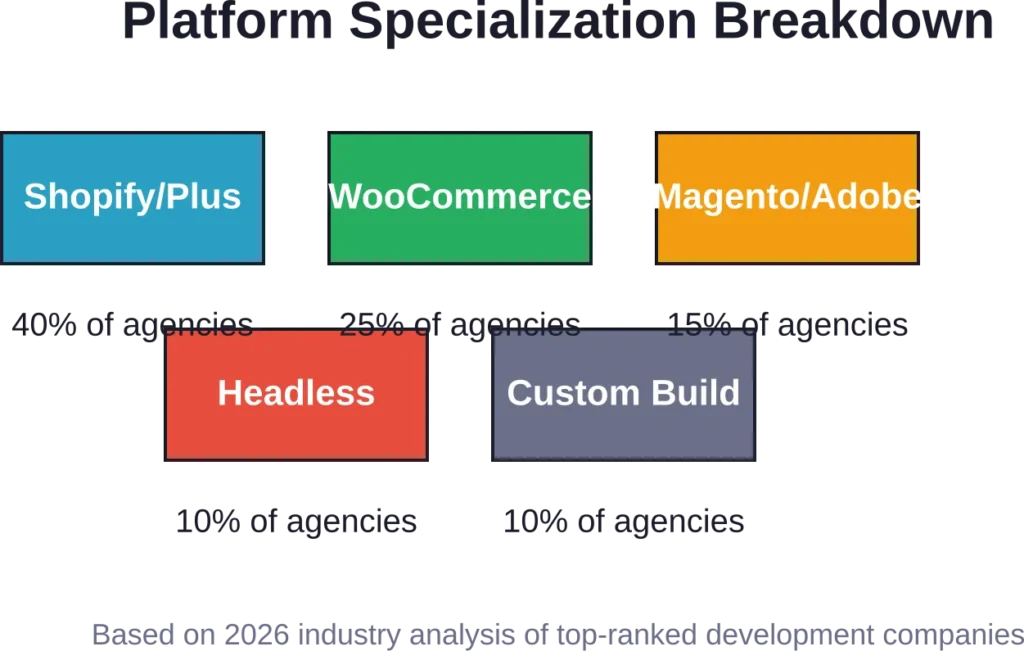
Top ecommerce development companies typically specialize in one or two platforms rather than claiming to master everything. Shopify partners, for instance, have built stores that collectively process billions in transactions.
According to Shopify’s partner program data, $1,300,000,000 paid to partners in 2025 through apps, themes, store builds, and referrals. That figure reflects the value flowing through their ecosystem—and the agencies earning those revenues have demonstrated real expertise.
Certifications matter. Shopify’s Certified Technology Partner Program connects Plus merchants with developers who’ve proven they can handle complex requirements. Built for Shopify status signals that an app or agency meets strict performance, design, and support standards.
For WooCommerce, look for agencies contributing to the WordPress ecosystem or holding WooExpert credentials. Magento specialists often carry Adobe Commerce certifications.
Custom Development Capabilities
Theme-based stores work fine for straightforward catalogs, but growing businesses eventually need custom features. The ability to build bespoke functionality—whether custom checkout flows, subscription systems, or third-party API integrations—separates competent agencies from great ones.
Custom development typically involves headless commerce architectures, progressive web apps (PWAs), or entirely proprietary systems built on frameworks like React or Node.js. These projects demand deeper technical skills and architectural planning.
Basic Shopify or WooCommerce stores typically range from $10,000–$15,000, while enterprise-level custom solutions with advanced integrations, AI, or mobile apps can exceed $50,000–$100,000. The range reflects the difference between template customization and ground-up development.
Post-Launch Support and Optimization
Launch day is just the beginning. Ecommerce sites need ongoing maintenance, security updates, performance monitoring, and conversion rate optimization.
The best agencies offer retainer packages covering these needs—fixing bugs, adding features, optimizing page speed, and A/B testing checkout flows. Some also provide strategic consulting as businesses scale.
Real talk: an agency that disappears after launch leaves merchants scrambling when payment processors change APIs or a plugin update breaks the cart.
Top 15 Ecommerce Website Development Companies in 2026
This curated list represents agencies with verified client portfolios, platform certifications, and specializations across different ecommerce needs. No single agency fits every project—the goal is matching capabilities to requirements.
1. Lengreo

Lengreo acts as a complete marketing and tech partner specializing in building high-converting eCommerce websites, business sites, and landing pages. Their full-cycle website development process includes in-depth discovery and business analysis, prototyping, design development, implementation, quality assurance, and continuous support.
They create performance-focused eCommerce solutions with strong emphasis on user experience, clear checkout flows, and seamless integration with SEO, paid ads, and lead-generation systems to drive measurable growth.
Best for: B2B companies and service providers seeking eCommerce websites tightly connected with full-funnel digital marketing and conversion optimization.
Contact Information:
- Website: Lengreo.com
- Phone: +31 686 147 566
- Email: [email protected]
- Address: Vrijstraat 9 C/D, 5611 AT Eindhoven, Netherlands
- LinkedIn: Lengreo
- Twitter: @Lengreo
- Instagram: @lengreo
2. Gilzor

Gilzor excels in custom web development for eCommerce, delivering scalable online stores and marketplace solutions. They have built successful eCommerce grocery shopping applications that aggregate hundreds of stores, helping users save significantly while increasing retailer revenue through better turnover and reduced waste.
Their full-cycle approach covers UI/UX design optimized for higher conversion rates, secure and high-performance web development, quality assurance, and go-to-market strategy support.
Best for: Startups and small-to-medium businesses looking for custom eCommerce web platforms or additional online sales channels.
Contact Information:
- Website: www.gilzor.com
- Email: [email protected]
- Address: Poland, Warsaw, Office 58, street Adama Mickiewicza 37, 01-625
- LinkedIn: www.linkedin.com/company/gilzor-softwaredevelopment
3. A-listware

A-listware provides comprehensive software development services with strong expertise in eCommerce solutions. They work with leading platforms including Shopify, Magento, and PrestaShop to build custom online stores, web portals, and integrated B2B/B2C systems. Their services include full development, UX/UI design, cloud applications, QA, and seamless ERP/CRM integrations.
The company focuses on creating scalable, secure, and responsive eCommerce platforms tailored to enterprise needs.
Best for: Mid-to-large businesses and enterprises needing custom eCommerce development, platform implementation, or complex system integrations.
Contact Information:
- Website: a-listware.com
- Phone: +1 (888) 337 93 73
- Email: [email protected]
- Address: North Bergen, NJ 07047, USA
- LinkedIn: www.linkedin.com/company/a-listware
- Facebook: www.facebook.com/alistware
4. OSKI Solutions
OSKI Solutions builds scalable digital solutions with dedicated focus on eCommerce. They develop and maintain online stores that enhance customer experiences through personalization, automation, and smooth performance using reliable CMS platforms (Umbraco and WordPress) combined with modern frontend technologies and cloud infrastructure.
Their work emphasizes intuitive shopping journeys, booking flows, and operational efficiency for online retail businesses.
Best for: Tech-forward enterprises and growing companies in eCommerce, travel, and logistics requiring reliable, high-performance web stores.
Contact Information:
- Website: oski.site
- Phone: +48571282759
- Email: [email protected]
- Address: Kaupmehe tn 7, 10114 Tallinn, Estonia
- LinkedIn: www.linkedin.com/company/oski-solutions
5. Mobian Studio
Mobian Studio builds dedicated full-stack engineering teams that deliver production-ready eCommerce solutions, including web platforms, mobile storefronts, and integrated backends. They specialize in scalable architecture, clean code, and seamless legacy system connections while maintaining focus on performance and user experience.
Their end-to-end approach covers everything from UI/UX to cloud infrastructure and post-launch support, ensuring stores can grow from hundreds to tens of thousands of users without major rebuilds.
Best for: Companies in Fintech, Logistics, and IT that need fast, reliable eCommerce web and mobile development with senior-level execution.
Contact Information:
- Website: mobian.studio
- Phone: [email protected]
- Address: Harju maakond, Tallinn, Kesklinnalinnaosa, Masina tn 22, 10113
- LinkedIn: www.linkedin.com/company/mobian-studio
6. BlackBelt Commerce

BlackBelt Commerce positions itself as a Shopify-focused agency for merchants serious about growth. Their service model combines development with strategic consulting—helping brands identify growth levers, optimize product pages, and structure stores for scalability.
They’ve launched dozens of Shopify and Shopify Plus stores, with particular strength in subscription commerce using apps like Recharge and Bold. Their developers customize subscription flows, customer portals, and retention email sequences.
BlackBelt also emphasizes conversion rate optimization—A/B testing product page layouts, refining add-to-cart CTAs, and simplifying multi-step checkouts.
Best for: Direct-to-consumer brands and subscription box businesses on Shopify.
7. Custom Headless Commerce Specialists
Several top agencies now focus exclusively on headless commerce—decoupling the front-end presentation layer from the back-end commerce engine. This architecture allows brands to use React, Vue, or Next.js for the storefront while Shopify, Magento, or BigCommerce handles products, orders, and payments via API.
Headless setups offer unmatched design flexibility and performance. Progressive web apps (PWAs) built this way load instantly and work offline. But they require serious technical chops—front-end frameworks, API management, and often custom middleware.
These projects typically range from $50,000 to well over $100,000, depending on complexity and integrations.
Best for: High-growth brands with unique UX requirements and development resources to maintain headless infrastructure.
8. WooCommerce Experts for WordPress Sites
For businesses already running WordPress for content, adding WooCommerce makes sense. Specialized WooCommerce agencies build stores that integrate seamlessly with existing WordPress sites—shared user accounts, unified design, and content-driven product pages.
Top WooCommerce developers customize everything from product page layouts to complex shipping rules. They integrate membership plugins, build custom calculators for configurable products, and optimize database queries to keep stores fast even with thousands of products.
WooCommerce’s flexibility is both strength and challenge—poor configuration can create security vulnerabilities or performance bottlenecks. Expert agencies know how to harden WooCommerce installations and optimize hosting environments.
Best for: Content-heavy brands, bloggers monetizing audiences, and WordPress users adding ecommerce.
9. Enterprise Omnichannel Commerce Agencies
The largest ecommerce agencies handle omnichannel projects—unifying online stores, mobile apps, in-store POS systems, marketplaces (Amazon, eBay), and social commerce into a single inventory and order management system.
These projects demand integration expertise across dozens of systems: ERPs, warehouse management software, customer data platforms, marketing automation, and analytics tools. Development timelines stretch six months to over a year.
Enterprise agencies typically serve retailers with physical locations, wholesale divisions, and complex fulfillment requirements. They’re experienced in phased rollouts, change management, and training internal teams.
Best for: Multi-channel retailers, franchises, and brands with both B2C and B2B operations.
10. Mobile-First Ecommerce App Developers
Mobile commerce continues to dominate ecommerce growth. Some agencies specialize in native mobile apps (iOS and Android) or PWAs that deliver app-like experiences through web browsers.
Native apps offer push notifications, offline browsing, and smoother performance—but require separate development for each platform and ongoing app store maintenance. PWAs install directly from websites, work across devices, and update automatically without app store approval.
Mobile-first agencies optimize every interaction for thumb navigation, fast load times on cellular networks, and streamlined checkout flows designed for smaller screens. They integrate mobile payment methods like Apple Pay, Google Pay, and Shop Pay.
Best for: Brands with mobile-heavy traffic and repeat customers who’d benefit from app features.
11. ParallelHQ

ParallelHQ focuses on research-driven ecommerce design with strong UX optimization and iterative testing. The agency supports Shopify, WooCommerce, and custom headless architectures.
Their approach emphasizes user research before design—eye-tracking studies, session recordings, and checkout flow analysis inform every decision. One case study recounts how changing a “register” button to “continue” generated measurably higher conversions by removing friction by removing friction.
ParallelHQ integrates carts with inventory systems, implements SSL and PCI compliance measures, and streamlines checkout flows by reducing unnecessary fields. They don’t force account creation unless merchants specifically request it.
Best for: Mid-market brands prioritizing conversion optimization and data-driven design decisions.
12. Elogic Commerce
With over 500 projects launched and a 92% customer satisfaction rate, Elogic Commerce specializes in Magento (Adobe Commerce) and WooCommerce development. Their team handles complex B2B catalogs, multi-store setups, and enterprise integrations.
Elogic’s portfolio includes omnichannel solutions connecting online stores with brick-and-mortar POS systems, ERP platforms, and third-party logistics providers. They’ve worked with retailers managing tens of thousands of SKUs across multiple regions.
Their development process includes performance optimization from day one—lazy loading images, database query optimization, and CDN configuration to keep page load times under three seconds even on product-heavy pages.
Best for: Enterprise retailers and B2B businesses needing scalable multi-store platforms.
13. Certified Shopify Plus Partner (University of Miami Partner)

This agency earned recognition as a Certified Shopify Plus Partner, a designation reserved for developers meeting Shopify’s highest standards for Plus merchant projects. One client saw a 2.5x increase in transactions after launch.
When the University of Miami trusted them with their ecommerce presence, it validated their ability to handle high-traffic, brand-sensitive projects. Their work focuses on Shopify Plus customizations—advanced discount logic, custom checkout fields, wholesale portals, and subscription integrations.
They also build private apps extending Shopify’s native functionality, connecting stores to university systems, CRMs, and marketing automation platforms.
Best for: Education institutions, nonprofits, and large retailers requiring Shopify Plus expertise.
14. Techling LLC

Techling LLC operates with a team of 10–49 employees specializing in ecommerce development, web design, and AI development. Their client roster includes CAPA, Chex AI, Cazvid, Dressup, Deft GPT, and Daspire.
The agency builds on multiple platforms—Shopify, WooCommerce, custom PHP frameworks—and integrates emerging technologies like AI-powered product recommendations and chatbots. Their AI development services extend beyond basic plugins to custom machine learning models for inventory forecasting and dynamic pricing.
Techling also offers ongoing support packages, handling everything from plugin updates to feature additions as businesses grow.
Best for: Startups and mid-sized businesses exploring AI integration in ecommerce.
15. nopStation
nopStation specializes exclusively in nopCommerce, the open-source ASP.NET ecommerce platform. Their focus makes them the go-to agency for businesses committed to the Microsoft stack or requiring .NET integration with existing enterprise systems.
They’ve built hundreds of nopCommerce stores, developed custom plugins, and offer performance optimization services specific to ASP.NET hosting environments. Their team contributes to the nopCommerce core project and maintains several popular extensions in the marketplace.
nopStation also provides UX/UI design tailored to nopCommerce’s architecture, ensuring custom designs don’t sacrifice platform performance or upgrade compatibility.
Best for: Enterprises invested in Microsoft technologies or requiring .NET-based ecommerce solutions.
Key Factors When Choosing an Ecommerce Development Partner
The agency with the prettiest portfolio isn’t necessarily the right fit. Here’s what actually matters when evaluating partners.
Platform Alignment and Technical Stack
Start by identifying which platform best serves business needs—then find agencies specializing in that platform. A Magento expert won’t be the best choice for a Shopify build, and vice versa.
Ask about the specific technical stack they use. For custom development, what frameworks? What hosting providers do they recommend? How do they handle version control, testing, and deployment?
Agencies comfortable with modern tools like Git, staging environments, and CI/CD pipelines will deliver cleaner code and smoother updates.
Portfolio and Relevant Experience
Review their portfolio for projects similar in size, industry, and complexity. An agency that’s built twenty small Shopify stores might struggle with a large multi-vendor marketplace.
Look for case studies with metrics—conversion rate improvements, page speed gains, or revenue growth. Vague testimonials mean less than concrete numbers.
Ask for references from clients in similar industries. A call with a current client reveals more than any sales deck.
Development Process and Communication
How does the agency manage projects? Do they use Agile sprints or waterfall phases? How often will they provide updates?
Clear communication prevents expensive misunderstandings. Agencies should provide detailed proposals outlining deliverables, timelines, and approval points. They should ask lots of questions upfront—about business goals, target customers, and technical constraints.
Red flag: agencies that promise exact timelines before understanding requirements.
Ownership and Scalability
Who owns the code after launch? Some agencies retain ownership, locking merchants into ongoing relationships. Insist on full code ownership and access to all accounts (hosting, domain, third-party services).
Ask how the solution will scale. What happens when traffic doubles? When the product catalog grows from 100 to 10,000 items? Good agencies build with growth in mind—choosing hosting that scales, optimizing database structures, and avoiding architectural shortcuts.
Security and Compliance Standards
Ecommerce sites handle sensitive customer data and payment information. Agencies must implement SSL certificates, PCI compliance measures, secure payment gateway integrations, and regular security updates.
For businesses in regulated industries (health, finance, government), ask about HIPAA, SOC 2, or other compliance frameworks. Not every agency has experience with these requirements.
| Selection Criteria | Why It Matters | What to Ask |
|---|---|---|
| Platform Expertise | Specialists deliver better results than generalists | How many [platform] stores have you built? Show examples. |
| Portfolio Relevance | Similar projects indicate capability | Have you worked with businesses in our industry/size? |
| Technical Stack | Modern tools mean maintainable code | What frameworks, hosting, and deployment tools do you use? |
| Communication Process | Prevents misalignment and delays | How often will we receive updates? Who’s our point of contact? |
| Code Ownership | Avoids vendor lock-in | Will we own all code and have full account access? |
| Security Standards | Protects customer data and brand reputation | How do you handle PCI compliance and security updates? |
Ecommerce Development Investment Ranges
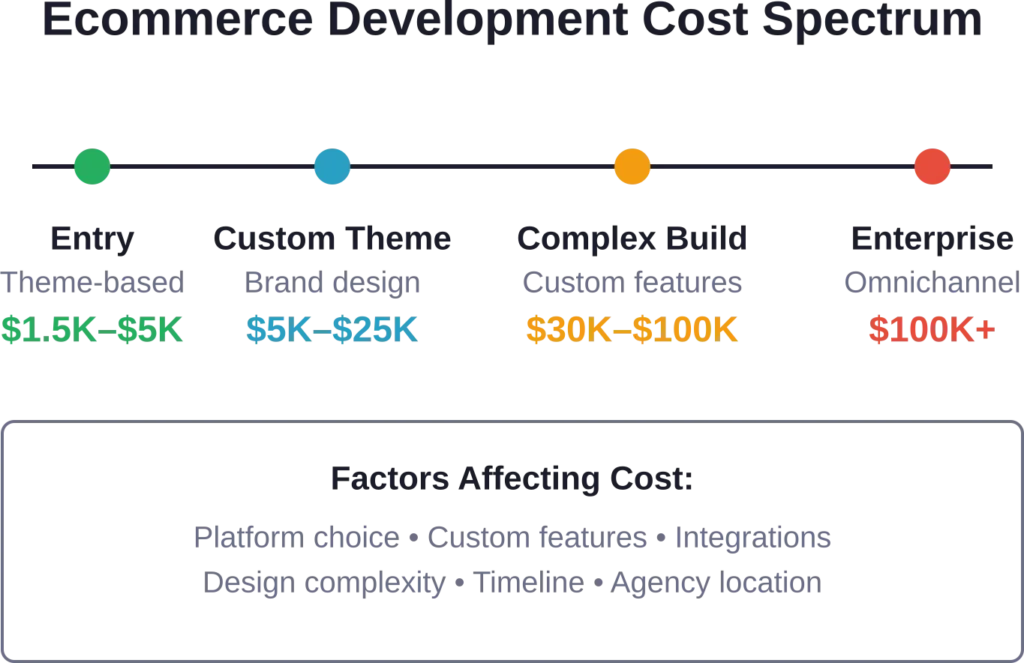
Development costs vary wildly based on scope, platform, and customization level. Understanding typical ranges helps set realistic budgets.
Entry-Level Stores
Theme-based Shopify or WooCommerce stores with minimal customization typically fall in the $1,500–$5,000 range. These projects involve selecting a premium theme, configuring basic settings, adding products, and setting up payment/shipping.
This tier works for very small businesses testing ecommerce or side projects with limited budgets. Expect template constraints and DIY product management.
Custom-Themed Stores
Custom design applied to platforms like Shopify or WooCommerce—unique layouts, brand-specific styling, and some custom functionality—typically ranges from $5,000–$25,000.
This tier includes custom homepage design, product page layouts, checkout customization, and integration with email marketing or inventory tools. Development takes 4–8 weeks.
Complex Custom Builds
Stores requiring custom features—subscription systems, configurators, membership areas, complex shipping logic, or advanced integrations—typically range from $30,000 to $100,000.
These projects involve custom application development, API integrations, database architecture, and often headless setups. Timelines extend 3–6 months. Ongoing development and support retainers are common.
Enterprise Platforms
Large-scale ecommerce platforms with omnichannel integrations, mobile apps, custom middleware, and enterprise system connections can exceed $100,000 and stretch well into six figures.
Enterprise projects involve dedicated teams, extensive planning phases, phased rollouts, training, and long-term support agreements. Development timelines run 6–18 months.
Red Flags to Avoid When Hiring Agencies
Some warning signs indicate an agency may not deliver as promised.
Unrealistic Promises
Agencies guaranteeing first-page Google rankings, specific revenue numbers, or “viral” social media success are overselling. Ecommerce success depends on dozens of factors beyond website development—product-market fit, pricing, marketing, customer service.
Good agencies focus on what they control: site performance, conversion optimization, technical SEO foundations.
Vague Proposals and Scope Creep
Proposals should specify deliverables, timelines, revision rounds, and what’s explicitly not included. Vague language like “full ecommerce solution” without details sets up mismatched expectations.
Watch for scope creep—projects expanding beyond the original agreement without corresponding budget adjustments. Clear change order processes prevent this.
Poor Communication Early On
If the agency is slow to respond during the sales process, communication won’t improve after signing. Pay attention to how they handle questions, whether they listen to requirements, and if they push back when suggestions don’t align with best practices.
Yes-men agencies that agree to everything often lack the expertise to advise better approaches.
No Post-Launch Support Plan
Agencies that treat launch as the finish line leave merchants stranded when issues arise. Insist on a support plan—whether a retainer, hourly support, or at minimum, a warranty period covering bugs.
The Role of Ongoing Optimization
Launch is the starting line, not the finish. Successful ecommerce requires continuous testing, refinement, and feature additions.
Conversion Rate Optimization
Even small improvements compound over time. A/B testing product page layouts, simplifying checkout steps, improving product photography, or refining CTAs can lift conversion rates meaningfully.
Many agencies offer CRO services—analyzing user behavior through heatmaps and session recordings, identifying friction points, and testing solutions.
Performance Monitoring
Page speed directly impacts conversions and search rankings. Sites slow down over time as products, images, and apps accumulate. Regular performance audits identify bottlenecks—unoptimized images, inefficient code, slow third-party scripts.
Top agencies monitor Core Web Vitals and address issues proactively.
Security and Compliance Updates
Platforms release security patches regularly. Plugins and themes need updates. Payment processors change requirements. Neglecting updates creates vulnerabilities.
Agencies managing ongoing maintenance handle these updates, test for conflicts, and keep stores secure.
Platform-Specific Considerations
Different platforms suit different business models and technical requirements.
Shopify and Shopify Plus
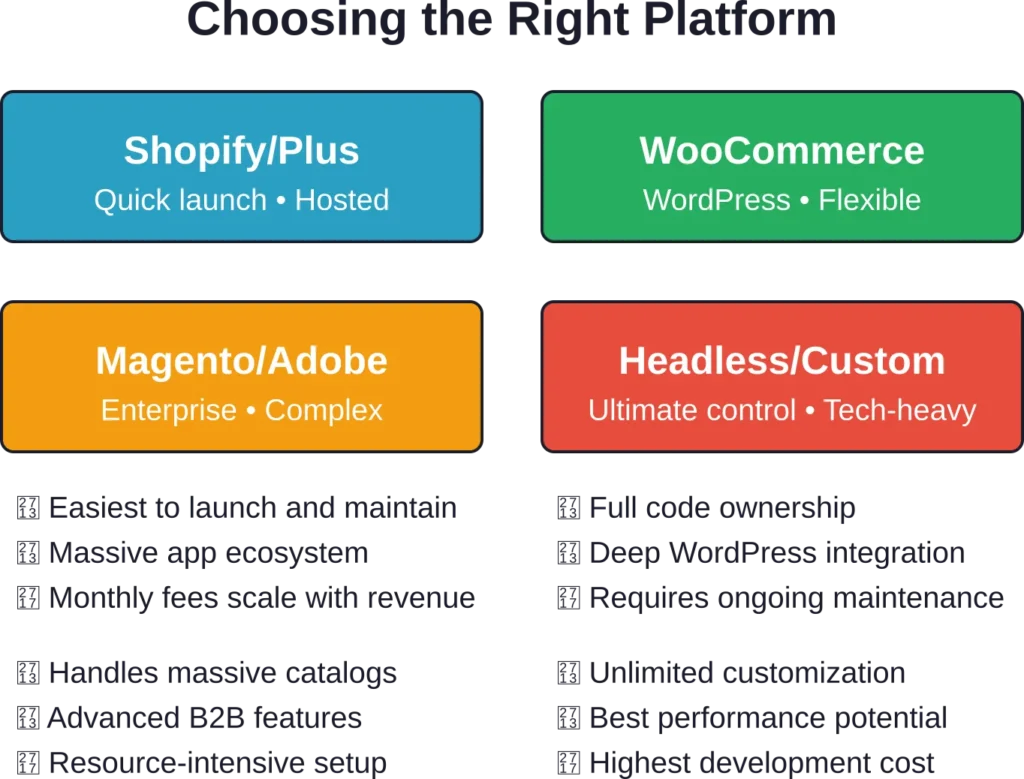
Shopify dominates the hosted ecommerce market for good reason—ease of use, reliability, and a massive app ecosystem. Shopify Plus adds features for high-volume merchants: custom checkout, automation tools, wholesale channels.
Limitations include less flexibility than open-source platforms and ongoing monthly fees that scale with revenue. Customization happens through Liquid templating and apps—deep custom functionality may require private app development.
Best for: Small to mid-sized businesses wanting turnkey solutions, and large brands needing Plus features.
WooCommerce
WooCommerce’s flexibility and integration with WordPress make it ideal for content-driven brands. Complete control over hosting, code, and data appeals to businesses wanting ownership.
The tradeoff is maintenance responsibility—updates, security, performance optimization all fall to the merchant or their agency. Hosting quality significantly impacts performance.
Best for: WordPress sites adding commerce, content-heavy brands, and businesses wanting complete platform control.
Magento (Adobe Commerce)
Magento handles complex catalogs, multi-store setups, and B2B requirements better than most platforms. Enterprise features include advanced pricing rules, customer segmentation, and robust API capabilities.
But Magento is resource-intensive—requiring significant development expertise, powerful hosting, and ongoing technical management. It’s overkill for small stores.
Best for: Large retailers, B2B companies, and multi-brand enterprises.
Headless and Custom Solutions
Headless commerce decouples front-end and back-end, enabling unique customer experiences while leveraging proven commerce engines. Custom builds offer ultimate flexibility but require dedicated development resources.
These approaches demand significant upfront investment and ongoing technical maintenance. They’re not for businesses needing quick launches or lacking development teams.
Best for: Brands with unique UX requirements, high-growth companies, and businesses with in-house development capabilities.
Questions to Ask Before Signing a Contract
These questions help evaluate whether an agency is the right fit.
Can you show three similar projects with measurable results? Look for case studies matching your industry, size, and platform with concrete metrics—conversion improvements, traffic growth, or technical performance gains.
What’s included in the base proposal versus add-ons? Clarify exactly what deliverables the quoted price covers. Common exclusions: content writing, product photography, product data entry, ongoing support, training.
Who will be working on the project day-to-day? Meet the actual developers and designers, not just the sales team. Understand team structure and who handles communication.
What’s the revision and approval process? How many design rounds are included? What happens if additional revisions are needed? Clear processes prevent endless back-and-forth.
How do you handle project delays or scope changes? What’s the change order process? How are delays communicated and addressed?
What happens after launch? Understand support options, response times for critical issues, and how ongoing feature requests are handled.
Will we own all code, designs, and accounts? Confirm full ownership and access to hosting, domain, repositories, and third-party service accounts.
Frequently Asked Questions
Timeline depends on complexity. A theme-based Shopify store can launch in 2–4 weeks. Custom-designed stores on Shopify or WooCommerce typically take 6–12 weeks. Complex custom builds with advanced features run 3–6 months. Enterprise platforms with extensive integrations may require 6–18 months, often with phased rollouts.
Shopify Plus is the enterprise tier, offering advanced features unavailable in standard Shopify: custom checkout modifications, automation workflows, dedicated support, wholesale channels, and higher API rate limits. Plus starts at significantly higher monthly costs but serves high-volume merchants needing these capabilities. Standard Shopify works well for small to mid-sized businesses.
Location matters less than expertise and communication. Remote agencies often offer better value and access to specialized talent. However, local agencies can meet in person and may better understand regional market nuances. Prioritize portfolio quality, platform expertise, and communication style over geography. Time zone alignment does help with real-time collaboration.
Ongoing maintenance typically runs 10–20% of the initial build cost annually. A $20,000 custom store might need $2,000–$4,000 yearly for updates, security patches, bug fixes, and minor enhancements. Complex custom platforms require higher maintenance budgets. Many agencies offer monthly retainers covering set hours of support and updates.
Platform migration is possible but complex and expensive. It involves exporting product data, recreating design and customizations on the new platform, redirecting URLs for SEO, and reconfiguring integrations. Migration projects can cost 40–60% of a new build. Choose the right platform initially rather than planning to migrate later.
All major platforms can be optimized for search when configured properly. WooCommerce and custom builds offer most control over technical SEO. Shopify handles technical fundamentals well but has some URL structure limitations. Magento provides robust SEO capabilities for enterprise needs. Platform choice matters less than proper implementation—fast page speed, clean URLs, proper metadata, and quality content.
Most businesses should start with a mobile-optimized website rather than a native app. Apps make sense for brands with highly engaged repeat customers who’d benefit from push notifications, offline access, or app-exclusive features. Progressive web apps (PWAs) offer middle ground—app-like experience without app store distribution. Evaluate whether customers would actually download and use an app before investing in native development.
Making the Final Decision
Choosing an ecommerce development partner is one of the most important decisions for online business success. The right agency doesn’t just build a website—they create a revenue-generating platform designed to scale with business growth.
Start by clarifying requirements: platform preferences, must-have features, budget constraints, and timeline expectations. Use those criteria to shortlist agencies with relevant expertise.
Review portfolios critically. Look past visual design to technical implementation—how fast do their sites load? How clean is the checkout flow? Can the work handle growth?
Interview multiple agencies. Pay attention to how they ask questions, whether they challenge assumptions, and if their communication style fits company culture. The best technical skills mean little if communication breaks down.
Request detailed proposals outlining scope, deliverables, timeline, and costs. Compare apples to apples—some agencies quote full project prices while others itemize every component.
Check references. Talk to past clients about responsiveness, problem-solving ability, and how the agency handled challenges. Ask if they’d hire them again.
Trust but verify credentials. Platform certifications, case study metrics, and years in business matter—but so do recent work and current capabilities. Technology evolves fast.
Remember that the cheapest option rarely delivers the best value. Agencies charging premium rates often provide deeper expertise, cleaner code, and better long-term support. The investment pays off through fewer issues, faster performance, and higher conversions.
The ecommerce landscape in 2026 rewards businesses that invest in solid technical foundations, thoughtful user experience, and platforms built to scale. Whether launching a first store or rebuilding an existing one, partnering with a specialized agency accelerates success.
Ready to find the right ecommerce development partner? Review the agencies listed above, explore their portfolios, and reach out to discuss specific project requirements. The perfect agency is out there—finding them requires clear criteria, thorough vetting, and trust in expertise that aligns with business goals.