
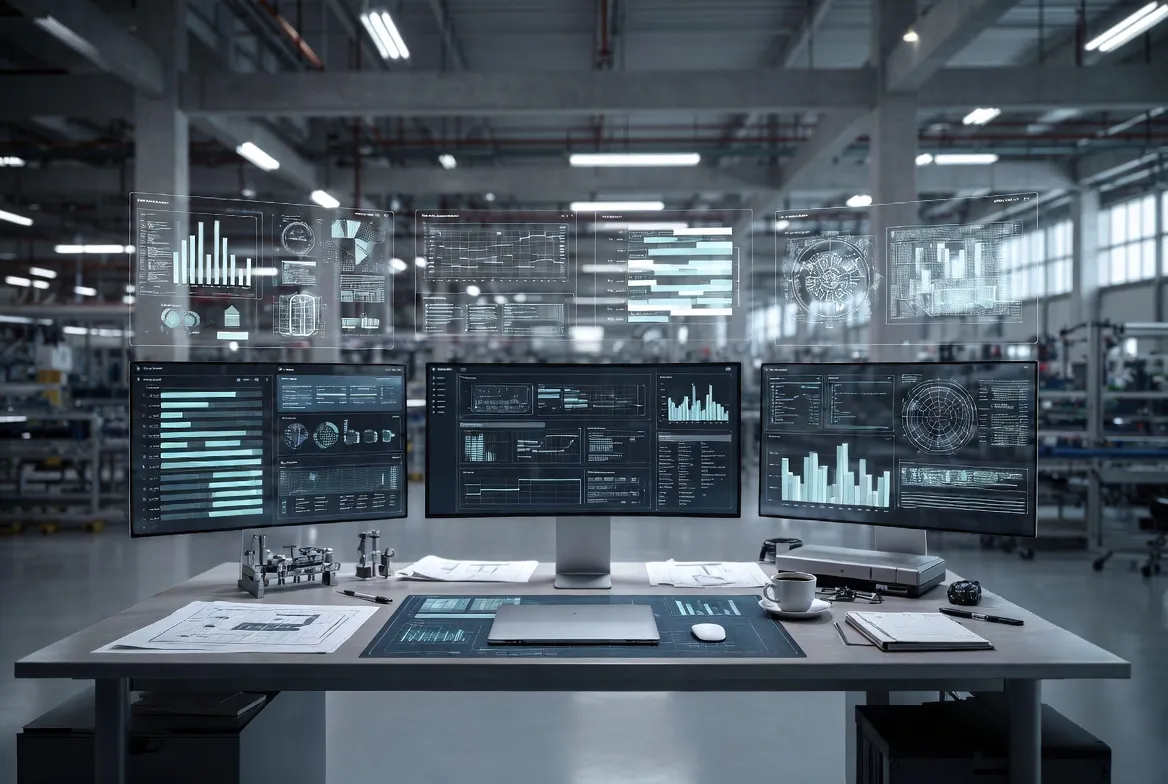
Quick Summary: The top industrial web development companies in 2026 specialize in creating custom B2B platforms, manufacturing portals, and complex digital solutions for technical sectors. This curated list features 15 agencies with proven expertise in industrial design patterns, robust integrations, and engineering-focused workflows—without pricing details, focusing purely on capabilities and track record.
Finding the right web development partner for industrial businesses isn’t the same as hiring an agency for consumer retail or hospitality. Industrial companies face unique challenges: complex product catalogs, technical specifications that run dozens of pages, distributor portals, compliance requirements, and workflows that don’t fit template solutions.
According to Forbes, 75% of businesses now maintain a website, and 43% of small businesses plan to invest specifically in website performance during 2024. But for industrial firms—manufacturers, distributors, equipment suppliers, engineering companies—generic website builders and e-commerce templates don’t cut it.
The agencies on this list specialize in the industrial sector. They understand CAD integration, inventory systems for thousands of SKUs, technical documentation management, and the specific design patterns B2B buyers expect. No fluff, no trendy consumer aesthetics that don’t convert technical audiences.
This guide covers 15 leading industrial web development companies, what makes them stand out, and how to evaluate which partner fits specific project requirements.
Why Industrial Web Development Requires Specialized Agencies
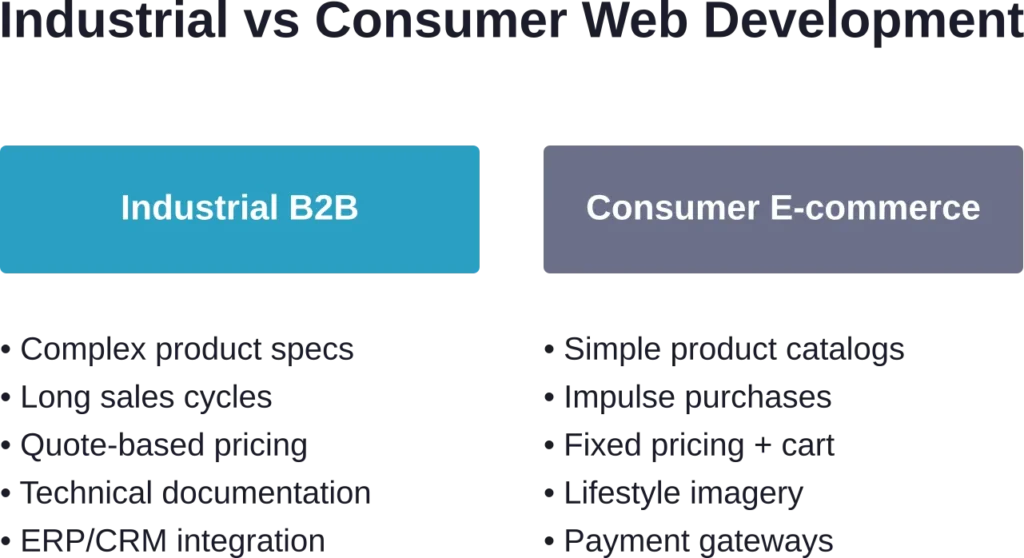
Industrial web projects differ fundamentally from consumer-facing websites. The user journey starts with research, not impulse. Buyers spend weeks evaluating specifications, requesting quotes, and comparing technical data across multiple vendors.
Standard e-commerce platforms struggle with industrial requirements. Product variants might number in the thousands when factoring in sizes, materials, certifications, and custom configurations. A single valve might have 47 specification fields. Documentation libraries need version control, access permissions, and integration with ERP systems.
Here’s what separates industrial-focused agencies from general web developers:
- Experience with complex product information management (PIM) systems
- Understanding of B2B buyer behavior and longer sales cycles
- Technical documentation architecture and searchable specification databases
- Integration capabilities with manufacturing software, inventory systems, and CRM platforms
- Design patterns that prioritize function, data density, and quick access to technical details
- Quote request workflows, distributor portals, and tiered access controls ten
Industry reports suggest that meaningful custom web projects for industrial companies typically start at tens of thousands of dollars, reflecting the engineering complexity involved. Template approaches under that threshold usually deliver generic results that don’t address sector-specific workflows.
Top 15 Industrial Web Development Companies
The agencies below represent diverse specializations within industrial web development. Some focus on manufacturing, others on distribution platforms or engineering services. All have demonstrated track records building complex B2B solutions.
1. A-listware

A-listware specializes in software development and dedicated teams for enterprise and industrial clients. They deliver custom software, enterprise applications, and technical solutions that address complex operational needs in manufacturing and related sectors.
The company offers full-cycle development including ERP, CRM, cloud applications, IoT/embedded systems, and data analytics. Their expertise supports industrial workflows through infrastructure management, legacy modernization, and scalable platforms. A-listware integrates seamlessly as an extension of client teams, providing UX/UI design, QA, and cybersecurity tailored to technical B2B environments.
Contact Information:
- Website: a-listware.com
- Phone: +1 (888) 337 93 73
- Email: [email protected]
- Address: North Bergen, NJ 07047, USA
- LinkedIn: www.linkedin.com/company/a-listware
- Facebook: www.facebook.com/alistware
2. Oski

Oski builds smart, well-engineered software solutions for tech-forward enterprises, with strong capabilities in web development, cloud infrastructure, and AI integrations suitable for industrial applications.
The agency focuses on cloud solutions, frontend development, AI-powered tools, and CMS platforms that enable scalability and efficiency. They have experience delivering solutions for logistics and transportation — key areas overlapping with industrial operations — including real-time tracking, supply chain platforms, and enterprise systems. Their approach prioritizes clean architecture, performance, and integration with existing business processes.
Contact Information:
- Website: oski.site
- Phone: +48571282759
- Email: [email protected]
- Address: Kaupmehe tn 7, 10114 Tallinn, Estonia
- LinkedIn: www.linkedin.com/company/oski-solutions
3. Gilzor

Gilzor provides custom software development and full-cycle web development services for startups, SMBs, and product companies. While they excel in building web and mobile applications with strong UI/UX focus. Their portfolio examples center on airlines, e-commerce, and consumer-facing apps.
Contact Information:
- Website: www.gilzor.com
- Email: [email protected]
- Address: Poland, Warsaw, Office 58, street Adama Mickiewicza 37, 01-625
- LinkedIn: www.linkedin.com/company/gilzor-softwaredevelopment
4. Lengreo

Lengreo acts as a complete marketing and tech partner with strong website development capabilities tailored for B2B and technical sectors. Their services support industrial-adjacent clients through custom websites, landing pages, and digital platforms that drive lead generation and conversions.
The agency combines website development with B2B digital marketing strategy, SEO, paid ads, and lead generation. They build business websites and eCommerce solutions that help companies in technical fields present complex offerings effectively. Their approach emphasizes discovery, business analysis, prototyping, and ongoing support to create platforms that convert high-value prospects.
Contact Information:
- Website: Lengreo.com
- Phone: +31 686 147 566
- Email: [email protected]
- Address: Vrijstraat 9 C/D, 5611 AT Eindhoven, Netherlands
- LinkedIn: Lengreo
- Twitter: @Lengreo
- Instagram: @lengreo
5. Mobian
Mobian builds dedicated engineering teams for mobile and AI solutions, primarily serving IT, Healthcare, Fintech, and Logistics companies. They offer strong full-stack and AI development capabilities. Their domain expertise emphasizes logistics and regulatory-heavy sectors rather than machinery, component manufacturing, or industrial equipment configurators.
Contact Information:
- Website: mobian.studio
- Phone: [email protected]
- Address: Harju maakond, Tallinn, Kesklinnalinnaosa, Masina tn 22, 10113
- LinkedIn: www.linkedin.com/company/mobian-studio
6. LLT Group

LLT Group focuses specifically on industrial and manufacturing clients, bringing specialized understanding of sector challenges. Their portfolio demonstrates experience with machinery manufacturers, component suppliers, and industrial service providers.
The agency handles both standard implementations and highly custom development for unique industrial workflows. They’ve built product configurators, custom quote engines, and distributor portals with tiered access controls.
LLT Group’s team includes developers with engineering backgrounds who can translate technical product specifications into web-friendly formats without losing critical details that industrial buyers need.
7. Mighty Roar

Mighty Roar specializes in custom web applications and complex platform development. While they work across sectors, their technical depth makes them suitable for industrial projects requiring significant custom functionality beyond standard content management.
The agency excels at building custom tools: product configurators, ROI calculators, specification selectors, and interactive diagrams that help technical buyers evaluate complex products. These interactive elements engage engineers and procurement teams more effectively than static content.
Mighty Roar’s development approach emphasizes clean architecture and maintainability—important for industrial platforms that need ongoing expansion as product lines grow.
8. WebFX
WebFX combines development with comprehensive digital marketing services, managing over 50,000 client campaigns across various industries including manufacturing and B2B services. Their scale brings specialized resources for different aspects of industrial web projects.
The agency has developed internal technology for lead tracking, attribution modeling, and performance analytics—valuable for industrial companies needing clear ROI visibility from web investments. They understand the longer attribution windows B2B sales require.
WebFX handles both custom development and platform-based implementations, working with clients to identify the right technical approach based on specific requirements and growth plans.
9. Lform Design

Lform Design focuses on technical B2B companies, with portfolio examples spanning industrial manufacturing, engineering services, and specialized equipment providers. Their design approach prioritizes clarity and usability for technical audiences.
The agency understands how engineers and procurement professionals evaluate products differently than consumer buyers. Their designs accommodate dense technical information, comparison workflows, and detailed specification displays without overwhelming users.
Lform Design’s development capabilities include custom WordPress implementations, third-party integrations, and responsive designs that work across the wide range of devices industrial buyers use—from shop floor tablets to office desktops.
10. DesignRush
DesignRush operates as both an agency and a marketplace connecting businesses with specialized web development partners. For industrial companies, they offer access to vetted agencies with specific sector experience and can facilitate matching based on detailed project requirements.
Their platform includes agencies specializing in manufacturing, distribution, and technical B2B sectors. DesignRush’s curation process evaluates agencies based on portfolio quality, client reviews, technical capabilities, and industry focus.
This approach works well for companies needing to evaluate multiple agencies quickly or those with specific niche requirements requiring specialized expertise.
11. Orbit Media Studios

Orbit Media Studios brings over two decades of experience building content-driven websites with strong technical foundations. While not exclusively industrial-focused, they’ve developed expertise in B2B platforms requiring robust content management and lead generation systems.
Their approach emphasizes research-backed design decisions and measurable outcomes. Orbit Media works closely with clients to understand buyer personas and map content strategies to sales funnels—particularly valuable for industrial companies with long sales cycles.
The agency excels at WordPress implementations for complex content architectures, including technical resource libraries, specification databases, and multi-level navigation systems that industrial buyers need.
12. Thrive Internet Marketing Agency
Thrive combines web development with digital marketing services, making them suitable for industrial companies that need both a technical platform and strategies to drive qualified traffic. Their portfolio includes manufacturing clients and B2B service providers.
The agency handles custom web development alongside SEO, PPC, and content marketing—useful for companies launching new platforms that need visibility in competitive industrial markets. Thrive’s integrated approach means development decisions consider marketing objectives from the start.
They’ve built experience with lead generation systems, quote request workflows, and analytics implementations that track B2B buyer journeys across long decision cycles.
13. Straight North

Straight North specializes in B2B web development and marketing, with particular strength in manufacturing and industrial distribution sectors. Their portfolio features clients in machinery, industrial supplies, and technical services.
The agency focuses on conversion-optimized designs that turn technical browsers into qualified leads. They understand the data density requirements of industrial product pages and how to structure specification information for quick evaluation.
Straight North’s development team handles custom functionality for distributor networks, dealer portals, and multi-location manufacturing companies needing centralized content management with localized customization.
14. americaneagle.com
With a client roster that includes Fortune 500 manufacturers and global industrial brands, americaneagle.com handles enterprise-scale web development projects. They bring significant resources to complex implementations requiring multiple integrations and custom functionality.
The agency has deep experience with large product catalogs, PIM system integrations, and multi-language platforms for international manufacturing companies. Their development team can architect solutions handling hundreds of thousands of SKUs with complex variant logic.
americaneagle.com offers full-service capabilities including strategic planning, UX research, custom development, and managed hosting—suitable for companies needing comprehensive support.
15. Major Tom
Major Tom approaches web development through a performance marketing lens, building platforms designed for measurable business outcomes. Their B2B experience includes industrial clients requiring lead generation systems and complex product showcases.
The agency emphasizes data-driven design, using analytics and user testing to optimize conversion paths for technical buyers. They understand that industrial purchases involve multiple stakeholders and build experiences accommodating research, comparison, and team collaboration.
Major Tom’s technical capabilities extend to custom applications, API integrations, and headless CMS implementations for companies with unique content delivery requirements.
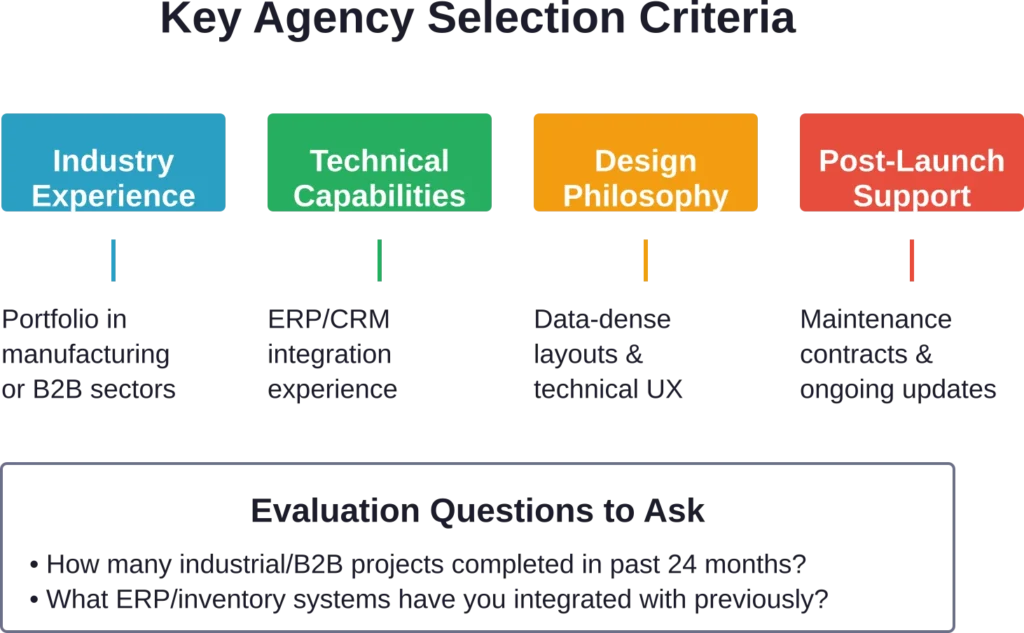
How to Choose an Industrial Web Development Partner
Not every agency excels at every dimension—prioritize what matters most for the specific project.
Industry Experience
Look for agencies with portfolio examples in manufacturing, distribution, industrial equipment, or technical B2B sectors. Generic web development experience doesn’t translate directly to understanding how engineers and procurement teams search for products.
Ask about previous projects involving similar product complexity, catalog sizes, or integration requirements. An agency that built platforms for automotive parts distributors will understand challenges that a consumer retail specialist won’t.
Technical Capabilities
Industrial websites often require integration with existing business systems. Check whether the agency has demonstrated experience connecting web platforms to ERP systems, inventory management software, CRM platforms, and payment processing for B2B transactions.
Custom development capabilities matter more than template expertise. Industrial requirements frequently demand unique workflows that off-the-shelf solutions can’t accommodate.
Design Philosophy
Industrial web design balances aesthetics with function. The best agencies understand that B2B buyers prioritize speed, clarity, and data density over visual flair. Look for portfolios that demonstrate clean information architecture and intuitive navigation for complex product lines.
Project Communication
Industrial web projects involve multiple stakeholders: engineering teams providing technical specs, sales teams defining lead capture requirements, IT managing integrations. Agencies need structured communication processes to coordinate across these groups.
Ask about project management methodology, typical communication cadence, and how they handle scope changes during development.
Post-Launch Support
Industrial websites evolve continuously as product lines expand, specifications change, and new integrations become necessary. Evaluate whether agencies offer ongoing maintenance, support contracts, and clear processes for updates after launch.
Common Services Industrial Web Development Agencies Provide
Industrial web projects typically involve multiple service areas beyond basic website development. Understanding the full scope helps in evaluating which agencies can handle end-to-end implementations versus those requiring additional partners.
Custom Web Development
Most industrial projects require custom development beyond template customization. This includes product configurators, quote engines, dealer portals, specification search tools, and custom dashboards for different user roles.
Agencies build these features using various technology stacks—PHP frameworks, JavaScript frameworks like React or Vue, and backend systems optimized for handling complex business logic.
Product Information Management
Managing thousands of SKUs with detailed specifications requires structured PIM approaches. Agencies implement systems for organizing product data, managing variants, handling technical documentation, and keeping specifications synchronized across multiple channels.
Some agencies build custom PIM solutions; others integrate existing platforms like Akeneo or Salsify with web frontends.
System Integration
Industrial websites rarely operate in isolation. Agencies connect web platforms to ERP systems for inventory data, CRM platforms for lead routing, payment processors handling net-terms and purchase orders, shipping calculators for freight quotes, and analytics platforms tracking multi-touch attribution.
Integration work often represents significant project scope, requiring API development, data mapping, and ongoing synchronization maintenance.
Technical Documentation Management
Industrial buyers need access to CAD files, spec sheets, installation guides, compliance certificates, and safety documentation. Agencies build systems for organizing, versioning, and controlling access to these resources.
Advanced implementations include smart search across technical documentation, version control for specifications that change over time, and user-specific content based on geographic region or account type.
Dealer and Distributor Portals
Manufacturing companies working through distribution networks need portals where dealers access marketing materials, place orders, check inventory, and manage their product catalogs. These portals require authentication, tiered permissions, custom pricing by account, and sometimes separate branding per dealer.
Lead Capture and Quote Systems
Industrial sales often start with quote requests rather than direct purchases. Agencies build custom quote forms that capture technical requirements, route requests to appropriate sales teams, and integrate with CRM systems for follow-up tracking.
More sophisticated implementations include guided product selection tools that help buyers identify the right specifications before requesting quotes.
| Service Type | Typical Applications | Technical Complexity |
|---|---|---|
| Custom Development | Configurators, calculators, portals | High |
| PIM Implementation | Large catalogs, variant management | High |
| ERP Integration | Inventory sync, order processing | Very High |
| Document Management | Spec sheets, CAD files, certificates | Medium |
| Dealer Portals | Distribution networks, resellers | High |
| Quote Systems | Custom pricing, RFQ workflows | Medium |
Technology Platforms Common in Industrial Web Development
Different projects suit different technology foundations. Industrial web development agencies typically have expertise across multiple platforms and can recommend the right fit based on specific requirements.
WordPress
WordPress powers a significant portion of industrial websites due to its flexibility, extensive plugin ecosystem, and relatively low maintenance requirements. For content-heavy industrial sites with moderate e-commerce needs, WordPress with WooCommerce provides a solid foundation.
Custom development extends WordPress functionality for industrial-specific needs: custom post types for products, advanced search implementations, integration plugins connecting to business systems, and custom themes built for technical content.
Custom PHP Frameworks
Laravel and Symfony provide robust foundations for highly custom industrial platforms requiring complex business logic. These frameworks suit projects with unique workflow requirements that don’t fit standard CMS patterns.
Agencies use PHP frameworks when building dealer portals with sophisticated permission systems, custom quote engines with complex pricing logic, or product configurators with hundreds of variable dependencies.
Headless CMS Architectures
Headless approaches separate content management from presentation, using APIs to deliver content to websites, mobile apps, and other channels. This architecture suits industrial companies with multiple digital touchpoints or those requiring exceptional performance.
Contentful, Strapi, and WordPress used headlessly provide flexible content management while allowing modern JavaScript frameworks on the frontend.
Enterprise Platforms
Large-scale industrial implementations sometimes require enterprise-grade platforms like Adobe Experience Manager or Sitecore. These systems bring advanced personalization, multi-site management, and extensive integration capabilities at significantly higher cost and complexity.
Enterprise platforms make sense for Fortune 500 manufacturers with international operations, complex content workflows, and requirements for advanced targeting and personalization.
Red Flags When Evaluating Industrial Web Development Agencies
Not every agency claiming industrial expertise actually delivers. Watch for warning signs during the evaluation process.
No Relevant Portfolio Examples
If an agency claims industrial experience but shows primarily consumer retail or restaurant websites in their portfolio, that experience likely doesn’t translate to manufacturing or distribution challenges. Look for concrete examples of technical B2B projects.
Template-First Approach
Agencies pushing toward template solutions for complex industrial requirements probably lack the custom development capabilities needed. Templates work for basic corporate sites but rarely accommodate unique industrial workflows without significant limitations.
Vague Integration Answers
When discussing ERP or CRM integration, agencies should ask specific questions about existing systems, data formats, and synchronization requirements. Vague assurances that “integration is no problem” without technical follow-up questions suggest limited experience.
No Questions About Business Processes
Good industrial agencies dig into how businesses operate: how quotes are processed, how product specifications are managed, what approval workflows exist for content changes. Agencies that jump straight to design mockups without understanding operational context will build platforms that don’t match actual workflows.
Unrealistic Timelines
Complex industrial platforms require time for proper requirements gathering, custom development, integration work, and testing. Agencies promising full custom implementations in 6-8 weeks either have template solutions in mind or will deliver rushed work requiring extensive post-launch fixes.
Project Timeline Expectations for Industrial Web Development
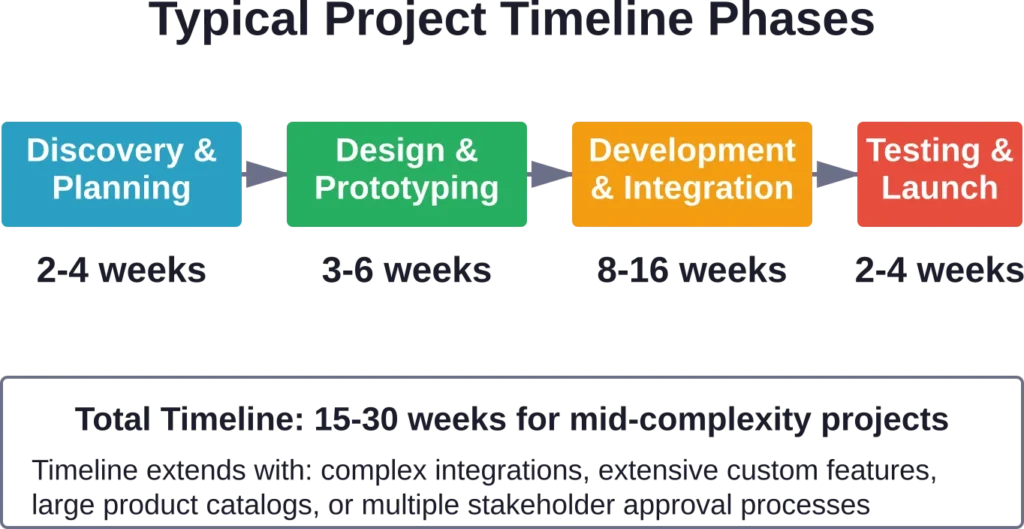
Industrial web projects typically take longer than consumer-facing websites due to complexity and stakeholder coordination. Here’s what realistic timelines look like for different project scales.
Basic Corporate Site with Product Showcase
A straightforward corporate website with product information, company background, and contact forms typically requires 8-12 weeks. This includes discovery, design, development, content migration, and testing.
Timeline extends if content isn’t ready, multiple approval layers exist, or custom functionality beyond standard features is needed.
Mid-Scale Platform with Custom Features
Industrial websites with product configurators, basic e-commerce capabilities, dealer locators, and document management systems typically require 4-6 months. Custom feature development, integration work, and thorough testing for complex workflows drive the longer timeline.
Enterprise Platform with Extensive Integration
Full-scale industrial platforms connecting to ERP systems, managing tens of thousands of SKUs, supporting multiple user roles with custom portals, and including advanced features can require 9-18 months. These projects involve phased rollouts, extensive testing, and careful coordination with IT teams managing backend systems.
How Industrial Companies Measure Web Development Success
Unlike consumer e-commerce where sales metrics are straightforward, industrial web platforms require different success metrics aligned with longer B2B sales cycles.
Lead Quality and Volume
Industrial websites generate leads through quote requests, contact forms, and resource downloads. Tracking lead volume matters, but lead quality is more important—measuring what percentage convert to actual sales opportunities versus dead-end inquiries.
Good industrial websites pre-qualify leads through progressive disclosure: asking relevant technical questions, requiring company information, and providing enough self-service information that only serious prospects reach out.
Time to Information
Engineers and procurement professionals value efficiency. Successful industrial websites minimize clicks required to find specifications, compare products, access technical documentation, and identify the right contact person.
Analytics should track how quickly users find key resources. High bounce rates on product pages might indicate poor information architecture or missing specifications buyers need.
Integration Reliability
For platforms connected to ERP or inventory systems, uptime and data accuracy are critical metrics. Real-time inventory displays lose value if synchronization fails. Quote systems break down if pricing data doesn’t match backend systems.
Monitor integration error rates, data sync frequency, and discrepancies requiring manual resolution.
Self-Service Adoption
Industrial web platforms often aim to reduce load on sales teams by enabling self-service. Track what percentage of returning customers use dealer portals, place reorders through the website, download documentation without contacting support, or use product configurators instead of calling for specifications.
Content Engagement
Technical content like application guides, case studies, and specification comparisons indicate buying intent when engagement is tracked. Monitor which resources prospects consume before converting to leads, and optimize content strategy accordingly.
| Metric Category | Specific Measurements | Why It Matters |
|---|---|---|
| Lead Generation | Quote requests, form submissions, qualified contacts | Direct sales pipeline impact |
| User Efficiency | Time to spec, clicks to documentation, search success rate | Buyer experience quality |
| System Performance | Integration uptime, sync errors, page load speed | Platform reliability |
| Self-Service Use | Portal logins, reorder rates, documentation downloads | Sales team efficiency |
| Content Impact | Guide downloads, video views, time on technical pages | Buying intent signals |
Future Trends in Industrial Web Development
Industrial web development evolves as technologies mature and buyer expectations shift. Several trends are shaping how agencies approach projects in 2026.
AI-Powered Product Discovery
Industrial catalogs with thousands of products benefit from intelligent search and recommendation systems. Emerging implementations use natural language processing to interpret technical requirements and suggest appropriate products, reducing the expertise burden on buyers.
Some agencies are building product selectors where buyers describe their application in plain language, and the system translates that into relevant specifications and product matches.
3D Product Visualization
WebGL and improved browser capabilities enable interactive 3D product models directly in web browsers. For industrial equipment, components, and machinery, 3D visualization helps buyers understand physical products better than static images.
Advanced implementations allow configuration visualization—showing how product variations affect appearance, dimensions, or component arrangements in real-time 3D.
Enhanced Mobile Experiences
While desktop remains primary for detailed specification research, mobile usage continues growing for field applications. Technicians checking compatibility on job sites, purchasing agents verifying availability during meetings, and maintenance teams accessing documentation all drive mobile optimization requirements.
Progressive web app approaches enable offline access to critical specifications and documentation—valuable when connectivity is limited in industrial settings.
Personalization for Account-Based Experiences
B2B personalization goes beyond generic recommendations. Industrial platforms increasingly deliver account-specific experiences: custom pricing visible upon login, product catalogs filtered to previously purchased items or contract terms, tailored documentation based on owned equipment, and rep contact information specific to the account.
Integration with Design and Engineering Tools
Forward-thinking industrial companies connect web platforms directly to CAD software, configurator outputs to BIM systems, and specification data to engineering calculation tools. These integrations streamline workflows for technical buyers who previously toggled between multiple disconnected systems.
Cost Considerations for Industrial Web Development
While specific pricing varies dramatically based on scope, understanding general cost drivers helps in budget planning and evaluating proposals.
What Drives Project Cost
Custom functionality adds cost more than any other factor. A product configurator with complex logic might require weeks of development. Integration with ERP systems involves API work, data mapping, error handling, and ongoing maintenance—all adding to project budgets.
Content migration for large product catalogs requires significant effort. Moving 5,000 SKUs with specifications from old systems to new platforms involves data cleanup, field mapping, image processing, and quality assurance—labor-intensive work that agencies price accordingly.
Design complexity affects cost less than many assume. Industrial websites prioritize function over elaborate visual design, so development and integration work typically consumes more budget than design phases.
Team Size and Geography Impact
Industry analyses indicate that agencies in the United States and Western Europe typically set rates in the mid-to-upper range, while distributed teams in Eastern Europe or Asia often work in lower ranges with comparable technical capability. Location affects cost, but expertise matters more than geography alone.
Larger agencies bring specialized resources—dedicated UX researchers, integration specialists, QA teams—but operate at higher rates. Smaller boutique agencies often deliver more personalized service at lower costs but may lack specialized expertise for niche requirements.
Ongoing Costs Beyond Initial Development
Industrial websites require ongoing investment beyond launch. Hosting infrastructure, particularly for high-traffic sites with complex functionality, represents recurring cost. Security updates, platform patches, and compatibility maintenance continue indefinitely.
Content updates, product additions, specification changes, and marketing adjustments require either internal resources or ongoing agency retainers. Integration maintenance—ensuring ERP connections continue functioning as systems upgrade—adds operational cost.
Budget for post-launch optimization. Initial launches rarely get everything perfect. Expect to invest in usability improvements, performance optimization, and feature enhancements based on actual usage patterns.
Frequently Asked Questions
Industrial web development requires understanding B2B buyer behavior, managing complex product information with detailed specifications, integrating with manufacturing and inventory systems, and building workflows for quote-based sales rather than standard e-commerce. The technical depth, longer sales cycles, and integration complexity distinguish industrial projects from consumer-facing websites.
Basic corporate sites with product showcases require approximately 8-12 weeks. Mid-complexity platforms with custom features and moderate integration work typically need 4-6 months. Enterprise-scale implementations with extensive ERP integration, large product catalogs, and custom portals can require 9-18 months. Timeline depends heavily on scope, integration complexity, and content readiness.
Template solutions work for straightforward corporate websites with basic product information and standard contact forms. However, companies with complex product catalogs, custom pricing workflows, distributor networks, or ERP integration requirements typically need custom development. Templates lack flexibility for industrial-specific workflows and often create limitations that become expensive to work around later.
Common integrations include ERP systems for inventory and product data, CRM platforms for lead management and customer information, PIM systems for managing complex product specifications, payment processors that handle net-terms and purchase orders, shipping calculators for freight quotes, and analytics platforms tracking multi-touch B2B attribution across long sales cycles.
Success metrics focus on lead quality and volume, time required for users to find specifications and technical information, integration reliability and uptime, self-service adoption rates reducing sales team workload, and content engagement indicating buying intent. Unlike consumer e-commerce, direct sales conversions matter less than qualified lead generation and buyer enablement given longer B2B sales cycles.
Strong RFPs include current platform limitations and specific pain points, detailed product catalog scope including SKU counts and specification complexity, existing systems requiring integration with technical details, user roles and permission requirements, specific custom functionality needs, content migration scope, timeline expectations, and budget parameters. The more specificity provided, the more accurate and comparable proposals will be.
Hosting requirements depend on traffic volume, integration complexity, and reliability needs. Basic corporate sites function well on standard managed hosting. Platforms with real-time ERP integration, high traffic volume, or complex custom functionality benefit from dedicated hosting environments with load balancing, redundancy, and optimized database configurations. Security requirements for handling customer data also influence hosting decisions.
Conclusion
Industrial web development requires specialized expertise that general web agencies often lack. The companies listed here bring proven experience in manufacturing, distribution, and technical B2B sectors—understanding the unique challenges of complex product catalogs, long sales cycles, and integration requirements.
Choosing the right partner involves evaluating portfolio examples in relevant industries, assessing technical capabilities for required integrations, understanding design philosophy around data-dense content, and confirming post-launch support availability. The best agency for one industrial company might not suit another—alignment between project requirements and agency strengths matters more than reputation alone.
Industrial websites represent significant investments. They function as critical sales tools, self-service platforms reducing operational costs, and technical resources supporting customer success. Budget appropriately, plan for realistic timelines, and prioritize agencies that ask detailed questions about business processes over those jumping to visual mockups.
The industrial web development landscape continues evolving with technologies enabling better product discovery, 3D visualization, mobile field access, and tighter integration with engineering workflows. Partner with agencies demonstrating not just current capabilities but commitment to staying current as platforms and buyer expectations advance.
Ready to move forward with an industrial web development project? Start by documenting current platform limitations, defining specific technical requirements, and gathering examples of functionality needed. Approach multiple agencies from this list with detailed requirements, evaluate proposals against consistent criteria, and choose partners aligned with both immediate project needs and longer-term digital strategy.