

Quick Summary: The best website redesign companies combine strategic thinking, technical expertise, and creative execution to transform outdated websites into high-performing digital assets. This curated list features 15 top agencies—from product-focused studios to enterprise-level design firms—each with proven track records in user experience, branding, and conversion optimization. Selecting the right partner depends on your project scope, industry focus, and design philosophy alignment.
A website redesign isn’t just about making things look pretty. It’s about solving real business problems—low conversion rates, poor user engagement, unclear brand positioning, or outdated technology that can’t keep pace with growth.
The challenge? Finding a redesign partner that actually understands this. Too many agencies treat redesigns as cosmetic exercises rather than strategic transformations. The best website redesign companies approach projects differently—they start by understanding what’s broken, who your users are, and what business outcomes you need to achieve.
This guide breaks down 15 agencies that consistently deliver results. Some specialize in SaaS products, others in eCommerce or enterprise platforms. Some bring a branding-first approach, while others lead with data and user research. But all share one thing: they don’t just push pixels—they solve problems.
What Makes a Great Website Redesign Company
Not all web design agencies are built for redesign work. Redesigning an existing site requires different skills than building from scratch. You need partners who can audit what’s currently there, identify what’s worth keeping, and strategically rebuild around your existing users and business constraints.
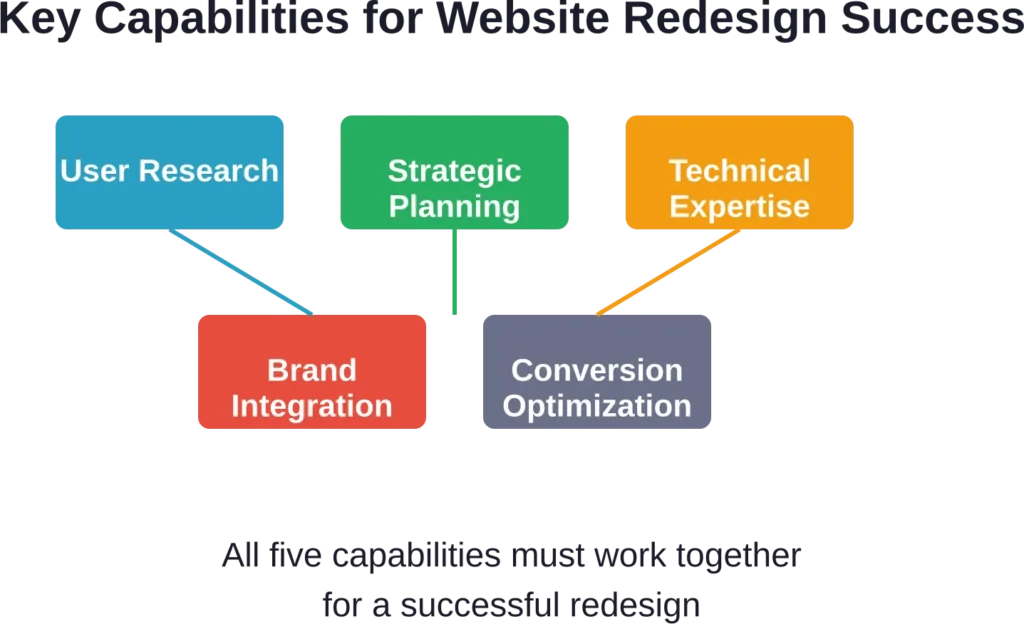
Great redesign companies excel at user research. They dig into analytics, conduct user interviews, and build redesign strategies around actual behavior—not assumptions. They understand that every redesign carries risk. Users have muscle memory. SEO rankings need protection. Existing functionality can’t just disappear.
They also bring cross-functional expertise. Redesigns touch everything—brand identity, information architecture, content strategy, technical infrastructure, and conversion optimization. The best agencies coordinate all these elements instead of treating them as separate workstreams.
And they measure results. Successful redesigns often show measurable improvements in key metrics over time—whether that’s time on site, conversion rates, or user satisfaction scores. Top agencies define success metrics upfront and track progress against baselines.
The 15 Best Website Redesign Companies in 2026
Here’s the curated list. Each agency brings something different to the table—different specialties, different approaches, different ideal client profiles. The goal isn’t to crown a single winner but to help you find the right match for your specific needs.
1. Mobian

Mobian builds dedicated engineering teams that deliver production-ready digital products with strong expertise in mobile and web solutions. Their redesign projects help companies in IT, healthcare, fintech, and logistics modernize platforms to meet real-world performance demands while improving user experiences.
What sets Mobian apart is their focus on end-to-end delivery and scalable architecture. They approach redesigns as opportunities to enhance interfaces, integrate modern technologies, and create maintainable systems that support long-term business growth.
The agency covers full-stack development, UI/UX implementation, legacy system integration, and post-launch support. Their dedicated team model ensures deep product knowledge and continuity throughout the redesign process.
Mobian partners with companies that require high-quality technical execution. They deliver strong results for clients who need redesigned digital products that are both innovative and operationally reliable.
Contact Information:
- Website: mobian.studio
- Phone: [email protected]
- Address: Harju maakond, Tallinn, Kesklinnalinnaosa, Masina tn 22, 10113
- LinkedIn: www.linkedin.com/company/mobian-studio
2. A-listware

A-listware provides software development and consulting with dedicated UX/UI design capabilities. Their redesign projects often involve creating responsive, user-focused interfaces as part of broader digital solutions for enterprises, SMBs, and startups.
The agency’s strength lies in combining design excellence with technical execution. They approach website and application redesigns with a focus on user engagement, brand alignment, and functional performance that supports business operations.
A-listware handles UX/UI design, responsive web design, custom software development, and application modernization. This allows them to deliver cohesive redesigns that integrate smoothly with existing systems and processes.
They work with companies across various sectors seeking reliable digital solutions. A-listware is particularly effective for clients who need redesigns that balance aesthetic quality with robust, enterprise-grade functionality.
Contact Information:
- Website: a-listware.com
- Phone: +1 (888) 337 93 73
- Email: [email protected]
- Address: North Bergen, NJ 07047, USA
- LinkedIn: www.linkedin.com/company/a-listware
- Facebook: www.facebook.com/alistware
3. Oski
Oski delivers expert web development and frontend solutions for enterprises and ambitious startups. Their redesign projects focus on creating intuitive, high-performance digital experiences that help businesses operate more effectively in competitive markets.
What distinguishes Oski is their emphasis on well-engineered, scalable web solutions. They approach redesigns with attention to modern frontend architectures, seamless user experiences, and technologies that support long-term growth and maintainability.
The agency offers frontend development, UI/UX design, CMS implementations, cloud integration, and ongoing maintenance. Their process supports both new builds and comprehensive redesigns of existing platforms.
Oski works with tech-forward companies across industries such as e-commerce, fintech, education, logistics, and travel. Their expertise helps clients modernize digital properties while maintaining reliability and performance.
Contact Information:
- Website: oski.site
- Phone: +48571282759
- Email: [email protected]
- Address: Kaupmehe tn 7, 10114 Tallinn, Estonia
- LinkedIn: www.linkedin.com/company/oski-solutions
4. Gilzor

Gilzor specializes in custom digital product development with strong capabilities in web and UI/UX design. Their redesign work helps startups and growing businesses create or refresh web applications that deliver excellent user experiences while supporting business scaling objectives.
The agency’s strength lies in their full-cycle approach. They combine user-centric design with robust development to produce websites and web apps that are both attractive and highly functional. Redesign projects benefit from their emphasis on conversion-oriented interfaces, performance, and scalability.
Gilzor’s team covers UI/UX design, web development, prototyping, quality assurance, and post-launch support. This integrated process ensures redesigned websites align with product goals and market needs from the start.
They serve startups, small and medium businesses, and product companies across various industries. Gilzor excels with clients who need web solutions that combine strong design with reliable technical foundations.
Contact Information:
- Website: www.gilzor.com
- Email: [email protected]
- Address: Poland, Warsaw, Office 58, street Adama Mickiewicza 37, 01-625
- LinkedIn: www.linkedin.com/company/gilzor-softwaredevelopment
5. Lengreo

Lengreo has built a strong reputation in B2B digital marketing with integrated website development services. Their redesign projects often support companies focused on lead generation and conversion optimization—businesses that need websites to better capture and nurture high-value prospects.
What sets Lengreo apart is their performance-driven approach. They treat website redesigns as part of a broader growth engine, combining user journey mapping, conversion-focused design, and technical optimizations that directly impact lead quality and cost per acquisition. Their work emphasizes measurable business outcomes over purely visual updates.
The agency handles website development that includes discovery and business analysis, prototyping and design, full implementation, and ongoing optimization. Their process typically starts with audits and strategy alignment, then moves into targeted design improvements and technical enhancements that support marketing goals.
Lengreo works primarily with B2B companies in tech, services, and specialized industries. Their client projects often involve modernizing digital presences to improve SEO performance, lead capture, and overall user conversion.
Contact Information:
- Website: Lengreo.com
- Phone: +31 686 147 566
- Email: [email protected]
- Address: Vrijstraat 9 C/D, 5611 AT Eindhoven, Netherlands
- LinkedIn: Lengreo
- Twitter: @Lengreo
- Instagram: @lengreo
6. Fantasy
Fantasy approaches redesign work through a product lens. Their background in product design and brand strategy shows up in websites that feel more like applications—purposeful, user-centered, and built around clear user journeys rather than just content presentation.
The agency excels at information architecture and interaction design. Their redesign process involves detailed user flow mapping, journey optimization, and systematic thinking about how different user segments need different experiences from the same website.
Fantasy works across brand, product, and marketing challenges. For redesign projects, this means they can tackle both the marketing website and any product interfaces or application components that need updating. Their design systems bridge marketing and product experiences rather than treating them as separate problems.
Client work includes venture-backed startups, established tech companies, and brands undergoing digital transformation. Fantasy works particularly well with companies where the website serves complex user needs beyond just information—platforms, marketplaces, or products with significant web components.
7. Locomotive

Locomotive brings a Canadian perspective to web design with particularly strong technical capabilities. Their redesign projects stand out for smooth animations, sophisticated interactions, and attention to performance optimization.
The agency’s development team works closely with designers throughout the redesign process. This collaboration means designs get created with technical feasibility in mind, and developers understand the design intent behind every detail. The result: implementations that match design vision without compromise.
Locomotive specializes in custom-built websites rather than template-based solutions. Their redesigns typically involve bespoke development tailored to specific brand needs and user requirements. They’re particularly known for creative use of WebGL, smooth scroll animations, and other advanced web technologies.
Their client roster includes cultural institutions, design studios, tech companies, and creative brands. Common themes include storytelling through interaction, generous use of imagery and video, and interfaces that reward exploration.
8. Huge

Huge operates as a digital agency with scale—large enough to handle enterprise complexity but still focused on craft and quality. Their redesign work serves companies dealing with multiple stakeholder groups, global markets, or complex technical requirements.
The agency’s capabilities span strategy, design, technology, and marketing services. For redesign projects, this breadth means they can address not just the interface design but the underlying content management systems, analytics implementation, personalization engines, and marketing automation platforms.
Huge’s process emphasizes research and validation. Redesign recommendations come from user research, competitive analysis, and business case development. They help organizations build internal alignment around redesign decisions by grounding choices in data rather than opinion.
Client work includes major retail brands, financial services companies, healthcare organizations, and media companies. Their projects often involve significant technical complexity—integrating with existing systems, managing large content libraries, or supporting sophisticated personalization and targeting.
9. Build in Amsterdam
Build in Amsterdam brings a distinctive European design sensibility to digital projects. Their redesign work balances minimalism with warmth—clean interfaces that still feel human and approachable rather than cold or corporate.
The agency’s core strength lies in brand-driven design. They treat every redesign as an opportunity to strengthen brand expression through digital touchpoints. Typography, color systems, imagery styles, and interaction patterns all serve the brand strategy.
Build handles strategy, branding, digital design, and development. Their redesign process typically begins with brand workshops to align on positioning and personality before moving into visual exploration. This brand-first approach ensures the redesigned website authentically expresses what makes the company distinctive.
Their portfolio includes tech companies, consumer brands, and cultural organizations primarily across European markets. Build works particularly well with companies that value design quality and are willing to invest in bespoke solutions rather than template-based approaches.
10. Area 17

Area 17 specializes in content-rich websites where information architecture and content management are core challenges. Their redesign work serves organizations with large content libraries, complex taxonomies, or sophisticated content workflows.
The agency brings deep expertise in content management systems and headless CMS architectures. Their redesign projects often involve not just new design systems but new content strategies and editorial tools that make it easier for organizations to maintain and update their websites post-launch.
Area 17’s approach emphasizes sustainability—building websites that organizations can actually manage themselves rather than becoming dependent on agency support. They invest significant effort in content modeling, editorial interface design, and documentation to set clients up for long-term success.
Client work includes cultural institutions, media companies, educational organizations, and brands with significant content marketing initiatives. Their projects often feature sophisticated filtering and search capabilities, flexible content modules, and well-organized content hierarchies.
11. Clay

Clay has built a reputation around interface design and branding work for high-growth companies. Their redesign projects tend to focus on companies at inflection points—startups that have found product-market fit and need a website that matches their ambition, or established brands looking to reposition themselves.
What sets Clay apart is their product design background. They approach website redesigns with the same rigor they’d apply to a SaaS dashboard—mapping user journeys, creating interaction patterns that feel intuitive, and building design systems that scale. Their work isn’t just beautiful; it’s systematically thought through.
The agency handles everything from brand strategy and visual identity to UI design and motion design. Their redesign process typically starts with stakeholder workshops and user research, moves into brand exploration and concepting, then into high-fidelity design and prototyping. They partner with development teams or handle implementation in-house depending on project scope.
Clay works primarily with tech companies, particularly in SaaS, fintech, and Web3 spaces. Their client roster includes both venture-backed startups and established companies looking to modernize their digital presence. If brand positioning is a core part of the redesign challenge, Clay’s integrated approach to branding and web design delivers strong results.
12. Instrument

Instrument operates at the intersection of brand, product, and growth. Their redesign work tends to serve companies with complex challenges—multiple product lines that need cohesive presentation, global brands that need localization strategies, or digital products that require both marketing websites and application interfaces.
The agency’s strength lies in strategic thinking. Before touching any design tools, they spend time understanding market positioning, competitive landscape, and business objectives. Their redesign recommendations come from this strategic foundation rather than aesthetic preferences.
Instrument’s team structure reflects their comprehensive approach. Strategists, brand designers, product designers, content strategists, and developers work in integrated teams. This means the website redesign isn’t happening in isolation from other brand touchpoints or product experiences.
They’ve worked with companies ranging from digital-native brands to established enterprises undergoing digital transformation. Their process accommodates both agile iteration and more traditional project structures, making them versatile partners for different organizational contexts.
13. Code and Theory

Code and Theory brings enterprise-scale capabilities to complex redesign challenges. With a team exceeding 500 employees, they handle projects that require significant resources—multi-brand platform redesigns, global rollouts, or technical migrations happening alongside design updates.
Their redesign methodology emphasizes digital transformation rather than just visual updates. They help organizations rethink their entire digital ecosystem—how content gets managed, how user data flows between systems, how personalization and optimization get implemented at scale.
The agency offers end-to-end services: strategy and research, experience design, brand and creative, content production, platform engineering, and ongoing optimization. This comprehensive capability means they can own the entire redesign process from initial audit through post-launch iteration.
Code and Theory’s client base skews toward larger organizations—Fortune 500 companies, major media brands, and global retail chains. Their projects often involve coordinating across multiple stakeholder groups, integrating with existing enterprise systems, and meeting stringent accessibility and compliance requirements.
14. Ueno
Ueno built its reputation on bold, distinctive design work that doesn’t look like everything else on the internet. Their redesign projects tend to push creative boundaries while maintaining strong focus on usability and performance.
The agency’s design philosophy centers on clarity and purpose. They strip away unnecessary elements and focus on making the core message and user journey as clear as possible. But within that clarity, they bring creativity—unexpected interactions, distinctive motion design, or unique ways of presenting content.
Ueno handles branding, web design, and app design work. Their redesign process emphasizes prototyping and testing. Rather than presenting static mockups, they build interactive prototypes early so stakeholders can experience the redesigned site before full development begins.
Their client work spans tech companies, consumer brands, and mission-driven organizations. Ueno seems to work best with clients who want to stand out rather than blend in—companies willing to take some creative risks in service of differentiation.
15. Basic Agency
Basic Agency (now part of DEPT) specializes in branded digital experiences with a strong focus on storytelling. Their redesign work often involves significant content strategy and editorial design—helping companies figure out not just how their site should look, but what story it should tell.
The agency brings a media-influenced perspective to web design. Many of their projects feature editorial layouts, rich imagery, and content-forward approaches. They’re particularly strong at redesigns where thought leadership, brand narrative, or content marketing play central roles.
Basic’s process integrates brand strategy, content strategy, experience design, and technical implementation. They help clients develop brand positioning and messaging frameworks alongside the visual design system. This integrated approach works well when the redesign involves refreshing not just the website but the entire brand story.
Their portfolio includes work with consumer brands, creative agencies, tech companies, and cultural institutions. Common themes across their projects include strong typography, generous whitespace, and design systems that give content room to breathe.
How to Choose the Right Redesign Partner
The best agency for someone else’s redesign might be wrong for yours. Choosing well requires clarity about your specific situation—what’s driving the redesign, what constraints you’re working within, and what success looks like.
Start by defining the core problem. Is this primarily a brand positioning challenge? A user experience issue? A technical modernization project? Different agencies excel at different problems. Matching agency strengths to your primary challenge produces better outcomes than hiring based on portfolio aesthetics alone.
Consider your organizational context. Do you have internal design resources that need partnership rather than replacement? Are you comfortable with agencies that challenge your assumptions, or do you need partners who’ll execute against your vision? How much ambiguity can your organization tolerate in the design process?
Look at recent work in your industry or adjacent spaces. Agencies that understand your market dynamics, user expectations, and competitive landscape will ramp up faster and make better strategic recommendations. But don’t over-index on industry experience—sometimes fresh perspectives from outside your space spark breakthrough thinking.
Questions to Ask During Agency Selection
Smart questions reveal how agencies actually work beyond the marketing polish. Ask about their redesign methodology: How do they balance user research with business requirements? How do they handle disagreements about design direction? What happens when timelines get compressed or scope needs adjustment?
Dig into team composition and availability. Who specifically will work on your project? What’s their workload look like? Will you get senior attention throughout, or will juniors handle execution after seniors sell the work?
Understand how they measure success. What metrics do they track during and after redesigns? How do they validate design decisions? What does their post-launch involvement look like? Agencies serious about outcomes have clear frameworks for measuring impact beyond launch day.
Ask about challenges and failures. How do they handle projects that go off track? What have they learned from redesigns that didn’t hit targets? Agencies that can articulate specific learnings from difficulties tend to be more honest partners than those claiming perfect track records.
| Evaluation Criteria | Why It Matters | How to Assess |
|---|---|---|
| Relevant Experience | Agencies familiar with your challenges ramp up faster and avoid common pitfalls | Review case studies, ask about similar projects, request references from comparable clients |
| Strategic Capability | Great execution of the wrong strategy wastes resources | Ask how they develop redesign recommendations, what research informs strategy, how they validate assumptions |
| Cultural Fit | Misaligned working styles create friction that undermines outcomes | Have multiple team members meet the agency, discuss communication preferences, clarify decision-making processes |
| Technical Expertise | Beautiful designs that can’t be built or perform poorly fail users | Understand their development capabilities, ask about performance optimization, discuss CMS and platform expertise |
| Process Transparency | Visibility into progress and challenges enables better collaboration | Ask about project management approach, reporting cadence, how they handle feedback and revisions |
What to Expect During a Website Redesign Project
Redesign projects follow predictable patterns, though agencies package and name phases differently. Understanding the typical flow helps set realistic expectations and prepare your team for meaningful participation.
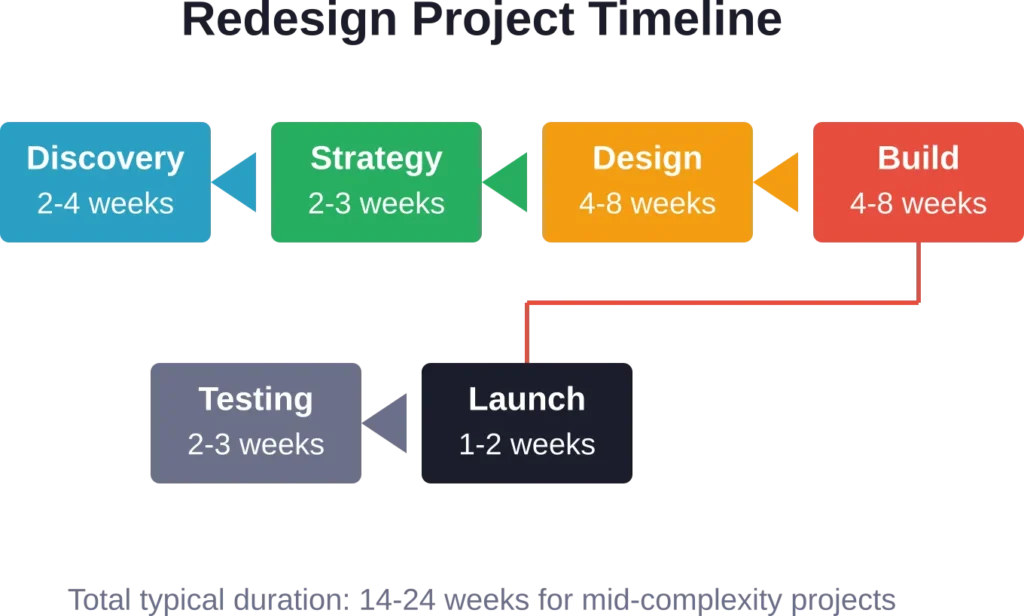
Most redesigns start with discovery and audit work. Agencies review the current site, dig into analytics, conduct stakeholder interviews, and sometimes perform user research. This phase establishes baseline metrics and identifies specific problems the redesign needs to solve.
Strategy development comes next. Based on discovery findings, agencies develop recommendations around information architecture, user flows, content strategy, and design direction. Good agencies present options with clear rationales rather than single solutions.
Design exploration involves creating visual concepts and interaction patterns. Agencies typically show multiple directions initially, then refine the selected approach through iterative feedback cycles. Expect to see low-fidelity wireframes before high-fidelity mockups, and interactive prototypes before final designs.
Development and implementation translate designs into functioning websites. This phase involves both building the front-end interface and configuring backend systems—content management, analytics, integrations, and other technical infrastructure.
Testing and refinement happen before launch. Agencies conduct quality assurance, cross-browser testing, performance optimization, and often some form of user testing to validate that the redesigned site achieves its objectives.
Launch and iteration close the project, though the best agencies stay engaged post-launch to monitor performance, address issues, and make optimization adjustments based on real user behavior.
Timeline Expectations
How long does a website redesign take? It varies wildly based on complexity, but typical ranges help with planning. Simple marketing sites with straightforward content might redesign in 8-12 weeks. Mid-complexity projects with custom design systems and moderate content typically run 3-5 months. Complex redesigns involving multiple stakeholder groups, custom functionality, or technical migrations often take 6-12 months.
Rush timelines usually backfire. Compressed schedules force agencies to skip research and strategy work, limit design exploration, or cut corners in implementation. The result: redesigns that look updated but don’t solve underlying problems or that launch with technical debt requiring immediate fixes.
Build buffer into timelines for internal approval processes. Decision bottlenecks inside client organizations cause more delays than agency work. If feedback takes two weeks to gather and approvals require multiple committee meetings, account for that in scheduling.
Red Flags to Watch For
Some warning signs indicate potential problems with agency partnerships. Agencies that lead with technology platforms rather than problems and solutions may prioritize their preferred tools over your actual needs. Be cautious of rigid “our way or the highway” processes that don’t adapt to client circumstances.
Vague answers about who’ll work on your project suggest bait-and-switch risks—senior talent sells the work, junior team delivers it. Agencies unwilling to share detailed case studies or connect you with past clients may be hiding something.
Watch for agencies that dismiss your current site entirely without understanding why it evolved to its current state. Context matters. Sometimes “bad” design decisions made sense given previous constraints. Agencies that lead with criticism rather than curiosity often repeat past mistakes.
Be wary of unrealistic promises. Claims that redesigns will instantly double conversion rates or revolutionize user engagement without clear reasoning suggest either inexperience or dishonesty. Good agencies set realistic expectations and explain the rationale behind projected improvements.
Maximizing Redesign Success
Client involvement significantly impacts redesign outcomes. Agencies bring expertise, but clients bring essential context—deep understanding of customers, knowledge of business constraints, and organizational dynamics that affect what’s actually feasible.
Designate empowered decision-makers. Projects stall when feedback comes from people who can’t actually approve direction. Ensure whoever represents your organization has authority to make binding decisions or clear paths to escalate when needed.
Provide honest feedback quickly. Agencies can’t read minds. When something doesn’t work, explain why—is it brand misalignment, technical constraints, or just personal preference? Specific feedback enables better refinement than vague dissatisfaction.
Resist redesigning by committee. Gathering input from many stakeholders makes sense, but design decisions made by vote typically produce mediocre compromises. Designate final decision-makers and trust them to synthesize input rather than accommodating every opinion.
Prepare content in parallel. Content strategy should happen during design, but actual content creation often becomes a bottleneck. Start writing, gathering imagery, and preparing assets early. Launching on time with placeholder content wastes the design investment.
Trends Shaping Website Redesigns in 2026
Several shifts are influencing how top agencies approach redesign work this year. Understanding these trends helps contextualize agency recommendations and assess whether partners are thinking forward or backward.
Performance has become non-negotiable. Users abandon slow sites, and search engines penalize them. Leading redesign companies now treat performance as a core design constraint rather than an afterthought. This means making hard choices about imagery, animations, and third-party scripts during design rather than discovering performance problems after launch.
Accessibility standards continue tightening. Redesigns need to meet WCAG compliance not just for legal reasons but because accessible design serves everyone better. Top agencies build accessibility into their design systems from the start rather than retrofitting it at the end.
Content management flexibility matters more than ever. Organizations need to publish content quickly, test variations, and personalize experiences. Redesigns increasingly involve headless CMS architectures or highly flexible component systems that enable marketing teams to build pages without developer involvement.
AI integration is starting to appear in redesigns—not just chatbots, but AI-powered personalization, content recommendations, and adaptive interfaces. Forward-thinking agencies help clients understand which AI applications actually serve users versus which are technology looking for problems.
Design systems are becoming standard even for small redesigns. Rather than creating one-off page designs, agencies build component libraries and design tokens that maintain consistency while enabling flexibility. This systematic approach makes sites easier to maintain and evolve post-launch.
Cost Considerations for Website Redesigns
Redesign investments vary dramatically based on scope, complexity, and agency positioning. Understanding the factors that drive costs helps with realistic budgeting and prevents sticker shock during agency conversations.
Project scope affects costs most directly. A 10-page marketing site costs less than a 100-page content library. Simple brochure websites with straightforward information architecture require less effort than complex platforms with user dashboards, personalization engines, or sophisticated search functionality.
Agency positioning influences rates. Boutique agencies with small teams and selective client rosters often command premium fees. Large agencies bring more resources but also more overhead. Geographic location plays a role—agencies in major metropolitan areas typically charge more than those in smaller markets.
The level of customization matters. Template-based designs or rebuilds on standard platforms cost less than fully custom design systems and bespoke development. But customization often delivers better differentiation and addresses unique requirements that templates can’t accommodate.
Research and strategy work adds cost but improves outcomes. Agencies that invest significant time in discovery, user research, and strategic planning charge more upfront but typically deliver redesigns that perform better because they’re built on solid foundations rather than assumptions.
Post-launch support varies by agency. Some include several weeks of refinement and optimization in project fees. Others charge separately for any work after launch. Clarify what’s included to avoid surprise costs when inevitable adjustments are needed.
Alternatives to Full Redesigns
Not every website problem requires a complete redesign. Sometimes targeted improvements deliver better ROI than comprehensive overhauls. Understanding alternatives helps determine whether a full redesign is actually the right solution.
Incremental improvements address specific issues without rebuilding everything. If conversion rates are the primary problem, focused optimization of key user flows might deliver results faster and cheaper than total redesigns. If the brand feels dated, refreshing visual design while keeping underlying structure can update perception without massive disruption.
Landing page optimization serves companies that drive most traffic to specific entry points. Building high-performing landing pages for campaigns while leaving the broader site alone can improve results without full redesign investments.
Mobile-specific improvements help when mobile traffic converts poorly but desktop performance is acceptable. Responsive redesigns or separate mobile experiences can address the specific problem without reworking everything.
Content and messaging updates sometimes matter more than design changes. If positioning has evolved but the site still talks about what the company used to be, content strategy work might deliver more value than visual redesign.
That said, piecemeal fixes accumulate technical debt and design inconsistency. Eventually sites reach a point where incremental improvements become more expensive and less effective than starting fresh. Good agencies help assess whether targeted improvements or comprehensive redesigns make more sense given specific circumstances.
Frequently Asked Questions
Most website redesigns take between three and six months from initial kickoff to launch. Simpler marketing sites with limited content and straightforward requirements can complete in 8-12 weeks. Complex projects involving custom functionality, extensive content migration, or multiple stakeholder approval processes often require 6-12 months. Timeline factors include project scope, client feedback speed, content readiness, and technical complexity. Rushing redesigns typically produces suboptimal results—research, strategy, and thorough testing need adequate time.
Industry specialization brings advantages—agencies familiar with market dynamics, user expectations, and competitive standards ramp up faster and avoid common mistakes. However, over-indexing on industry experience can limit creative thinking. Agencies that work across multiple sectors often bring fresh perspectives and cross-pollinate ideas between industries. The best approach: prioritize agencies that understand your specific challenges (whether through industry experience or analogous work) over those that only know your vertical. Ask how agencies have solved problems similar to yours rather than just whether they’ve worked with similar companies.
Web design agencies focus on user experience, visual design, branding, and strategic elements—how sites should look, feel, and function from a user perspective. Web development agencies emphasize technical implementation—building the underlying code, infrastructure, and systems that make sites work. Many top agencies offer both capabilities under one roof, with integrated teams of designers and developers. For redesign projects, integrated agencies often deliver smoother results because design and technical feasibility inform each other throughout the process rather than designers handing off specs to developers who then discover constraints.
Success metrics should be defined before the redesign begins, based on what problems prompted the project. Common metrics include conversion rate improvements, increased time on site, reduced bounce rates, higher engagement with key content, improved search rankings, better mobile performance scores, increased lead generation, or higher customer satisfaction scores. Establish baseline measurements before launch, then track the same metrics post-launch. The best agencies define success criteria upfront and build measurement frameworks into redesign planning rather than treating evaluation as an afterthought.
Website redesigns carry SEO risk if not managed properly. Changing URLs, removing pages, or altering site structure without proper redirects and planning can tank search rankings. Responsible redesign agencies conduct SEO audits before starting design work, map old URLs to new ones, implement proper 301 redirects, preserve or improve on-page optimization, and monitor rankings throughout the transition. Done well, redesigns can improve SEO by enhancing site performance, improving mobile experience, clarifying content hierarchy, and updating content to better match search intent. The key: treat SEO as a core consideration throughout redesign rather than addressing it at the end.
In-house redesigns make sense when organizations have design and development resources available, understand user research and UX principles, and can dedicate focused time to the project. The main challenges: internal teams often lack objectivity about brand and messaging, may not have specialized redesign expertise, and frequently get pulled away by day-to-day operational demands. Agencies bring fresh perspectives, dedicated focus, and deep redesign experience across many projects. Middle-ground options include hiring agencies for strategy and design while handling development in-house, or using agencies for specific phases like research and concepting while managing execution internally. The right approach depends on internal capabilities, available time, and project complexity.
Strong preparation improves agency conversations and proposal quality. Gather analytics data showing current site performance and pain points. Document specific problems you’re trying to solve and business goals you’re trying to achieve. Clarify budget parameters—agencies tailor recommendations to available investment. Define timeline constraints and any hard deadlines. Identify key stakeholders who’ll be involved in decisions. Compile examples of sites you admire and articulate what appeals about them. Document technical constraints like required platforms, integrations, or compliance requirements. The more context agencies have upfront, the better they can assess fit and develop relevant proposals rather than generic pitches.
Making Your Decision
Choosing a website redesign partner ranks among the more consequential vendor decisions organizations make. The right partner transforms your digital presence into a business asset. The wrong one wastes budget and time while delivering mediocre results that need to be redone in a few years.
So how do you decide? Start by being honest about what’s actually driving the redesign. Is it stakeholder aesthetics or user problems? Internal politics or external market pressure? Understanding the real motivation helps identify which agency capabilities matter most for your specific situation.
Look beyond portfolio aesthetics to process and outcomes. Beautiful case studies indicate design talent but don’t necessarily predict success with your project. Dig into how agencies work, how they handle challenges, and what measurable results they’ve delivered for clients facing similar challenges.
Trust matters more than any other factor. Redesigns require collaboration, vulnerability, and willingness to have difficult conversations. Choose partners you can be honest with about constraints, concerns, and organizational realities. Chemistry during the sales process predicts working relationship quality.
The agencies in this list represent different approaches, different strengths, and different ideal client profiles. None of them is universally “the best”—but one of them might be exactly right for your specific needs, timeline, and context.
Take time to explore their work, have conversations, and assess alignment. The investment in choosing well pays dividends throughout the project and for years afterward when your redesigned site continues driving business results.