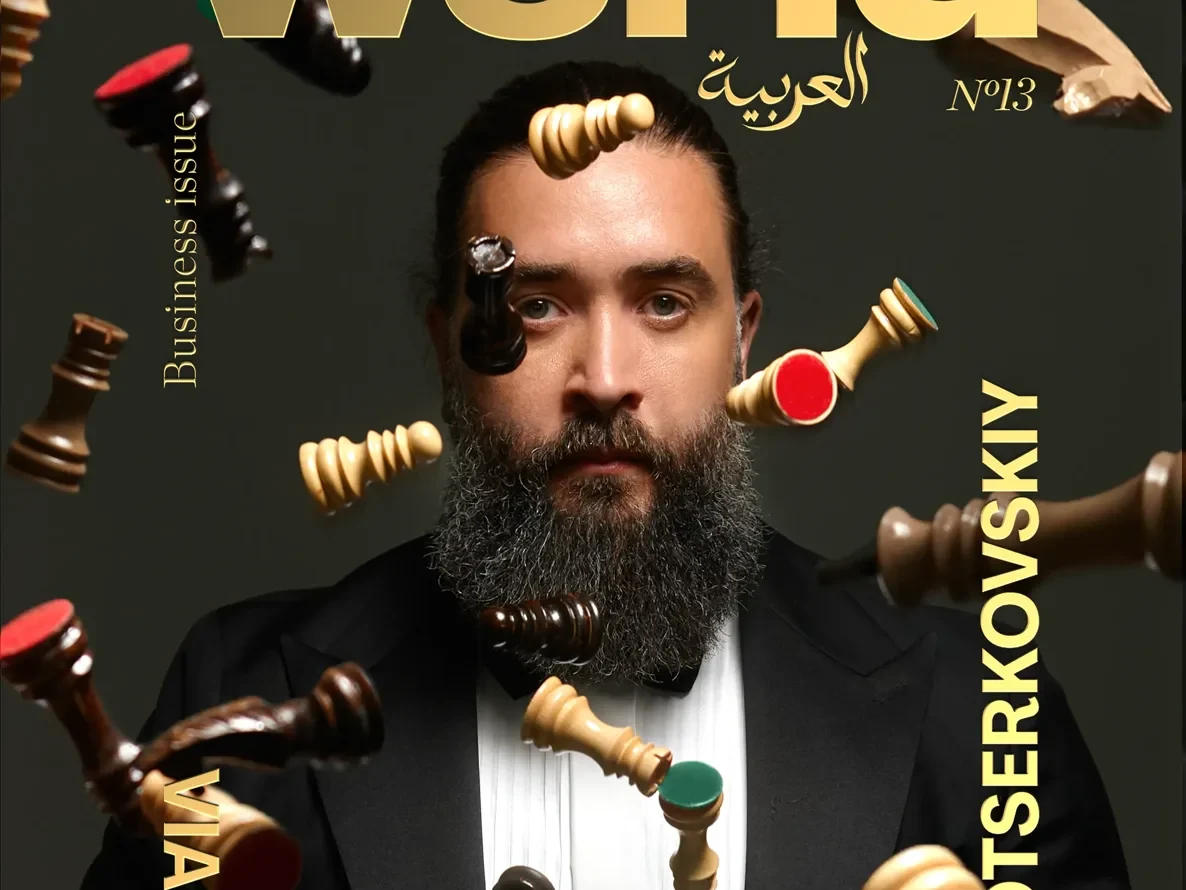
Something changes when money stops being the goal and becomes the instrument — not only in the way wealth is managed, but in how far ahead a person is prepared to look. Viacheslav Belotserkovskiy, Head of Freedom Broker UAE, talks about the financial architecture taking shape in the Middle East, what trust is really made of, and why the soundest principle of investing needs only three words.
Lara Palmer: The UAE is no longer simply one of the world’s great centres of capital — it has become a laboratory for a new financial architecture. Which factors made that transformation possible, and which mattered most to Freedom as it built its business in the region?
Viacheslav Belotserkovskiy: While the rest of the world has been in turbulence, the Emirates have offered precisely what capital lacks right now: security, stability, a predictable regulatory environment — and, on top of all that, extraordinary momentum. Entrepreneurs, investors and international companies are moving here, and capital moves with them. That was what decided it for Freedom. A favourable tax regime, strong infrastructure and the ease of doing business are real advantages, but they come second. Our reasoning is simple: we follow our clients and their capital. At this moment, the UAE is one of the most important points on that map.
L. P.: Investors still tend to think of the region in terms of property and local assets. Are you seeing clients rethink their portfolios — a stronger appetite for international diversification?
V. B.: Real estate is still one of the great symbols of investing in the UAE, especially after the remarkable run that market has had in recent years. But property and equities have always competed for the same capital, which is exactly why we believe international investment has so much room to grow here. Look at the presence of the world’s biggest banks, brokers and investment houses: they are not just opening offices, they are relocating entire private wealth teams from Europe, because the capital in the region is growing so fast. At the same time, a culture of classic long-term investing is only just emerging. Appetite for risk is high, and much of the market still gravitates towards speculative instruments. Part of our job, then, is to offer an alternative — to show clients that international markets can be the foundation for disciplined capital management, real diversification and a coherent long-term strategy.
L. P.: The UAE gathers entrepreneurs, family offices, institutions and wealthy expatriates from all over the world. Can the same principles really serve such a diverse clientele?
V. B.: Their profiles differ, but our clients have something essential in common: they are professional investors, and for them reliable infrastructure, fast access to their portfolios and a wide range of instruments across global markets are a given. That is why we have spent many years building Tradernet — a single digital ecosystem designed to meet the widest possible range of needs, for clients and for the people who look after them. Tradernet is now the technological heart of the business. It combines the trading environment and client portal, a CRM for relationship managers, and the databases and accounting systems behind the back office, trading and compliance. In effect, one digital space links the client, the team and the whole operational infrastructure of the company.
L. P.: Geopolitics and technology are visibly changing how investors behave. What worries your clients most today, and where does human expertise still win in the age of artificial intelligence?
V. B.: Three things now come first: speed, liquidity and reliability. When the climate is uncertain, clients need instant access to their assets and the ability to respond the moment circumstances change. Markets move so quickly that hours can matter more than days. The fundamental task, though, is the same as ever — protect capital and make sure it grows over the long term.
I see artificial intelligence, above all, as an exceptionally powerful tool. It already saves a vast amount of time and speeds up the way we work with information and analysis. But our business still rests first and foremost on human expertise and trust. What AI produces has to be interpreted, questioned and put into context. Financial markets are far too complex and multi-layered for any decision to be handed over to an algorithm.
There is a further point. Money is deeply personal, and people still need people. When significant capital is involved, a client wants more than a calculation or a recommendation — they want to know exactly whom they are trusting. That is why our managers meet clients in person, sometimes flying to another country for that alone. Zoom made communication easier and AI made it more efficient, but meeting face to face creates a different quality of trust altogether. So I don’t believe AI will replace analysts, investment professionals or client managers any time soon. It will extend what they can do. The best results come not when technology takes the place of a person, but when its speed and computing power are joined with human experience, judgement and the ability to understand someone else.
L. P.: The Middle East must have made you question some of your established ways of managing. What was the biggest professional challenge, and how has it changed the way you make decisions?
V. B.: It was an important stage in my development. My management style had been shaped in an environment of very fast decisions and tight discipline. Here I had to learn a different management culture while immersing myself in the operations, the specifics of the business and the dynamics of a new market. The most important lesson, I think, was a cultural one. The region taught me to pay much closer attention to how decisions are actually made in different business cultures — to value personal trust, the quality of relationships and the wider context, not just the immediate commercial goal. It made me more flexible. I became better at judging when to move quickly and when to invest more time in dialogue and in building the relationship. If an international market teaches one thing, it is this: a strong leader doesn’t simply transplant a familiar model to new ground — they adapt it, while staying true to their own principles.
L. P.: Which changes will define the global investment industry over the next five to ten years?
V. B.: Technology will remain the main driver — I have very little doubt about that. We are already in a new cycle built around artificial intelligence, but its effect reaches far beyond AI itself. It pulls a whole ecosystem along with it: automation, robotics, semiconductor production, computing power, data storage and the wider build-out of technological infrastructure. Another major area is space. Commercial space is gradually losing its purely governmental or scientific character and turning into a real market, around which new technologies and investment opportunities will grow. Alongside that, the energy transition and environmental concerns will carry more and more weight. Clean energy, stricter efficiency standards, carbon regulation and the tech sector’s ever-growing hunger for power will create new markets and reshape existing ones.
So I would talk not about one dominant trend, but about several technological and infrastructural revolutions that feed one another. AI needs more and more computing power and energy, which drives microelectronics and energy infrastructure; automation accelerates robotics; space creates demand for new materials and technologies. I believe the most interesting investment opportunities of the coming decade will appear exactly where these lines intersect.
L. P.: As the Middle East becomes one of the key centres of global capital, wealthy investors expect more. Where is the brokerage business heading, and what role will the UAE play in the world’s financial system over the next decade?
V. B.: That process is already well advanced. The UAE is steadily becoming a financial bridge between East and West, and if things continue on their current path, that role will only grow stronger over the next ten years. Capital, family offices, international banks, investment firms and brokers are arriving, and a complete financial ecosystem is forming around them.
The brokerage business is changing at the same time. The traditional model, in which a broker mainly provides market access and executes trades, is no longer enough by itself. It is turning into a wealth management ecosystem that combines technology, access to global markets, investment expertise, personal service and local financial solutions — including instruments that reflect the region and the principles of Islamic finance. Fierce competition in the UAE will only speed this up: the more international players and capital arrive, the higher clients’ expectations become and the faster the financial infrastructure has to develop. Importantly, all of this is in line with the Emirates’ own strategy of diversifying the economy and building up the financial and technology sectors. I see the UAE not only as a place where capital is concentrating today, but as one of the future global centres of capital management. For financial companies, being here is becoming less a regional decision and more a part of global strategy.
L. P.: Islamic finance is becoming a visible part of the global system and attracts interest far beyond Muslim-majority countries. How do you see its prospects and its influence on international markets?
V. B.: Islamic finance really is spreading well beyond the GCC and Muslim-majority countries. Interest in these instruments is growing internationally, and to my mind this is no longer a regional feature — it is a global investment trend in the making. I am convinced Islamic finance will take a prominent place in the world’s financial industry. As demand rises, these solutions will appear more and more often in the product lines of international banks, brokers and investment firms. In the end, the financial business always follows the needs of capital. If demand for Islamic instruments keeps growing at today’s pace, they will gradually become as natural a part of the international offering as many instruments we now consider standard. For any firm that wants to serve a global investor base, this trend is already hard to ignore.
L. P.: Global investment flows have shifted considerably in recent years. How has that affected your clients’ strategies? Has the balance between American, European and Middle Eastern assets changed, and have wealthy investors become more cautious about risk?
V. B.: For us, the geographical shift in global capital has coincided with a new chapter in the international growth of the business itself. Historically, a large part of our client base was in the post-Soviet space; today our European operations are growing fast, and our presence and infrastructure there bring in more and more new clients. The Middle East is the next important step. We are still at an early stage in the region, so it is too soon to talk about a settled balance between European, American and Middle Eastern clients. But we expect that, over time, clients and capital from the UAE and the wider region will become a significant part of our international business. In that sense we are following the same process as the whole global financial market: capital is less and less tied to one geography, and financial firms have to be present wherever new centres of wealth and investment demand appear. Today the UAE is, without doubt, one of them.
L. P.: Freedom Broker is developing a digital investment platform. How actively do wealthy clients in the UAE use digital services to manage their capital, and how are their habits changing?
V. B.: Freedom’s particular strength is the combination of digital infrastructure — which gives clients independent access to investment instruments — with deep expertise and the personal attention of an adviser.
Over the past few years the UAE has gone through a profound digital transformation, and not only in finance. People are used to running almost every part of daily life through apps, and those habits are naturally carrying over into wealth management. A sophisticated investor is no longer satisfied with the name of a respected institution or a capable personal manager alone. They expect constant access to their portfolio, full transparency, current information and the ability to make the transactions they need on their own, through a well-designed digital interface. As major international players enter the market, the bar rises further: once clients experience high-quality technology, they expect the same from everyone.
Of course, there are still clients for whom personal contact matters more than technology — people who prefer to come into the office, sit down with their manager and talk things through face to face. Overall, though, habits are changing fast. The quality of digital infrastructure has become one of the criteria clients use to choose a financial partner, especially among the new generation of wealthy investors.
L. P.: Sustainability and client trust are becoming as important as financial results — particularly in a region where long-term relationships have always carried as much weight as the numbers. How do you build a company that can keep investors’ trust for the long term?
V. B.: I wouldn’t call long-term relationships a Middle Eastern peculiarity — in finance they are a universal principle. But here personal contact, reputation and relationships built over years are valued especially highly. At Freedom, a lasting relationship with the client has always been part of the company’s philosophy. And trust can’t be reduced to the quality of a product or a financial result. It starts inside the company — in the relationships between colleagues, managers and teams — and from there it naturally extends to the way the firm treats its clients.
No contract can guarantee trust. You can sign as many documents as you like, but real relationships only appear when a company backs its words with actions again and again: delivering the standard of service it promised, providing quality infrastructure and expertise, keeping its commitments — above all in difficult times. Trust builds slowly. In finance, where a client is effectively handing you part of their future, that consistency is the essential condition for a business that lasts.
L. P.: If you could give an entrepreneur who has already achieved financial success just one rule for managing personal capital, what would it be?
V. B.: I think the main rule is: don’t fidget. An investor needs a strategy, and if it has been built thoughtfully, what matters most is to stick to it — especially when markets are volatile. The most dangerous moment is when emotion pushes a person to abandon their own plan: to chase the market, to sell in a panic, or, on the contrary, to buy something simply because everyone else seems to be buying. That is when most mistakes happen, and the market, as we know, is not particularly forgiving.
Naturally, a strategy isn’t set in stone. Economic cycles turn, markets change, an investor’s own circumstances evolve, and the plan has to be adjusted. But revising a strategy and giving in to panic are two completely different things. My principle is simple: if you have a plan, follow it. And the larger the capital, the more that rule matters.
L. P.: You are passionate about snowboarding — a sport that demands focus, precision and a quick reading of risk. What draws you to it, and does it help you switch off after an intense week?
V. B.: Absolutely. Mountains, snow, a board under your feet — I can hardly think of a better way to get away from work. What I love most is the sense of freedom and controlled adrenaline. When you are moving fast, with mountains all around and wind in your face, you are completely alone with yourself. Unlike the pressures of everyday professional life, here you decide the level of risk: you can push harder or ease off at any moment. That feeling of control is what makes it so rewarding.
There is probably a parallel with business. You make a decision, weigh the risk and know that your next move will decide where you end up. In the mountains, though, there is a great deal more freedom — and a great deal more pleasure.
L. P.: You travel a lot. Is there a place you go back to when you need to recover and put some distance between yourself and work?
V. B.: I have never really managed to put complete distance between myself and work — whether that is good luck or bad. But there is a place I could return to endlessly: the mountains. As the saying goes, the only thing better than mountains is mountains you have not yet climbed. For me they are a real source of energy. In the mountains the rhythm of life changes: you can stop, look around, rethink things, simply breathe clean air and reset.
If I had to name one spot on the map, it would be Bali. For a long time I went back year after year. I am drawn to surfing, to the waves, to the raw power of the ocean and to the feeling of nature that hasn’t quite been tamed. In a way, the ocean is the mountains in another form. Bali has changed enormously in the last fifteen years, but for me that sense of freedom is still there.
L. P.: You have recently become a father again. Has that changed how you think about long-term goals, responsibility and personal legacy? Has your idea of success — professional and personal — shifted since your son was born?
V. B.: It has, although this is the third time I have become a father, so many of those changes came earlier. With a third child, though, the sense of responsibility becomes even sharper. Once you have children, your planning horizon inevitably stretches. It is hard to think only about the next year or the next career step — you start looking decades ahead. Their education, their development, the family’s future, the capital you want to build and one day pass on — all of it calls for a strategy. In that sense, fatherhood is a remarkable teacher of long-term thinking.
Your sense of legacy changes too. You start thinking not only about what you have achieved yourself, but about what will remain after you and what opportunities you are creating for the next generation. Perhaps that is why the children’s investment accounts we are working on now feel so personal to me: they are a very practical way of turning long-term planning from an abstract idea into a concrete tool.
For me, success has always had two sides, professional and personal. I am proud of what I have built in my career, and my ambitions are still considerable. But three sons, a wife, a home, a family — here too I can honestly say I feel like a very lucky man. There is an old saying that a man should build a house, raise a son and plant a tree. The house is built; the sons now number three. The tree is still waiting. And I think personal and professional success are connected in the end. A family gives you a completely different reason to keep going — sometimes exactly the push you need.