
Quick Summary: Finding the right web design agency in 2026 means matching your project’s specific needs with a partner who has proven expertise in that domain. This guide profiles 15 top web design companies spanning eCommerce, SaaS, branding, and UX specialization, with verified client ratings and real-world project highlights to help you make an informed decision without getting lost in pricing details.
Choosing a web design agency isn’t about finding the biggest name or the cheapest rate. It’s about alignment—matching the agency’s actual strengths with what the project genuinely demands.
Some agencies excel at making complex SaaS platforms feel intuitive. Others specialize in high-converting eCommerce experiences or bold brand identities that turn heads.
The web design landscape in 2026 has matured beyond generic full-service promises. The agencies that consistently deliver results tend to focus deeply on specific industries, design philosophies, or project types.
This guide breaks down 15 web design companies that have earned their reputations through verifiable client work, documented reviews, and specialized expertise. No fluff, no fabricated rankings—just practical insight into who does what well and where each agency fits best.
What Makes a Web Design Agency Stand Out in 2026
The web design industry has shifted dramatically. Generic template customization no longer cuts it for businesses that compete on digital experience.
Agencies that rank among the best share specific characteristics that separate them from the thousands of design studios claiming expertise.
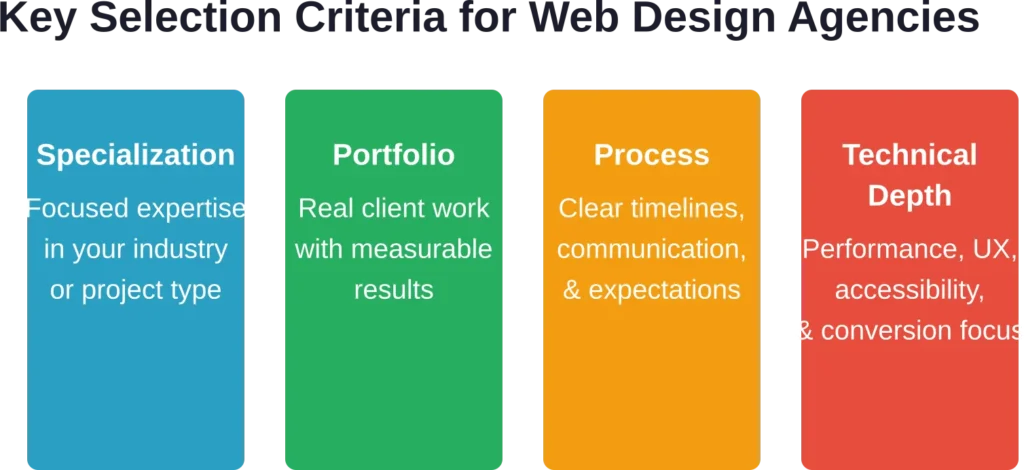
Specialization Beats Generalization
The era of one-size-fits-all web design is over. Top agencies in 2026 typically focus on specific verticals or project types.
A SaaS-focused design firm understands product onboarding flows, feature adoption patterns, and subscription conversion tactics. An eCommerce specialist knows checkout optimization, product page psychology, and inventory display strategies.
Trying to be everything to everyone usually means being mediocre at most things. The agencies featured here have chosen their lanes deliberately.
Proven Track Record With Real Clients
Client reviews on platforms like Clutch provide unfiltered insight into how agencies actually perform. But raw star ratings don’t tell the whole story.
What matters more: specific projects the agency has shipped, results those projects generated, and whether clients returned for additional work. Repeat business signals trust and satisfaction more reliably than any testimonial.
The agencies in this list all have documented client portfolios and verifiable reviews, not just marketing claims.
Process Clarity and Communication
Web design projects fail most often due to misaligned expectations and poor communication, not technical inability.
Strong agencies document their processes clearly. They explain timelines, revision policies, deliverable formats, and collaboration methods upfront.
Client feedback consistently highlights communication quality as a differentiator between smooth projects and painful ones.
Technical Depth Beyond Visual Design
Beautiful mockups mean nothing if they don’t translate into fast, accessible, conversion-focused websites.
The best web design companies combine visual design skill with technical understanding—page speed optimization, semantic HTML, responsive behavior, accessibility standards, SEO fundamentals.
Many agencies now integrate motion design, micro-interactions, and advanced animations that enhance usability rather than just decorating interfaces.
Top 15 Web Design Agencies in 2026
Here’s the breakdown. Each agency brings specific strengths to the table, suited for different project types and business needs.
1. Mobian
Mobian builds dedicated engineering teams that deliver production-ready digital products with emphasis on mobile and modern web experiences.
The studio specializes in creating scalable, high-performance solutions for companies that demand technical excellence. Specific project details should be verified against current case studies.
Mobian excels in end-to-end product development with clean architecture and user-focused implementation.
What they specialize in: Full-stack delivery, mobile and web development, AI-powered systems, scalable architecture, and legacy integration.
Best for: Companies in IT, healthcare, fintech, and logistics building or scaling digital products, and organizations needing senior-level execution for complex web and mobile platforms.
Their approach ensures clean, documented code and solutions designed for long-term scalability and maintainability. Client collaborations often extend post-launch due to reliable ongoing partnership.
Contact Information:
- Website: mobian.studio
- Phone: [email protected]
- Address: Harju maakond, Tallinn, Kesklinnalinnaosa, Masina tn 22, 10113
- LinkedIn: www.linkedin.com/company/mobian-studio
2. Lengreo
Lengreo has built its reputation as a complete marketing and tech partner that delivers results-driven digital experiences for B2B companies.
The agency combines strategic digital marketing with professional website development, creating high-converting websites, landing pages, and digital platforms that drive measurable business growth. Specific client results should be verified against current case studies.
Lengreo’s approach focuses on understanding business objectives and implementing tailored solutions across marketing channels and web platforms.
What they specialize in: B2B digital marketing strategy, SEO, website development (e-commerce, business sites, landing pages), paid ads, lead generation, and demand generation.
Best for: Tech and service companies seeking qualified leads, improved conversion rates, and scalable digital presence through optimized websites and marketing systems.
Client feedback consistently highlights Lengreo’s initiative, dedication, and ability to deliver high-quality work that supports business development and measurable ROI.
Contact Information:
- Website: Lengreo.com
- Phone: +31 686 147 566
- Email: [email protected]
- Address: Vrijstraat 9 C/D, 5611 AT Eindhoven, Netherlands
- LinkedIn: Lengreo
- Twitter: @Lengreo
- Instagram: @lengreo
3. A-listware
A-listware delivers high-quality software development and digital solutions with a focus on responsive, user-friendly web platforms.
The agency provides end-to-end services including UX/UI design, custom development, and dedicated teams that act as an extension of client organizations. Specific client names should be verified against current case studies.
A-listware balances technical excellence with user engagement, creating digital solutions that empower business growth.
What they specialize in: Custom software development, UX/UI design, responsive web design, cloud applications, enterprise software, and dedicated development teams.
Best for: Enterprises needing reliable web and application solutions, SMBs scaling digital operations, and startups requiring professional development support.
Notable strength: Their ability to create vibrant, engaging web designs and robust systems that ensure user engagement while delivering secure, responsive performance.
Contact Information:
- Website: a-listware.com
- Phone: +1 (888) 337 93 73
- Email: [email protected]
- Address: North Bergen, NJ 07047, USA
- LinkedIn: www.linkedin.com/company/a-listware
- Facebook: www.facebook.com/alistware
4. Gilzor
Gilzor operates at the intersection of custom software development and user-centered digital products, building web and mobile solutions from idea to launch.
Their work helps startups and established businesses create functional, attractive digital products that connect with audiences and deliver real value. Specific project outcomes should be verified against current case studies.
Gilzor excels in full-cycle development with strong emphasis on UI/UX design, quality assurance, and go-to-market strategies that support product success.
What they specialize in: Web development, UI/UX design, mobile development, idea validation, business analysis, quality assurance, and go-to-market strategies.
Best for: Startups launching new digital products, SMBs scaling with web and mobile applications, and product studios enhancing existing offerings.
Their technical approach prioritizes secure, scalable, high-performance solutions with user-centric design that improves conversion rates and user satisfaction.
Contact Information:
- Website: www.gilzor.com
- Email: [email protected]
- Address: Poland, Warsaw, Office 58, street Adama Mickiewicza 37, 01-625
- LinkedIn: www.linkedin.com/company/gilzor-softwaredevelopment
5. Oski
Oski builds smart, well-engineered web solutions for tech-forward enterprises and ambitious startups.
The agency focuses on designing, developing, and maintaining robust digital platforms that combine innovative design with reliable performance. Specific client projects should be verified against current case studies.
Oski’s strength lies in creating intuitive user experiences and scalable architectures across cloud, frontend, and CMS platforms.
What they specialize in: Frontend solutions, cloud development, CMS implementations, AI integrations, and full-cycle web application development.
Best for: Enterprises modernizing their digital infrastructure, startups building scalable web platforms, and companies in travel, logistics, e-commerce, education, fintech, and insurance.
Client testimonials frequently mention Oski’s strong project management, timely delivery, and ability to create solutions that enhance business operations through thoughtful web experiences.
Contact Information:
- Website: oski.site
- Phone: +48571282759
- Email: [email protected]
- Address: Kaupmehe tn 7, 10114 Tallinn, Estonia
- LinkedIn: www.linkedin.com/company/oski-solutions
6. Code and Theory
Code and Theory operates as a large-scale digital agency with capabilities spanning strategy, design, and technology development.
With a team size exceeding 500 employees, they handle enterprise projects that require coordination across multiple disciplines—brand strategy, UX research, visual design, front-end development, back-end integration, and ongoing optimization.
Their client list includes Fortune 500 companies and global brands: Adidas, JPMorgan Chase, and Pfizer. These are complex, high-stakes projects with rigorous requirements and extensive stakeholder involvement.
What they specialize in: Enterprise digital transformation, large-scale web applications, multi-platform digital ecosystems, and projects requiring deep technical integration.
Best for: Large organizations modernizing legacy systems, global brands launching unified digital experiences, and projects with complex technical requirements.
Team structure: Code and Theory’s size allows them to staff dedicated teams for long-term engagements, maintaining consistency across extended timelines.
Their work emphasizes strategic thinking backed by execution capability—they can both define the vision and build it.
7. Basic Agency (DEPT)
Basic Agency, now part of the DEPT network, specializes in brand-centric digital experiences with a strong editorial sensibility.
The agency excels at content-rich websites where typography, layout, and narrative structure carry the experience. Their work feels more like digital publishing than traditional web design.
Basic Agency’s portfolio is stated to include major brands and media organizations; specific client names should be verified against current case studies.
What they specialize in: Editorial-style websites, content-heavy marketing platforms, brand storytelling sites, and digital magazines.
Best for: Media companies, content-driven brands, publishers, and organizations where written content is central to the web experience.
Design approach: Basic emphasizes typographic hierarchy, reading comfort, and content flow. Their sites prioritize clarity and readability without feeling plain.
Client feedback highlights the agency’s editorial sensibility—they understand how audiences consume content and design accordingly.
8. Locomotive
Locomotive specializes in immersive, animation-rich websites that leverage scroll-based storytelling and advanced interaction patterns.
The Montreal-based agency has built a reputation for technically sophisticated projects that push browser capabilities while maintaining performance and accessibility standards.
Locomotive’s open-source contributions (including the popular Locomotive Scroll library) demonstrate their technical depth. They’re not just using existing tools—they’re building new ones.
What they specialize in: Scroll-driven storytelling, parallax effects, advanced animation, and interactive brand experiences.
Best for: Brands launching major campaigns, agencies showcasing creative work, and projects where the website itself is a key brand differentiator.
Technical capability: Locomotive maintains high performance standards even with complex animations. Their sites feel smooth across devices and connection speeds.
Reviews consistently mention the agency’s ability to deliver ambitious concepts without the technical compromises that often plague interactive projects.
9. Huge

Huge operates as a global digital agency with offices across North America, Europe, and South America.
The agency combines design, technology, and marketing capabilities to deliver integrated digital experiences. Their scale allows them to handle projects that span multiple markets, languages, and platforms simultaneously.
Huge’s portfolio is described as including large-scale projects; specific client names should be verified against current case studies.
What they specialize in: Global digital platforms, multi-market website rollouts, design systems for large organizations, and integrated digital/marketing campaigns.
Best for: International brands launching unified experiences, enterprises needing design systems that scale, and organizations requiring ongoing design partnership.
Service breadth: Huge’s capabilities extend beyond web design into app development, marketing strategy, and digital transformation consulting.
Client testimonials highlight the agency’s ability to maintain quality across large, distributed teams—a challenge many competitors struggle with at scale.
10. Area 17

Area 17 focuses on content management systems, publishing platforms, and editorial-focused web experiences.
The agency has deep expertise in complex content architectures—sites with thousands of articles, multiple content types, sophisticated taxonomies, and editorial workflows.
Area 17’s portfolio is stated to include work with major institutions; specific client names should be verified against current case studies.
What they specialize in: Custom CMS implementations, publishing platforms, content-heavy institutional websites, and editorial workflow design.
Best for: Educational institutions, museums, publishers, research organizations, and any entity managing large content archives.
Technical strength: Area 17’s development team specializes in CMS customization and content infrastructure. They understand both the editor experience and the public-facing site.
Reviews frequently mention the agency’s understanding of content workflows—they design systems that work for editorial teams, not just end users.
11. Clay
Clay has built its reputation on high-stakes digital branding and web experiences for companies that need to make a statement.
The agency works with well-funded startups and established brands launching new digital products; specific client names should be verified against current case studies.
Clay’s approach combines strategic brand positioning with polished visual execution. They don’t just design websites; they craft entire digital identities that establish market presence.
What they specialize in: Digital branding, product launches, marketing websites for tech companies, and B2B SaaS platforms that need credibility.
Best for: Companies raising Series A funding or later, established tech brands refreshing their digital presence, and businesses where design quality directly impacts customer acquisition.
Team structure: Mid-sized agency with dedicated strategists, brand designers, and web developers working collaboratively.
Client feedback consistently highlights Clay’s ability to understand business objectives and translate them into design decisions that support growth.
12. Instrument

Instrument operates at the intersection of brand, digital product, and marketing—a full-service design studio that handles complex, multi-touchpoint projects.
Their client roster is stated to include major brands; specific client names should be verified against current case studies. These aren’t simple website builds; they’re large-scale digital ecosystems requiring coordination across brand guidelines, user experience, content strategy, and technical implementation.
Instrument excels when projects demand both strategic depth and execution polish. They’re comfortable working within existing brand frameworks or building new ones from scratch.
What they specialize in: Enterprise-level digital experiences, design systems, brand evolution projects, and marketing platforms that integrate with broader ecosystems.
Best for: Large organizations launching major digital initiatives, established brands modernizing their web presence, and projects requiring design system development.
Notable strength: Their ability to balance creative vision with the operational realities of large organizations. They understand corporate approval processes and stakeholder management.
Instrument’s work tends toward premium aesthetics without sacrificing functionality—a balance many agencies struggle to achieve.
13. Fantasy
Fantasy specializes in interactive experiences that push technical boundaries while maintaining usability.
The agency is known for ambitious animation work, scroll-driven storytelling, and motion-rich interfaces that feel polished rather than gimmicky. Their portfolio demonstrates technical confidence—sites that load fast despite visual complexity.
Fantasy works best when the brand story benefits from immersive presentation. They’re not the right fit for minimalist corporate sites, but perfect for product launches, creative portfolios, and brands targeting design-conscious audiences.
What they specialize in: Motion-heavy websites, scroll-driven narratives, product showcase sites, and interactive brand experiences.
Best for: Consumer brands with strong visual identities, creative agencies showcasing their own work, and product companies launching innovative offerings.
Technical approach: Fantasy invests heavily in custom animation development, often using WebGL and advanced JavaScript frameworks to achieve effects that feel unique.
Client reviews frequently mention the agency’s ability to deliver complex interactions on schedule—a rare combination in the high-end interactive space.
14. Ueno
Ueno (now part of the Fjord network) built its reputation on thoughtful digital product design with a distinctive personality.
The agency’s work balances playfulness with professionalism—sites that feel friendly without sacrificing authority. Their approach emphasizes clear information architecture, smooth interactions, and brand personalities that come through in micro-copy and subtle animations.
Ueno’s portfolio is stated to include notable consumer and product brands; specific client names should be verified against current case studies.
What they specialize in: Digital product design, brand-focused marketing websites, and user interfaces that need personality without compromising usability.
Best for: Consumer-facing products, brands targeting younger demographics, and companies that want approachable rather than corporate design.
Design philosophy: Ueno emphasizes research-informed design decisions. They spend time understanding user behavior before jumping to visual solutions.
Their process documentation and design thinking have influenced countless other agencies—Ueno’s blog posts on design approach are frequently cited across the industry.
15. Build in Amsterdam
Build in Amsterdam focuses on data-driven eCommerce and conversion-optimized web experiences.
The agency works primarily with brands that need their websites to drive measurable business results—lead generation, product sales, subscription sign-ups. Design decisions are informed by analytics, user testing, and conversion research.
Build in Amsterdam’s portfolio is stated to include notable digital brands; specific client names should be verified against current case studies.
What they specialize in: eCommerce platforms, conversion-focused landing pages, growth-oriented web applications, and marketing sites tied to performance metrics.
Best for: Online retailers, SaaS companies optimizing trial-to-paid conversion, and businesses where website performance directly impacts revenue.
Approach: Build in Amsterdam integrates analytics into the design process from day one. They establish measurement frameworks before launch and iterate based on real user behavior.
Client testimonials frequently mention the agency’s focus on outcomes rather than just deliverables—they care whether the site actually converts, not just whether it looks good.
How to Evaluate Web Design Agencies for Your Project
Looking at portfolios and reading reviews provides useful information, but structured evaluation prevents costly mismatches.
Define Project Requirements First
Before contacting agencies, document what the project actually needs. Not aspirations—requirements.
Is this a complete redesign or incremental improvement? Does the site need custom functionality or standard features? What’s the realistic timeline? Who approves design decisions?
Clear requirements enable better agency matching and more accurate proposals.
Review Relevant Portfolio Work
Don’t just browse the agency’s best work—look specifically for projects similar to what’s being considered.
If evaluating agencies for an eCommerce site, examine their eCommerce projects specifically. How do product pages look? Is checkout flow visible in case studies? Are results quantified?
Beautiful branding work doesn’t necessarily predict eCommerce competence.
Check Client Reviews for Patterns
Individual testimonials can be cherry-picked. Review patterns across multiple clients reveal more.
Do reviews consistently mention communication quality? Do clients report projects finishing on schedule? Are there recurring complaints?
Pay attention to negative reviews—how the agency responds to criticism tells a lot about their professionalism.
Assess Technical Capabilities
If the project has technical requirements beyond basic WordPress, verify the agency has relevant development expertise.
Do they have developers on staff or outsource? What frameworks and platforms do they specialize in? Can they show examples of sites with similar technical complexity?
Many design-focused agencies struggle with technically demanding projects—better to know that upfront.
Evaluate Communication and Process
Ask prospective agencies to explain their process. How do they structure projects? What does collaboration look like? How are revisions handled?
Vague answers suggest the agency doesn’t have a consistent process—a red flag for project predictability.
Strong agencies can articulate their approach clearly because they’ve refined it across dozens of projects.
| Evaluation Factor | What to Look For | Red Flags |
|---|---|---|
| Portfolio Relevance | Projects similar in scope, industry, and complexity to yours | Only showing branding when you need eCommerce; no relevant examples |
| Client Reviews | Consistent positive feedback across multiple platforms; detailed testimonials | Only generic praise; no negative reviews anywhere (suspicious) |
| Process Clarity | Clear explanation of phases, timelines, revision policies | Vague answers; “we’re flexible” without specifics |
| Technical Depth | In-house developers; familiarity with required platforms/frameworks | Outsourced development; unfamiliarity with technical requirements |
| Communication | Prompt responses; clear documentation; proactive updates | Slow replies during sales process; unclear deliverables |
Common Mistakes When Hiring Web Design Agencies
Even with research, certain missteps happen repeatedly when businesses select design partners.
Choosing Based on Portfolio Aesthetics Alone
A stunning portfolio doesn’t guarantee the agency can solve specific business problems.
Visual appeal matters, but functional requirements matter more. An agency that designs beautiful sites for media companies might struggle with complex SaaS dashboards or high-volume eCommerce platforms.
Match the agency’s demonstrated strengths to actual project needs, not just visual preferences.
Ignoring Communication Red Flags Early
Slow responses and unclear communication during the sales process don’t improve once the project starts.
If an agency takes days to respond to initial inquiries or provides vague answers to direct questions, those patterns will intensify under project pressure.
Communication quality during evaluation predicts project experience.
Skipping References and Direct Client Conversations
Written reviews provide useful data, but direct conversations with past clients reveal nuances that testimonials miss.
Most agencies will provide references if asked. Talk to at least two past clients about their experience—what went well, what challenges emerged, what they’d do differently.
Former clients often share insights they wouldn’t put in public reviews.
Underestimating Timeline and Scope
Quality web design takes time. Agencies promising exceptionally fast turnarounds are either cutting corners or overcommitting.
Complex projects—custom functionality, extensive content, multiple stakeholder approvals—require months, not weeks. Rushing the process produces mediocre results.
Realistic timelines prevent disappointment and enable proper planning.
Focusing Solely on Upfront Cost
The cheapest proposal often becomes the most expensive project when accounting for revisions, delays, and necessary fixes.
Web design is investment in a business asset that will be used for years. Underfunding that investment to save a few thousand dollars rarely makes financial sense.
Value matters more than price alone.
What to Expect During a Web Design Project
Understanding typical project structure helps set realistic expectations and enables better collaboration.
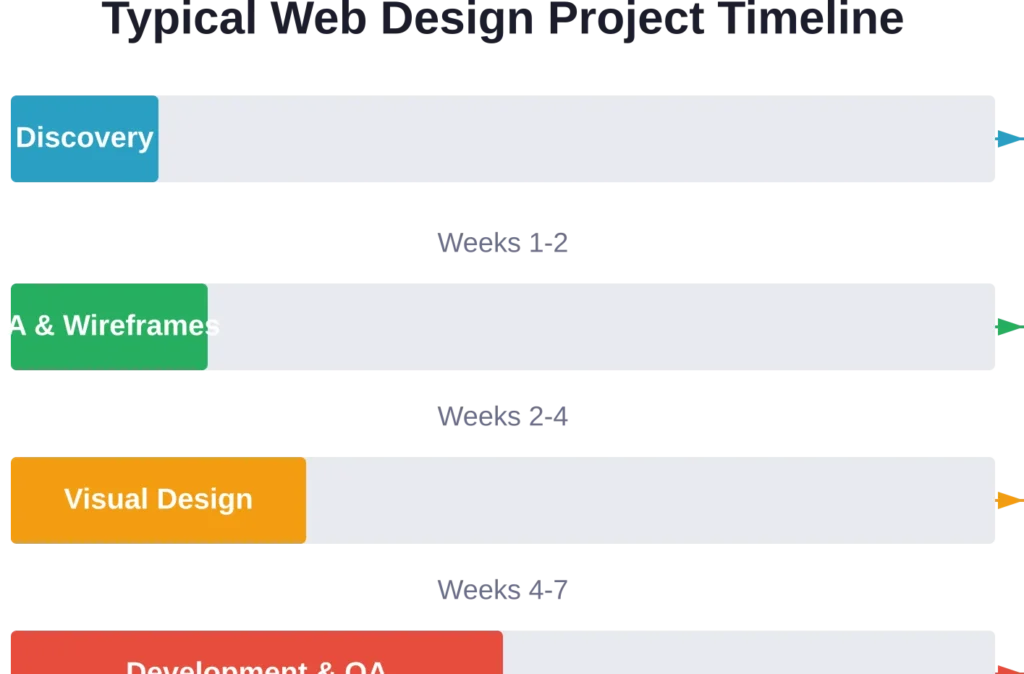
Discovery and Strategy Phase
Most agencies begin with discovery—understanding business goals, target audiences, competitive landscape, and technical constraints.
This phase typically involves stakeholder interviews, user research (for larger projects), content audits, and technical assessments.
Good discovery prevents misalignment later. Agencies that skip this phase tend to deliver designs that miss strategic objectives.
Information Architecture and Wireframing
Before visual design starts, strong agencies map site structure and create wireframes—low-fidelity layouts showing content hierarchy and user flows.
Wireframes establish functional foundations without the distraction of colors and imagery. This is where navigation structure, page layouts, and interaction patterns get defined.
Stakeholders should review wireframes carefully—structural changes are easy now, expensive later.
Visual Design
With structure approved, agencies create high-fidelity designs showing actual colors, typography, imagery, and branded elements.
Most agencies design key page templates first—homepage, product page, article page—then apply those patterns across remaining pages.
Expect multiple revision rounds. Good agencies build revision cycles into their process and timelines.
Development and Implementation
Once designs are approved, development translates static mockups into functional code.
Modern web development involves responsive behavior across devices, performance optimization, accessibility compliance, and CMS integration.
This phase takes longer than many clients expect. Quality development requires testing across browsers, devices, and screen sizes.
Quality Assurance and Launch
Before launch, thorough testing catches bugs, broken links, display issues, and performance problems.
Professional agencies test systematically—functionality testing, cross-browser testing, mobile testing, accessibility testing, and performance testing.
Skipping QA to meet deadlines creates problems that are embarrassing to fix post-launch.
Post-Launch Support
Most agencies provide some post-launch support—fixing bugs that emerge in real-world use, making minor adjustments, and addressing issues discovered after launch.
Clarify support terms before signing contracts. What’s included? For how long? What falls outside scope?
Ongoing maintenance and updates typically require separate arrangements.
Industry-Specific Considerations
Different industries have unique web design requirements that general-purpose agencies may miss.
SaaS and Software Companies
SaaS websites need to explain complex products clearly, demonstrate value quickly, and optimize trial-to-paid conversion flows.
Product screenshots, feature comparisons, integration showcases, and clear CTAs matter more than elaborate animations.
Look for agencies with documented SaaS experience—they’ll understand free trials, pricing page optimization, and feature communication patterns.
eCommerce and Retail
eCommerce sites live or die on conversion rates, page load speed, and checkout experience.
Product photography, filtering and search, shopping cart functionality, and payment integration all require specialized knowledge.
Agencies specializing in eCommerce understand inventory display strategies, promotional banner placement, and mobile shopping behavior.
Healthcare and Medical
Healthcare websites must balance regulatory compliance (HIPAA in the US) with usability. Patient portal integration, appointment scheduling, and insurance information all require careful handling.
Medical content needs clear hierarchy—patients seeking emergency information have different needs than those researching procedures.
Agencies with healthcare experience navigate compliance requirements and accessibility standards that general designers might overlook.
Education and Nonprofits
Educational institutions manage complex content hierarchies—multiple audiences (prospective students, current students, parents, faculty, alumni) with different information needs.
Nonprofits need donation flows, volunteer management, impact storytelling, and event promotion—specialized functions that benefit from experience.
These organizations often have budget constraints that require agencies comfortable working within tighter financial parameters.
Professional Services and B2B
Professional services sites emphasize expertise and trust-building over flashy visuals. Case studies, team credentials, and thought leadership content take priority.
B2B purchasing cycles are longer and involve multiple stakeholders. Websites need to support lead nurturing and provide content for different decision-maker roles.
Agencies experienced in B2B understand these dynamics and design accordingly.
Questions to Ask Prospective Web Design Agencies
The right questions during evaluation reveal how agencies actually operate beyond marketing promises.
About Their Process
“Walk me through your typical project timeline from kickoff to launch.” This reveals whether they have a structured process or wing it project-by-project.
“How do you handle revisions and feedback?” Clear revision policies prevent scope creep and budget overruns.
“What do you need from us to stay on schedule?” This identifies client responsibilities—content delivery, stakeholder approvals, technical access.
About Their Expertise
“Can you show examples of projects similar to ours?” Relevant experience matters more than impressive-but-unrelated work.
“Who will actually work on our project?” Make sure senior team members in the pitch will be involved in execution, not just junior staff.
“What platforms and technologies do you specialize in?” Confirms technical capabilities match project requirements.
About Project Specifics
“What does your proposal include and what falls outside scope?” Prevents misunderstandings about what’s covered.
“How do you measure project success?” Agencies focused on outcomes will have clear metrics; others focus only on deliverables.
“What happens if we need changes after launch?” Clarifies post-launch support and ongoing maintenance options.
About Their Team
“How large is your team and how is it structured?” Size impacts capacity and communication patterns.
“Do you have in-house developers or outsource development?” In-house teams typically communicate better and deliver more consistent quality.
“What’s your current project load?” Overbooked agencies miss deadlines and provide inconsistent attention.
About Results
“Can you provide references from similar projects?” Direct client conversations reveal what reviews don’t.
“What results have clients seen after launching sites you’ve designed?” Quantified outcomes—traffic increases, conversion improvements, lead growth—demonstrate business impact.
“How do you approach performance optimization and accessibility?” These technical factors impact user experience and SEO but often get deprioritized.
Red Flags to Watch For
Certain warning signs during agency evaluation predict project problems.
Overpromising and Unrealistic Timelines
Agencies promising full custom websites in four weeks are either cutting massive corners or don’t understand project scope.
Quality work requires time. Compress timelines too much and something suffers—usually strategy, QA, or design refinement.
Poor Communication During Sales
If an agency is slow to respond, vague in answers, or difficult to reach during evaluation, those patterns intensify once money changes hands.
Sales is when agencies are most motivated to impress. Communication won’t improve after contracts are signed.
No Clear Process or Timeline
Agencies that can’t articulate their process don’t have one. That means inconsistent execution and unpredictable outcomes.
Professional agencies have refined processes they can explain clearly because they’ve used them dozens of times.
Portfolio Doesn’t Match Project Needs
Beautiful work in unrelated domains doesn’t translate to competence in the required specialization.
An agency with stunning fashion eCommerce work might struggle with B2B SaaS. Branding specialists might lack eCommerce conversion expertise.
Vague or Missing Contract Terms
Proposals should clearly specify scope, deliverables, timelines, revision policies, payment terms, and ownership rights.
Vague contracts lead to disputes about what’s included, how changes are handled, and when the project is actually complete.
No Post-Launch Support Plan
Bugs and adjustments are inevitable after launch. Agencies with no support plan leave clients stranded.
Clarify what’s included post-launch and what requires additional budget before signing contracts.
Maximizing ROI from Web Design Investment
Getting maximum value from an agency relationship requires active participation, not passive oversight.
Provide Clear, Complete Information Upfront
Agencies produce better work when they understand business context, competitive positioning, target audiences, and specific goals.
Vague briefs produce generic work. Detailed information enables strategic thinking and tailored solutions.
Involve Key Stakeholders Early
Major revisions requested after visual design begins waste budget and delay timelines.
Get stakeholder input during wireframing and strategy phases when changes are cheap and easy.
Deliver Content on Schedule
Late content is the most common cause of project delays. Agencies can’t design pages around content that doesn’t exist.
If content creation is a bottleneck, many agencies offer copywriting services or can accommodate phased content delivery.
Trust Agency Expertise
Agencies bring specialized knowledge gained across hundreds of projects. When they recommend approaches different from initial assumptions, consider their rationale carefully.
That doesn’t mean accepting everything uncritically—but dismissing expertise because it conflicts with personal preferences wastes the investment.
Plan for Iteration and Testing
Launch is the beginning, not the end. Sites improve through data-informed iteration—adjusting based on user behavior, A/B testing, and performance metrics.
Budget and plan for post-launch optimization. Initial launches rarely get everything perfect.
| Investment Strategy | Description | Impact on ROI |
|---|---|---|
| Clear Requirements | Document goals, audiences, and success metrics before starting | Prevents revisions and scope creep; keeps project focused |
| Timely Content Delivery | Provide final copy and assets according to project schedule | Avoids delays; enables designers to work continuously |
| Early Stakeholder Buy-in | Involve decision-makers during wireframing phase | Reduces expensive late-stage revisions |
| Trust Expertise | Listen to agency recommendations based on their experience | Leverages their specialized knowledge effectively |
| Post-Launch Optimization | Budget for iteration based on real user data | Improves performance beyond initial launch |
Frequently Asked Questions
Web design investment varies dramatically based on project scope, agency expertise, and complexity. Basic small business sites start around several thousand dollars with freelancers or small studios. Mid-market business websites with custom functionality typically range from $25,000 to $50,000. Enterprise projects with complex requirements, custom development, and integration needs can exceed $100,000. Rather than fixating on cost alone, focus on value—the right investment depends on business impact, not arbitrary budget limits.
Timelines depend on project complexity and scope. Simple marketing sites might launch in 6-8 weeks. Mid-sized business websites with custom features typically require 3-4 months from kickoff to launch. Complex enterprise projects or sites requiring extensive custom development can take 6-12 months. These timelines assume clients provide content and feedback on schedule. Late deliverables from the client side consistently cause delays across all project types.
Location matters less in 2026 than it did historically. Remote collaboration tools enable effective partnerships across time zones. The key factors are communication quality, process clarity, and relevant expertise—not physical proximity. That said, some businesses prefer local agencies for easier in-person meetings and timezone alignment. The best approach matches company preferences and project needs. Don’t restrict options to local agencies only, but don’t exclude them either if they offer relevant expertise.
Web design focuses on visual appearance, user experience, and interface layout—colors, typography, spacing, navigation structure, and interaction patterns. Web development translates those designs into functional code—HTML, CSS, JavaScript, backend programming, database integration, and CMS implementation. Many agencies offer both services under one roof. Smaller studios might excel at design but outsource development, or vice versa. Understanding this distinction helps evaluate agency capabilities against project technical requirements.
Website maintenance includes security updates, plugin updates, content updates, performance monitoring, and occasional feature additions. Some agencies offer ongoing maintenance packages covering technical updates and minor content changes. Others hand off the completed site for client management. For clients without technical staff, ongoing maintenance contracts make sense. For companies with internal development resources, self-management works fine. Clarify maintenance expectations before selecting an agency—some excel at ongoing partnerships while others focus purely on project delivery.
Platform choice depends on specific requirements. WordPress powers roughly 40% of websites and offers extensive plugin ecosystems, making it suitable for content-driven sites and small-to-mid-sized businesses. Shopify dominates eCommerce for good reason—powerful commerce features with less technical complexity. Custom-built solutions make sense for unique requirements that existing platforms can’t accommodate. Many SaaS companies use Webflow for marketing sites combined with custom application development for product interfaces. The right platform matches technical requirements, budget constraints, and long-term flexibility needs.
Critical. Mobile traffic surpassed desktop years ago and continues growing. Search engines prioritize mobile-friendly sites in rankings. Poor mobile experience directly impacts bounce rates, conversions, and business results. Responsive design—sites that adapt gracefully across screen sizes—is standard practice, not optional. Any agency not prioritizing mobile optimization lacks current expertise. Evaluate mobile versions of portfolio sites carefully during agency selection to ensure they understand mobile-first design principles.
Making the Final Decision
After research, conversations, and proposal reviews, decision time arrives.
The best agency choice balances specialized expertise, communication quality, process clarity, and cultural fit. Not every top agency suits every project.
Trust pattern recognition over isolated factors. When multiple positive signals align—relevant portfolio work, clear process, strong client feedback, responsive communication—confidence in the choice increases.
Conversely, when red flags accumulate—communication issues, process vagueness, portfolio mismatches—listen to those concerns even if other factors seem attractive.
Web design partnerships last months and impact businesses for years. Choosing carefully upfront prevents expensive mistakes.
The agencies featured in this guide represent different specializations and project types. No single agency is universally “best”—but each excels within their domain.
Match project needs with demonstrated agency strengths. Verify claims through references and portfolio review. Ask questions that reveal process and approach.
Done right, a web design partnership produces sites that drive business results and evolve with company growth. Done poorly, it wastes budget and delays progress.
The difference lies not in luck but in thoughtful evaluation and strategic selection.
Choose wisely.