

Quick Summary: The best web design companies for small businesses in 2026 combine responsive design, conversion optimization, and scalable solutions tailored to budget-conscious entrepreneurs. This curated list features 15 agencies with proven track records in creating high-performing websites for startups and SMBs, from AI-native specialists to full-service digital studios.
Building a website that actually drives growth isn’t as simple as dragging and dropping a template. Small businesses need design partners who understand conversion architecture, search visibility, and the balance between aesthetics and performance.
The problem? Most agency directories bury the signal in noise. Hundreds of firms claim to specialize in small business web design, but their portfolios tell different stories.
This guide cuts through the marketing speak. What follows is a vetted list of 15 web design companies that consistently deliver results for small businesses, from early-stage SaaS startups to established local service providers.
What Makes a Great Small Business Web Design Agency?
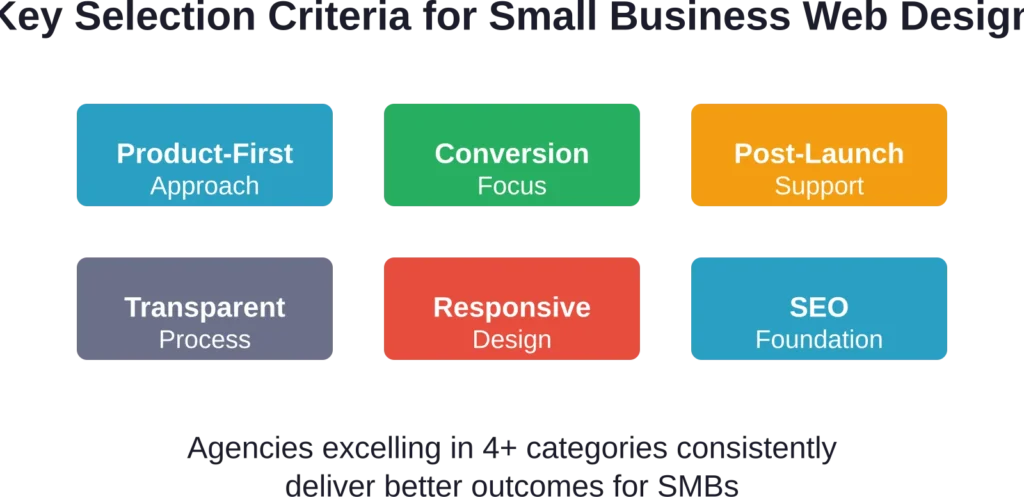
Not every agency that builds websites understands the constraints and priorities of small business owners. The best firms share specific characteristics that set them apart.
Startup-Native Thinking
Top agencies approach design through a product lens rather than treating websites as digital brochures. They ask questions about conversion goals, user journeys, and growth roadmaps before discussing color palettes.
According to the U.S. Small Business Administration, most non-manufacturing businesses with average annual receipts under $7.5 million qualify as small businesses. These companies need sites that scale without requiring constant redesigns.
Conversion Architecture Over Decoration
Pretty sites don’t pay bills. The agencies worth partnering with focus on structure—how information flows from first visit to contact form, how calls-to-action guide decision-making, how page load speed impacts bounce rates.
Community discussions consistently highlight that conversion rate matters more than design awards. A site converting at 4% delivers better ROI than one converting at 1%, regardless of visual polish.
Post-Launch Support Terms
Many agencies disappear after launch. The best ones define maintenance, optimization, and support expectations upfront. What happens when a plugin breaks? Who handles security patches? How are content updates managed?
These operational details matter enormously for small businesses without dedicated IT staff.
The 15 Best Small Business Web Design Companies in 2026
Each agency below has demonstrated consistent capability in delivering small business websites that balance design quality, technical performance, and business outcomes.
1. Lengreo

Lengreo specializes in integrated marketing and technology solutions with a strong emphasis on website development for small businesses. The team builds eCommerce, business, and portfolio websites along with targeted landing pages that drive real growth and conversions.
Rather than generic templates, Lengreo starts with discovery, business analysis, and research to ensure every site aligns with the client’s goals. Their development process includes prototyping, design, implementation, quality assurance, and ongoing support, creating websites that function as powerful lead-generation tools.
The agency excels at combining web development with full-funnel digital marketing, making it ideal for small businesses that need their website to attract clients, convert visitors, and integrate seamlessly with SEO, paid ads, and lead-generation campaigns.
Contact Information:
- Website: Lengreo.com
- Phone: +31 686 147 566
- Email: [email protected]
- Address: Vrijstraat 9 C/D, 5611 AT Eindhoven, Netherlands
- LinkedIn: Lengreo
- Twitter: @Lengreo
- Instagram: @lengreo
2. Mobian Studio
Mobian Studio creates dedicated engineering teams that deliver production-ready web and digital solutions for small businesses in competitive markets. They specialize in full-stack web development, modern interfaces, and scalable architectures that help companies ship faster and more effectively.
The studio combines strong UI/UX practices with clean code and documented delivery, ensuring websites are both beautiful and technically solid. Their end-to-end product development approach covers everything from initial design to deployment and ongoing support.
Small businesses working with Mobian gain senior-level web development expertise and reliable delivery, resulting in digital products that stand out and perform consistently.
Contact Information:
- Website: mobian.studio
- Phone: [email protected]
- Address: Harju maakond, Tallinn, Kesklinnalinnaosa, Masina tn 22, 10113
- LinkedIn: www.linkedin.com/company/mobian-studio
3. Oski
Oski builds smart, well-engineered web solutions for tech-forward small businesses and ambitious startups. Their frontend expertise spans modern frameworks and UI/UX design, creating fast, intuitive, and visually appealing websites that reflect brand quality.
The team focuses on seamless integration, performance, and user experience, delivering websites that scale as the business grows. Whether building new sites or enhancing existing platforms, Oski ensures technical excellence paired with business-oriented design.
Small businesses benefit from Oski’s ability to combine cloud infrastructure, modern frontend development, and thoughtful design into cohesive digital experiences that support long-term growth.
Contact Information:
- Website: oski.site
- Phone: +48571282759
- Email: [email protected]
- Address: Kaupmehe tn 7, 10114 Tallinn, Estonia
- LinkedIn: www.linkedin.com/company/oski-solutions
4. A-listware

A-listware provides comprehensive software development and UX/UI design services tailored for small businesses seeking professional web solutions. Their approach includes custom web development, application services, and user interface design that prioritizes clarity and functionality.
The company excels at creating responsive, secure, and user-friendly websites as part of broader digital transformation projects. By treating design and development as interconnected, A-listware delivers websites that perform well and integrate smoothly with business operations.
Ideal for small businesses that need reliable web solutions without complexity, A-listware offers end-to-end support from initial design through implementation and optimization.
Contact Information:
- Website: a-listware.com
- Phone: +1 (888) 337 93 73
- Email: [email protected]
- Address: North Bergen, NJ 07047, USA
- LinkedIn: www.linkedin.com/company/a-listware
- Facebook: www.facebook.com/alistware
5. Gilzor

Gilzor delivers custom web and mobile development focused on helping small and medium businesses establish a strong digital presence. Their full-cycle web development services cover everything from user-centric UI/UX design to robust implementation and post-launch maintenance.
The studio emphasizes clean, conversion-oriented interfaces and scalable solutions that support business growth. By combining research-driven design with technical excellence, Gilzor creates websites and digital products that improve user experience and deliver measurable results.
Particularly strong for small businesses launching new online channels or modernizing existing ones, Gilzor helps clients turn their website into a reliable sales and engagement platform.
Contact Information:
- Website: www.gilzor.com
- Email: [email protected]
- Address: Poland, Warsaw, Office 58, street Adama Mickiewicza 37, 01-625
- LinkedIn: www.linkedin.com/company/gilzor-softwaredevelopment
6. Huemor

Huemor specializes in website redesigns for established small businesses that have outgrown their initial sites. The agency focuses on modernizing outdated platforms while preserving SEO equity.
The team conducts thorough technical audits before redesign work begins, identifying redirect strategies, content gaps, and structural improvements that maintain search rankings through the transition.
Best for companies with existing organic traffic that can’t afford to lose visibility during a platform migration.
7. Bop Design
Bop Design concentrates on B2B professional services firms—accounting practices, law firms, engineering consultancies. The agency understands the specific trust signals and credentialing these industries require.
Projects emphasize content strategy and thought leadership positioning. Websites are structured to support long sales cycles where prospects research extensively before engaging.
The firm’s narrow industry focus means accelerated timelines compared to generalist agencies that need to learn business models from scratch.
8. eDesign Interactive

eDesign Interactive builds custom WordPress and proprietary CMS solutions for content-heavy small businesses. The agency excels at information architecture for sites with extensive service pages, resource libraries, or knowledge bases.
Development includes custom post types, advanced filtering systems, and editorial workflows that allow non-technical staff to manage content updates without breaking layouts.
Ideal for businesses that publish frequently—media companies, educational organizations, membership associations—where content management capabilities matter as much as initial design.
9. Lounge Lizard

Lounge Lizard operates as a full-service digital agency with capabilities spanning web design, mobile app development, and digital marketing. The agency works with both startups and established brands.
Projects often include custom illustration and animation work, making Lounge Lizard a strong fit for consumer brands that need personality and distinctiveness in crowded markets.
The creative-forward approach works particularly well for e-commerce businesses, hospitality brands, and consumer services where emotional connection drives purchase decisions.
10. The Creative Momentum

The Creative Momentum, now a CloudMellow Company, focuses on small business websites with integrated lead generation systems. Projects include CRM integration, marketing automation setup, and conversion tracking implementation.
The agency emphasizes measurable outcomes. Post-launch reports track form submissions, phone calls, chat conversations, and other conversion events tied back to specific traffic sources.
Well-suited for local service businesses—contractors, medical practices, legal services—where lead volume and quality directly impact revenue.
11. ParallelHQ

ParallelHQ specializes in AI and SaaS startup websites with a product-design-first methodology. Rather than starting with visual mockups, the team begins with user research and conversion architecture.
The firm’s strength lies in understanding technical audiences. For early-stage companies that need to explain complex products simply, ParallelHQ structures content around clarity and credibility rather than decoration.
Typical projects combine web design with product design consultation, making the agency particularly valuable for startups where the website needs to align closely with the application interface.
12. Clay Agency

Clay focuses on brand-forward technology companies that need visual identity work alongside web development. The agency treats websites as one component of a broader brand system.
What distinguishes Clay is the integration between branding and digital execution. Rather than handing off a style guide for another team to implement, Clay maintains creative control through launch.
Best suited for companies raising Series A or beyond that need to elevate their market positioning through cohesive visual storytelling.
13. Lollypop Design Studio

Lollypop operates as a full-service UX and UI design studio with dedicated practices for web, mobile, and enterprise software. Small businesses benefit from the agency’s research-driven approach to interface design.
The team emphasizes usability testing and iterative refinement. Initial designs go through multiple rounds of user feedback before final development, reducing the risk of launching sites that confuse visitors.
Lollypop works well for service businesses that need to communicate complex offerings—consulting firms, healthcare providers, financial services—where information architecture challenges are significant.
14. Digital Silk

Digital Silk combines web design with full-funnel digital marketing strategy. The agency approaches websites as conversion engines rather than standalone assets.
Projects typically include analytics implementation, A/B testing frameworks, and integration with marketing automation platforms. The focus extends beyond launch to ongoing optimization.
Small businesses that view their website as their primary customer acquisition channel tend to see strong returns from Digital Silk’s integrated approach.
15. Thrive Internet Marketing Agency
Thrive operates across SEO, paid media, social media management, and web design. The multi-service model allows for coordinated campaigns where design decisions support search visibility goals.
Recent case data shows Thrive achieved substantial growth in referral traffic from generative AI platforms using innovative optimization strategies. From January to October of 2025, total traffic from all AI platforms grew by +4,302% for client sites.
The agency suits small businesses that need a single partner handling both website development and ongoing digital marketing execution.
Agency vs. Freelancer: What Works for Small Businesses?
The agency-versus-freelancer question dominates founder conversations. Both models work, but context matters.
When Agencies Make Sense
Agencies provide team redundancy. If the designer gets sick, someone else picks up the work. For businesses with hard launch deadlines—product releases, event tie-ins, seasonal campaigns—this reliability justifies higher costs.
Agencies also handle coordination across disciplines. A single project manager orchestrates design, development, copywriting, and QA rather than the business owner juggling five freelancer relationships.
Typical engagement structures for specialist 5–10 page marketing sites built on Webflow or WordPress range from $8,000 to $25,000, based on competitive market data.
When Freelancers Work Better
Single-page sites, template customizations, and straightforward content updates often don’t need agency infrastructure. A skilled freelancer delivers faster and at lower cost—template-based projects typically start around $1,500 to $8,000.
Freelancers also make sense for ongoing maintenance after an agency builds the initial site. Retainer arrangements typically fall in the $3,000 to $10,000 monthly range for continuous optimization and content work.
The trade-off is availability. Freelancers juggle multiple clients. Response times stretch, and scope expansions face harder boundaries.
Critical Questions to Ask Before Hiring
Most agencies sound competent in initial sales calls. These questions reveal actual working dynamics.
Who Actually Does the Design Work?
Many agencies lead with senior creative directors in pitches but assign junior designers after contract signing. Ask to meet the specific person who will design the site before committing.
Request portfolio examples from that individual designer, not just agency case studies. Design quality varies dramatically within firms.
What Does Post-Launch Support Include?
The phrase “post-launch support” means different things to different agencies. Some include 30 days of bug fixes. Others offer a year of hosting, security patches, and minor content updates.
Clarify exactly what’s covered, for how long, and at what additional cost. Ambiguity here leads to strained relationships and unexpected invoices.
How Do Revisions Work During Design Phases?
Some agencies include unlimited revisions within defined project phases. Others limit to two rounds per deliverable, with additional changes billed hourly.
Neither model is inherently better, but mismatched expectations cause project friction. Understand the revision policy before kickoff.
What Content Do We Need to Provide?
Agencies handle content strategy differently. Some include full copywriting as part of standard engagements. Others expect clients to provide all text, with design wrapped around existing content.
If the agency writes copy, ask to see writing samples specific to the industry. Generic agency copywriters often struggle with technical or specialized subjects.
| Question Category | Why It Matters | Red Flag Answer |
|---|---|---|
| Designer Assignment | Quality consistency between pitch and execution | “We’ll assign someone from our team” (no name given) |
| Post-Launch Terms | Ongoing cost predictability | “We’ll handle any issues” (no timeframe or scope defined) |
| Revision Policy | Scope creep and budget control | “We work until you’re happy” (unlimited without structure) |
| Content Responsibility | Timeline and quality expectations | “Just send us whatever you have” (no content strategy defined) |
Budget Reality for Small Business Web Design in 2026
Understanding typical investment ranges helps calibrate expectations and avoid low-quality providers or overpriced boutiques.
Entry-Level Projects
Template-based sites with minimal customization start around $1,000 to $5,000. These work for very early-stage businesses that need online presence quickly but lack budget for custom work.
Limitations include generic layouts, restricted flexibility for future changes, and minimal strategic input on conversion optimization or content structure.
Mid-Market Range
Most small businesses land in the $8,000 to $25,000 range for specialist marketing sites. This gets custom design, CMS implementation on WordPress or Webflow, mobile responsiveness, and basic SEO setup.
Projects at this level include discovery phases where agencies research target audiences and competitive positioning before design work begins.
Premium Engagements
For early-stage SaaS or AI startups with investor funding, engagements typically range from $15,000 to $40,000. These projects combine website design with product marketing strategy, often including landing page testing frameworks and analytics instrumentation.
The premium tier makes sense when conversion rate improvements of even 1-2 percentage points translate to significant revenue impact.
Retainer Models
Ongoing optimization retainers typically run $3,000 to $10,000 monthly. These arrangements include continuous A/B testing, content updates, performance monitoring, and incremental feature additions.
Retainer relationships often deliver better ROI than one-off projects for businesses where the website functions as the primary sales channel.
Red Flags to Watch For
Some warning signs appear consistently in problematic agency relationships.
Vague Timeline Estimates
Professional agencies provide detailed project timelines with milestones, deliverable dates, and feedback windows. Responses like “typically takes 2-3 months” without specifics indicate poor project management.
No Discovery Phase
Agencies that jump straight to design mockups without research skip the strategic foundation that separates effective sites from decorative ones. Discovery phases should include competitor analysis, user persona definition, and conversion goal mapping.
Reluctance to Share References
Every agency should readily provide 3-5 client references for similar project types. Hesitation or generic testimonials rather than specific contacts suggest limited successful engagements.
Ownership Ambiguity
Some agencies retain ownership of design files, code repositories, or even domain names. Contracts should explicitly state that all deliverables transfer to the client upon final payment.
Platform Considerations: WordPress, Webflow, and Custom Solutions
The underlying technology platform affects long-term maintenance costs and flexibility.
WordPress Advantages
WordPress dominates small business websites because of plugin ecosystem depth and affordable developer availability. Finding someone to make updates years after launch is straightforward.
The trade-off is security maintenance. WordPress requires regular updates to core software, themes, and plugins. Neglected sites become vulnerability targets.
Webflow Benefits
Webflow eliminates plugin management and reduces security concerns through its hosted platform model. The visual editor allows non-technical staff to make content updates without breaking layouts.
Limitations include less extensive third-party integrations compared to WordPress and higher monthly hosting costs for sites with significant traffic.
Custom Development
Large enterprises build on custom frameworks, but small businesses rarely need this complexity. Custom development makes sense only when specific functionality requirements can’t be met through existing platforms.
Maintenance costs run higher because changes require developer time rather than plugin configuration.
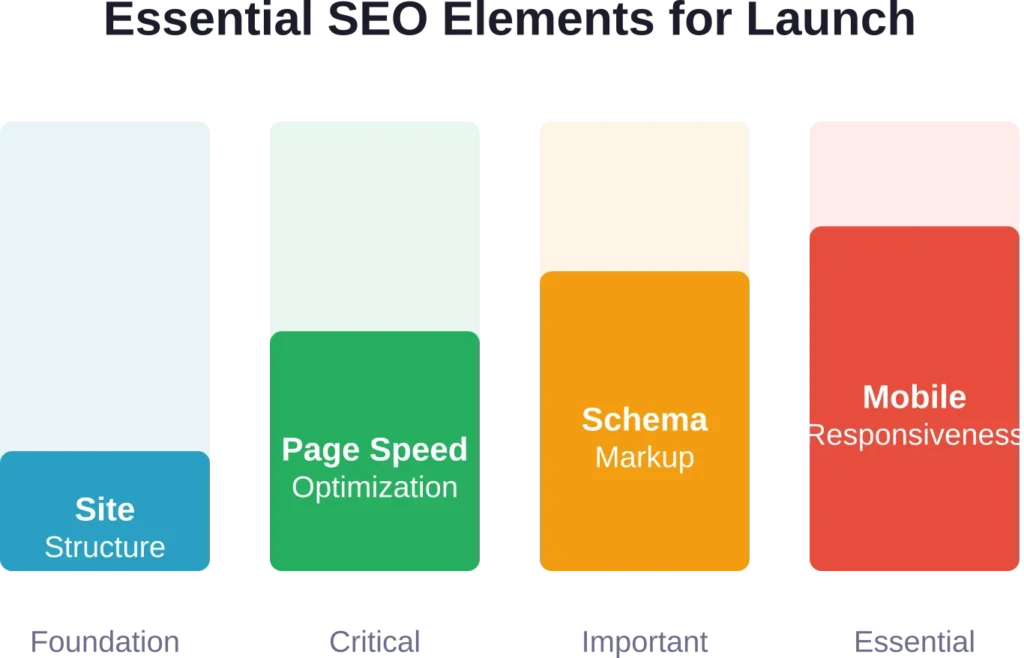
SEO Foundations That Matter From Day One
Search visibility doesn’t happen by accident. Certain technical foundations need implementation during initial development rather than retrofitted later.
Site Structure and Internal Linking
URL hierarchy should reflect information architecture. Service pages branch logically from main category pages. Blog posts include contextual links to relevant service pages.
Agencies that understand SEO design these structures proactively. Those that don’t create flat architectures that require extensive rework.
Page Speed Optimization
Mobile page load speed directly impacts search rankings. Proper image compression, lazy loading implementation, and minimal JavaScript bloat need attention during development.
Sites that prioritize visual effects over performance pay for it in organic traffic.
Schema Markup Implementation
Structured data helps search engines understand page content and display rich results. Local businesses benefit particularly from Organization and LocalBusiness schema.
Most small business sites launch without schema implementation because designers don’t consider it. Adding markup later works but represents wasted time in rankings.
The Discovery Phase: Why It Can’t Be Skipped
Agencies that jump straight to design mockups without research consistently deliver underperforming websites. The discovery phase might feel like unnecessary overhead, but the strategic foundation it provides separates conversion-focused sites from digital brochures.
Competitive Analysis
Proper discovery includes auditing 5-10 competitor websites. What conversion paths do they emphasize? How do they structure service descriptions? What trust signals appear most prominently?
This research reveals industry conventions worth following and opportunities for differentiation. Skipping it means designing in a vacuum.
User Persona Definition
Small businesses often serve multiple customer segments with different needs and pain points. Discovery phases map these personas and prioritize which to optimize for.
A site designed for enterprise buyers looks fundamentally different from one targeting individual consumers, even when selling the same product.
Conversion Goal Mapping
Not every site optimizes for the same action. Some prioritize demo requests, others phone calls, others e-commerce purchases. Discovery sessions define primary and secondary conversion goals that inform every subsequent design decision.
Sites without clear conversion priorities scatter calls-to-action inconsistently, confusing visitors about what action to take.
Maintenance and Long-Term Costs
Launch day represents the beginning of website costs, not the end. Understanding ongoing expenses prevents budget surprises.
Hosting and Infrastructure
Shared hosting runs $5-30 monthly but limits traffic capacity and provides minimal support. Managed WordPress hosting through WP Engine or similar providers costs $30-100 monthly but includes automatic backups, security scanning, and performance optimization.
Webflow hosting starts around $15-40 monthly for basic sites, scaling with traffic volume and CMS needs.
Security and Updates
WordPress sites require ongoing plugin updates, security monitoring, and backup management. Maintenance plans typically run $100-300 monthly depending on site complexity.
Webflow handles most security concerns through its hosted platform, reducing maintenance overhead.
Content Updates
Simple text changes and image swaps can be handled in-house with proper CMS training. Structural changes, new page creation, and feature additions typically require ongoing agency relationships.
Budget $500-2,000 monthly for active content programs including blog publishing, landing page creation, and continuous optimization.
Mobile-First Design in 2026
Mobile traffic now represents the majority of website visits for most small businesses. Design processes that start with desktop layouts and adapt them to mobile consistently underperform.
Touch Target Sizing
Mobile interfaces require larger tap targets than desktop hover states. Buttons and links need minimum 44×44 pixel touch areas to prevent mis-taps.
Agencies experienced in mobile-first design structure navigation and calls-to-action with these constraints from the start rather than awkwardly adapting desktop patterns.
Simplified Navigation
Desktop sites afford complex mega-menus with nested categories. Mobile interfaces need streamlined navigation with clear primary paths.
The best mobile sites eliminate secondary navigation elements entirely, focusing user attention on conversion paths rather than comprehensive browsing.
Performance on Limited Bandwidth
Mobile users often access sites on cellular connections with variable speeds. Image optimization, lazy loading, and minimal JavaScript become critical rather than optional.
Test sites on actual mobile devices with throttled connections, not just browser resize tools.
Evaluating Agency Portfolios
Portfolio review reveals more than aesthetic taste. Smart evaluation focuses on business outcomes and technical execution.
Look Beyond Visual Polish
Beautiful screenshots don’t indicate conversion performance. Look for case studies that include metrics—traffic growth, lead volume increases, conversion rate improvements.
Agencies confident in their outcomes lead with data. Those emphasizing only aesthetics often lack performance results.
Check Technical Execution
Visit portfolio sites on mobile devices. Test page load speeds using tools like Google PageSpeed Insights. Inspect source code for proper semantic HTML and schema markup.
Visual design impresses clients, but technical implementation impacts actual performance.
Evaluate Industry Experience
Agencies with deep experience in specific industries understand unique conversion dynamics, regulatory requirements, and audience expectations.
A firm that’s built five medical practice sites understands HIPAA considerations and patient trust signals. A generalist might deliver attractive design that misses critical compliance or credibility elements.
| Portfolio Element | What to Evaluate | Success Indicator |
|---|---|---|
| Case Studies | Quantitative outcomes, not just descriptions | Specific metrics: conversion rates, traffic growth, lead volume |
| Technical Quality | Page speed, mobile responsiveness, code quality | PageSpeed scores above 85, clean semantic HTML |
| Industry Relevance | Experience with similar business models | 3+ projects in target industry with documented outcomes |
| Design Consistency | Quality across entire portfolio, not just hero projects | Even older work shows solid fundamentals |
Working With Your Chosen Agency
Even excellent agencies deliver poor results when client relationships dysfunction. These practices improve collaboration.
Nail the Brief Before Kickoff
Scope changes mid-project cause budget overruns and timeline delays. Invest time upfront defining exactly what success looks like, what pages need to be built, and what functionality is required.
Ambiguous briefs lead to mismatched expectations and contentious change orders.
Provide Complete Assets Early
Designers can’t work without content, logos, brand guidelines, and product information. Compile all assets before the project officially starts.
Staggered asset delivery causes cascading delays as designers wait for inputs to proceed.
Consolidate Feedback
Internal stakeholders often have conflicting opinions. Designate a single point of contact who consolidates feedback into coherent direction.
Designers receiving contradictory inputs from multiple reviewers waste time reconciling competing visions rather than moving projects forward.
Respond to Requests Promptly
Agency timelines assume clients provide feedback and approvals within agreed windows. A project scoped for 8 weeks stretches to 12 when client responses consistently take a week instead of two days.
Track response commitments and treat them as seriously as delivery deadlines.
When to Consider a Redesign vs. Optimization
Not every struggling website needs a complete rebuild. Sometimes targeted improvements deliver better ROI.
Redesign Indicators
Complete redesigns make sense when underlying technology is outdated, site structure fundamentally misaligns with current business model, or brand positioning has shifted dramatically.
Sites built 5+ years ago often run on obsolete frameworks that can’t support modern functionality. Patching legacy systems costs more than rebuilding.
Optimization Opportunities
If the core site works but conversion rates disappoint, targeted optimization often outperforms full redesigns. A/B testing different calls-to-action, rewriting key landing pages, or improving mobile experience addresses specific friction points.
Optimization preserves SEO equity built over years. Redesigns risk traffic losses during migration even with proper redirects.
Cost-Benefit Analysis
A complete redesign might cost $15,000-40,000 and take 3-4 months. Conversion rate optimization programs run $3,000-8,000 monthly but show results within weeks.
For sites with existing traffic, optimization ROI often exceeds redesign ROI in the first year.
Questions to Ask During Agency Consultations
Initial sales calls reveal working style and competence. These questions separate capable agencies from smooth talkers.
What’s Your Discovery Process?
Detailed answers covering competitive research, user persona definition, and conversion mapping indicate strategic thinking. Vague responses suggest design-only focus without business strategy.
How Do You Handle Scope Changes?
Professional agencies have documented change order processes with clear pricing for additions. Resistance to discussing scope changes suggests poor project management.
What Metrics Do You Track Post-Launch?
Agencies focused on outcomes track conversion rates, traffic sources, and user behavior. Those focused on deliverables mention only completion and launch dates.
Can You Walk Me Through a Recent Project?
Specific project descriptions including challenges faced and solutions implemented demonstrate real experience. Generic portfolio overviews without details suggest limited involvement.
Making the Final Decision
After evaluating portfolios, checking references, and conducting consultations, several factors should weigh into the final choice.
Chemistry and Communication
Technical competence matters, but so does working relationship quality. Choose teams that communicate clearly, respond promptly, and demonstrate genuine interest in business goals.
Brilliant designers with poor communication skills create frustrating collaborations.
Availability and Timeline
In-demand agencies book weeks or months ahead. Balance agency quality against business timeline needs. A slightly less perfect agency available immediately sometimes beats the ideal partner available in three months.
Specialization Alignment
Agencies with relevant industry experience deliver better results faster. Generalists can certainly build quality sites, but specialists understand nuances that accelerate projects.
Post-Launch Support
Sites need ongoing attention—bug fixes, security updates, content changes, performance monitoring. Agencies offering strong post-launch support relationships deliver better long-term value than those disappearing after launch.
Frequently Asked Questions
Most small business website projects take 6-12 weeks from kickoff to launch. This includes discovery phases, design rounds, development, content population, and testing. Simpler template-based sites can launch in 3-4 weeks. Complex custom sites with extensive integrations may require 16+ weeks. Timeline depends heavily on prompt client feedback and asset delivery.
WordPress suits businesses needing extensive plugin functionality, complex content management, or budget-conscious long-term maintenance. Webflow works better for design-focused brands wanting visual editing control and reduced security concerns. Both platforms support professional small business sites—the choice depends on specific functionality needs, technical comfort level, and maintenance preferences.
Conversion rates vary dramatically by industry, traffic source, and conversion goal definition. B2B service sites converting 2-4 percent of visitors to qualified leads perform well. E-commerce sites converting 1-3 percent of visitors to customers meet industry benchmarks. Local service businesses should see 5-10 percent of visitors complete contact forms or phone calls. Focus on improving conversion rate over time rather than absolute benchmarks.
Basic maintenance including hosting, security updates, and backups runs $100-300 monthly for WordPress sites. Webflow maintenance costs less, primarily hosting fees of $15-40 monthly. Active content programs including blog publishing, landing page optimization, and feature additions require $500-2,000 monthly depending on scope. Budget separately for major updates or redesigns every 2-3 years.
Agencies make sense when timeline reliability matters, multiple skill sets are needed simultaneously, or ongoing support relationships are required. Freelancers work well for straightforward projects, template customizations, or maintenance work after an agency builds the initial site. Projects exceeding $10,000 typically benefit from agency infrastructure. Simpler sites under $5,000 often don’t justify agency overhead.
Ask references about communication quality, responsiveness to feedback, how scope changes were handled, whether projects stayed on budget, quality of post-launch support, and whether they would hire the agency again. Specifically request to speak with clients who had similar project types and business sizes. Generic positive testimonials matter less than detailed experiences from comparable engagements.
Industry specialization accelerates projects and improves outcomes because specialized agencies understand regulatory requirements, buyer expectations, and competitive dynamics without extensive learning curves. For regulated industries like healthcare or finance, specialization becomes critical for compliance. For less-regulated sectors, strong general capabilities with transferable experience can work well, especially when agencies demonstrate research-driven approaches during discovery.
Conclusion
Selecting a web design company represents one of the most consequential marketing decisions small businesses make. The right partner delivers a conversion-focused site that drives growth for years. The wrong choice produces an expensive digital brochure that looks good but performs poorly.
The 15 agencies profiled here have demonstrated consistent capability across small business web design. But the best agency for any specific business depends on industry, budget, timeline, and growth stage.
Prioritize agencies that lead with discovery and strategy rather than jumping straight to design. Ask detailed questions about working processes, post-launch support, and how they measure success. Check references thoroughly, focusing on clients with similar business models and project scopes.
Most importantly, remember that launch day marks the beginning of website work, not the end. Plan for ongoing optimization, content updates, and technical maintenance. Sites that convert well result from continuous testing and refinement, not one-time perfect execution.
According to the U.S. Small Business Administration, modernizing digital presence through strategic website improvements continues to be a priority for entrepreneurs looking to enhance customer acquisition and credibility in 2026. The agencies listed here represent solid starting points for those research conversations.
Ready to move forward? Start by shortlisting 3-4 agencies from this list that align with your industry and budget. Schedule discovery calls, review portfolios carefully, and check references before making final decisions. The investment in thorough evaluation pays dividends through better project outcomes and smoother collaborations.