
Quick Summary: The best website design companies in 2026 combine technical excellence with strategic vision to deliver sites that convert. This guide profiles 15 top agencies—from SaaS-focused product studios to enterprise-level digital powerhouses—each vetted for design quality, client results, and specialized expertise. Whether building from scratch or redesigning an existing platform, the right partner depends on your budget, industry, and growth goals.
Finding the right website design company isn’t just about pretty visuals anymore. In 2026, the digital landscape demands agencies that understand product thinking, conversion optimization, and user behavior at a fundamental level.
The challenge? Thousands of agencies claim expertise. Few deliver measurable results.
This guide provides analysis to help cut through the noise of generic agency listings. The agencies profiled have been analyzed based on client portfolios, project outcomes, and design philosophies to identify 15 agencies that consistently ship exceptional work. No fluff, no affiliate bias—just agencies that have earned their reputation through proven client success.
Whether launching a SaaS platform, rebuilding an enterprise site, or scaling an ecommerce brand, the agencies below represent the top tier of website design in 2026.
What Makes a Website Design Company Worth Hiring in 2026
The standards have shifted. A website isn’t a digital brochure—it’s a product that needs to perform.
Top agencies in 2026 share several characteristics. They lead with strategy, not templates. They prioritize user research over personal preference. And they measure success in business outcomes, not just design awards.
Here’s what separates exceptional agencies from the rest:
Product thinking over aesthetic decoration. The best agencies approach web design as product development. They ask about user journeys, conversion funnels, and business models before opening Figma. According to interaction design research, users typically take just 50 milliseconds to assess the visual appeal of a website—but they stay or leave based on functionality and clarity.
Research-backed decision making. Top agencies conduct user interviews, analyze competitor patterns, and test assumptions. They don’t guess what works—they validate through data.
Technical depth. Design can’t exist in isolation. The best agencies understand front-end development, performance optimization, and content management systems deeply enough to design within realistic constraints.
Specialization beats generalization. Agencies that focus on specific industries or platforms consistently outperform generalists. A SaaS-focused agency understands trial-to-paid conversion. An ecommerce specialist knows checkout psychology. This depth matters.
The agencies below demonstrate these qualities consistently.
15 Top Website Design Companies in 2026
Each agency below excels in specific contexts. Some specialize in SaaS products, others in enterprise transformation or ecommerce. Each agency profile includes core strengths, typical client profiles, and distinctive approach elements.
1. Lengreo – Complete Marketing & Tech Partner
Lengreo acts as a full-service partner that combines B2B digital marketing with hands-on website development. They build eCommerce, business, portfolio sites, and high-converting landing pages that drive measurable growth in leads and conversions. Their work integrates strategy, SEO, and technical implementation to turn websites into active lead-generation engines.
Best for: B2B companies in software, architecture, tech services, and event sectors that need websites optimized for lead generation, SEO performance, and conversion rate improvements.
Notable strength: They excel at creating websites that directly impact business metrics through hyper-personalized outreach integration, conversion optimization, and data-driven design decisions.
Contact Information:
- Website: Lengreo.com
- Phone: +31 686 147 566
- Email: [email protected]
- Address: Vrijstraat 9 C/D, 5611 AT Eindhoven, Netherlands
- LinkedIn: Lengreo
- Twitter: @Lengreo
- Instagram: @lengreo
2. Gilzor – Custom Digital Product Development
Gilzor specializes in building custom web and mobile applications from idea validation to full launch. They deliver user-centric UI/UX design that improves conversion rates, combined with full-cycle web development, prototyping, and go-to-market strategies. Their focus is on functional, attractive products that connect seamlessly with target audiences.
Best for: Startups launching new products, SMBs scaling with new sales channels, and product studios expanding their offerings through polished web and mobile experiences.
Notable strength: They create intuitive, conversion-focused designs backed by thorough business analysis and quality assurance that minimize rework and maximize user satisfaction.
Contact Information:
- Website: www.gilzor.com
- Email: [email protected]
- Address: Poland, Warsaw, Office 58, street Adama Mickiewicza 37, 01-625
- LinkedIn: www.linkedin.com/company/gilzor-softwaredevelopment
3. Oski – Smart Software Solutions for Digital Experiences
Oski designs, develops, and maintains well-engineered web solutions with strong emphasis on frontend excellence and intuitive user interfaces. Their expertise spans modern frameworks, CMS platforms, and seamless integrations that deliver aesthetically pleasing, high-performance digital experiences across industries.
Best for: Tech-forward enterprises and ambitious startups that require scalable websites, e-commerce platforms, and complex web applications with clean, responsive design and robust backend support.
Notable strength: They prioritize innovative frontend design and user experience that combines visual appeal with technical reliability and industry-specific functionality.
Contact Information:
- Website: oski.site
- Phone: +48571282759
- Email: [email protected]
- Address: Kaupmehe tn 7, 10114 Tallinn, Estonia
- LinkedIn: www.linkedin.com/company/oski-solutions
4. A-listware – UX/UI Design & Software Development

A-listware delivers vibrant web designs and comprehensive digital solutions through expert UX/UI services. They create responsive interfaces and SaaS-level user experiences that drive engagement while providing full software development, application services, and dedicated teams for end-to-end project delivery.
Best for: Enterprises, SMBs, and startups needing professional UX/UI design paired with custom software development for web portals, enterprise applications, and customer-facing digital platforms.
Notable strength: Their designers and developers work hand-in-hand to blend latest UI/UX trends with brand excellence, resulting in engaging, goal-oriented web solutions.
Contact Information:
- Website: a-listware.com
- Phone: +1 (888) 337 93 73
- Email: [email protected]
- Address: North Bergen, NJ 07047, USA
- LinkedIn: www.linkedin.com/company/a-listware
- Facebook: www.facebook.com/alistware
5. Mobian – Dedicated Teams for Production-Ready Digital Products
Mobian builds dedicated engineering teams that design, develop, and scale mobile-first and AI-enhanced digital products. They deliver end-to-end experiences from wireframes to production with clean architecture, scalable interfaces, and domain-specific solutions for complex web and mobile applications.
Best for: Companies in IT, healthcare, fintech, and logistics that need reliable, production-grade web and mobile solutions with senior-level design and development execution.
Notable strength: They emphasize full-stack delivery with strong focus on intuitive user interfaces, scalable architecture, and post-launch support that keeps digital products performing at peak levels.
Contact Information:
- Website: mobian.studio
- Phone: [email protected]
- Address: Harju maakond, Tallinn, Kesklinnalinnaosa, Masina tn 22, 10113
- LinkedIn: www.linkedin.com/company/mobian-studio
6. Locomotive – Creative Development Studio
Locomotive bridges design and development more seamlessly than most agencies. Based in Montreal, their team thinks in code—designing with technical possibilities and constraints in mind from the start.
They’re known for smooth, performance-optimized sites with sophisticated animations. Their work loads fast despite visual richness, a balance few agencies achieve.
The studio has received recognition from Awwwards and similar design platforms, but their real value lies in technical execution. They build sites that designers admire and developers respect.
Best for: Design-forward companies that refuse to compromise between visual ambition and technical performance—brands where the website itself is a product differentiator.
Notable strength: They’re equally strong in design and front-end development, eliminating the typical friction between creative vision and technical reality.
7. Huge – Digital Agency for Major Brands

Huge works at the scale of Fortune 500 companies. Part of the IPG network, they bring institutional knowledge and proven methodologies to complex digital projects.
Their expertise spans web design, mobile applications, and digital platforms. They’ve designed experiences for Google, TD Bank, and HBO—projects measured in millions of users.
What distinguishes Huge is their research capability. They employ dedicated user research teams that conduct extensive testing before, during, and after design. This rigor reduces risk on high-stakes projects.
Best for: Major corporations redesigning flagship digital properties where user research and testing rigor matter as much as visual design.
Notable strength: Research depth and organizational scale to support ongoing optimization and iteration post-launch.
8. Ueno – Design and Development for Global Brands
Ueno brings Scandinavian design sensibility—clean, functional, beautiful—to digital products. They’ve worked with Google, Airbnb, and Uber on everything from websites to mobile applications.
The agency maintains studios in San Francisco, New York, Los Angeles, and Reykjavik. This distributed structure gives them access to diverse talent while maintaining cultural cohesion through strong design principles.
Their work prioritizes clarity and usability. No unnecessary decoration, no trendy effects that age poorly. Just solid, thoughtful design that serves user needs.
Best for: Companies that value timeless design over trends, particularly B2B SaaS and fintech brands building for professional audiences.
Notable strength: They create design systems that remain relevant years after launch, reducing the need for constant redesigns.
9. Build in Amsterdam – European Digital Excellence
Build in Amsterdam represents the high standard of European digital design. They work primarily with brands that value craft, attention to detail, and strategic thinking.
The agency combines brand strategy, design, and development with an emphasis on long-term partnerships. Many of their client relationships span multiple years and evolve from web projects into broader digital ecosystems.
Their portfolio includes KLM, Heineken, and various European startups. The work demonstrates sophisticated typography, thoughtful spacing, and purposeful animation.
Best for: International brands and European companies that need agencies understanding regional design preferences and cultural nuances.
Notable strength: They excel at multilingual, multi-market websites that maintain design coherence across localized versions.
10. Area 17 – Museum-Quality Digital Experiences

Area 17 specializes in cultural institutions and organizations where content is king. They’ve designed digital experiences for museums, universities, and media companies including MoMA, Harvard, and The New York Times.
Their approach prioritizes content architecture and information design. These sites handle vast amounts of complex content—exhibitions, research, archives—and make it accessible and engaging.
The agency’s work demonstrates sophisticated typography, thoughtful content hierarchies, and navigation systems that handle complexity without confusion.
Best for: Educational institutions, cultural organizations, and media companies with extensive content libraries that need elegant organization and presentation.
Notable strength: They understand content management at scale and design systems that empower non-technical editors to maintain quality.
11. Eleken – SaaS Product Design Specialists
Eleken operates at the intersection of product design and web development, with laser focus on SaaS companies. They’re not building marketing sites—they’re designing product experiences that directly impact metrics like activation, retention, and expansion.
Founded in 2015 as a distributed team of 100+ designers and product experts, Eleken works exclusively with software companies. Their philosophy centers on making complex applications feel simple and intuitive.
What sets them apart? They’ve become startup accelerators by proxy. Their designs have contributed to clients raising significant funding: $3.6M for Datawisp, $2.3M for Floret, and $18M for Aampe. That’s not coincidence—investors notice when product design demonstrates clear thinking and market understanding.
Best for: SaaS startups and scale-ups that need product-focused web application design, particularly companies preparing for funding rounds or facing retention challenges.
Notable strength: They understand the full SaaS customer lifecycle, from trial signup flows to enterprise dashboard design. Their work prioritizes usability over decoration.
12. Clay – Enterprise Brand and Digital Experiences
Clay has built a reputation for transforming enterprise brands through sophisticated digital experiences. They work with companies like Slack, Google, and Coinbase—organizations where design directly impacts billions in market value.
Their approach combines brand strategy with technical execution. They don’t just redesign websites; they rethink how companies present themselves digitally across every touchpoint.
The agency’s work demonstrates exceptional attention to motion design, interaction patterns, and visual systems that scale across products. Their websites feel alive—animations serve purpose, not decoration.
Best for: Established companies undergoing rebrands or digital transformations, particularly B2B SaaS and fintech companies that need to signal maturity and trust.
Notable strength: They excel at creating cohesive design systems that work across marketing sites, product interfaces, and brand materials. Everything feels connected.
13. Fantasy – Interactive Storytelling and Brand Sites
Fantasy approaches web design as narrative experience. They create sites that tell stories through scroll-based animations, creative layouts, and unexpected interactions.
Based in New York, Fantasy works primarily with consumer brands, entertainment companies, and creative studios that need websites as distinctive as their products. Their portfolio includes Nike, Apple Music, and Glossier.
The agency’s sites often push technical boundaries—custom WebGL implementations, sophisticated scroll choreography, and innovative navigation patterns. These aren’t sites you forget.
Best for: Consumer brands and entertainment properties that compete on creativity and cultural relevance, where the website itself becomes a marketing asset.
Notable strength: They create memorable, shareable digital experiences that generate organic attention and social discussion.
14. Instrument – Digital Products for Growth-Stage Companies

Instrument specializes in digital products for companies at inflection points—series B SaaS startups scaling to enterprise, consumer brands expanding product lines, or established companies launching new verticals.
Their team of 150+ spans strategy, design, and engineering. This structure allows them to own projects end-to-end, from initial positioning through launch and iteration.
Clients include Stripe, Impossible Foods, and Sonos. The common thread? Companies where digital presence directly drives business growth, not just awareness.
Best for: Growth-stage companies ($10M-$100M revenue) that need websites built for scale, with complex information architectures and conversion-optimized user flows.
Notable strength: They think like product managers. Their designs prioritize user goals and business metrics over aesthetic trends.
15. DEPT (formerly Basic Agency) – Full-Service Digital for Enterprise
DEPT operates at enterprise scale with 3,500+ employees across global offices. After acquiring Basic Agency, they’ve combined boutique design sensibility with enterprise delivery capabilities.
They handle end-to-end digital transformation—from brand strategy and web design through platform implementation, content production, and ongoing optimization. For large organizations, this integration matters.
Their client roster spans Google, Nike, and Johnson & Johnson. These relationships typically extend years, evolving from project work into embedded partnerships.
Best for: Enterprise organizations that need an agency partner capable of handling complex, multi-stakeholder projects with rigorous governance and compliance requirements.
Notable strength: They navigate corporate complexity better than most boutique agencies, with proven processes for stakeholder alignment and organizational change management.
How to Choose the Right Website Design Company
The wrong agency wastes six months and six figures. The right partner accelerates growth and becomes a strategic asset.
Start with honest self-assessment. Where does the project fit in your growth trajectory? Early-stage startups need different capabilities than enterprise replatforming efforts.
Match Agency Size to Project Complexity
Small agencies (10-30 people) offer partner attention and nimble execution. Principals stay involved. Communication stays direct. But they can struggle with complex integrations or enterprise requirements.
Mid-size agencies (30-150 people) balance attention with capability. They’ve developed processes and specialization without bureaucracy. This sweet spot works well for growth-stage companies.
Large agencies (150+ people) bring institutional knowledge and resilience. Individual turnover doesn’t derail projects. They navigate corporate politics effectively. But smaller projects may not receive senior attention.
Evaluate Portfolio Depth, Not Just Aesthetic
Look beyond pretty screenshots. Ask deeper questions:
What problems did each project solve? Generic portfolio descriptions signal surface-level thinking. Strong case studies articulate business challenges, research insights, and measurable outcomes.
Do they show work in your industry? Vertical expertise accelerates projects. Agencies familiar with your market understand user expectations, competitive patterns, and regulatory constraints.
What’s the age of portfolio work? If everything dates from 2022, investigate why. High client retention indicates satisfaction.
Assess Strategic Capability
Design execution is table stakes. Strategic thinking separates good agencies from great ones.
Strong agencies challenge your assumptions. They ask uncomfortable questions about positioning, user needs, and business models. Weaker agencies take the brief without pushback.
Look for evidence of research practices. Do case studies mention user interviews, competitive analysis, or usability testing? Or just design sprints and stakeholder workshops?
Understand the Team Structure
Who actually does the work? Some agencies show senior portfolio work but staff projects with junior teams. Others maintain consistent quality through strong processes.
Ask specific questions during vetting:
- Who will be assigned to our project specifically?
- What’s their experience level and background?
- How many other projects will they handle simultaneously?
- What’s the escalation path if we hit issues?
Meet the actual team before signing. Chemistry matters on projects spanning months.
Review Their Process
Mature agencies articulate clear processes. They explain phases, deliverables, and decision points. This structure prevents scope creep and timeline drift.
Warning signs include vague timelines, undefined deliverables, or resistance to discussing process. These predict painful projects.
Strong processes balance structure with flexibility. Fixed milestones with room for iteration between them.
| Selection Criteria | Early-Stage Startups | Growth Companies | Enterprise Organizations |
|---|---|---|---|
| Key Priority | Speed and flexibility | Scalability and systems | Process and governance |
| Portfolio Evidence | Similar stage companies | Growth metrics and scale | Complex integrations |
| Team Structure | Partner involvement | Dedicated specialists | Account teams |
| Strategic Depth | Product thinking | Research capability | Change management |
Common Website Design Project Types and Timelines
Understanding typical project structures helps set realistic expectations. Timelines vary based on scope, but patterns emerge across agency work.
Marketing Website Redesign
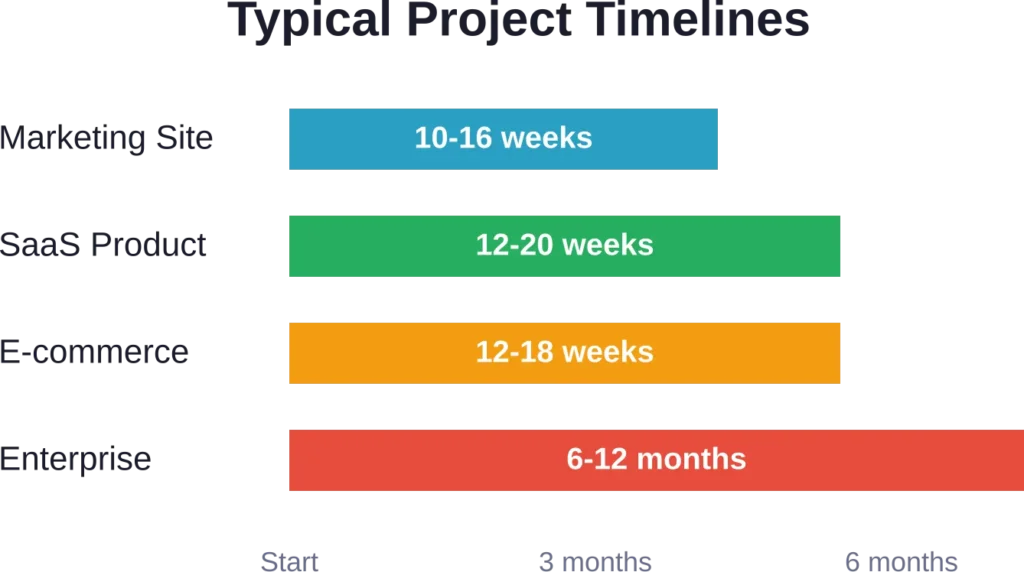
A full marketing site redesign typically spans 10-16 weeks from kickoff to launch. This includes:
Discovery and strategy (2-3 weeks) covering user research, competitive analysis, and content strategy. Teams conduct stakeholder interviews, analyze existing site data, and map user journeys.
Design phase (4-6 weeks) produces wireframes, visual design, and interactive prototypes. Multiple review cycles with stakeholder feedback happen here.
Development and implementation (4-6 weeks) builds the site in the chosen CMS, integrates with marketing tools, and optimizes performance.
Testing and launch (1-2 weeks) includes QA, accessibility testing, and staged rollout.
Complexity factors that extend timelines: custom integrations, extensive content migration, complex approval chains, or multi-language requirements.
SaaS Product Website
Product-focused sites require deeper strategic work. Expect 12-20 weeks for complete projects.
These sites prioritize conversion optimization, clear product education, and integration with trial/demo flows. Additional time goes into pricing page strategy, feature comparison tools, and customer evidence (case studies, testimonials, metrics).
The best agencies run conversion tests post-launch, iterating on key pages based on data.
Enterprise Digital Platform
Large organization projects stretch 6-12 months. Not because the work requires it—because stakeholder alignment does.
Enterprise projects involve multiple business units, legal review, security audits, and change management processes. Smart agencies build these realities into timelines rather than fighting them.
Phased rollouts work better than big-bang launches at enterprise scale. Launch to one division, gather feedback, refine, then expand.
E-commerce Site Build
E-commerce projects typically take 12-18 weeks, depending on catalog size and integration complexity.
Additional time goes into product data migration, payment gateway integration, shipping calculator configuration, and checkout flow optimization. Performance optimization matters more for e-commerce—slow sites kill conversion.
Post-launch optimization through A/B testing is essential. Initial designs rarely achieve optimal conversion immediately.
Red Flags When Vetting Website Design Companies
Some warning signs predict troubled projects. Watch for these during the vetting process.
Overpromising on Timeline or Results
Agencies that promise unrealistic timelines either don’t understand the work or plan to cut corners. A complete marketing site redesign doesn’t happen in four weeks—not with proper research, iteration, and testing.
Similarly, guarantees about traffic increases or conversion rates signal either inexperience or dishonesty. Too many variables lie outside design control.
Generic Portfolio Without Case Studies
Pretty screenshots prove nothing. Strong agencies explain their thinking through detailed case studies—the problem, the research, the strategic approach, the outcome.
If an agency can’t articulate why they made specific decisions, question whether strategic thinking actually happened.
Resistance to Process Questions
Mature agencies welcome process questions. They’ve refined their approach through dozens of projects and confidently explain how they work.
Vague answers or deflection around process suggests either inexperience or problematic track record. Either way, it predicts friction.
No Research or Discovery Phase
Agencies that jump straight to design without discovery inevitably produce work disconnected from user needs and business goals.
Quality work requires understanding—users, competitive context, business model, constraints. This takes time.
Over-Emphasis on Awards
Design awards recognize aesthetic innovation. That’s valuable, but not sufficient. Awards don’t indicate whether sites actually perform for businesses.
Strong agencies balance creative recognition with client results. Both matter, but business impact matters more.
Poor Communication During Sales Process
How agencies communicate during vetting predicts how they’ll communicate during projects. Slow responses, unclear answers, or difficulty scheduling calls during the honeymoon phase? It gets worse under deadline pressure.
Questions to Ask During Agency Evaluation
The right questions reveal agency capability and cultural fit. Use these during discovery calls and proposal reviews.
About Their Approach
- Walk me through your typical project process from kickoff to launch.
- How do you conduct user research? What methods do you use?
- How do you handle disagreements about design direction?
- What happens if we need to pause or adjust scope mid-project?
- How do you measure success after launch?
About Team and Resources
- Who specifically will work on our project?
- Can we meet the proposed team before signing?
- What happens if a key team member leaves during the project?
- How many projects will our team handle simultaneously?
- Do you work with subcontractors or keep everything in-house?
About Experience and Expertise
- What similar projects have you completed in our industry?
- What’s your experience with [our specific platform/technology]?
- Can you share examples of solving [our specific challenge]?
- What’s your typical client relationship length?
- Can we speak with 2-3 recent clients as references?
About Collaboration and Communication
- How do you prefer to communicate during projects?
- What tools do you use for project management and file sharing?
- How often should we expect formal check-ins?
- What level of client involvement do you need for success?
- How do you handle feedback and revision requests?
Strong agencies answer these questions confidently and specifically. Weak agencies give vague or generic responses.
Current Web Design Trends Shaping 2026
Design trends shift constantly, but several patterns dominate quality work in 2026.
Performance as Design Constraint
Speed isn’t optional anymore. Users expect instant loading, and Google’s ranking algorithms heavily weight Core Web Vitals.
The best agencies design within performance budgets from the start. They choose lightweight animations, optimize images during design, and collaborate closely with developers on implementation approaches.
This constraint actually improves design. Removing unnecessary elements focuses attention on what matters.
AI-Augmented Personalization
Static sites are losing ground to personalized experiences. Modern websites adapt content, navigation, and calls-to-action based on user behavior and context.
Research shows that brands sending tailored in-app messages retain between 61% and 74% of their users in the subsequent 28 days—significantly higher than generic approaches. Smart agencies build personalization capability into site architecture.
Accessibility as Standard Practice
WCAG compliance has moved from nice-to-have to requirement. Legal risk aside, accessible sites simply work better for everyone.
Top agencies test with screen readers, ensure keyboard navigation, provide proper heading hierarchy, and maintain sufficient color contrast. These practices produce clearer, more usable sites.
Modular Content Systems
Fixed page templates don’t scale. Modern sites use component-based architectures where editors assemble pages from reusable content blocks.
This approach balances design consistency with content flexibility. Marketing teams can create new pages without developer involvement while maintaining visual coherence.
Motion with Purpose
Animation serves communication, not decoration. Thoughtful motion guides attention, provides feedback, and clarifies relationships between elements.
Gratuitous animation, by contrast, just slows things down. The best agencies use motion sparingly and intentionally.
Brutalist Simplicity
Some design trends push toward extreme simplification—stark layouts, minimal color, bold typography, generous whitespace.
This aesthetic works particularly well for SaaS and B2B brands that want to signal confidence and clarity. It’s polarizing, which makes it effective for differentiation.
Platform Considerations and Technology Choices
Technology decisions impact long-term maintenance, flexibility, and cost. Strong agencies guide these choices based on real requirements, not personal preference.
Content Management Systems
WordPress dominates market share but isn’t always the right choice. Consider these factors:
WordPress offers maximum flexibility and the largest ecosystem of developers. It handles everything from simple blogs to complex e-commerce. But it requires ongoing maintenance, security updates, and can become bloated without disciplined plugin management.
Webflow provides visual development tools that empower designers to build without code. It’s excellent for marketing sites that need frequent updates. Limitations emerge with complex functionality or high-traffic sites.
Contentful, Sanity, and headless CMS options separate content management from presentation. This architecture enables omnichannel content distribution—website, mobile app, digital signage—from single content repository. More complex to set up but more flexible long-term.
Shopify dominates e-commerce for good reason. The platform handles payments, inventory, shipping, and thousands of edge cases that custom solutions miss. Unless you have truly unique requirements, don’t build custom e-commerce.
Technical Architecture Decisions
Static site generators (Gatsby, Next.js) produce blazing-fast sites by pre-rendering pages. They work brilliantly for content that updates occasionally. Dynamic content requires different approaches.
Progressive Web Apps (PWAs) bridge website and native app experiences. They work offline, send push notifications, and install to home screens. Consider for web applications with engaged user bases.
The right architecture depends on content velocity, traffic patterns, team capabilities, and long-term maintenance plans. Strong agencies explore trade-offs openly rather than pushing their preferred stack.
| Platform | Best For | Key Strengths | Limitations |
|---|---|---|---|
| WordPress | Content-heavy sites, blogs, enterprise | Flexibility, ecosystem, developer availability | Requires maintenance, security attention |
| Webflow | Marketing sites, design-forward brands | Visual development, designer control | Limited custom functionality, scaling costs |
| Contentful | Omnichannel content, enterprise | Content flexibility, API-first | Complexity, developer dependency |
| Shopify | E-commerce, product sales | Complete e-commerce solution, reliability | Template constraints, customization limits |
Beyond Launch: Optimization and Iteration
Launch day isn’t the finish line—it’s the starting line for optimization.
The best websites improve continuously based on user behavior data, conversion metrics, and changing business needs. Static sites decay as competitors innovate and user expectations evolve.
Post-Launch Testing Strategy
Smart agencies include post-launch optimization in project scope. This typically involves:
Analytics implementation and baseline measurement in the first 2-4 weeks. Identify which pages drive conversions, where users drop off, and how traffic sources perform differently.
Hypothesis-driven testing begins once baseline data accumulates. Test one variable at a time—headline messaging, call-to-action placement, form length, social proof positioning.
Iteration cycles every 4-6 weeks implement learnings. Some tests produce clear winners. Others reveal that initial designs were optimal. Both outcomes provide value.
Content Evolution
Initial launch content represents best guesses about messaging. User behavior reveals what actually resonates.
Heat maps show where users actually look. Session recordings reveal confusion points. Support tickets indicate missing information.
Use this data to refine content quarterly. Sites that evolve outperform static competitors.
Technical Maintenance
Websites require ongoing technical care. CMS platforms need security updates. Plugins require compatibility testing. Integrations occasionally break when APIs change.
Budget for monthly maintenance or hire agencies offering support retainers. Neglected sites accumulate technical debt that eventually forces expensive rebuilds.
Working Effectively With Your Chosen Agency
Project success depends as much on client behavior as agency capability. Strong partnerships require effort from both sides.
Provide Clear, Consolidated Feedback
Nothing derails projects faster than conflicting feedback from multiple stakeholders. Agencies receive eight different opinions, all presented as requirements, none acknowledging trade-offs.
Designate a single point person who consolidates internal feedback before sharing with the agency. This person makes final decisions when internal stakeholders disagree.
When providing feedback, distinguish between preferences and problems. “I don’t like blue” is a preference. “This blue doesn’t meet contrast requirements” identifies a problem. Agencies need problems, not preferences.
Trust the Expertise You’re Paying For
Agencies bring specialized knowledge. If you knew how to design high-performing websites, you wouldn’t need them.
Ask questions when you don’t understand reasoning. But resist the urge to override decisions based on personal taste. Good agencies back recommendations with research and strategic rationale.
Meet Deadlines and Commitments
Client delays cascade through project timelines. When you miss a content deadline by two weeks, the entire schedule shifts.
Agencies build buffers into schedules, but those buffers exist for genuine emergencies, not routine client disorganization.
Involve the Right People at the Right Time
Bringing senior executives into late-stage reviews invites starting over. Their feedback would have been valuable in strategy phase. At design refinement stage, it’s destructive.
Similarly, legal and compliance reviews happen at defined project gates, not continuously. Surprise requirements at launch time cause expensive delays.
Frequently Asked Questions
Professional website design costs vary significantly based on scope, complexity, and agency positioning. Marketing website redesigns from established agencies typically fall in a wide range. E-commerce sites and complex web applications cost more due to technical requirements. Enterprise platforms with custom integrations represent the highest investment. Project scope—number of pages, custom functionality, integrations, content migration—drives cost more than agency selection. Check official agency websites for current project minimums, as these change frequently.
Marketing site redesigns generally take 10-16 weeks from kickoff to launch, including discovery, design, development, and testing phases. SaaS product sites require 12-20 weeks due to additional conversion optimization work. E-commerce projects span 12-18 weeks depending on catalog complexity. Enterprise initiatives can extend 6-12 months, primarily due to stakeholder coordination and governance rather than actual design and development work. Timeline extensions usually stem from client feedback delays, scope changes, or content production bottlenecks rather than agency work pace.
Web design focuses on user experience, visual aesthetics, information architecture, and interaction patterns. Designers create layouts, choose typography, establish color systems, and map user flows. Web development translates those designs into functional code—HTML, CSS, JavaScript, and backend systems. Developers build CMS integrations, optimize performance, ensure browser compatibility, and implement functionality. The best agencies maintain strong collaboration between disciplines, with designers understanding technical constraints and developers contributing to user experience decisions. Many modern agencies blur these lines with designers who code and developers who understand design principles.
Specialized agencies consistently outperform generalists within their focus area. A SaaS-focused agency understands trial conversion, onboarding flows, and product-led growth in ways generalists don’t. Similarly, e-commerce specialists know checkout psychology, product discovery patterns, and merchandising strategies deeply. Hire specialists when your needs align with their focus and when vertical expertise matters for success. Choose full-service agencies when you need capabilities spanning multiple disciplines—brand strategy, web design, and ongoing marketing, for instance—and want a single partner managing everything. The coordination benefit sometimes outweighs the specialization advantage.
Start with process questions: How do you approach discovery and research? What deliverables do you provide at each phase? How do you handle scope changes? Then explore team structure: Who specifically will work on our project? What’s their experience level? How many simultaneous projects will they handle? Ask about their experience with your industry, platform, and specific challenges. Request client references—speaking with recent clients reveals how agencies actually work under pressure. Finally, discuss post-launch support: What happens after launch? Do you offer maintenance retainers? How do you handle urgent fixes? Strong agencies answer all these questions confidently and specifically.
Templates work well for straightforward sites with modest differentiation needs—local businesses, personal portfolios, simple service companies. Modern premium templates offer professional design and solid technical foundations at fraction of custom cost. Custom design makes sense when brand differentiation matters, when user experience directly impacts business metrics, when you have unique functional requirements, or when existing templates don’t match your content structure. Many successful sites start with templates and invest in custom design during later growth stages when ROI justifies the investment. The decision depends on business goals, budget, and timeline more than technical requirements.
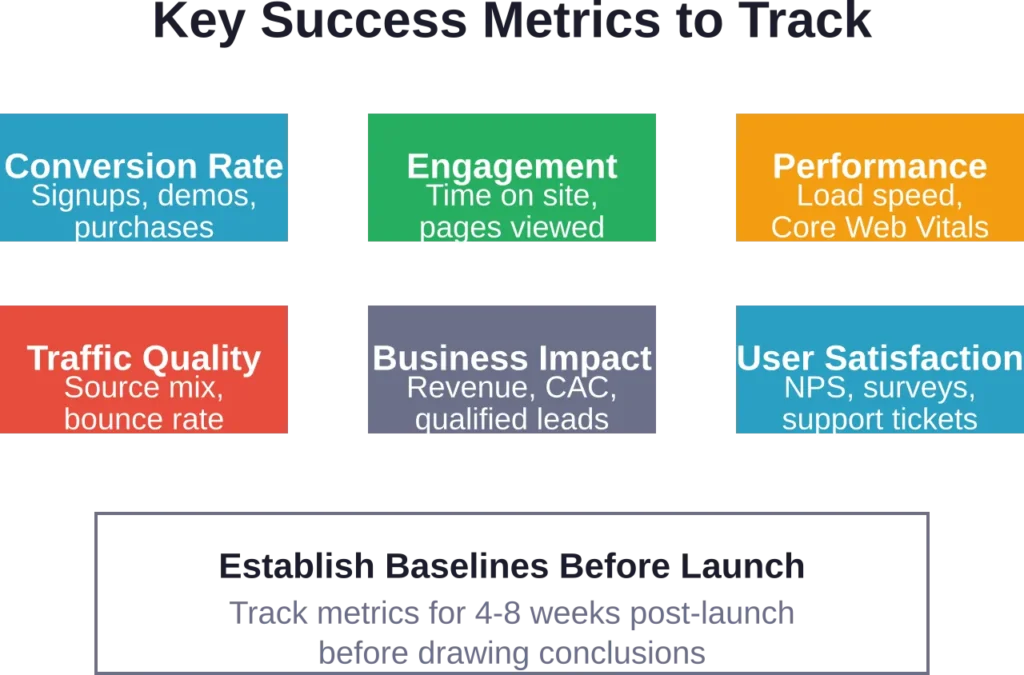
Define success metrics before the project starts, not after launch. Common metrics include conversion rate changes (trial signups, demo requests, purchases), user engagement (session duration, pages per visit, bounce rate), and business outcomes (qualified leads, revenue, customer acquisition cost). Establish baseline measurements before redesign, then track identical metrics post-launch. Statistical significance requires time—meaningful measurement typically needs 4-8 weeks of post-launch data. Beyond quantitative metrics, gather qualitative feedback through user interviews and support ticket analysis. The best measurement frameworks balance leading indicators (engagement, behavior) with lagging indicators (revenue, retention). Remember that external factors—seasonality, market conditions, marketing campaigns—influence results alongside design changes.
Final Thoughts on Selecting Your Website Design Partner
The right website design company becomes a strategic partner, not just a vendor. They challenge assumptions, bring domain expertise, and deliver work that drives measurable business results.
Start the selection process with honest self-assessment. What stage is the business? What specific challenges does the website need to solve? What internal capabilities exist to support the project?
Match agency specialization to business needs. Vertical expertise accelerates projects and improves outcomes. A SaaS specialist understands product-led growth. An e-commerce expert knows conversion optimization. A B2B agency speaks the language of complex sales cycles.
Evaluate portfolios for strategic depth, not just aesthetic appeal. Case studies should explain problems solved, research conducted, and results achieved. Pretty screenshots prove nothing about an agency’s ability to drive business outcomes.
But here’s the thing: no amount of research replaces direct conversation. Talk to the actual team who would work on the project. Ask hard questions about process, experience, and approach. Request client references and actually call them.
Trust emerges through these interactions. The best agency partnerships feel collaborative from first conversation—both sides asking questions, challenging each other, and building shared understanding.
Budget matters, obviously. But cheap agencies create expensive problems. A poorly executed website wastes the investment entirely and costs more to fix than doing it right initially.
The agencies profiled in this guide represent proven capability across different specializations and price points. Each has demonstrated consistent client success through multiple projects and market cycles.
Your website represents the business 24/7 to potential customers worldwide. It’s simultaneously a marketing asset, sales tool, and product delivery mechanism. Getting it right matters.
Choose the partner who understands that responsibility and has the track record to deliver on it.
Ready to start the conversation? Reach out to 2-3 agencies whose specialization aligns with business needs. Schedule discovery calls. Share the actual challenges being faced. The right partner will ask questions that make you think differently about the project.
That’s when you know you’ve found them.