

Quick Summary: Calling ICE to report someone triggers an investigation process where authorities evaluate the tip’s credibility and the individual’s immigration status. ICE prioritizes cases involving criminal activity, public safety threats, or immigration fraud, though not all reports lead to immediate action. The reported person may face questioning, detention, or removal proceedings depending on their circumstances and ICE’s enforcement priorities.
Immigration enforcement touches thousands of lives every year. The decision to report someone to U.S. Immigration and Customs Enforcement isn’t straightforward—and what happens afterward depends on multiple factors.
Understanding the reporting process and its consequences matters whether someone’s considering making a report or worried about being reported themselves.
How to Report an Immigration Violation
According to the official USAGov website, ICE accepts anonymous reports through two main channels. The online ICE Tip Form allows detailed submissions with attachments. Alternatively, the ICE Homeland Security Investigations Tip Line operates at 1-866-DHS-2-ICE (1-866-347-2423).
Reports can address various situations: criminal acts committed by foreign nationals, visa violations, employment authorization fraud, or public safety threats. The submission doesn’t require personal identification, though providing contact information helps investigators follow up if needed.
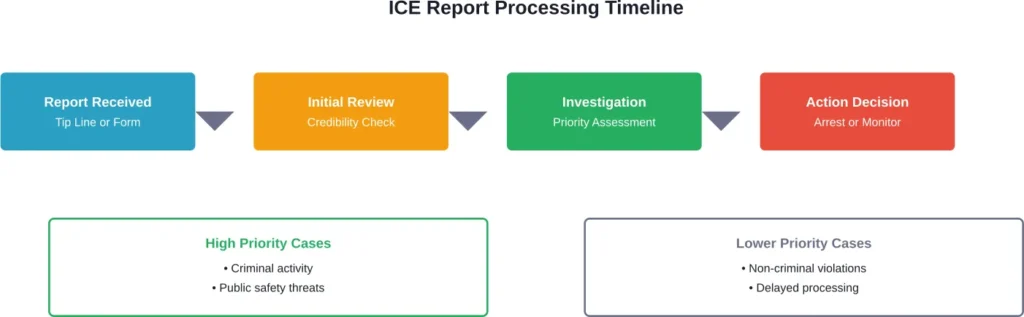
Here’s the thing though—not every report triggers immediate action. ICE receives thousands of tips and must prioritize based on resource availability and enforcement priorities.
What ICE Does After Receiving a Report
According to ICE’s official documentation, Enforcement and Removal Operations manages all aspects of the immigration enforcement process, including identification, arrest, and detention of immigration violators.
ICE evaluates each tip for credibility and actionable information. Cases involving criminal activity, threats to public safety, or immigration fraud receive higher priority. As stated in ICE’s frequently asked questions published in August 2025, officers prioritize public safety by locating and removing criminal aliens and immigration violators.
But wait. Does ICE need a warrant? According to their FAQ documentation, ICE officers and agents don’t need judicial warrants to make arrests, unlike many other law enforcement scenarios.
Potential Outcomes for the Reported Person
The consequences vary dramatically based on immigration status, criminal history, and current enforcement policies.
ICE’s Detention Management division oversees the nation’s civil immigration detention system. If authorities determine enforcement action is warranted, the individual may face arrest and detention while their case is processed.
| Immigration Status | Likely Outcome | Timeline |
|---|---|---|
| Legal permanent resident with criminal record | Investigation and possible removal proceedings | Weeks to months |
| Undocumented with criminal history | Priority for arrest and detention | Days to weeks |
| Visa overstay without criminal record | Lower priority, possible monitoring | Months to years |
| Pending asylum case | Case review, possible detention | Variable |
Not everyone reported faces immediate consequences. Some anecdotal accounts describe experiences where reports led to no action, particularly when the individual had pending legal cases or no criminal background.
Current Enforcement Priorities
As of 2025, enforcement priorities have intensified. According to a USCIS release from December 2025, officers made over 29,000 fraud referrals to the USCIS Fraud Detection and National Security Directorate. FDNS completed investigations on more than 19,300 fraud cases and identified fraud in 65% of them.
The 287(g) program, which allows state and local law enforcement to perform immigration officer functions, has expanded significantly. An ACLU report from February 26, 2026 documented rapid expansion of these agreements, with at least 77.2 million people — 32 percent of the country — now living in a county with a local law enforcement agency that has enlisted in the 287(g) program.
Legal Protections and Rights
Real talk: individuals have constitutional protections regardless of immigration status. The ACLU documented in April 2023 that ICE occasionally uses deceptive tactics, including impersonating police officers to gain entry or cooperation.
Sound familiar? According to the ACLU’s research on filming ICE interactions published March 2026, documenting encounters with federal agents is protected by the First Amendment.
Now, this is where it gets interesting. ACLU data shows that immigration arrests at courthouses have created significant barriers to justice. Surveys of 232 law enforcement officers and 103 judges across multiple states revealed that courthouse arrests damage the ability of police, prosecutors, and judges to deliver justice.
Unintended Consequences of Immigration Enforcement
Research from academic institutions reveals broader impacts. Research from Emory University’s School of Public Health examines how increased immigration enforcement activity affects public health, particularly for pregnant mothers and children in immigrant communities.
Stanford research examines how strict enforcement affects schoolchildren. Research notes that approximately 80 percent of undocumented immigrants in the U.S. during the study window were from Latin American countries, providing a proxy for undocumented population trends through Hispanic enrollment data.
Frequently Asked Questions
Can immigration reports be made anonymously?
Yes, both the ICE Tip Form and the HSI Tip Line accept anonymous reports. Providing contact information is optional but helps investigators if they need additional details.
How long does ICE take to respond to a report?
Response times vary based on case priority. High-priority cases involving criminal activity may see action within days, while non-criminal violations could take months or receive no immediate action.
Will the person know who reported them?
ICE doesn’t disclose reporter identities. If someone provides their contact information, it remains confidential and isn’t shared with the reported individual.
Does ICE investigate every report?
No. ICE prioritizes based on enforcement resources and case severity. Reports involving public safety threats, criminal activity, or fraud receive higher priority than civil violations alone.
Can employers be reported for hiring undocumented workers?
Yes. According to USCIS documentation from January 2025, employer sanctions under section 274A of the Immigration and Nationality Act address unauthorized employment. Violations can be reported through official channels.
What happens if ICE shows up at someone’s home?
Individuals aren’t required to open the door without a judicial warrant signed by a judge. ICE administrative warrants don’t grant entry authority. People have the right to remain silent and request an attorney.
Can false immigration reports lead to legal consequences?
While ICE accepts anonymous tips, knowingly filing false reports to harass or harm someone could potentially violate other laws. USCIS actively works to detect fraud and false information in immigration matters.
Conclusion
The immigration reporting process involves multiple stages and variable outcomes. ICE evaluates each case based on credibility, enforcement priorities, and available resources.
Those considering making a report should understand the serious implications for all parties involved. Those concerned about being reported should know their constitutional rights and seek legal counsel from qualified immigration attorneys.
Immigration enforcement continues evolving with policy changes and shifting priorities. Staying informed about current procedures and protections helps everyone navigate this complex landscape.