

Quick Summary: If you don’t file your taxes but don’t owe anything, you generally won’t face the standard penalties that apply when you owe money. However, you might still miss out on refunds you’re entitled to, and in some cases you could face a minimum penalty if you’re more than 60 days late. The IRS still expects you to file if you meet the income thresholds, regardless of whether you owe taxes.
Tax season brings stress for millions of Americans. But what happens when you skip filing altogether and don’t actually owe the government any money?
The answer isn’t as straightforward as you might think. While the IRS won’t come after you with the same intensity as someone who owes thousands, there are still consequences worth understanding.
According to the IRS, most U.S. citizens or permanent residents who work in the country need to file a tax return if their income exceeds certain thresholds. The thing is, whether you owe taxes and whether you’re required to file are two entirely different questions.
Do You Actually Need to File?
Here’s where it gets interesting. Not everyone needs to file a tax return, even if they worked during the year.
The IRS sets specific income thresholds based on your filing status and age. For the 2025 tax year, if you were under 65 at the end of 2025, you need to file if you made:
| Filing Status | Gross Income Threshold |
|---|---|
| Single | $15,750 or more |
| Head of household | $23,625 or more |
| Married filing jointly | $31,500 or more |
| Married filing separately | $5 or more |
Gross income means your total income from all sources before any deductions. So those retirement contributions and student loan interest deductions don’t help you get below the threshold.
But wait. If you’re self-employed, the rules change completely. According to IRS guidelines, anyone with net earnings from self-employment of $400 or more must file a return. That side hustle driving for a rideshare company? Yeah, that counts.
The Failure to File Penalty When You Owe Nothing
So what actually happens if you don’t file but meet the income requirements?
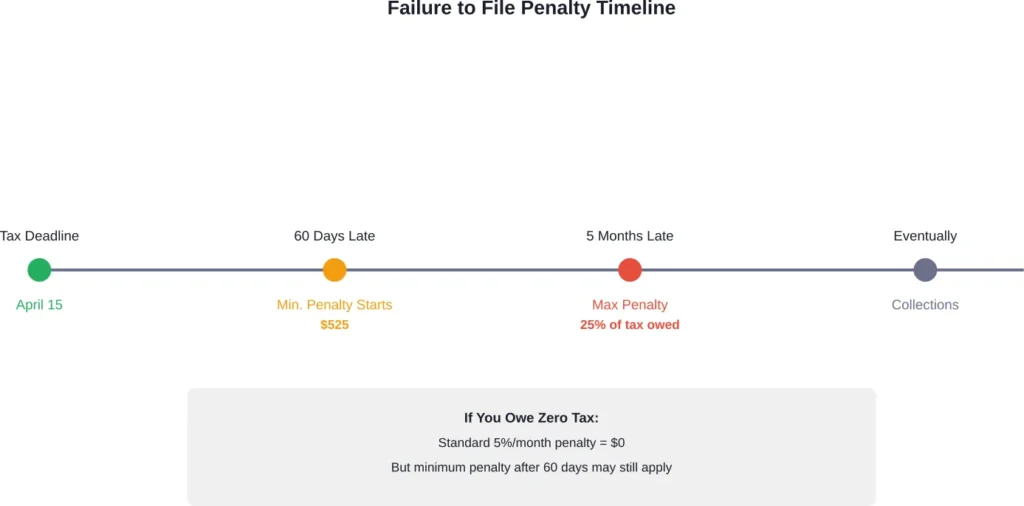
The standard failure to file penalty is 5% of the unpaid taxes for each month your return is late, maxing out at 25%. The IRS calculates this penalty by taking the tax required to be shown on your return, subtracting any tax you paid on time through withholding or estimated payments, subtracting available refundable credits, then multiplying by 5% per month.
Here’s the thing though—if you don’t owe any tax, that calculation results in zero. Five percent of nothing is still nothing.
Real talk: most people who don’t owe taxes won’t face the standard failure to file penalty at all.
The 60-Day Minimum Penalty Exception
But there’s a catch. And it’s an important one.
If your return is more than 60 days late, the IRS can assess a minimum penalty regardless of whether you owe taxes. For returns due after December 31, 2025, that minimum penalty is $525.
This minimum penalty applies even when your actual tax liability is zero. The IRS expects compliance with filing requirements, and this provision exists to enforce that expectation.
That said, the IRS typically focuses enforcement efforts on taxpayers who actually owe money. The IRS sends approximately 170 million notices to individual taxpayers annually, many of which are automated compliance reminders. But that doesn’t mean it can’t happen.
What You Lose by Not Filing
Penalties aren’t the only consequence. Sometimes what you lose matters more than what you pay.
Missing Out on Refunds
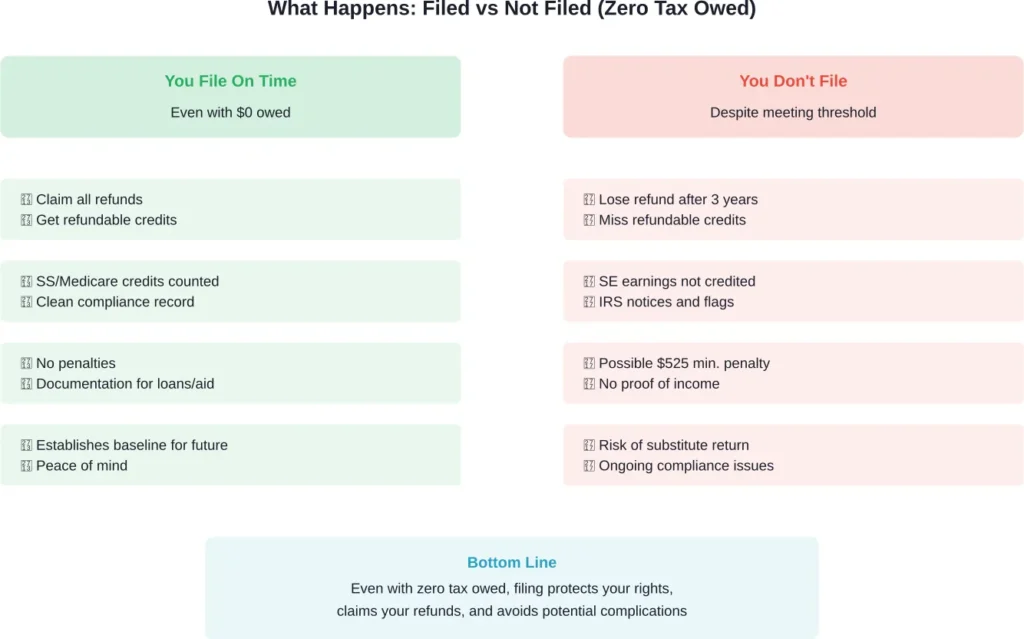
If you had taxes withheld from your paycheck throughout the year but don’t file a return, that money stays with the IRS. Forever.
The IRS doesn’t automatically send you a refund just because they have your withholding records. You need to file a return to claim that money back. And you only have three years from the original filing deadline to claim a refund.
Miss that window? The money becomes property of the U.S. Treasury.
Refundable Tax Credits Left on the Table
Even more valuable than basic refunds are refundable tax credits. These credits can result in a refund even if you had zero income tax withheld.
The Earned Income Tax Credit alone can be worth thousands of dollars for eligible taxpayers. The Child Tax Credit, American Opportunity Tax Credit, and other refundable credits represent real money that requires filing to claim.
According to Treasury Department data from 2021, wage earners with third-party reported income exhibit near-perfect compliance rates. Those who don’t file despite having refundable credits available are essentially giving the government an interest-free loan they’ll never get back.
Social Security and Medicare Credits
For self-employed individuals, not filing means those earnings don’t get credited toward Social Security and Medicare benefits. This can reduce your benefits when you retire or become disabled.
The IRS shares tax information with the Social Security Administration. No tax return means no record of those earnings for benefit calculations.
When the IRS Takes Action
Look, the IRS has limited resources. They prioritize cases where they can collect revenue.
If you don’t file and don’t owe taxes, you’re not exactly at the top of their enforcement list. But that doesn’t mean you’re completely off the radar.
Automated Notices
The IRS sends approximately 170 million notices to individual taxpayers every year. Many of these are automated reminders about unfiled returns.
If the IRS has third-party income reports showing you earned above the filing threshold, their systems will eventually flag your missing return. You’ll likely receive a notice requesting that you file.
These notices don’t necessarily mean penalties are coming. They’re often just compliance reminders. But ignoring them isn’t smart.
Substitute for Return
In some cases, the IRS can prepare a substitute tax return on your behalf. This happens when you have significant income reported by third parties but haven’t filed your own return.
Here’s the problem: the IRS substitute return won’t include deductions or credits you’re entitled to. It calculates tax based on standard deductions only, potentially showing that you owe money even if a properly prepared return would show you owe nothing.
Once the IRS assesses tax based on a substitute return, the burden shifts to you to prove otherwise by filing your actual return.
Special Situations That Complicate Things
Some scenarios make the “don’t file, don’t owe” situation more complex.
Dependents and Students
If someone else can claim you as a dependent, different rules apply. The income thresholds change, and you might need to file even with relatively modest earnings.
For dependents, the requirement to file depends on whether income is earned (from working) or unearned (from investments). The thresholds are lower for unearned income.
Self-Employment Income
That $400 self-employment threshold mentioned earlier is serious. It’s much lower than the standard filing thresholds because self-employment tax applies even when income tax doesn’t.
Self-employment tax covers Social Security and Medicare contributions. Even if you owe no income tax, you might owe self-employment tax. Not filing means not paying into the system that funds your future benefits.
Advance Premium Tax Credits
If you received advance payments of the premium tax credit for health insurance through the marketplace, you must file a return to reconcile those payments. This applies regardless of your income level or whether you owe income tax.
Failing to file when you received advance premium tax credits can make you ineligible for those credits in future years.
Filing Past Due Returns
Okay, so what if you’re reading this and realized you should have filed for previous years?
The IRS makes it relatively straightforward to file past due returns. You file them the same way you’d file a current return, sending them to the same location.
If you’ve already received a notice from the IRS, send your past due return to the specific address shown on that notice instead.
Why File Late Returns Even With Zero Liability
Beyond avoiding potential penalties, filing past due returns helps you:
- Claim refunds you’re entitled to (within the three-year window)
- Establish compliance for future years
- Provide documentation for loan applications, financial aid, and government benefits
- Get credit for Social Security and Medicare earnings
- Stop receiving IRS notices and reminders
The IRS notes that filing voluntarily is always better than waiting for enforcement action. Even when you don’t owe money, proactive filing demonstrates good faith compliance.
Practical Steps to Take
If you haven’t filed and meet the income thresholds, here’s what makes sense:
First, determine whether you actually need to file. Check your gross income against the thresholds for your filing status. Don’t forget about self-employment income or other special situations that might require filing.
Second, gather your income documents. W-2s, 1099s, and other tax forms should be available from employers and financial institutions. If you lost them, you can request wage and income transcripts from the IRS.
Third, calculate whether you’re actually owed a refund. Many people who think they owe nothing are actually entitled to refunds from withholding or refundable credits.
Fourth, file as soon as practical. The sooner you file, the sooner you can claim any refunds and stop worrying about compliance issues.
| Situation | Required to File? | Penalty Risk |
|---|---|---|
| Income below threshold, no SE income | No | None |
| Income above threshold, zero tax owed | Yes | Possible $525 minimum after 60 days |
| Self-employment income over $400 | Yes | Penalties plus SE tax owed |
| Received advance premium tax credits | Yes | Future credit eligibility at risk |
| Want to claim refundable credits | Must file to claim | None, but lose credits after 3 years |
The Bigger Picture
Filing requirements exist for reasons beyond just collecting taxes. The tax system serves multiple purposes: revenue collection, benefit administration, income verification, and economic policy implementation.
When you don’t file despite meeting the requirements, you’re not just risking penalties. You’re potentially missing benefits, creating compliance problems for future years, and losing documentation you might need for non-tax purposes.
Generally speaking, the administrative burden of filing a simple return when you owe nothing is minimal compared to the potential downsides of not filing.
Modern tax software makes filing straightforward even for people with simple tax situations. Many taxpayers with basic returns qualify for free filing options through the IRS Free File program.
Frequently Asked Questions
Criminal prosecution for failure to file is extremely rare and typically reserved for cases involving tax evasion, fraud, or substantial amounts of unpaid taxes. If you don’t owe taxes, criminal prosecution is highly unlikely. However, willfully failing to file when required is technically a misdemeanor. The IRS focuses criminal enforcement on cases where they can demonstrate intentional evasion of significant tax liabilities, not simple failures to file zero-liability returns.
There’s no statute of limitations on the requirement to file. If you meet the income thresholds for a given year, you’re required to file a return for that year indefinitely. However, the three-year window to claim refunds creates a practical deadline. After three years from the original due date, you lose the right to claim any refund you were entitled to, making late filing less beneficial though still technically required.
Not filing a tax return by itself doesn’t directly impact your credit score. The IRS doesn’t report filing status to credit bureaus. However, if the IRS later assesses taxes against you through a substitute return and you don’t pay, they can file a tax lien. Tax liens can appear on your credit report and significantly damage your credit score. Additionally, not having tax returns can make it harder to qualify for mortgages and other loans that require income documentation.
The IRS offers multiple free filing options. The Free File program provides free tax software for taxpayers with income below certain thresholds. Volunteer Income Tax Assistance (VITA) and Tax Counseling for the Elderly (TCE) programs offer free tax preparation help. If your return is simple—just W-2 income with standard deductions—you can often complete it yourself in less than an hour using free software. The cost of professional preparation shouldn’t prevent you from filing a required return.
Yes, you can and should file all past due returns at the same time if you have multiple years unfiled. Prepare a separate return for each tax year, using the forms and tax law that applied to that specific year. Send them to the IRS together or separately. Filing all past due returns at once demonstrates good faith compliance and helps resolve your situation completely rather than piecemeal.
If you don’t file a return to claim a refund within three years of the original due date, the money becomes property of the U.S. Treasury. There’s no exception to this rule. The IRS holds onto the money for the three-year window, but after that, you permanently lose the right to claim it. This applies to all refunds, including those from overwithholding and refundable credits. The three-year period starts from the original filing deadline, not from when you actually file.
In most cases, yes. Employers, banks, investment companies, and other payers send copies of W-2s, 1099s, and other information returns to the IRS. The IRS computer systems match this third-party reporting against filed tax returns. If you have income reported to the IRS but don’t file a return, their systems will eventually flag the discrepancy. The IRS receives billions of information returns annually and uses automated matching to identify non-filers.
Final Thoughts
Not filing taxes when you don’t owe anything might seem harmless. After all, if there’s no money at stake, what’s the big deal?
But the reality is more nuanced. You risk minimum penalties, lose potential refunds, miss out on valuable credits, and create complications that can follow you for years.
The filing requirement exists regardless of whether you owe taxes. Meeting that requirement protects your interests and maintains your compliance standing with the IRS.
If you’re behind on filing, take action now. Gather your documents, determine what you owe or are owed, and file those returns. The process is usually simpler than you think, and the peace of mind is worth the effort.
Need help getting caught up on unfiled returns? Consider consulting a tax professional or using IRS free filing resources to get compliant and protect your financial future.