
Quick Summary: Failing to pay child support can result in serious legal and financial consequences, including wage garnishment, tax refund seizure, driver’s license suspension, and passport denial. Federal law makes it a crime to willfully fail to pay child support exceeding $5,000 or unpaid for more than one year, with penalties ranging from misdemeanors to felonies carrying up to two years in prison.
Child support obligations don’t disappear just because payments stop. When support goes unpaid, both state and federal enforcement mechanisms kick in, creating a cascade of consequences that can disrupt every aspect of life.
Understanding what happens when child support payments lapse is critical for non-custodial parents facing financial difficulties. The legal system treats unpaid child support seriously, with enforcement tools ranging from administrative penalties to criminal prosecution.
State-Level Enforcement Actions
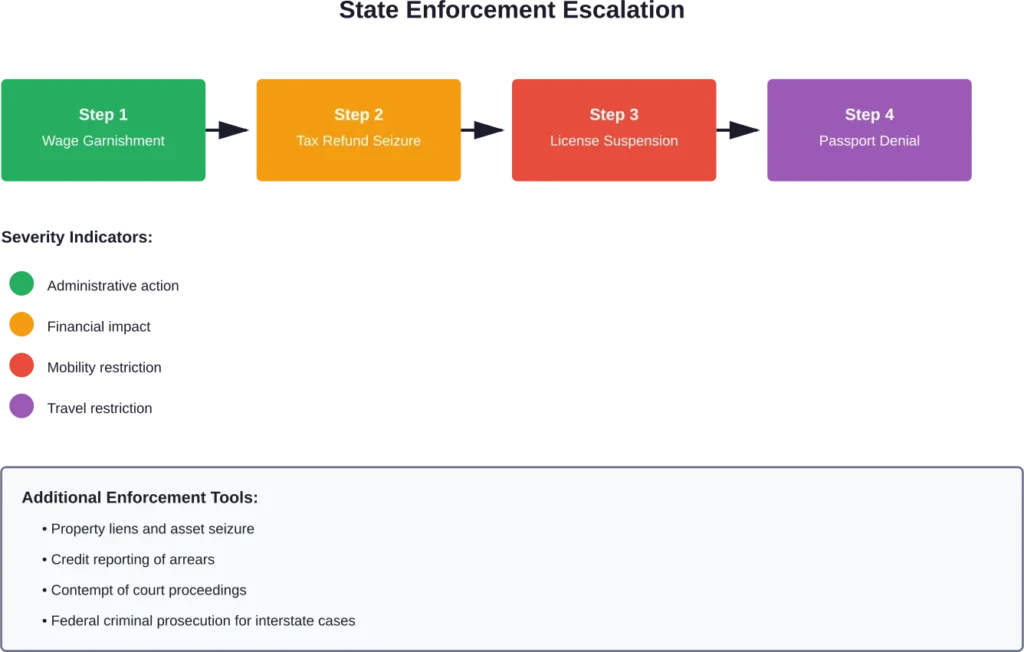
State child support agencies have multiple enforcement tools at their disposal. These administrative actions don’t require additional court hearings and can be implemented relatively quickly.
Wage garnishment is typically the first enforcement action. Child support agencies can direct employers to withhold support payments directly from paychecks through Income Withholding Orders (IWOs). The IRS can also seize tax refunds to cover past-due amounts through the Treasury Offset Program.
Driver’s license suspension occurs when arrears exceed certain thresholds. Many states suspend professional licenses, recreational licenses, and even vehicle registrations for parents with significant unpaid support.
Here’s the thing though—passport denial is a federal enforcement tool that kicks in when arrears exceed $2,500. The State Department won’t issue or renew passports for parents who owe this amount or more.
Federal Criminal Penalties
When child support cases cross state lines, federal law steps in. 18 U.S.C. § 228 makes it a federal crime to willfully fail to pay child support under specific circumstances.
The Child Support Recovery Act of 1992 established federal jurisdiction when unpaid support exceeds $5,000 or remains unpaid for more than one year, and the child lives in another state. These cases are prosecuted as misdemeanors, punishable by up to six months in prison.
But wait. When arrears exceed $10,000 or remain unpaid for two years or longer, the offense escalates to a felony. According to federal guidelines, felony convictions can result in up to two years in prison.
| Arrears Amount/Duration | Federal Classification | Maximum Penalty |
|---|---|---|
| Over $5,000 or 1+ year unpaid | Misdemeanor | 6 months imprisonment |
| Over $10,000 or 2+ years unpaid | Felony | 2 years imprisonment |
| Interstate travel to evade support | Felony | 2 years imprisonment |
Civil Contempt and Jail Time
State courts can hold non-paying parents in civil contempt. The key legal distinction is that contempt requires proving the parent has the financial ability to pay but willfully refuses.
Civil contempt proceedings for child support can result in incarceration. In Turner v. Rogers, a documented case involved a parent ordered to pay $51.73 per week beginning in June 2003 who was held in contempt five times over three years for failure to pay.
Real talk: jail time for civil contempt is meant to be coercive, not punitive. Parents can typically secure release by paying the owed amount or demonstrating inability to pay.
What to Do If Payments Are Unaffordable
Financial hardship doesn’t automatically excuse child support obligations. However, legal options exist for parents genuinely unable to pay.
Court modification is the primary solution. Child support orders can be adjusted when circumstances change significantly—job loss, medical emergencies, or substantial income reduction. According to state child support agencies, modifications require filing a formal petition with the court that issued the original order.
The critical rule? Never just stop paying. Arrears continue accumulating even during financial hardship, and enforcement actions proceed regardless of current financial circumstances. According to recent research, approximately 25.9 percent of custodial parents receive nothing at all from child support orders, while 43.4 percent receive everything owed and 30.4 percent receive partial payments.
Documentation is essential. Parents seeking modification should gather evidence of changed circumstances: pay stubs, termination notices, medical bills, or disability documentation.
Frequently Asked Questions
No. Child support obligations are non-dischargeable debts under federal bankruptcy law. Filing for bankruptcy won’t eliminate past-due support payments.
Generally speaking, child support arrears don’t expire. They remain collectible indefinitely in most states, even after the child reaches adulthood. Interest continues accruing on unpaid balances—some states charge 1% per month.
No. Visitation rights and child support obligations are separate legal issues. Courts don’t allow custodial parents to withhold visitation because support payments are late.
The IRS can intercept federal tax refunds through the Treasury Offset Program to pay past-due child support. Tax refunds can be applied to prior federal and state liabilities including child support arrears.
Administrative actions like wage garnishment can begin almost immediately after payments are missed. License suspensions and passport denials typically require larger arrears amounts or longer periods of non-payment.
Yes. Many jurisdictions impose interest on past-due child support at rates of 1% per month on unpaid balances.
Most states have no statute of limitations on child support collection. Agencies can pursue arrears decades after they accrued, using enforcement tools like tax refund intercepts and wage garnishment indefinitely.
Conclusion
The consequences of unpaid child support extend far beyond financial penalties. From administrative enforcement actions to federal criminal charges, the legal system has extensive tools to compel payment.
Parents facing genuine financial hardship should immediately pursue court modification rather than simply stopping payments. Legal assistance is available through state child support agencies and family law attorneys.
Contact a family law attorney or your state child support enforcement agency if struggling with payments. Early intervention prevents the escalation of enforcement actions and protects parental rights.