

Quick Summary: Failing to pay property taxes triggers a cascade of consequences: penalties and interest accumulate immediately, followed by tax liens that damage credit and prevent property sales. Most taxing authorities will eventually sell either the lien or the property itself through a tax sale, which can result in complete loss of ownership. However, redemption periods in most states allow homeowners to reclaim their property by paying the debt plus fees before final foreclosure.
Property taxes fund essential local services—schools, libraries, parks, emergency services, road maintenance. Every property owner faces this obligation, yet the question remains: what actually happens when those bills go unpaid?
The answer isn’t simple. And it’s not the same everywhere.
The timeline from missed payment to complete property loss varies dramatically by jurisdiction. But one thing stays consistent: taxing authorities have powerful collection mechanisms at their disposal, and they will use them.
How Property Taxes Work
Local governments assess property values and apply tax rates to fund municipal operations. The tax authority—typically county or city governments—sends bills annually or semi-annually.
These aren’t optional payments. Property taxes create what’s called a “super lien” that takes priority over nearly all other debts, including mortgages. That legal status gives taxing authorities extraordinary collection power.
The revenue supports public infrastructure that benefits the community. When owners don’t pay, that burden shifts to taxpaying neighbors.
The Immediate Consequences
Miss a property tax deadline, and the clock starts ticking.
Penalties and Interest Accumulate Fast
Most jurisdictions impose penalties immediately after the due date passes. Interest begins accruing monthly or even daily, depending on local ordinances.
These aren’t trivial amounts. Interest rates and penalty structures vary, but combined charges can easily exceed 10-15% annually. The debt compounds quickly.
Communication From the Tax Authority
Expect notices. Tax collectors send delinquency letters outlining the amount owed, accumulated penalties, and payment deadlines.
Ignoring these notices doesn’t make them disappear. The legal process continues whether or not the owner responds.
Tax Liens: The Legal Claim Against Your Property
When property taxes remain unpaid, the taxing authority files a tax lien. This public record attaches to the property itself, not just the owner.
What does that mean practically?
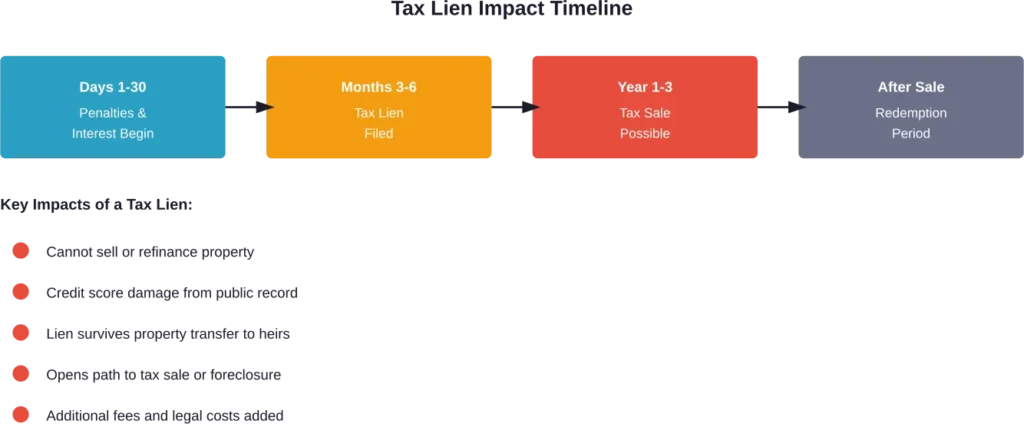
The lien prevents property sales or refinancing until the debt is satisfied. Title companies won’t clear transactions with outstanding tax liens.
Credit reporting agencies may include tax liens in public records, damaging credit scores. This makes securing loans difficult.
The lien remains attached even if the property transfers to heirs or new owners attempt to take possession.
Tax Sales: When the Government Takes Action
Eventually, the taxing authority moves to recover the debt through a tax sale. Two primary types exist.
Tax Lien Sales
Some jurisdictions sell the lien itself to private investors. The investor pays the outstanding taxes to the government, then earns interest on the debt as the property owner repays them.
Interest rates vary. According to government sources, PACE financing has an average range of 6-8% interest rate with additional associated fees, typically repaid over 15 to 20 years, though tax lien rates often differ and can be higher.
If the owner never pays, the lien holder can eventually foreclose.
Tax Deed Sales
Other jurisdictions sell the property itself. The tax authority auctions the property to the highest bidder, transferring ownership entirely.
This is where property owners face complete loss.
Can You Actually Lose Your Home?
Yes. Absolutely.
Consider the Tyler v. Hennepin County case. Geraldine Tyler, past age 80, moved from her one-bedroom condominium into a senior community in 2010. Beginning in 2011, she stopped paying real estate taxes on the condominium. The county eventually sold the property through tax foreclosure.
The property sold for significantly more than the tax debt. This raised constitutional questions about whether governments could keep surplus proceeds—equity that belonged to the homeowner.
Here’s the thing though—not all states handled surplus equity the same way.
Equity and Surplus Proceeds
Most states and the federal government now require that profits go to the taxpayer after a property is sold to satisfy an outstanding tax debt. For example, if the owner owed $15,000 in taxes, but the property sold for $40,000, the $25,000 in profits would go to the homeowner.
But historically, some states allowed governments to keep all proceeds. Legal challenges have addressed these practices, protecting property owners’ constitutional rights to equity.
How Long Before Foreclosure Happens?
The timeline varies dramatically by state and local jurisdiction.
| Stage | Typical Timeframe | What Happens |
|---|---|---|
| Initial Delinquency | 1-30 days after due date | Penalties and interest begin accruing |
| Tax Lien Filing | 3-6 months | Public record attached to property |
| Tax Sale Eligibility | 1-3 years | Property becomes eligible for lien/deed sale |
| Actual Tax Sale | 2-5 years typically | Lien or property sold to investor/buyer |
| Redemption Period | 6 months – 3 years | Owner can reclaim by paying debt plus costs |
Some states move aggressively. Others provide extended grace periods. Local budget pressures influence how quickly authorities pursue collections.
Redemption Rights: Your Last Chance
Most states provide a redemption period after a tax sale. During this window, the original owner can reclaim the property by paying the full tax debt, accumulated interest, penalties, and sale-related costs.
Redemption periods range from six months to three years depending on jurisdiction. But they require coming up with substantial funds quickly.
Miss the redemption deadline, and ownership transfers permanently.
Special Considerations and Complications
Mortgage Lenders and Tax Payments
If a mortgage exists, most loan agreements require the lender to pay delinquent taxes to protect their collateral. The lender then adds those costs to the mortgage debt.
This doesn’t eliminate the owner’s obligation—it just shifts who’s owed.
Tax Debt and Bankruptcy
Property tax debt survives most bankruptcy filings. The lien remains attached even after personal liability is discharged.
Chapter 13 bankruptcy may allow restructuring tax debt into a payment plan, but the obligation persists.
Debt Cancellation and Tax Implications
According to IRS guidance, when debt is forgiven, it typically becomes taxable income. The Mortgage Forgiveness Debt Relief Act of 2007 generally allows taxpayers to exclude income from the discharge of debt on their principal residence for debt forgiven in calendar years 2007 through 2017. Up to $2 million of forgiven debt is eligible for this exclusion ($1 million if married filing separately).
Here’s a simplified example from IRS documentation: borrow $10,000 and default after paying back $2,000. If the lender cannot collect the remaining debt, there’s a cancellation of debt of $8,000, which generally becomes taxable income.
Current tax treatment of forgiven property tax debt may differ—consult current IRS guidance.
Options When You Can’t Pay
Facing property tax delinquency doesn’t mean immediate hopelessness. Several options exist.
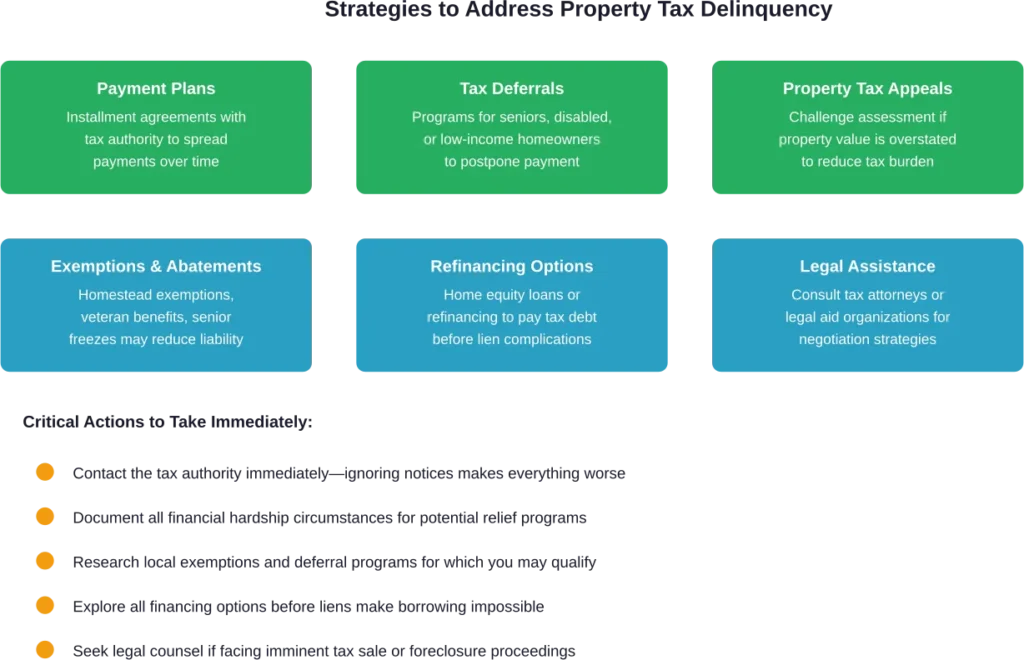
Payment Plans
Many tax authorities offer installment agreements. These spread the debt over months or years, making payments manageable.
Application processes vary. Some require demonstrating financial hardship. Others accept any property owner willing to commit to a schedule.
Tax Deferral Programs
Certain jurisdictions offer deferral programs for seniors, disabled homeowners, or those experiencing financial hardship. These postpone tax obligations until the property sells or ownership transfers.
Deferred taxes typically accrue interest, but at lower rates than penalties.
Property Tax Exemptions
Homestead exemptions, veteran benefits, senior freezes, and disability exemptions can significantly reduce property tax liability. Many homeowners don’t realize they qualify.
Research local programs. The savings can be substantial.
Challenging the Assessment
Property assessments determine tax bills. If the assessed value exceeds actual market value, appeal the assessment.
Successful appeals reduce the tax burden going forward and may retroactively adjust current bills.
What Happens to Other Debts?
Property tax liens take priority over virtually all other debts, including mortgages. When a tax sale occurs, the mortgage lender’s security interest gets wiped out in many cases.
This explains why mortgage servicers pay delinquent taxes—it protects their collateral.
Other judgment liens, HOA liens, and mechanic’s liens typically subordinate to tax liens.
Frequently Asked Questions
The timeline varies by jurisdiction but typically ranges from one to five years. Some states allow tax sales after just one year of delinquency, while others wait three years or longer. Redemption periods after a tax sale add another six months to three years before ownership transfers permanently.
Partial payments reduce the total debt but don’t stop the collection process. Penalties and interest continue accruing on the unpaid balance. The taxing authority can still file liens and pursue tax sales for the remaining amount. Many jurisdictions accept partial payments as part of formal installment plans, but this requires arrangement with the tax collector.
Direct negotiation to reduce the principal tax amount is rare—taxes reflect legal obligations based on property assessments. However, many tax authorities negotiate payment plans, may reduce penalties in hardship cases, and sometimes offer settlement programs. Challenging the underlying property assessment can reduce future tax bills if the valuation was incorrect.
No. Homeowners insurance covers property damage, liability claims, and similar risks. It does not cover property tax obligations, which remain the owner’s responsibility regardless of insurance coverage.
Property tax liens remain attached to the property regardless of ownership changes. When someone dies, the estate becomes responsible for paying outstanding taxes before the property can transfer to heirs. If the estate cannot pay, the taxing authority can force a tax sale, and heirs receive any surplus proceeds after debts are satisfied.
Technically yes, but practically very difficult. Title companies won’t insure transactions with outstanding tax liens, and mortgage lenders won’t fund purchases. Cash buyers can acquire properties with tax liens, but they assume responsibility for the debt. The lien must be satisfied before clear title transfers.
Tax liens may appear in public records sections of credit reports, potentially damaging credit scores. Recent changes to credit reporting practices removed some tax liens from consumer credit reports, but lenders and title companies still discover them through public record searches during loan applications or property transactions.
The Bottom Line
Property tax delinquency starts small but escalates quickly. Penalties compound, liens attach, and eventually the taxing authority sells either the lien or the property itself.
The consequences are serious: damaged credit, inability to sell or refinance, and ultimately complete loss of property ownership.
But the situation isn’t hopeless if addressed early. Payment plans, deferral programs, exemptions, and assessment appeals provide paths forward. The critical factor is action—ignoring the problem guarantees the worst outcomes.
Facing property tax trouble? Contact the local tax authority immediately to explore options. Every jurisdiction offers some form of assistance, and early communication dramatically improves available solutions. Don’t wait until the tax sale notice arrives—by then, options narrow considerably and costs multiply.