
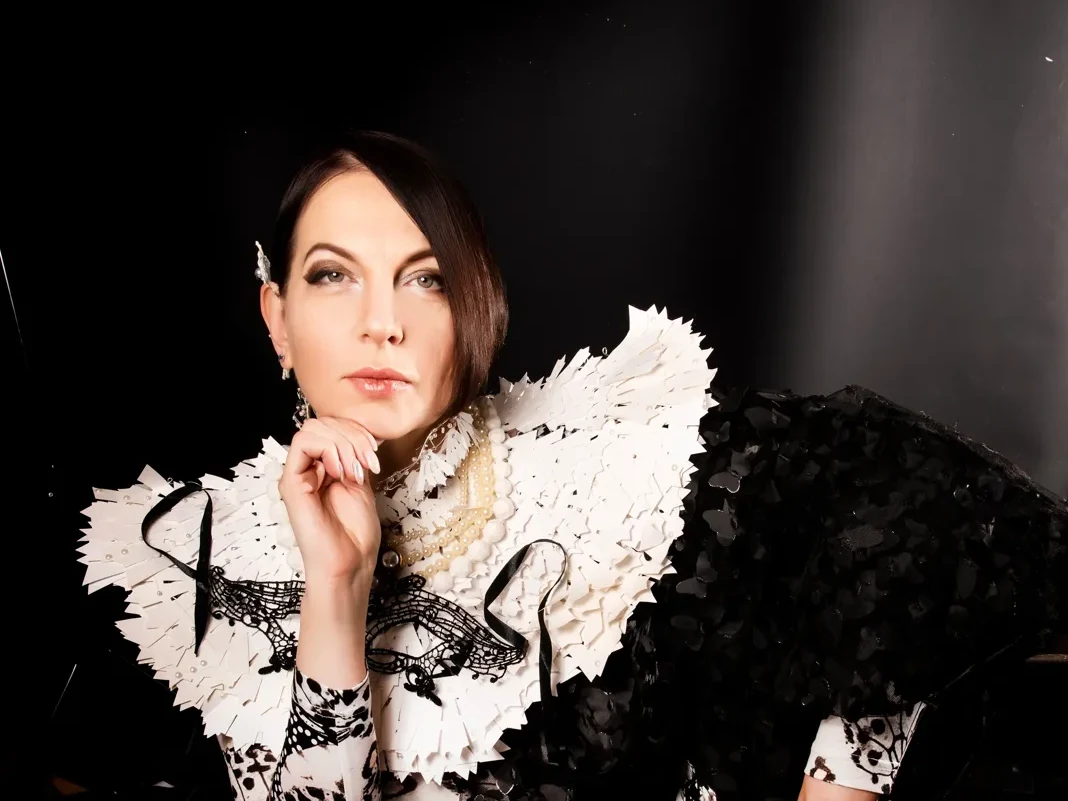
What an artwork is really worth usually has little to do with its price tag — and jewellery, an industry that has turned the myth of value into an art in itself, proves it better than anything. Designer, gemmologist and ARTA founder Yulia Dobronosova has lived inside that myth for more than two decades and has learned to separate genuine value from the imitation.
Lara Palmer: You came into jewellery by an unusual route — your husband gave you a factory as a present. What does a gift like that do to your relationship with a profession?
Yulia Dobronosova: It all happened very fast, and maybe that was the idea. It looked like madness and yet, somehow, like fate. My relatives were restorers, icon painters and doctors, and I had gone into medicine. Only later did I understand that those worlds were never as far apart as they looked. Precision, structure, not cutting corners when the material won’t allow it — all of that transfers. The factory wasn’t really a gesture; it was a question, and I have spent twenty years answering it.
L. P.: Which meant beginning your career all over again.
Y. D.: From scratch. Gemmology, design, the basics of the trade, bookkeeping — everything. I wanted to know the business from the inside, not to manage it from afar. If you know how a piece is made, you can talk to craftsmen without simply trusting whatever they tell you, and that matters more than people realise. If you know materials, you buy better stones and metal. All the rest grows out of that early discipline.
That approach eventually let me bring in teachers from the Kosygin Russian State University and other experts I respected. The workshop we built together is a place where art and business have agreed to coexist.
L. P.: Angels and Demons sounds like an exception — a collection that came not from a brief or a concept but from years of personal searching.
Y. D.: Exactly. For years I had been looking for antique brooches on that theme, combing through catalogues, vintage Trifari among them. I found the angel at an auction, but the demon never turned up. In the end I accepted that a genuine original probably no longer existed anywhere I could reach, and that a poor copy would be worse than nothing — so I decided to create my own.
My demon is ironic and grotesque, a visual debate about the seven deadly sins, and we are still refining the sketches. What fascinates me is how the series was born: not from “inspiration”, a word that hides more than it reveals, but from staring at a gap for years until you decide to fill it yourself.
L. P.: Let’s look at the industry’s awkward corners. Which piece do most women consider true luxury when it is really a well-made illusion?
Y. D.: Luxury can’t be expressed in numbers — not in carats and not in a boutique’s address. If it exists at all, it lies in the match between an object and the person who wears it, when a piece reveals something true about her instead of merely announcing a price. My problem with certain houses — Cartier, Van Cleef & Arpels and a few others — is that their whole strategy depends on the price being readable. A bracelet matters because everyone in the room can guess what it cost. The woman buying it is often not buying the object at all but the message it sends. That is communication, not luxury.
L. P.: So what exactly does the customer pay for when she pays for the name?
Y. D.: Above all, the name. Top makers genuinely can’t afford to cheapen it; reputation is both their capital and their cage, and they know that only exceptional work protects it. I have been asked more than once to design collections for big labels, to be mass-produced under a famous signature, and I have always refused. The commercial sense is clear — it just bores me.
Look at Tiffany: what it costs them to make their silver pieces is negligible. You pay for the brand and the special experience of walking into their stores. In haute joaillerie that is, in its way, a reasonable convention — we don’t sell by weight, and the price of a fine piece has always partly reflected the maker’s standing. But you should understand how it works before you hand over your money.
L. P.: You’ve said that an expensive piece can make a woman look cheaper. What do you mean by that?
Y. D.: A piece with no idea in it. The classic example is a big diamond in a plain claw setting, with nothing designed and nothing thought through — just a stone in a mount. All its value is the weight of the stone, and that’s the end of it: no character, no statement, nothing to say. Real luxury — and I choose that word carefully — is when an object tells a story, mirrors the woman wearing it and becomes part of her image without shouting for attention.
Today the market is driven by a simpler goal: sell as many carats as possible and worry about design later, or never. The result is costly stones that have been cut crudely — matter that nature spent millions of years producing, ruined in an afternoon by a cutter chasing weight. That crudeness is what makes even a pricey stone look cheap. The money shows; the thinking doesn’t.
L. P.: Can someone at your level tell a lab-grown diamond from a natural one just by looking?
Y. D.: No — and neither can specialists who work at a microscope every day; they make mistakes often enough to prove it. Laboratories have certified stones as natural that later turned out to be synthetic. The human eye simply isn’t the tool for this.
L. P.: If two diamonds look the same but one costs five thousand dollars and the other twenty thousand, what is the buyer actually paying for?
Y. D.: With that gap you are almost certainly looking at a lab-grown stone next to a natural one, and the real question is what happens to their value over time. Cubic zirconia was once marketed very aggressively and sold for serious sums; today those crystals are worth next to nothing. Lab diamonds will very likely follow the same curve.
That’s no accident — it is what always happens once the technology behind a product becomes cheap and scalable. At the start of a trend the marketing is loudest, because that is when it has to be. My practical advice: on a limited budget, buy a smaller natural stone. Natural diamonds have a long record of keeping their value; their grown equivalents are priced on a line that only goes down.
L. P.: Synthetics are hardly new, though — hydrothermal emeralds, Verneuil rubies.
Y. D.: True, and synthetic alexandrites have been around for years. With lab diamonds the difference is scale: production has reached an industrial level that changes the whole equation. They are lovely, clean stones and there’s nothing wrong with them as objects. Buyers just need to understand that the hype around them is a marketing event — a very successful one, but still a marketing event.
L. P.: Is it true, as people say, that jewellery costing thirty to fifty thousand dollars loses value when you resell it?
Y. D.: At my level, seldom. There are investment-grade stones, and their value only moves one way. When a new source opens up — tanzanite, fine spinel — the market receives a scarce and very specific material. Spinel was undervalued for years, and anyone who was paying attention had an obvious opportunity. Natural gemstones go up in price, and the metal charts tell the same story: when I started out, a kilogram of 999.9 gold cost seven hundred roubles. Just look at the price today.
Where people do lose money is somewhere else — in heavy retail mark-ups for the brand, the workmanship and the complexity of the design, none of which the resale market will pay back. Buying a piece because a salesperson promises it will be worth more next year is a reliable route to regret. Buying exceptional natural material and keeping it is not. That distinction is everything.
L. P.: A single stone or several finished pieces — which makes more sense as an investment?
Y. D.: For me, as a professional with access to the wholesale market, always loose stones. For a private buyer the advice is different: find an independent gemmologist and valuer you trust and choose one or two really fine specimens together — and not necessarily the obvious diamonds and sapphires everyone goes for. The market is flooded with treated stones, so finding something fully natural and untreated is already rare, and that rarity is the investment.
One thing I always insist on: don’t let them sit in a safe as raw material — have them set. A piece that keeps its value and gives its owner pleasure every day makes sense both to the resale market and in your own home. An investment that just lies there, inert, has only done half its job.
L. P.: You’ve talked about the energy that surrounds an object. Does that affect how you approach antiques — pieces with unknown or difficult pasts?
Y. D.: It is less about mysticism than about context and conscience. Years ago people from the provinces — Kostroma and similar towns — would call me offering old family rings for almost nothing, and I always said no. Something in me objected very strongly: when a treasured object is sold for a fraction of its worth, it usually means things have gone badly for its owners, and I didn’t want to profit from that. Later a friend told me about a remarkable antique piece. I was ready to refuse until she explained that the owner was in real trouble, selling was her way out, and paying a fair price would genuinely help. That changed my view. It’s the same when a company shuts down, its owners emigrate and taking valuables across a border is complicated — they sell their working stones at fair prices to recover what they can. There’s nothing wrong with that.
Each case is different. These days I simply ask why a piece is for sale. I am not afraid of other people’s stories; as long as they are honest, buying can be real help rather than opportunism.
L. P.: Has social media created new categories of desirable stones, or just new prices for familiar ones?
Y. D.: Both, in different ways. Diamonds are a structural story: a monopoly, controlled supply, prices set through quotas. Coloured stones are another world. The truly rare ones — Paraíba tourmaline, Kashmir sapphire, good alexandrite, the stunning and badly underrated Malaia garnet, whose historic Tanzanian mine is exhausted while its Madagascan successor can’t keep up — barely reach mass audiences, because they are mined by hand in amounts too small for any campaign. Clients for such stones have to be educated over years, and most aren’t there yet.
What social media and the big houses have done is raise interest in the middle range — quartz, topaz, amethyst — stones that are abundant and until recently counted as decorative rather than serious. Demand has pushed their prices up, which is rather ironic: the commonest stones got expensive because someone started talking about them, while the genuinely rare ones remain unknown to the very people who could most easily afford them.
Russia had its own version of the problem. For generations the respectable canon was five stones — diamond, emerald, ruby, sapphire and alexandrite — and everything else was dismissed as “semi-precious”, one of the most damaging labels the trade ever invented. That category contained some of the most fascinating material on the planet.
L. P.: Is there a piece you dream of creating?
Y. D.: I think in materials, not objects. Given the chance, I’d love to work with a truly fine Paraíba tourmaline, a Kashmir sapphire or a rare ruby — and give the cutting to someone whose taste I admire, then see what they did with it. The thinking behind that kind of decision interests me as much as the outcome.
The finished pieces that move me are usually old — Russian antiques such as Fabergé. They carry the imprint of a particular moment in history, and that weight can’t be designed into a modern piece, however skilled the craftsman.
L. P.: What should a woman check before buying a diamond?
Y. D.: If there’s no certificate, get one; if there is one, get a second opinion from another laboratory, because labs disagree about the same stone far more often than people think. Never buy an expensive diamond just because you happened to pass a shop. If it’s an investment, treat it like one and involve a gemmologist. That is standard practice for any serious purchase, and it will save you money.
L. P.: What could a salesperson say that should make you walk out at once?
Y. D.: It’s less the words than the manner. Constant pressure on one point, a non-stop stream of talk designed to stop you thinking — when that begins, leave. Jewellery is intimate; it will live on your skin. Someone who doesn’t know you can’t tell you what to wear, and a salesperson who tries too hard has shown you where their priorities lie.
Incompetence is another matter. If they can’t judge carat weight or colour, they shouldn’t be selling at that level. I once asked about pale emeralds and was told they were “young” — the saleswoman sincerely believed emeralds ripen like fruit and darken over time. When an owner lets untrained staff serve clients, the business has already said the most important thing about itself.
L. P.: How long have you been in the industry?
Y. D.: In finance since 1999 and in jewellery manufacturing since 2004 — more than twenty years.
L. P.: Who orders your pieces — men or women?
Y. D.: Mostly men, and I’m glad of it. My view, which I don’t apologise for, is that a woman shouldn’t buy her own jewellery. If she is buying herself gems while living with a man, you have to ask what he is bringing to the relationship. Jewellery shouldn’t be an impulse buy or a substitute for a difficult conversation; it should be a gift.
Many women now out-earn their partners, and young women often come to me planning to start a business precisely to pay for their own independence. I always ask them: why? Why get married at all, then? Running a business is brutal. Keeping a home and raising children is already a huge amount of work — something you only fully see when the person doing it stops. A friend of mine ran the household on his own for six weeks after his wife broke her arm, and afterwards told me quite seriously: “You women are heroes.” He meant it. The least men can do is look after the jewellery.
There is one snag: women generally know what they want far better than the men buying for them. I keep a list of my regular clients’ wives’ birthdays and ring the husbands in autumn — “What are we making her for January?” — because men forget, and forgetting tends to cost more than the piece. One husband told me they had jointly decided to give his wife a tattoo instead. I wasn’t upset; I have enough work. And it nearly always ends the same way: she comes to me herself, explains what she really wants, and I make it.
L. P.: What is the industry’s central myth — the one you would most like to bury?
Y. D.: That importance is defined by price and brand recognition. It isn’t. Real value lives in the idea, the quality of the work, the rarity of the material and the particular bond between a piece and its wearer. A brand can build an illusion so convincing that, for many buyers, it is indistinguishable from the real thing. But character can’t be manufactured: a piece either has it or it doesn’t. That is what I try to make clear to everyone who comes to me — sometimes against strong commercial pressure, including my own.