
Quick Summary: 2D to 3D CAD conversion services transform flat technical drawings into detailed three-dimensional models for manufacturing, product development, and visualization. This guide reviews ten leading agencies specializing in legacy drawing modernization, scan-to-CAD processing, and parametric modeling across industries including aerospace, automotive, and consumer products.
Engineering teams face a common challenge: stacks of legacy 2D drawings that need to become functional 3D CAD models. Whether updating decades-old manufacturing documentation or converting scanned blueprints into parametric assemblies, the conversion process demands both technical precision and software expertise.
The right conversion service doesn’t just trace lines. They rebuild geometry with manufacturing intent, preserve critical tolerances, and deliver models ready for CNC machining, FEA analysis, or product visualization.
This article explores ten specialized agencies that handle 2D to 3D CAD conversions across major platforms including SOLIDWORKS, AutoCAD, CATIA, and Inventor. Each company brings distinct capabilities—from aerospace-grade precision work to rapid turnaround for product design teams.
What Makes 2D to 3D CAD Conversion Essential
Legacy technical drawings still dominate many manufacturing environments. Paper blueprints, scanned PDF files, and decades-old DWG formats represent valuable intellectual property trapped in outdated formats.
Converting these flat representations into three-dimensional models unlocks significant operational advantages. 3D CAD files enable modern manufacturing methods, support digital twin initiatives, and integrate with contemporary PLM systems.
According to academic research from Yale Medicine, advances in 3D planning and patient-specific instrumentation enable precise virtual replicas and surgical planning in pediatric orthopedic applications. The same principle applies across engineering disciplines—seeing the complete object rather than projected views reveals design issues earlier.
The conversion process itself varies dramatically based on input quality and output requirements. Clean vector drawings convert faster than scanned raster images. Simple prismatic parts take hours while complex assemblies with intricate surfacing demand weeks of skilled modeling.
Common Conversion Scenarios
Manufacturing companies typically need conversion services in several situations. Product line acquisitions often include only paper documentation. Equipment maintenance requires 3D models for replacement part fabrication. Design modernization projects mandate current CAD formats.
Reverse engineering adds another dimension. Physical parts get laser scanned, generating point cloud data. Then conversion specialists build parametric CAD models from that scan data—essentially creating the engineering drawings that never existed.
The quality bar matters immensely here. A decorative visualization model accepts approximations. Manufacturing tooling requires exact dimensions, proper geometric tolerancing, and fully constrained parametric features.
Top 11 Companies for 2D to 3D CAD Conversion Services
The following agencies represent specialized providers with proven track records in technical drawing conversion. Each brings distinct capabilities tailored to specific industries, software platforms, and project scales.
1. Powerkh
Powerkh is a UK-based BIM and VDC consultancy with offices in the United States and Ukraine, providing 2D to 3D CAD conversion services for architects, engineers, contractors, and developers. The company helps project teams convert traditional 2D drawings into detailed 3D BIM models for design coordination, construction planning, and project documentation. Their work includes architectural, structural, and MEP modelling for residential, commercial, and industrial projects.
Powerkh uses Autodesk Revit, Navisworks, and BIM-based workflows to create accurate 3D models from CAD drawings, PDFs, point clouds, and scanned documents. The company also supports clash detection, scan-to-BIM workflows, shop drawings, and coordination between different project disciplines. Their approach is focused on improving model accuracy, reducing coordination issues, and helping teams move from 2D documentation to more efficient 3D project workflows.
Contact Information:
- Website: www.powerkh.com
- Email: [email protected]
- Facebook: www.facebook.com/100064039650167
- LinkedIn: www.linkedin.com/company/powerkh
- Instagram: www.instagram.com/powerkh_com
- Address: 3, Lavinia Walk, Taw Hill, Swindon SN25 1AP
- Phone: +44 7490 426678
2. CAD Crowd
CAD Crowd operates as a freelance marketplace connecting engineering teams with vetted CAD specialists worldwide. Their platform handles everything from simple part conversions to complex assembly modeling across all major CAD platforms.
What sets CAD Crowd apart is the depth of their freelancer vetting process. They maintain a roster of CATIA specialists, SOLIDWORKS experts, and AutoCAD professionals who’ve passed portfolio reviews and skills assessments.
The platform works particularly well for companies with variable conversion workloads. Rather than maintaining in-house drafting capacity, engineering managers can scale resources up or down based on project pipelines.
Project managers assign work through the platform, track progress through milestone deliveries, and hold payments in escrow until quality acceptance. This structure protects both parties while maintaining accountability.
Their conversion specialists handle diverse industries. Aerospace teams use the platform for legacy aircraft documentation. Automotive suppliers convert tooling drawings. Consumer product companies modernize existing product lines.
Best for: Companies needing flexible capacity across multiple CAD platforms with project-based pricing structures.
3. Cad Conversion Services Pro
Cad Conversion Services Pro specializes exclusively in drawing format transformation, making them deeply focused on the technical nuances of geometry translation. Their engineering team tackles both simple DWG-to-model conversion and complex scan data processing.
The company maintains expertise across SOLIDWORKS, Inventor, Creo, and CATIA—critical when clients need models in specific platforms for PLM integration. They don’t just export generic STEP files; they build native parametric models with proper feature trees.
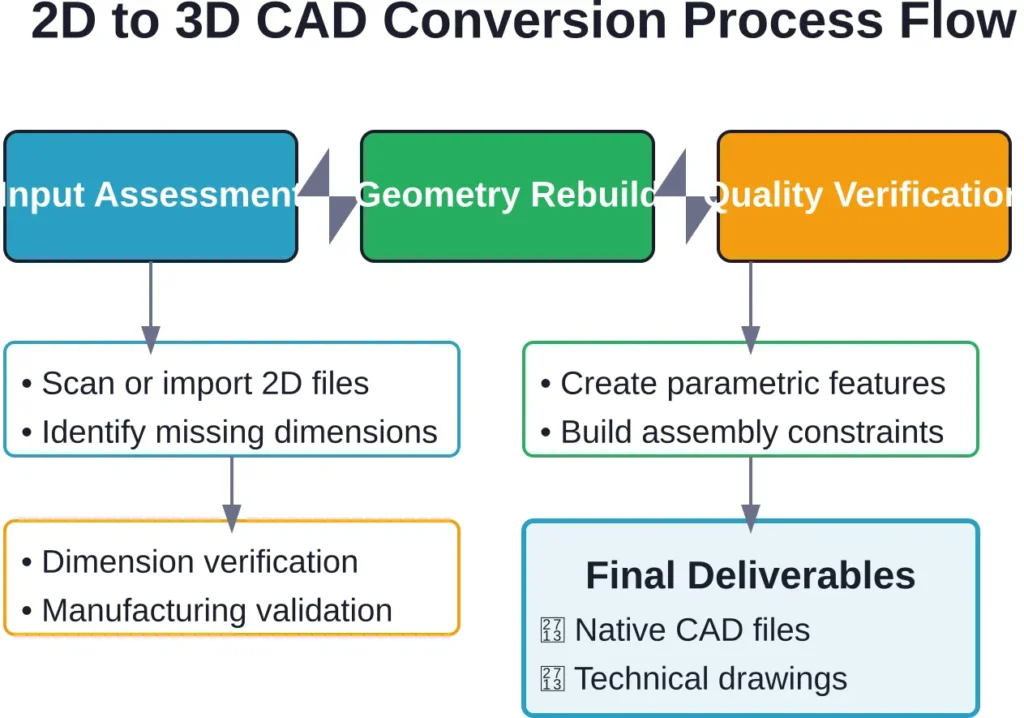
Their quality control process includes dimensional verification against source drawings. Converted models get checked for geometric accuracy, proper constraint schemes, and manufacturing feasibility before delivery.
For companies with extensive legacy documentation, they offer batch processing services. Entire drawing sets get cataloged, prioritized, and converted systematically rather than on an ad-hoc basis.
Best for: Manufacturing companies with large legacy drawing libraries requiring systematic conversion with strict quality standards.
4. BluEnt

BluEnt brings architectural and structural engineering focus to their CAD services, though their capabilities extend well into mechanical product design. They’ve built particular strength in building systems and equipment modeling.
Their conversion workflow emphasizes BIM integration. When converting HVAC equipment drawings or structural steel details, the resulting 3D models come ready for Revit or AutoCAD MEP environments with proper metadata and classification.
The team handles both 2D-to-3D conversion and scan-to-BIM projects. Laser scan data from existing facilities gets processed into accurate as-built models that support renovation planning and facility management.
Communication protocols run strong here. Project managers provide regular updates, maintain shared file repositories, and coordinate directly with client engineering teams to resolve ambiguities in source documentation.
Best for: AEC firms and building equipment manufacturers needing BIM-compatible models with proper metadata structure.
5. Hitech CADD Services

Hitech CADD Services operates as a dedicated technical documentation provider with teams across multiple global locations. Their conversion capabilities span mechanical, architectural, and civil engineering disciplines.
The company structures services around dedicated team assignments rather than individual freelancers. Clients get consistent points of contact who learn specific documentation standards and maintain quality continuity across multi-phase projects.
Their mechanical engineering group handles product design conversions, generating SOLIDWORKS and Inventor models from legacy drawings. The architectural division focuses on building documentation and construction drawing modernization.
For complex assemblies, they provide both individual part models and fully constrained assembly files. Mating conditions, motion constraints, and interference checking get addressed before delivery.
Security protocols accommodate sensitive intellectual property. NDA enforcement, secure file transfer systems, and access-controlled work environments protect client designs throughout the conversion process.
Best for: Enterprises requiring dedicated conversion teams with consistent quality standards across long-term documentation modernization initiatives.
6. TrueCADD

TrueCADD positions itself as a specialized provider for product design and manufacturing engineering. Their conversion services emphasize design intent preservation—ensuring converted models reflect how parts were meant to be manufactured.
The engineering team includes specialists in sheet metal design, plastic injection molding, and machined components. This manufacturing knowledge shows in how they structure feature trees and apply parametric constraints.
When converting sheet metal parts, they build models using proper sheet metal features rather than generic extrusions. Bend tables, K-factors, and flat patterns get configured correctly for downstream fabrication.
Their plastic part conversions account for draft angles, wall thickness requirements, and gate locations. The resulting models support mold flow analysis and tooling design rather than just visual representation.
Quality verification includes manufacturing feasibility reviews. Converted designs get checked against standard manufacturing constraints before delivery—catching issues that might cause production problems.
Best for: Product development teams needing manufacturing-ready models with proper design-for-manufacturability considerations built in.
7. Mechanical 3D Modeling
Mechanical 3D Modeling focuses specifically on industrial equipment and machinery conversion. Their portfolio shows particular strength with complex mechanical assemblies, hydraulic systems, and industrial machinery.
The company handles both new product development support and legacy equipment documentation. When manufacturers need to recreate discontinued parts or modernize old machine designs, Mechanical 3D Modeling rebuilds complete assemblies from whatever documentation exists.
Their reverse engineering capabilities complement conversion services. Physical parts can be measured, scanned, or manually dimensioned, then converted into fully parametric CAD models that match original specifications.
Assembly modeling includes proper mate conditions and motion simulation setup. Converted machinery models arrive ready for kinematic analysis, clearance verification, and virtual commissioning activities.
Technical communication runs detailed. Their engineers document assumptions made during conversion, flag ambiguities in source drawings, and provide recommendations when legacy designs don’t meet current standards.
Best for: Industrial equipment manufacturers and machine builders requiring detailed assembly models of complex mechanical systems.
8. ProtoTech Solutions

ProtoTech Solutions combines CAD conversion services with software development expertise. They’ve built proprietary tools that accelerate certain conversion workflows, particularly for batch processing of standard components.
The company offers both manual conversion by skilled modelers and semi-automated processing using their custom algorithms. Simple prismatic parts with clear dimensions can be processed quickly through algorithmic methods, while complex organic shapes receive full manual attention.
Their software development background shows in how they handle data translation. When clients need conversion output in unusual formats or with specific metadata requirements, ProtoTech can often accommodate through custom export scripting.
For companies with ongoing conversion needs, they provide API access to certain services. Engineering teams can potentially integrate conversion requests directly into PLM workflows rather than managing separate file exchanges.
Cross-platform expertise covers CATIA, SOLIDWORKS, NX, Creo, and Inventor. Models can be delivered in client-specific formats with proper feature history and parametric control.
Best for: Technology-forward companies needing both conversion services and potential integration with existing engineering systems.
9. Tesla Outsourcing Services
Tesla Outsourcing Services provides comprehensive engineering support including detailed CAD conversion capabilities. Their team structure supports both one-off conversion projects and ongoing retainer relationships.
The company emphasizes communication and project management. Dedicated coordinators track conversion projects through intake, modeling, quality review, and delivery stages—keeping clients informed without requiring constant follow-up.
Their modeling standards documentation ensures consistency. Whether a project involves two parts or two hundred, the resulting models follow uniform naming conventions, layer structures, and feature organization principles.
For product lines with variations, they build models using configurations or family tables. Rather than creating separate files for each size variant, master models include parametric variation logic.
Delivery packages typically include both native CAD files and neutral formats (STEP, IGES) plus rendered images and PDF drawing sheets for reference. Complete documentation supports downstream use without requiring additional work.
Best for: Companies wanting managed conversion services with strong project coordination and standardized deliverable packages.
10. SolidCAM Integration Services

SolidCAM Integration Services brings a manufacturing-centric perspective to conversion work. Their background in CAM programming influences how they structure converted models—always considering downstream machining requirements.
When converting parts destined for CNC manufacturing, they organize geometry to support efficient toolpath generation. Features get modeled in sequences that make sense for machining operations, and reference geometry needed for CAM setup gets included.
The team understands tolerance stack-ups and geometric dimensioning. Converted models include inspection dimensions, datum references, and GD&T callouts properly associated with model geometry rather than just floating in drawing views.
For turned components, they build models with proper axis alignment and feature organization. Mill-turn parts get structured to support both turning and milling operations in logical manufacturing sequences.
Their quality process includes virtual machining verification when appropriate. Before delivery, complex parts may be run through CAM simulation to confirm the converted geometry supports intended manufacturing processes.
Best for: Machine shops and contract manufacturers needing models optimized for CNC programming and manufacturing process planning.
11. Virtual Dimension Technologies

Virtual Dimension Technologies specializes in high-precision conversion work for aerospace, medical devices, and defense applications. Their quality systems meet ISO standards and support clients with strict documentation requirements.
The engineering team includes specialists with industry-specific knowledge. Aerospace conversions account for AS9100 requirements. Medical device work follows design control protocols compatible with FDA regulations.
Traceability runs throughout their process. Source documents get revision-controlled, conversion work gets logged with engineer identification, and quality checks include independent verification by separate reviewers.
For critical components, they provide detailed conversion reports documenting methodology, assumptions, and verification results. This documentation supports regulatory submissions and design history files.
Security measures include ITAR compliance capabilities. Controlled access, citizen verification for personnel, and secure facility requirements support defense industry clients.
Best for: Regulated industries requiring documented quality systems, traceability, and compliance with industry-specific standards.
Choosing the Right CAD Conversion Partner
Selecting a conversion provider requires matching service capabilities to specific project requirements. Not every agency suits every situation.
Technical Platform Compatibility
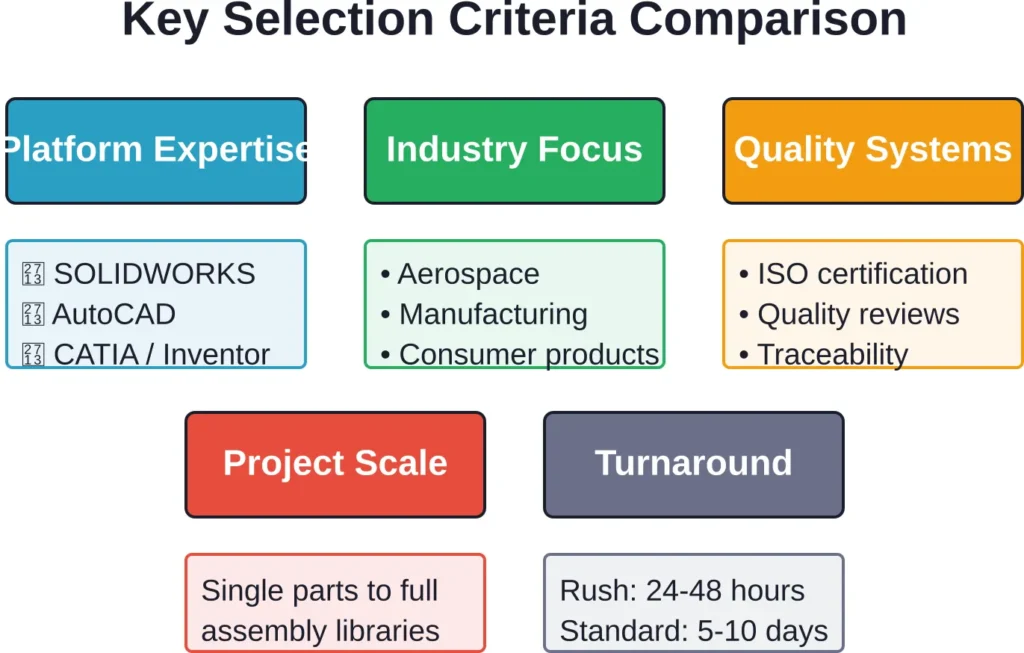
Native CAD format matters significantly. A model built in SOLIDWORKS carries different parametric structure than one created in CATIA or Inventor. For companies with established CAD environments, conversion output must match existing systems.
Some providers excel in specific platforms. They’ve built deep expertise with particular software quirks, best practices, and advanced features. Others maintain broader but shallower capabilities across multiple systems.
When PLM integration matters, native format becomes critical. Generic STEP files work for viewing but lose parametric intelligence. True integration requires models built using the same CAD kernel that the PLM system expects.
Industry-Specific Knowledge
Different industries carry distinct design conventions and regulatory requirements. Aerospace components require different documentation than consumer products. Medical devices demand traceability that industrial equipment doesn’t.
Providers with industry experience understand these nuances. They recognize standard component types, apply appropriate modeling approaches, and structure documentation to match industry norms.
For regulated industries, quality system compatibility matters immensely. Conversion work feeding FDA submissions or aerospace certifications needs proper documentation, revision control, and verification protocols.
Project Scale Considerations
Single-part conversion projects have different dynamics than thousand-drawing modernization programs. Small projects need quick turnaround and minimal overhead. Large initiatives require project management structure and quality consistency.
Some providers specialize in rapid small jobs. Others excel at managing complex multi-year documentation overhauls with dedicated teams and systematic workflows.
According to research from Carnegie Mellon University’s Software Engineering Institute published March 25, 2026, custom VR training development can cost $100,000 and take up to a year, with similar resource-intensive dynamics applicable to large-scale CAD conversion programs.
| Project Type | Typical Scope | Timeline | Best Provider Match |
|---|---|---|---|
| Rush conversion | 1-10 parts, simple geometry | 24-72 hours | Freelance platforms, quick-turn specialists |
| Product line update | 50-200 parts, medium complexity | 2-4 weeks | Dedicated service providers with team capacity |
| Legacy modernization | 500+ drawings, mixed complexity | 3-12 months | Enterprise-focused agencies with project management |
| Reverse engineering | Physical parts to CAD, scan data | Variable, 1-6 weeks per assembly | Specialists with metrology and surfacing expertise |
Quality Verification Standards
Conversion accuracy determines downstream usability. Models destined for manufacturing must hold tight tolerances. Visualization models accept more approximation.
Quality verification approaches vary significantly. Some providers rely on visual inspection. Others perform dimensional verification against source drawings. The most rigorous implement independent checking by separate engineers.
For critical applications, request sample conversions before committing to large projects. Evaluate how providers handle ambiguous dimensions, missing views, and conflicting information in source documents.
Understanding Conversion Methodologies
How providers actually execute conversion work varies based on source material quality and output requirements.
Manual Parametric Modeling
Traditional conversion involves skilled CAD operators rebuilding geometry feature-by-feature. They interpret 2D views, extract dimensions, and construct 3D features that match engineering intent.
This approach delivers highest quality for complex parts. Human judgment handles ambiguous documentation, recognizes standard features, and applies design intent rather than just copying lines.
The method takes time. Each feature requires thought about proper construction method, parametric relationships, and manufacturing considerations. But the results are fully editable parametric models suitable for design iteration.
Scan-to-CAD Processing
Physical parts can be laser scanned to generate point cloud data—essentially millions of measured surface points. Conversion specialists then fit CAD geometry to match that scan data.
This reverse engineering approach works when original drawings are lost or when as-built dimensions differ from design intent. The physical part becomes the source of truth.
Processing requires different skills than traditional drafting. Operators must clean noisy scan data, identify feature boundaries, and decide whether to model exact scanned surfaces or idealized design geometry.
Results vary based on part complexity. Simple machined components with clear geometric features convert cleanly. Organic shapes, worn surfaces, and parts with complex blend geometry present challenges.
Semi-Automated Translation
Some conversion tools attempt algorithmic interpretation of 2D drawings. Software analyzes projection views, identifies matching edges, and constructs 3D geometry automatically.
These tools work best for simple prismatic parts with orthographic projection views and complete dimensioning. Complex assemblies, sectioned views, and partial detail drawings typically defeat automation.
Even when automation assists, human verification remains essential. Algorithms make assumptions that may not match engineering intent. Manual review catches errors and refines results.
Common Challenges in CAD Conversion Projects
Converting legacy documentation inevitably encounters complications. Understanding common issues helps set realistic expectations.
Incomplete or Ambiguous Source Data
Legacy drawings often lack complete information. Missing dimensions, unclear views, or conflicting callouts create interpretation challenges. Conversion specialists must make educated assumptions or request clarification.
When source drawings are poor-quality scans, dimension text may be illegible. Operators must measure scaled distances and infer intended values—introducing potential accuracy issues.
The best providers document assumptions made during conversion. Rather than silently guessing, they flag ambiguities and explain their interpretation logic.
Non-Standard or Obsolete Features
Older designs sometimes include features that don’t conform to current manufacturing standards. Unusual thread forms, deprecated fasteners, or obsolete material callouts require research and potentially updating.
Conversion becomes an opportunity to modernize. Parts can be brought into compliance with current standards while preserving functional intent. But this requires engineering judgment beyond simple geometry translation.
Format and Version Compatibility
CAD software evolves constantly. Files created in decade-old versions may not open cleanly in current releases. Feature types, constraint methods, and file structures change across versions.
Cross-platform translation adds complexity. CATIA geometry translated to SOLIDWORKS may lose parametric relationships. Surface quality can degrade through translation steps.
Professional conversion providers maintain multiple software versions specifically to handle legacy format issues. They test translation paths and verify geometry integrity after format conversion.
Assembly Relationship Preservation
Individual part conversion is straightforward compared to maintaining assembly relationships. Mating conditions, motion constraints, and interference fit requirements must translate correctly.
When converting assemblies, providers must decide whether to model parts in-context or independently. In-context modeling preserves geometric relationships but creates file dependencies. Independent parts are more flexible but may not assemble correctly without careful constraint management.
Maximizing Value from Conversion Services
Getting optimal results requires active collaboration beyond just handing off drawings and waiting for models.
Provide Context and Requirements
Clear communication about model usage drives better results. Models for manufacturing need different structure than visualization assets. Specify intended applications upfront.
Share design intent documentation when available. Notes about critical dimensions, assembly sequences, or manufacturing processes help conversion specialists make appropriate choices when interpreting ambiguous source data.
Establish quality criteria explicitly. Define required accuracy, acceptable tolerance ranges, and verification methods before work starts rather than discovering mismatches at delivery.
Standardize Deliverable Formats
Request consistent file organization, naming conventions, and metadata structure. Standardized deliverables integrate smoothly into existing systems and reduce downstream cleanup work.
Specify required documentation. Should models include configuration tables? What drawing views need generation? Which formats require export? Clear specifications prevent iteration.
Plan for Iterative Review
Complex conversions benefit from milestone reviews rather than waiting for complete delivery. Review initial samples, provide feedback on approach, and validate methodology before bulk processing.
This iterative approach catches misunderstandings early. Course correction after five parts is manageable. Discovering issues after a hundred parts are complete is painful.
Invest in Knowledge Transfer
For large conversion programs, consider having provider teams document their methodology. Understanding how models were constructed helps internal teams maintain and modify the converted assets later.
Some providers offer training as part of service packages. Learning proper model structure, best practices for parametric control, and efficient modification techniques maximizes long-term value from converted models.
Cost Factors in CAD Conversion
While specific rates vary, understanding cost drivers helps budget conversion projects appropriately.
Complexity and Detail Level
Simple prismatic parts with basic features convert quickly. Complex organic surfacing, intricate assemblies, and highly detailed components require substantially more time.
Part count matters significantly for assemblies. A ten-part assembly takes much less time than a five-hundred-part assembly, even if individual components are simple.
Source Material Quality
Clean vector DWG files convert faster than poor-quality scanned PDFs. Operators spend less time deciphering dimensions and more time modeling.
Complete documentation reduces interpretation time. When all necessary views and dimensions exist, modeling proceeds straightforwardly. Incomplete drawings require additional research and assumption documentation.
Output Requirements
Basic geometry models deliver faster than fully parametric assemblies with complete constraint schemes. Adding configurations, family tables, or design automation increases modeling time.
Documentation requirements affect project scope. Generating formal drawing sheets, creating exploded assembly views, or producing rendered visualizations adds deliverable work beyond core modeling.
Turnaround Speed
Rush projects command premium costs. Standard turnaround typically offers better value than expedited service, though emergency conversions are available when necessary.
Batch processing of similar parts often achieves economies of scale. Converting fifty similar bracket designs costs less per part than modeling fifty completely different components.
Emerging Trends in CAD Conversion
The conversion services industry continues evolving with new technologies and methodologies.
AI-Assisted Feature Recognition
Machine learning algorithms are increasingly capable of recognizing standard features in 2D drawings. Neural networks trained on engineering drawings can identify holes, fillets, and common geometric patterns.
These AI tools assist rather than replace human operators. They accelerate initial geometry creation, but engineers still verify accuracy and refine parametric structure.
Cloud-Based Collaboration
Conversion workflows increasingly leverage cloud platforms. Clients upload source drawings, track project progress, and review deliverables through secure web interfaces rather than managing email attachments.
Real-time collaboration tools enable faster feedback cycles. Engineers can mark up models, request modifications, and approve deliverables without lengthy download-review-upload sequences.
Automated Quality Verification
Dimensional comparison software can automatically check converted models against source drawings. Algorithms measure critical dimensions in 3D geometry and flag discrepancies exceeding tolerance thresholds.
This automation catches errors faster than manual inspection. Every dimension gets verified rather than relying on sample checking.
Integration with Digital Manufacturing
Converted models increasingly feed directly into manufacturing execution systems. Rather than standalone files, they become components of digital twin ecosystems linking design, simulation, and production.
This integration demands higher model quality. Geometry must support not just viewing but analysis, toolpath generation, and automated manufacturing processes.
Frequently Asked Questions
Timeline varies dramatically based on part complexity and project scope. Simple parts may convert within hours, while complex assemblies require weeks. A typical medium-complexity mechanical component with 20-50 features generally takes 4-8 hours of modeling time. Large conversion projects involving hundreds of drawings typically span several weeks to months, with the exact duration depending on available resources and review cycles. Rush services can compress timelines by assigning additional modelers, though this typically increases project costs.
Professional conversion providers work with nearly any 2D format including DWG, DXF, PDF scans, paper drawings (photographed or scanned), and legacy CAD formats from obsolete systems. The quality and completeness of source material matters more than specific format. Vector formats like DWG preserve precision better than raster scans, but experienced operators can extract geometry from virtually any legible technical drawing. For scan-to-CAD projects, point cloud data from laser scanning equipment gets processed alongside or instead of traditional drawings.
When properly executed, converted models function identically to originally-designed CAD files. Professional conversion creates fully parametric geometry with editable feature trees, dimensional constraints, and design relationships. The key is native format modeling—building parts using the target CAD system’s tools rather than importing generic geometry. Models built this way support design iteration, dimension changes, and feature modifications just like parts designed from scratch. Quality conversion specifically focuses on preserving design intent and parametric control rather than just matching final geometry.
Professional conversion maintains dimensional accuracy within the precision specified by source drawings. For manufacturing applications, converted models typically achieve ±0.001″ accuracy for critical dimensions when source drawings are clear and complete. The limitation is usually source material quality rather than conversion capability. Ambiguous dimensions, unclear views, or conflicting information in legacy drawings create interpretation challenges that can affect accuracy. Reputable providers implement verification processes including dimensional checking and independent review to ensure converted geometry matches engineering intent within specified tolerances.
While skilled operators can work from drawings alone, additional context significantly improves results. Manufacturing process notes, material specifications, assembly instructions, and design intent documentation help conversion specialists make appropriate choices when interpreting ambiguous information. Photos of physical parts are extremely helpful for understanding three-dimensional relationships that may be unclear in 2D projections. For best results, provide everything available including related documentation, assembly diagrams, and answers to questions about critical features and intended manufacturing methods. This context reduces assumptions and improves first-pass accuracy.
Major conversion providers support all mainstream CAD platforms including SOLIDWORKS, AutoCAD, Inventor, CATIA, Creo (Pro/ENGINEER), NX (Unigraphics), Solid Edge, and Fusion 360. Most also handle architectural platforms like Revit and specialized software for specific industries. The key is matching output format to your existing CAD environment—native format models integrate better than translated files. When evaluating providers, confirm they have specific expertise with your target platform, not just generic conversion capability. Native modeling by experienced operators in your chosen software produces superior results compared to automated translation between different CAD systems.
Enterprise-focused conversion providers specifically structure services for large documentation modernization programs. These projects require systematic workflows including drawing inventory, prioritization planning, quality management systems, and progress tracking. Providers assign dedicated project managers and modeling teams to maintain consistency across thousands of drawings. Batch processing of similar components achieves efficiency through standardized approaches and template structures. Large programs typically run 3-12 months depending on drawing count and complexity. The best providers implement milestone-based delivery, allowing early converted assets to enter production use while remaining work continues.
Conclusion: Selecting the Right Partner for Your Conversion Needs
2D to 3D CAD conversion transforms static documentation into dynamic digital assets that drive modern manufacturing and product development. The ten agencies profiled here represent specialized capabilities spanning industries, software platforms, and project scales.
CAD Crowd offers flexibility through their freelance marketplace. Cad Conversion Services Pro delivers focused expertise in geometry translation. BluEnt brings BIM integration for architectural applications. Each provider fills specific niches within the conversion services landscape.
The right choice depends on matching service capabilities to project requirements. Platform compatibility, industry knowledge, quality systems, and project scale all factor into provider selection. Complex assemblies destined for regulated industries need different support than simple product visualization models.
But technical capability alone doesn’t ensure success. Communication, documentation standards, and collaborative working relationships separate adequate service from exceptional results. The best conversion partnerships involve active engagement rather than passive outsourcing.
Legacy documentation represents valuable intellectual property—decades of engineering knowledge captured in aging formats. Converting these assets into modern CAD systems preserves that knowledge and unlocks capabilities that flat drawings cannot provide.
Whether updating a single critical assembly or modernizing an entire product portfolio, professional conversion services deliver the expertise, capacity, and quality systems that engineering teams need.
Ready to transform your 2D drawings into parametric 3D models? Evaluate providers based on your specific platform requirements, industry needs, and project complexity. Request sample conversions to assess quality and approach. Then move forward with confidence knowing your legacy documentation will become manufacturing-ready digital assets.