
Quick Summary: Dubai’s architectural visualization industry is home to world-class studios specializing in photorealistic 3D rendering, virtual tours, and immersive walkthroughs. This guide profiles ten leading companies delivering exceptional visualization services for residential, commercial, and mixed-use developments across the UAE, helping architects, developers, and designers bring their projects to life with stunning digital imagery.
Dubai’s skyline tells a story of architectural ambition. Behind every striking tower and innovative development lies a team that transformed concepts into visual reality long before the first foundation was poured.
That’s where architectural visualization companies come in. These studios bridge the gap between blueprints and boardroom presentations, creating photorealistic renderings that help stakeholders understand design intent, secure financing, and market properties before construction begins.
The demand for high-quality visualization services in Dubai has grown substantially. Developers need compelling visuals to stand out in a competitive market. Architects require precise renderings to communicate complex spatial relationships. Real estate marketers depend on stunning imagery to attract buyers and investors.
But here’s the challenge: not all visualization studios deliver the same quality, turnaround times, or technical capabilities. Some specialize in luxury residential projects, others excel at commercial developments or heritage restoration work.
This guide profiles ten leading architectural visualization companies operating in Dubai as of 2026. Each brings unique strengths to the table, from cutting-edge rendering technology to specialized industry experience.
What Makes Dubai’s Architectural Visualization Scene Unique
Dubai’s position as a global architecture hub creates specific demands for visualization services. The city’s projects often push design boundaries, requiring studios that can render unconventional forms, complex facades, and innovative materials with precision.
Climate visualization matters here too. Rendering how structures interact with intense desert sunlight, how glass facades reflect the sky at different times of day, or how landscaping appears in arid conditions requires specialized knowledge.
Many Dubai-based studios work with international architecture firms on projects destined for locations worldwide. That global perspective combined with local expertise creates a competitive advantage.
Top 11 Architectural Visualization Companies in Dubai
The following companies represent the cream of Dubai’s visualization industry. They’ve earned recognition through consistent quality, technical innovation, and successful project delivery across various architectural sectors.

1. Powerkh
Powerkh is a UK-based BIM and VDC consultancy with offices in the United States and Ukraine, providing outsourced architectural BIM and modelling support for architects, engineers, contractors, and developers. The company works on residential, commercial, and industrial projects across different design and construction stages.
Their services include BIM modelling from LOD 100 to LOD 500, architectural visualization, Scan to BIM, clash detection, and coordination between architectural, structural, and MEP systems. Powerkh also supports project teams with Revit family creation, shop drawings, and as-built modelling.
The company uses Autodesk Revit, Navisworks, and point cloud-based workflows to help teams improve coordination, manage modelling workloads, and maintain accurate project information during project delivery.
Contact Information:
- Website: www.powerkh.com
- Email: [email protected]
- Facebook: www.facebook.com/100064039650167
- LinkedIn: www.linkedin.com/company/powerkh
- Instagram: www.instagram.com/powerkh_com
- Address: 3, Lavinia Walk, Taw Hill, Swindon SN25 1AP
- Phone: +44 7490 426678
2. VisEngine – Dubai-Based Architectural Visualization Experts
VisEngine operates as a dedicated 3D architectural visualization studio serving Dubai’s design community. Their team combines technical precision with creative execution to produce photorealistic renderings, animations, and virtual tours.
The studio handles residential, commercial, and mixed-use developments with equal facility. Their portfolio demonstrates particular strength in capturing Dubai’s unique lighting conditions and material treatments that characterize the city’s contemporary architecture.
VisEngine works closely with architecture firms throughout the design development process, offering iterative rendering services that help refine concepts before finalization. Their virtual tour capabilities allow clients to experience spaces immersively before construction begins.

3. Omegarender – International Reach with Dubai Focus
Omegarender brings international visualization expertise to Dubai projects while maintaining deep understanding of regional architectural preferences. They specialize in exterior renderings, interior visualization, and comprehensive real estate marketing imagery.
Their commercial architectural visualization services cater to developers presenting large-scale projects to investors and government authorities. The studio’s aerial view rendering capability proves particularly valuable for master-planned communities and mixed-use developments.
Omegarender’s workflow integrates seamlessly with major BIM platforms, allowing architects to provide models that translate directly into high-quality visualizations without extensive rework.

4. Techture – Professional 3D Rendering Services
According to their service portfolio, Techture creates photorealistic architectural visualizations that help architects, developers, interior designers, and contractors communicate design intent effectively. Their rendering services aim to improve stakeholder engagement and accelerate project approvals.
The company emphasizes creating visuals tailored to specific project needs rather than template-based approaches. This customization extends to lighting scenarios, material selections, and environmental context that reflects actual site conditions.
Techture serves clients across architecture, interiors, and product visualization sectors, offering flexibility for firms requiring multiple visualization types within single projects.

5. Eiwaa Consultancy – Top Virtual Rendering Specialist
Eiwaa Consultancy positions itself as a leading virtual rendering specialist and 3D visualization company in the UAE. They provide comprehensive services spanning 3D architectural rendering, building design visualization, and architectural visualization services throughout Dubai and Abu Dhabi.
Their service range includes 3D interior design services, 3D exterior design, and 3D floor plan preparation. This breadth allows clients to consolidate visualization needs with a single provider rather than coordinating multiple vendors.
The consultancy’s work spans various building types, from residential towers to commercial complexes, demonstrating versatility across project scales and typologies.

6. ODG Architects – Integrated Design and Visualization
ODG Architects offers architectural visualization services as an integrated component of their broader design practice. This integration means visualization work proceeds in lockstep with design development, ensuring renderings accurately reflect design intent at every stage.
Their Dubai-based team understands local building codes, material availability, and construction methods, which informs more realistic visualizations. When renderings show specific facade treatments or landscape elements, they reflect what’s actually achievable in the UAE construction market.
For clients seeking both design services and visualization under one roof, ODG provides streamlined coordination and accountability.

7. Binyan Studios – Specialized Architectural Focus
Binyan Studios concentrates exclusively on architectural visualization, bringing focused expertise to rendering projects. Their specialization means dedicated investment in the latest rendering technology, training, and workflow optimization.
The studio handles everything from early-stage concept visualizations through final marketing imagery. Their iterative approach allows design teams to visualize multiple options quickly, supporting better decision-making during schematic design phases.
Binyan’s client roster includes both regional and international architecture firms working on UAE projects, positioning them as a bridge between global design practices and local execution.

8. Brick Visual – European Standards in Dubai Market
Brick Visual brings European visualization standards and workflows to Dubai projects. Their approach emphasizes architectural accuracy and artistic composition in equal measure, creating images that satisfy both technical reviewers and marketing teams.
The studio’s experience with complex geometries and innovative structural systems makes them well-suited for Dubai’s more adventurous architectural projects. Their portfolio includes numerous high-rise towers and landmark developments.
Brick Visual’s rendering process incorporates extensive client feedback loops, ensuring final deliverables align precisely with project vision and marketing objectives.

9. DBOX – Luxury Development Specialists
DBOX has built reputation around luxury residential and commercial visualization. Their work appears in marketing campaigns for premium developments worldwide, including numerous Dubai projects.
The studio excels at lifestyle-oriented visualization that goes beyond architectural documentation to tell stories about how spaces will be experienced. Their renderings often incorporate carefully art-directed human figures, vehicles, and environmental details that communicate aspirational living.
For ultra-luxury developments where imagery must convey exclusivity and sophistication, DBOX’s proven track record makes them a go-to choice among high-end developers.
10. Gensler Visualization Studio – Architecture Firm Integration
Gensler’s in-house visualization capabilities serve their architecture practice while also supporting external clients. Their Dubai studio produces renderings for projects across the Middle East region.
Having visualization teams embedded within an architecture firm provides unique advantages. Visualizers attend design meetings, understand project constraints firsthand, and can anticipate how designs will evolve before formal drawing updates.
Gensler’s visualization work spans multiple sectors including commercial office, retail, hospitality, and mixed-use developments, reflecting the firm’s broad practice areas.
11 Perkins & Will Visualization Group – Sustainable Design Focus
Perkins & Will’s visualization team brings particular strength to sustainable and environmentally responsive architecture. Their renderings often highlight green building features, daylighting strategies, and landscape integration.
This focus aligns well with Dubai’s increasing emphasis on sustainable development and green building certification. Visualizations that effectively communicate environmental performance can support LEED, Estidama, or other certification submissions.
The group works closely with Perkins & Will’s design studios but also collaborates with external architecture firms on projects requiring specialized sustainable visualization expertise.
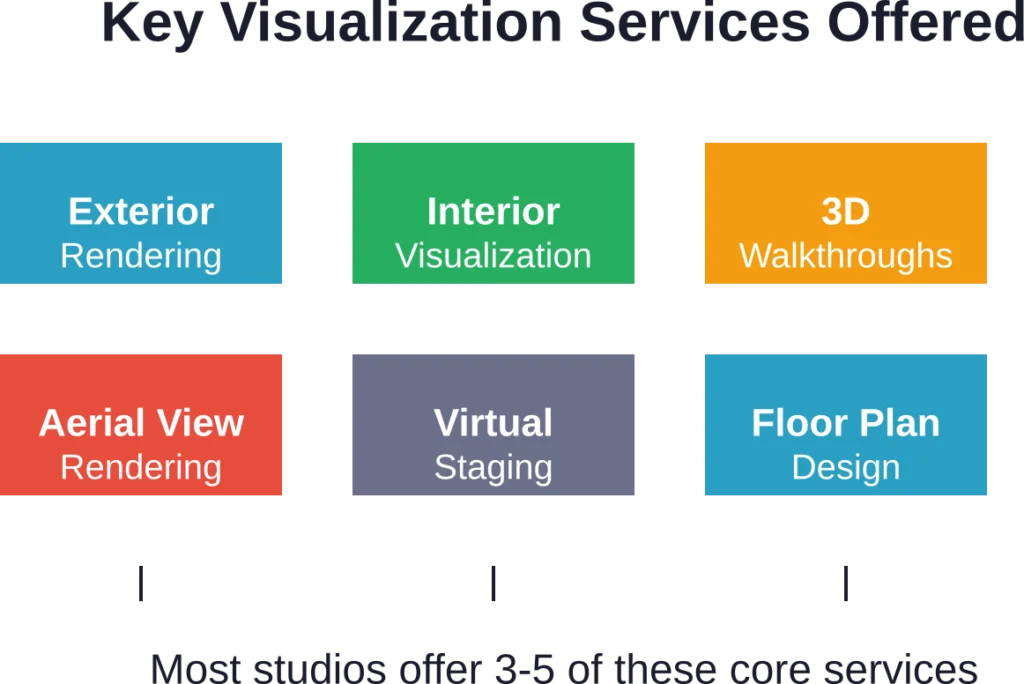
Services Offered by Dubai Architectural Visualization Companies
Understanding what services these companies offer helps match capabilities to project needs. Not every studio provides every service, and specialization often produces better results than one-size-fits-all approaches.
Exterior Architectural Rendering
Exterior renderings show buildings in their surrounding context. These visualizations communicate architectural style, material choices, landscaping, and how structures relate to adjacent development.
High-quality exterior renders account for accurate sun studies based on site location and orientation. In Dubai’s climate, this means showing how facades perform under intense sunlight and how shadows fall throughout the day.
Rendering companies typically deliver multiple views per building, including eye-level perspectives that convey pedestrian experience and elevated angles that show overall massing and roof design.
Interior Visualization Services
Interior renderings bring spaces to life before construction or renovation. These visualizations help clients understand spatial flow, material palettes, lighting design, and furniture layouts.
For residential projects, interior visualization allows buyers to envision themselves in spaces. For commercial developments, these renderings communicate brand identity and functional efficiency to prospective tenants.
Advanced interior visualization includes accurate material representation, from marble veining to fabric textures, plus realistic artificial and natural lighting that shows how spaces will actually appear at different times.
3D Walkthroughs and Animations
Static images tell part of the story. Walkthroughs and animations reveal how spaces unfold as people move through them, conveying spatial sequences impossible to capture in single frames.
These animations serve multiple purposes: marketing presentations that engage potential buyers emotionally, design review tools that help identify circulation issues, and stakeholder presentations that build consensus around proposed designs.
Production quality varies significantly. High-end walkthroughs feature cinematic camera movements, realistic lighting transitions, and carefully choreographed reveals that highlight key design features.
Aerial and Site Plan Rendering
Aerial perspectives show projects in broader context, revealing relationships to infrastructure, neighboring development, and geographic features. These views prove essential for master-planned communities and large mixed-use projects.
Site plan renderings transform technical drawings into understandable visual documents that communicate layout, circulation, and program distribution to non-technical audiences.
For Dubai projects, aerial renderings often extend to show proximity to landmarks, transportation networks, and amenities that influence property value and market positioning.
Virtual Staging and Photomontage
Virtual staging applies visualization technology to existing spaces or photographs, showing renovation potential or furniture arrangements without physical staging costs.
Photomontage inserts proposed buildings into photographs of existing sites, creating highly realistic representations of how new construction will appear in established contexts. This technique proves particularly valuable for infill development and urban projects where neighborhood character matters.
These services offer cost-effective alternatives to full CGI rendering when appropriate, especially for projects where context photography provides substantial realism.
How to Choose the Right Visualization Company for Your Project
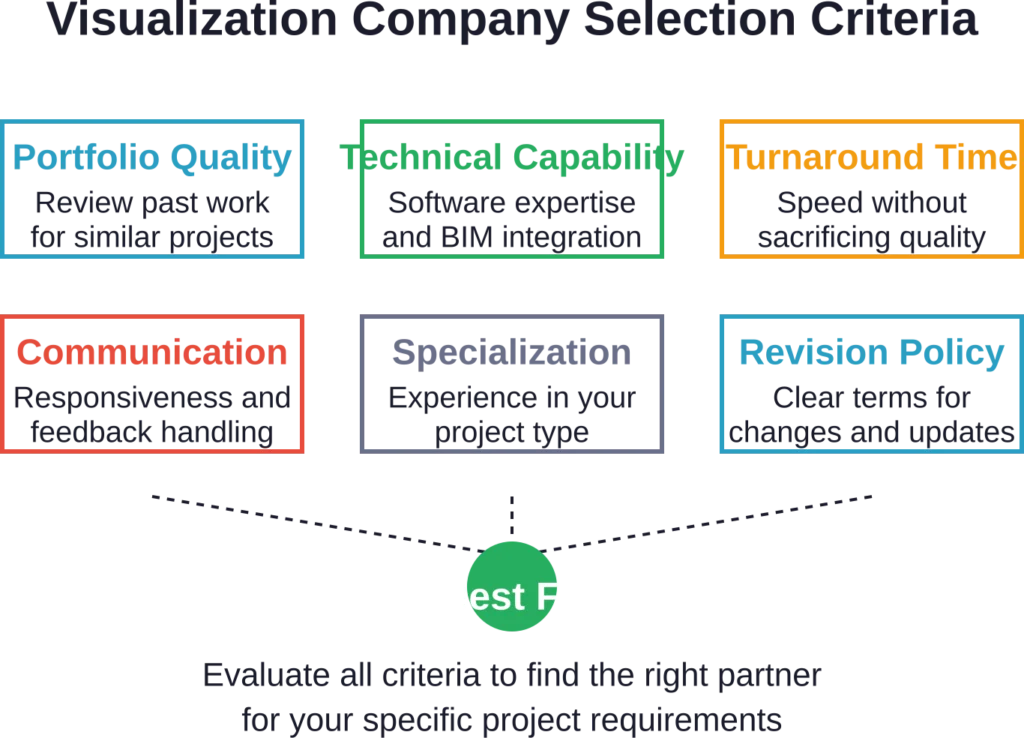
Selecting a visualization partner involves more than comparing portfolios. Several factors influence whether a particular studio will deliver results that meet project-specific needs.
Portfolio Review and Relevant Experience
Start by examining portfolios for projects similar in type, scale, and style to yours. A studio that excels at minimalist residential work may not be the best choice for ornate commercial developments.
Look beyond aesthetic appeal to technical execution. Do renderings show accurate perspective? Are materials rendered convincingly? Does lighting appear natural and physically plausible?
Check whether portfolios include completed built projects alongside renderings. This reveals how accurately the studio predicts final appearance and whether they understand constructability.
Technical Capabilities and Software Proficiency
Different studios use different software ecosystems. If your architecture firm works in Revit, a visualization company with strong Revit integration will save time and reduce translation errors.
Ask about rendering engines they employ. Real-time engines like Unreal Engine enable interactive walkthroughs. Traditional render engines like V-Ray produce exceptional still-image quality. The best choice depends on deliverable requirements.
Inquire about post-processing workflows. Many studios enhance raw renders in Photoshop, adding atmosphere, adjusting color balance, and inserting contextual elements. Understanding their process clarifies what to expect.
Communication and Project Management
Visualization projects require substantial back-and-forth. Studios that establish clear communication protocols, provide regular progress updates, and respond promptly to questions make collaboration smoother.
Understand their revision policy upfront. How many revision rounds are included? What constitutes a revision versus a scope change? Clear agreements prevent disputes later.
Ask about project timelines. Rush projects cost more and may compromise quality. Studios with realistic scheduling that accounts for feedback cycles typically deliver better results than those promising unrealistic turnarounds.
Understanding Deliverable Specifications
Clarify image resolution, file formats, and usage rights before engagement. Marketing materials require different specifications than presentation boards or large-format printing.
For animations, discuss length, resolution, frame rate, and file delivery formats. Will you receive raw files for editing or only finished videos?
Some projects require VR-ready outputs or interactive experiences. Not all studios offer these capabilities, so confirm deliverable types match project needs.
| Service Type | Best Used For | Typical Timeline | Technical Requirements |
|---|---|---|---|
| Exterior Rendering | Marketing, approvals, design development | 1-2 weeks per view | 3D model, material specs, site context |
| Interior Visualization | Space planning, finishes selection, sales | 1-2 weeks per view | Interior model, FF&E selections, lighting |
| 3D Walkthrough | Immersive presentations, marketing campaigns | 3-6 weeks | Complete 3D model, animation path |
| Aerial Rendering | Master plans, site context, investor presentations | 2-3 weeks | Site plan, surrounding context, topography |
| Virtual Staging | Existing space marketing, renovation proposals | 3-5 days per space | High-quality photographs, furniture style brief |
Trends Shaping Architectural Visualization in Dubai
The visualization industry continues evolving rapidly. Understanding current trends helps anticipate what leading studios will offer in coming years.
AI-Assisted Rendering Tools
According to the Chaos State of ArchViz Report 2025, 44% of architects now use AI for concept images. That adoption rate demonstrates how quickly AI has moved from experimental to mainstream.
AI tools excel at generating multiple design variations quickly, supporting early-stage exploration. They’re less reliable for final presentation imagery where precision matters, but that gap continues narrowing.
Some Dubai studios now integrate AI tools into workflows, using them for rapid concept development before transitioning to traditional rendering for final deliverables.
Real-Time Rendering and Interactivity
Real-time rendering engines allow clients to navigate projects interactively, changing camera angles, lighting conditions, and material selections on the fly.
This interactivity transforms presentations from passive viewings to collaborative exploration. Stakeholders can test different options immediately rather than waiting for new renderings.
The technology particularly benefits interior design, where clients want to visualize multiple furniture arrangements, finishes, and color schemes before committing.
Virtual Reality Integration
VR takes immersion further, placing viewers inside unbuilt spaces with true sense of scale and proportion. Walking through a space in VR reveals design issues that static images miss.
While not yet standard, more Dubai developers request VR deliverables for high-end projects. The technology proves especially valuable for overseas investors who can’t easily visit project sites.
Challenges remain around hardware requirements and file sizes, but these barriers decrease as technology improves and becomes more accessible.
Sustainable Visualization
As sustainability becomes central to Dubai’s development strategy, visualization must communicate environmental performance effectively.
This includes showing green roofs, solar installations, natural ventilation strategies, and daylighting performance. Some studios now offer specialized environmental visualization that demonstrates LEED or Estidama compliance visually.
Renderings that show projects across seasons or times of day help communicate passive design strategies and environmental responsiveness.
Common Mistakes When Hiring Visualization Services
Avoiding common pitfalls saves time, money, and frustration during visualization projects.
Choosing Based Solely on Price
The lowest bid rarely delivers the best value. Cheap visualization often means offshore production with minimal quality control, inexperienced artists, or hidden fees that inflate final costs.
Quality visualization requires skilled professionals, powerful hardware, and significant time investment. Studios offering prices far below market average cut corners somewhere.
Better approach: establish a realistic budget based on project complexity, then select the best studio within that range.
Providing Incomplete Information
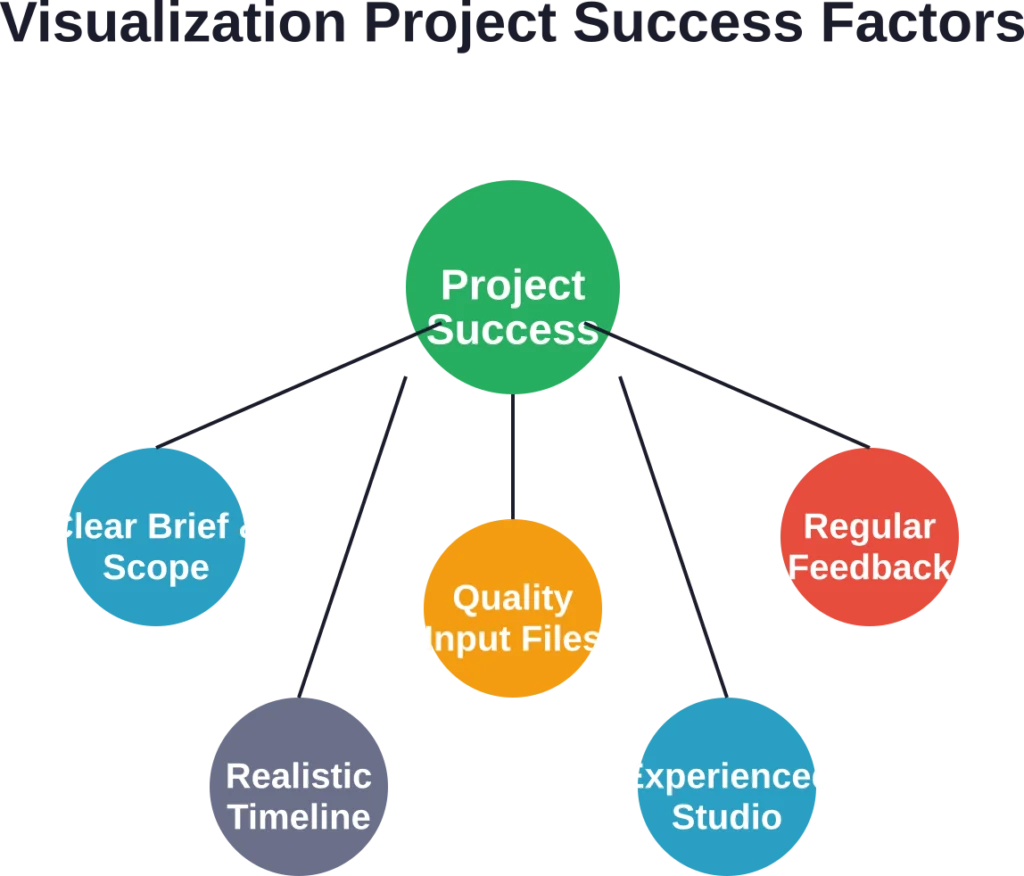
Visualization quality depends heavily on input quality. Incomplete models, vague material specifications, or missing context information force studios to make assumptions that may not align with design intent.
Before engaging a visualization studio, ensure design documentation reaches sufficient detail. This includes finalized or near-final drawings, material selections with specific product information, and clear aesthetic direction.
Time spent preparing thorough input materials pays dividends in visualization accuracy and reduces expensive revision cycles.
Unrealistic Timeline Expectations
Quality visualization takes time. Expecting photorealistic renderings overnight leads to disappointment.
Each image requires modeling, material application, lighting setup, test renders, adjustments, and final rendering. Complex scenes with detailed landscaping, populated interiors, or difficult lighting conditions take longer.
Factor visualization time into project schedules from the beginning rather than treating it as last-minute addition. Most studios need 2-4 weeks minimum for quality deliverables.
Skipping the Contract Details
Verbal agreements and vague scopes create disputes. Professional visualization engagements require written contracts specifying deliverables, timelines, revision policies, payment terms, and usage rights.
Pay particular attention to intellectual property clauses. Who owns the final images? Can they be used indefinitely or only for specific purposes? Can the studio use them in their portfolio?
Clear contracts protect both parties and establish shared expectations from project start.
Frequently Asked Questions
Turnaround times vary based on project complexity and deliverable type. Single exterior renderings typically require 1-2 weeks, while comprehensive packages with multiple views may need 3-4 weeks. Complex animations and walkthroughs often take 4-6 weeks or longer. Rush services are sometimes available but usually come with premium fees and may compromise quality. Planning visualization needs early in project schedules ensures adequate time for quality work.
Most visualization studios can work from either existing 3D models or 2D drawings, though this affects project scope and timeline. Providing a detailed 3D model from Revit, SketchUp, or other BIM software reduces costs and speeds delivery. If studios must create models from scratch using 2D drawings, expect additional time and expense for modeling services. The more complete and accurate your input files, the better and faster the visualization results.
Standard agreements usually include 2-3 revision rounds per deliverable. The first round addresses any misunderstandings about design intent, materials, or composition. Subsequent rounds refine details and adjust elements based on stakeholder feedback. Major scope changes or completely new directions typically fall outside included revisions and incur additional fees. Establishing clear revision policies in contracts prevents disputes and ensures both parties understand expectations.
Yes, most established architectural visualization companies in Dubai offer comprehensive services covering exterior and interior rendering, plus animations, aerial views, and floor plans. Working with a single studio for multiple deliverable types often provides better consistency in style, lighting, and overall aesthetic. It also simplifies project management by consolidating communication with one vendor rather than coordinating multiple specialists.
Common file formats include DWG or DXF for 2D CAD drawings, RVT for Revit models, SKP for SketchUp, and FBX or OBJ for general 3D geometry. Additionally, provide PDF drawing sets, material specification documents, reference images showing desired aesthetic direction, and site photographs for context. The more information provided upfront, the more accurately studios can interpret design intent. Confirm specific format requirements with your chosen studio before project start.
AI rendering tools have become valuable additions to architectural workflows, with 44% of architects now using AI for concept images according to industry data. However, these tools currently supplement rather than replace traditional visualization services. AI excels at rapid concept exploration but struggles with the precision, brand consistency, and technical accuracy required for final marketing imagery and approval submissions. Most professional studios now integrate AI tools into workflows while maintaining traditional rendering capabilities for deliverables requiring photorealistic accuracy.
Photorealistic rendering aims to create images indistinguishable from photographs, with accurate lighting, materials, and atmospheric effects. These serve marketing, investor presentations, and approvals where realism matters. Architectural illustration takes a more stylized approach, emphasizing design concepts through artistic interpretation rather than photographic accuracy. Illustrations often work better for early-stage concept communication or projects where architectural character matters more than literal representation. Choose based on project phase and audience expectations.
Conclusion
Dubai’s architectural visualization industry offers world-class expertise across diverse project types and scales. The ten companies profiled here represent different approaches, specializations, and strengths—from integrated architecture firm studios to dedicated visualization specialists.
Selecting the right partner requires looking beyond portfolio aesthetics to consider technical capabilities, communication practices, relevant experience, and cultural fit with your project team. The best visualization studio for a luxury residential tower may differ from the optimal choice for a sustainable mixed-use development or heritage restoration project.
As visualization technology continues evolving with AI integration, real-time rendering, and VR capabilities, Dubai’s leading studios invest in staying current while maintaining the fundamental skills that produce compelling architectural imagery: understanding of design intent, mastery of lighting and composition, and ability to tell stories that help stakeholders envision completed projects.
Whether you’re an architect seeking design development support, a developer needing marketing imagery, or a real estate firm requiring virtual staging services, Dubai’s visualization companies provide the expertise to transform concepts into photorealistic representations that inform decisions, secure approvals, and drive sales.
Ready to bring your architectural vision to life? Review portfolios, request proposals from studios specializing in your project type, and invest in quality visualization that communicates design excellence effectively. The right visualization partner becomes an extension of your design team, helping translate architectural ambition into images that inspire and persuade.